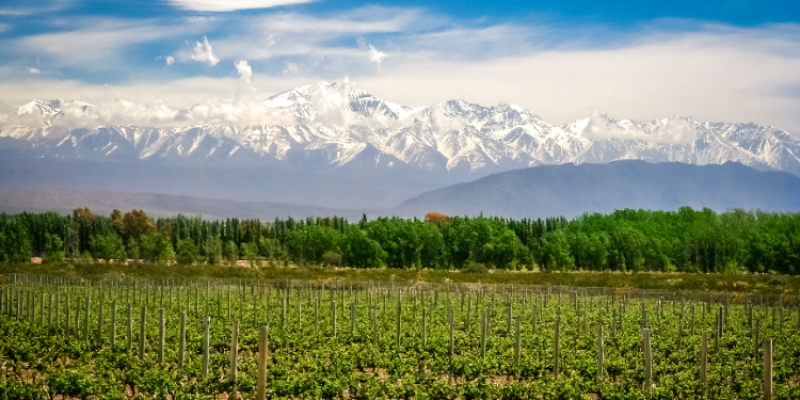
Mendoza is Argentina's wine capital and a city of around 122,840 people pressed against the Andes, with a wider provincial catchment of over 2 million. It is also a city of contrasts: monthly costs of around USD 1,155 sit alongside an unemployment rate of 6.7% in the metropolitan area, and a sunny semi-arid climate comes with winter days of only 10 hours of daylight. Public administration runs in Spanish, the cultural calendar revolves around wine and free municipal events, and Ciudad de Mendoza, Gran Mendoza, and Mendoza Province are three different things that newcomers will need to keep straight from day one.
Mendoza sits at the foot of the Andes in western Argentina, a mid-sized provincial capital of around 122,840 residents within a metropolitan catchment of just over 2 million across the wider province. The municipal seat at 9 de Julio 500 anchors a city officially branded as the Capital Mundial del Vino, presented by local authorities as a MERCOSUR development hub and a key link with neighboring Chile across the cordillera. Day-to-day, the city runs at a slower pace than Buenos Aires or Cordoba, with cafe culture, plaza life, outdoor recreation, and wine-related leisure forming the backbone of social routines.
For expatriates, the practical implication is a lifestyle closer to a regional wine town than a Latin American megacity. The municipality publishes all official communications in Spanish, and daily life: groceries, healthcare, rentals, school enrollment, runs in the same language. Newcomers should distinguish between three administrative layers they will encounter constantly: Ciudad de Mendoza (the city proper), Gran Mendoza (the metropolitan area used for labor and transport statistics), and Mendoza Province. Confusing them when searching for services, addresses, or rentals is one of the first mistakes new arrivals make.
Unlike many cities organized around named neighborhoods, Ciudad de Mendoza is officially divided into six numbered districts plus a western cluster: Primera, Segunda, Tercera, Cuarta, Quinta, and Sexta Seccion, alongside the Barrios del Oeste. These are the units used in municipal public-works schedules, hygiene rounds, and service planning, so addresses and rental listings refer to them directly.
The Segunda Seccion contains the Barrio Civico, the city's administrative quarter where provincial and municipal offices cluster. The Quinta Seccion, around the Fader area and Avenida Boulogne Sur Mer, is largely residential and visible in municipal press around the deployment of public-space security technology and preventores, the city's public-space safety officers. The Cuarta Seccion and the Barrios del Oeste host the city's nine Municentros C.A.E., municipal after-school spaces for children aged 6 to 12. The Barrios del Oeste, which include B La Favorita, receive recurring municipal community outreach programs in health, sanitation, and family activities, including sessions at Gimnasio Municipal N5.
In May 2026 the city introduced an updated Codigo Urbano y de Edificacion (Ordenanza 4234/2026), oriented toward a "proximate and mixed" city model designed to bring everyday services closer to residential areas. For expats choosing where to live, this means the central Secciones offer dense municipal services and active public-space management, while the western neighborhoods receive targeted community outreach.
Join the Mendoza community
Get regular tips and advice to make the most of your expat life
Cost of living in Mendoza
Mendoza is affordable by international standards, with a Numbeo Cost of Living Index of 31 and a Quality of Life Index of 64 for 2026. Monthly costs for a single person are estimated at around USD 1,155, including housing, food, and transportation, with property accounting for roughly 41% of typical spending, groceries 24%, and eating out 14%. Argentina's chronic inflation and peso volatility mean these dollar anchors are more reliable than peso figures, which can shift sharply from month to month.
Rental costs sit at the heart of the budget. A one-bedroom apartment in the city center averages USD 397 per month, ranging from USD 320 to USD 855, while the same size outside the center averages USD 300 per month, ranging from USD 250 to USD 400. A three-bedroom apartment in the center averages USD 800 per month (USD 600 to USD 1,400), and outside the center, USD 607 per month (USD 500 to USD 997). Everyday spending is comparatively modest: an inexpensive restaurant meal runs around USD 11, a three-course mid-range meal for two costs USD 40, a cappuccino costs USD 5.12, a liter of milk costs USD 1.36, and a half-liter of domestic draft beer costs USD 2.
Good to know:
Lease conditions and prices can shift between viewing and signing due to inflation indexing. Verify everything in Spanish at the moment of contract, and treat any USD figure quoted in this article as a planning anchor rather than a guaranteed price.
Climate and weather in Mendoza
The climate is semi-arid and sunny year-round, with hot summers from December to March and cool, dry winters from June to September. Forecasts and climate bulletins come from the Servicio Meteorologico Nacional (SMN), Argentina's national weather authority.
Winter daylight is short because the city sits in the Southern Hemisphere: the winter solstice falls on June 21, and mid-June daylight runs around 10 hours, roughly 8:35 am to 6:35 pm. June averages a high of 12.5 °C (54.5 °F), a low of 4.7 °C (40.5 °F), about 6 mm of rain, 9.6 hours of daily sunshine, and a UV index of 3. Winters are dry, cool, and sunny, with occasional rain or cloud cover, which makes them comfortable for those who dislike humid, cold weather but disorienting for newcomers used to longer northern winter afternoons. Summers bring intense sun and dry heat, with most homes relying on fans or air conditioning rather than central systems.
Getting around Mendoza
Public transportation in Mendoza is operated by MendoTran, the integrated trip-planning portal covering city buses (colectivos) and the Metrotranvia light-rail tram. Fares are paid with the national SUBE contactless card, with 2026 expansions adding SUBE digital, bank cards, QR payments, and NFC phone payments. The current tariff sets the urban bus and Metrotranvia fare at ARS 960, with a discounted ARS 797 fare on business days from 09:00 to 11:00 and 14:30 to 16:00, and from trip 81 onward in a monthly cycle. Timetables for all lines can be consulted through the Mi Recorrido app. The Metrotranvia is expanding: as of May 2026, the system operated 30 tramsets, with a total of 39 units planned under an agreement with the San Diego transport system.
biciTRAN is the shared bicycle system, integrated into the MendoTran intermodal network across Gran Mendoza and grounded in Article 87 of the provincial Ley de Movilidad (BICITRANS). The city tourism portal reports around 90 km of dedicated bike lanes, making cycling a practical option for central commuting.
For drivers, the municipal Estacionamiento Medido program regulates paid street parking in central Ciudad de Mendoza. The system completed its first digital year in June 2026 with over 80,000 registered users, and since May 2026, Municipal Decree 339 has applied differentiated tariffs by payment method.Taxis and remis (private hire cars) are credentialed by the province, with over 1,500 drivers holding official identifying credentials.
Spanish is the operational language across municipal and provincial administration, banks, healthcare, and almost every aspect of daily life. All current official portals, including Ciudad de Mendoza, the Gobierno de Mendoza, and the electoral portal, publish in Spanish, and English-language municipal services are not part of the standard offer. Expats settling for the long term will find that basic Spanish is essentially required for any administrative procedure, lease negotiation, or local job application.
Informal language exchange does exist. Community platforms have hosted English- and Spanish-language exchange events in the city, and these gatherings also serve as social entry points for newcomers. Starting Spanish lessons before arrival, even at a beginner level, materially shortens the time it takes to handle errands, sign contracts, and form friendships.
Culture and social norms in Mendoza
Wine sits at the center of cultural identity. Mendoza is officially branded the Capital Mundial del Vino, and the annual Fiesta Nacional de la Vendimia, the grape-harvest festival, frames tourism, business, and civic identity around viticulture. Vendimia 2026 marked the 90th edition of the festival and emphasized accessibility with Argentine Sign Language interpretation, a dedicated accessibility team, and more than 50 artists with disabilities in official roles. This inclusive ethos is visible across municipal public events.
Social life revolves around plazas, shared meals, and free public programming. Recurring events such as Aguas Danzantes in Plaza Independencia draw residents for evening communal leisure. The municipal cultural infrastructure includes Teatro Mendoza, the ECPI complex (housing the Museo Municipal de Arte Moderno, Teatro Municipal Julio Quintanilla, and Biblioteca Municipal Ricardo Tudela), Nave Cultural, and the Distrito Fundacional. Cycling and walking through historic neighborhoods are actively promoted by the city as part of the everyday cultural experience.
Mealtimes follow broader Argentine norms: dinner is late, often between 9 and 10 pm, and weekend asados (barbecues) with family or friends remain a central social ritual. Newcomers from northern Europe or North America usually need a few weeks to recalibrate their evening rhythm.
Pace of life and work culture in Mendoza
Daily rhythms run noticeably calmer than in larger Argentine cities, with cafe culture, outdoor leisure, and wine-related socializing shaping how residents spend their evenings and weekends. For professionals planning to work locally, the labor market tells a more sober story. Gran Mendoza unemployment reached 6.7% in the fourth quarter of 2025, with around 10,000 jobs reportedly lost in the metropolitan area, and private salaried employment in the province fell 3.4% year-on-year in March 2026, according to national labor ministry data.
Spanish fluency is essentially required for most local jobs, and getting hired without a local network is significantly harder than in Buenos Aires. For digital nomads and remote professionals working for foreign employers or international clients, this matters less; for those planning to find local employment, it is the central constraint. Many expatriates structure their move around foreign-currency income precisely to insulate themselves from peso volatility while taking advantage of Mendoza's lower cost base.
Family routines are shaped by the school calendar, which guarantees 190 school days in 2026 with a daily schedule half an hour longer than the rest of Argentina (a minimum of 630 annual hours at the initial level and 840 at the primary level). Working parents should factor this longer school day into childcare planning.
Food culture in Mendoza
Food and wine are inseparable in local identity, and the province treats gastronomia identitaria mendocina as a pillar of its tourism strategy. The city is one of Argentina's principal gastronomic poles, with Malbec, asado, and locally produced extra-virgin olive oil forming the backbone of the cuisine. The municipal "Brindemos" wine-focused experience, hosted at the Terraza Jardin Mirador Arq. Gerardo Andia, illustrates how the city actively programs wine-tasting events into the public calendar.
Olive oil has become a parallel identity product. The Mendoza Oliva Bien / Mes del Olivo program positions extra-virgin olive oil as a tourism and gastronomic asset alongside wine, with cultural and culinary activities running across the province during the olive month. To coordinate the wider ecosystem, the province has established a Foro de Origen e Identidad Gastronomica de Mendoza, bringing together actors in gastronomy, tourism, olive growing, and viticulture.
For day-to-day eating, beef-centered asado and Malbec remain at the heart of restaurant menus. Vegetarian and vegan options exist in the central Secciones but are less widespread than in larger capitals, so plant-based eaters should expect to cook at home more often.
Leisure and social life in Mendoza
The city's cultural calendar is dense, much of it free, and heavily weighted toward outdoor and wine-related activities. Core attractions include Parque San Martín, the Basilica San Francisco, Cerro de la Gloria, and the Mercado Central, supported by the network of around 90 km of bike lanes for active leisure. Outdoor offerings extend to the Reserva Natural Divisadero Largo, the Parque de Montana, guided free walking tours, and the City Bus Mendoza sightseeing service with multilingual audio guides.
Summer and seasonal programming combine wellness, wine, and nature: the Tour Divisadero offers guided treks in Reserva Natural Divisadero Largo, the Bicitour nocturno covers evening rides, and the Tour Dia de Campo combines trekking, yoga, and meditation. Carnival programming layers urban walks, yoga with mountain views, night tours, and the Picnic entre Olivos at Paseo de los Olivos in Barrio Civico, blending heritage, gastronomy, and recreation.
Free public music is central to weekend life. The Picnics Musicales at the gardens of Nave Cultural pair live music and DJ sets with gastronomy and the Diseno Libre entrepreneur fair. The Museo Municipal de Arte Moderno de Mendoza (MMAMM) runs free exhibitions, open Wednesday to Friday from 10:00 to 19:00 and Saturday, Sunday, and holidays from 16:00 to 20:00. Theater is active at Teatro Quintanilla, Teatro Mendoza, and the Microcine Municipal, with regular productions, film cycles, and acoustic concerts at Nave Cultural.
The city's family infrastructure is anchored by nine Municentros C.A.E. for children aged 6 to 12, concentrated in the Barrios del Oeste and the Cuarta Seccion. These municipal after-school spaces are a practical resource for working parents in those areas. In 2026, Mendoza was selected as one of five Argentine municipalities participating in "Salir a jugar", an initiative with FLACSO Argentina and University College London to recover children's free play in neighborhood public space, a sign of how the city approaches outdoor childhood as a policy priority.
School routines heavily shape the family week. The school calendar guarantees 190 school days, with a daily schedule half an hour longer than the national norm, meaning children typically finish school later than their peers elsewhere in Argentina. Outdoor weekends in Parque San Martín, in the Reserva Natural Divisadero Largo, or on day trips into the Andean foothills round out family life, fitting the slower pace that draws many relocating parents in the first place.
Safety in Mendoza
Mendoza is generally calmer than Argentina's largest cities, and provincial safety indicators trended down through 2025 and into 2026. Ciudad de Mendoza recorded 365 armed robberies in 2025, down from 510 in 2024, a 28.4% decrease, while at the provincial level, the Ministry of Security reported 59 homicides in 2025 versus 71 in 2024, described as the lowest figure in 10 years. The province also reached its lowest fatal-victim road-safety record in four years following intensified vehicle and alcohol controls. National criminal statistics are published through the Sistema Nacional de Informacion Criminal, whose methodology has been recognized by the UNODC Centre of Excellence on crime statistics.
Within Ciudad de Mendoza, the municipal preventores operate visibly in central public spaces, with 2026 reports of multiple interventions, including the detection of people with pending judicial measures. Everyday risks for residents and visitors remain in the realm of pickpocketing, phone snatching, and opportunistic theft, particularly around bus stations and markets. Standard urban precautions apply: keep phones out of sight in crowded areas, avoid displaying valuables on terraces, and use registered taxis or remis at night.
Good to know:
Consular assistance after a serious incident is provided by your country's embassy in Buenos Aires, not in Mendoza. Keep emergency contact details for your embassy saved and accessible from the moment you arrive.
The case for relocating is built around lifestyle, climate, and affordability. The Andes provide year-round access to hiking, rafting, and a ski season from June to September. The semi-arid sunny climate delivers low June rainfall (around 6 mm) and 9.6 hours of daily winter sunshine, attractive to anyone leaving humid or overcast environments. The municipal cultural agenda offers many free or low-cost events around plazas, museums, and the Vendimia calendar. Costs remain low by international standards.
The drawbacks are concrete. Spanish is operationally required for almost all public administration and most local jobs, and getting hired locally without it is difficult. Argentina's macroeconomic volatility affects rents, prices, and savings, and expats earning in foreign currency manage this risk far more easily than those relying on local pesos. The local labor market is under pressure, with Gran Mendoza unemployment at 6.7% in Q4 2025 and private salaried employment falling year-on-year through 2026.
ℹ️
We do our best to provide accurate and up to date information. However, if you have noticed any inaccuracies in this article, please let us know in the comments section below.
A journalist, holder of the DALF C1 and C2 and a diploma from the University of Mauritius, I have nearly twenty years of writing experience. After six years in the Mauritian press, I joined Expat.com, where I have been working for over a decade, including five years as editorial assistant, and now as editorial manager.