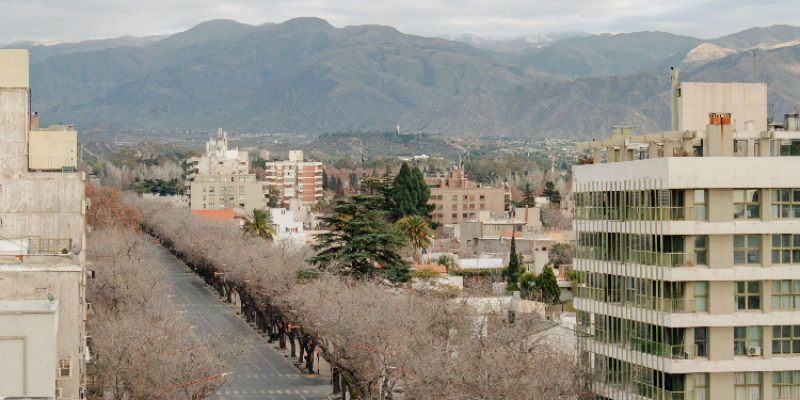
What does it actually take for a foreigner to buy an apartment in Mendoza? The legal answer is straightforward: Article 20 of the Argentine Constitution gives foreigners the same civil rights as nationals, so no residency is required to acquire urban property in the city. The practical answer is more layered. Buyers need an Argentine tax identifier obtained through a representative; mortgage finance for non-residents is effectively unavailable, and most transactions close in US dollars.
Foreigners can buyurban residential property in Mendoza without holding Argentine residency. The legal basis is Article 20 of the Argentine Constitution, which grants foreigners the same civil rights as citizens, including the right to acquire, hold, and sell real estate. In practice, this means a retiree from abroad can purchase an apartment in central Mendoza on the same legal footing as a local buyer, without needing a DNI or temporary residence permit first.
What every foreign buyer needs is an Argentine tax identifier. Non-residents must request a CUIT through a representative or authorized third party domiciled in Argentina; foreigners residing in Argentina without a local DNI fall under the CUIT/CDI registration category managed by ARCA, the national tax authority. Without this number, the notary cannot register the purchase deed in your name.
Rural land follows a different track. The law sets caps on foreign ownership of rural land and adds extra checks for properties located near borders, major waterways, or zones designated as strategic. The legal position has been contested since a 2023 decree attempting to repeal those caps was suspended by the courts. This matters specifically in Mendoza Province, where vineyards, fincas, and agricultural land are a common reason foreigners are drawn to the region. Buying a vineyard or rural finca is not legally equivalent to buying an urban apartment in Mendoza city and requires additional authorization steps that an urban purchase does not.
Mendoza's foreign-resident community is smaller and more tight-knit than Buenos Aires's. Choosing a neighborhood is less about settling into a single expat district and more about picking between central walkability, park access, and quieter residential streets close to local life.
Centro Mendoza is the most convenient first base for new arrivals. It is walkable, with restaurants, plazas, errands, and urban services concentrated together, anchored around Plaza Independencia, Plaza San Martín, Plaza España, and Plazoleta Caseros. The 2026 municipal public works list confirms active investment in those central public spaces, along with Parque O'Higgins, Parque Central Nicolino Locche, and Paseo República de Venezuela, which keeps Centro the best-serviced residential zone in the city.
For buyers who want central access without the densest commercial blocks, the area around Parque Central / Nicolino Locche offers a park-adjacent residential feel. The Sexta Sección (Residencial Norte) is a recognized residential district label for Mendoza city. Newcomers from car-dependent countries often find Centro the easiest place to settle while they adjust to driving in Argentina, since daily errands are within walking distance.
Real estate listings frequently mention Godoy Cruz, Guaymallén, Maipú, and Luján de Cuyo. These are part of Greater Mendoza but lie outside Mendoza city, with their own municipal rules and property taxes. If a listing you are considering is in one of these municipalities, the recurring local taxes and short-term rental rules will not match those of the city of Mendoza.
Join the Mendoza community
Get regular tips and advice to make the most of your expat life
Property prices in Mendoza
When budgeting a purchase in Mendoza, it helps to keep three different metrics separate: asking prices, fiscal land values set by the province for tax purposes, and construction costs if you plan to build. They are not interchangeable, and mixing them up leads to unrealistic budgets.
On the asking-price side, Mendoza Capital is at around USD 1,200 per m², with a typical range of USD 700 to USD 1,900 per m² depending on location, building age, and condition. These are listing figures, not closing prices, and the wide range reflects the gap between a renovated central apartment and an older property in a less serviced area.
For tax purposes, Administración Tributaria Mendoza (ATM) publishes an Observatorio de Valores Inmobiliarios with reference to urban land values expressed in USD per m² for a standard 300 m² lot. These fiscal land values are calibrated at roughly 10% of market value, with new generic value maps applying from January 1, 2026.
If you are considering a new build or a custom house, the Colegio de Arquitectos de Mendoza construction index for April to June 2026 stands at ARS 1,422,994.44 per m², up 4.98% on the previous quarter. That quarterly movement is a practical indicator of cost pressure on new construction; budgeting against a single number set months earlier will tend to under-cost the project.
Types of property in Mendoza
The 2026 municipal tax ordinance recognizes vivienda colectiva (multi-unit residential buildings, meaning apartments) and vivienda unifamiliar (detached single-family houses) as the two main residential construction categories in Mendoza city. Apartments dominate central districts, while single-family houses are more common as you move away from the center.
The city is actively developing mixed-use urban housing. The municipal Dirección de Vivienda y Hábitat is consolidating serviced urban areas, intervening in vacant land, intensifying land use, and promoting controlled densification. Brownfield-to-housing redevelopment is part of the current pattern, illustrated by the conversion of the former Aliar factory site in La Favorita into a 37-unit IPV housing project.
Two specific risks are worth flagging for older or social housing stock. First, properties originating from IPV social-housing programs: the provincial Mi Escritura program exists precisely because many homes occupied by their real owners are still registered in the name of the IPV, meaning the title transfer is incomplete. If you are buying a property with this history, confirm that the title is fully transferred before signing anything. Second, the city actively intervenes in abandoned or ruinous properties and can impose a punitive inspection and safety-control surcharge on top of the ordinary municipal service tax. This is a risk to verify when evaluating older buildings, particularly those that have stood vacant.
Finding property in Mendoza
Active local real-estate listings can be searched on platforms such as MendozaProp, which publishes purchase and rental listings with full conditions, including price, lease term, CPI adjustment, building expenses, and tenant obligations.
Before signing with any agency or seller, check Mendoza's Registro Público de Infractores for the company or individual name. This is the provincial public register of consumer-protection offenders, and it includes real-estate-related entities. A quick search before you commit to a reservation can flag agents or developers with a record of sanctions. If a problem arises, the Dirección de Defensa del Consumidor is at Patricias Mendocinas 529, Ciudad de Mendoza, with the email mesaentradasddc@mendoza.gov.ar, open Monday to Friday 8:00 to 13:00. Filing a complaint is free and does not require a lawyer. Advisory service is mostly virtual through 148@mendoza.gov.ar and the 148 Mendoza mobile app; in-person attention is reserved for hypervulnerable persons, a category that explicitly includes people with mobility limitations, older adults, and tourists, useful for newcomers still in temporary accommodation.
The city also runs a PAT (Propiedades de Alquiler Temporario) registration regime under Resolución 80/2026, a useful check that any holiday let you visit or consider buying into is legally registered.
The buying process in Mendoza
A typical urban property purchase in Mendoza follows a fairly predictable sequence: a written reservation or boleto de compraventa first, then notary-led due diligence on title, then execution of the escritura traslativa de dominio (the deed of ownership transfer), payment of provincial stamp tax, and finally registration with Mendoza's public registry.
Title and encumbrance checks are processed by the Dirección de Registros Públicos y Archivo Judicial under the Poder Judicial de Mendoza. Since June 1, 2026, the Informe de Titularidad (title report) for all four judicial circumscriptions is processed exclusively online through Mi Registro on line on the SAYGES system. Your notary will normally handle this on your behalf, but you should see the title report before the deed is signed.
Notarial work is coordinated by the Colegio Notarial de la Provincia de Mendoza, located at Patricias Mendocinas 756, 5500 Mendoza, telephone (0261) 476-4029. Notaries handle the cadastral certificate, the deed preparation, and the stamp-tax filing. For transfers by purchase-sale, donation, advance inheritance, or condominium division, the cadastral certificate must be requested through a notary. Active notaries enrolled with the Colegio Notarial initiate the stamp-tax procedure online through Mis trámites Online on the ATM website under "Impuesto de Sellos Solicitud de sellado".
One important practical warning from Mendoza's Defensa del Consumidor: never hand over money without documentary support. Any anticipo or seña (deposit) must be recorded in the contract and supported by a legal receipt or proof of payment. If a seller or agent asks for cash up front without paperwork, treat it as a red flag.
Transfer procedures are being streamlined: the provincial government has presented a Certificado Único de Transferencia project consolidating checks across Catastro, the Colegio Notarial, municipalities, AYSAM (water), Irrigación, and the Registro de la Propiedad. The aim is a single integrated certificate for property transfers, which, over time, should shorten the paperwork chain at closing.
Costs of buying in Mendoza
The headline transaction tax is the Mendoza Impuesto de Sellos, the provincial stamp tax. The official rate stands at 2.5% for real-estate purchase contracts, transfers of ownership for value, exchanges, and irrevocable powers to transfer real estate located in Mendoza Province. If the instrument is executed outside Mendoza but concerns real estate in Mendoza, the stamp-tax rate rises to 4%. For foreign-currency contracts, the tax base is converted using the Banco de la Nación Argentina seller exchange rate at the close of the business day immediately before the contract date, which can differ from the rate your home bank uses to send the funds.
Stamp tax must normally be paid within 10 business days of execution for instruments issued in Mendoza. For instruments issued outside Mendoza, payment is due before presentation to Mendoza authorities or banks, or within 10 days of the start of performance in Mendoza.
Registry copy fees are set by Mendoza's 2026 judiciary tariff:
Simple copy of a property volume or matrícula: ARS 6,500 (code 858).
Certified copy: ARS 13,000 (code 585).
Plus ARS 600 (Ley 6279 fee) for every 10 pages or smaller fraction.
On top of stamp tax, notarial fees commonly fall around 1% to 2% of the sale amount. Always request a written notarial budget before signing a reservation, especially for lots, assignments of rights, or developments not yet individually deeded. As a budgeting range, estimate total buyer closing costs at around 7% to 9% of the purchase value, covering stamp tax, notary fees, and certificates combined. Treat that as a planning range rather than an official schedule, and confirm the exact split with your notary before the deed is signed.
Financing and mortgages in Mendoza
Mortgage availability for non-resident foreigners in Mendoza is, in practical terms, very limited. Most foreign-buyer transactions in Mendoza are therefore cash purchases, often in US dollars, and budgeting should be done on that basis.
Difficulty accessing mortgage credit is acknowledged by the provincial authorities themselves. For a foreign retiree, the practical implication is that financing your purchase domestically is not a realistic plan; you will normally need to bring the full purchase amount, plus closing costs, in transferable funds. If you do borrow against assets in your home country to fund the purchase, factor in the currency risk between your home currency and the US dollars typically used to settle Mendoza property transactions.
Legal considerations in Mendoza
The single most important step before signing anything is to engage an independent local lawyer who works for you and not for the seller or the agency. Your lawyer should verify the title at the Registros Públicos, check for encumbrances and outstanding debts on the property, confirm that municipal and provincial taxes are paid up to date, review planning and building permissions, and check that the property is not still registered to the IPV under the Mi Escritura regularization program. The notary plays a central role in the transfer, but is a neutral public officer and not your personal adviser.
Immigration status is a separate matter, handled nationally by Argentina's Dirección Nacional de Migraciones (DNM), not by the municipality of Mendoza. Buying property does not, on its own, grant residency. Foreigners may hold transitory, temporary, or permanent residence; temporary and permanent residence each enables a corresponding DNI. Residence applications are initiated online through the Radex system, and applicants must be inside Argentina to file. After a visa is processed and the person enters Argentina, the DNI must be applied for at Renaper within 60 business days of entry, where applicable.
Owning property in Mendoza
The recurring tax on property ownership in Mendoza is the Impuesto Inmobiliario, a provincial real estate tax levied on each property and on real rights over property located in Mendoza. The tax base is the Avalúo Fiscal, the fiscal assessed value, which owners can check through ATM's Avalúo Vigente service.
The tax can be paid annually or in six installments. The official due dates are:
Annual payment or first installment: February 27.
Second installment: April 30.
Third installment: June 30.
Fourth installment: August 31.
Fifth installment: October 30.
Sixth installment: December 30.
Compliant taxpayers can stack discounts of up to 35%: 10% if the property had no debt as of December 31, 2025; an additional 10% if it was also up to date as of December 31, 2024; another 10% if the taxpayer has no enforceable debt across other taxes by December 31, 2025; plus 5% for paying the annual bill on time. For a modest property, the provincial property tax determined under the law cannot be lower than ARS 43,645 per property, a useful figure to anchor the minimum annual cost.
The bill can be obtained and paid via Descargar Boleto and Pagar Online on the ATM site. Payment channels include online card, QR code via E-Pagos and Billetera Virtual 3.0, Red Link, Red Pago Mis Cuentas, Pago Fácil, Rapipago, and the Bolsa de Comercio de Mendoza.
Owners can register their property under the Bien de Familia family-home protection regime through Registros Públicos. This protects the family dwelling from seizure or auction for debts generated after registration, which can be useful for a retiree settling permanently in a single home.
If you plan to let out your property, the rules differ by lease length. For long-term residential leases, contracts are governed by Argentina's Civil and Commercial Code with broad freedom of contract after DNU 70/2023. If no term is specified, the default is 2 years for permanent housing and 3 years for other uses. Around 99% of housing contracts in Mendoza are signed in Argentine pesos. For short-term or holiday letting, the property must be registered as a Propiedad de Alquiler Temporario under Resolución 80/2026, via Mendoza's Atención Ciudadana portal.
Good to know:
The Bien de Familia regime only protects against debts generated after registration, not against debts that already exist on the property at the time you register it.
Selling Argentine real estate as a foreign owner involves both federal income tax considerations and provincial transaction taxes, and the rules have recently changed.
At the federal level, Decree 406/2026, published in the Boletín Oficial on June 1, 2026, extends the exemption from tax on gains arising from the sale of real estate and the transfer of rights over real estate located in Argentina. The exemption applies to individuals and undivided estates, whether resident in Argentina or abroad, provided the sale or transfer takes place on or after January 1, 2026. As the decree does not specifically exclude non-residents, it may also benefit foreign owners selling property in Mendoza. Historically, ARCA's Impuesto cedular has applied to income derived from dividends, securities transactions, real estate sales, and transfers of rights over real estate. Given the interaction between the new exemption and the existing cedular tax regime, taxpayers should seek guidance from ARCA or a qualified tax adviser to determine how the rules apply to their specific situation before filing.
At the provincial level, the Impuesto de Sellos at 2.5% on the sale instrument applies to the transaction in Mendoza, under the 2026 Ley Impositiva 9680 and Código Fiscal. Sellers and buyers usually negotiate contractually how this is split, but the legal liability exists regardless of who pays.
Before signing the transfer deed, the notary must obtain the Certificado Catastral through ATM (ATM's Catastro Jurídico can be reached at 4611420 or 461-1489). The municipal tax ordinance also bars notaries from granting deeds and public offices from processing acts on properties with outstanding municipal debts at the time of the transfer deed. In practical terms, sellers must clear all municipal debts on the property before the notary can sign, which is worth checking early if you have been out of the country and may have unpaid bills.
For non-resident sellers, repatriating the sale proceeds will depend on Argentina's foreign-exchange rules at the time of sale and on the channel through which the original purchase funds entered the country. A tax adviser familiar with cross-border Argentine transactions is the appropriate professional to map this out before listing.
Have questions about moving to Mendoza? Join the Expat.com community to connect with expats who have been through the process.
ℹ️
We do our best to provide accurate and up to date information. However, if you have noticed any inaccuracies in this article, please let us know in the comments section below.
A journalist, holder of the DALF C1 and C2 and a diploma from the University of Mauritius, I have nearly twenty years of writing experience. After six years in the Mauritian press, I joined Expat.com, where I have been working for over a decade, including five years as editorial assistant, and now as editorial manager.