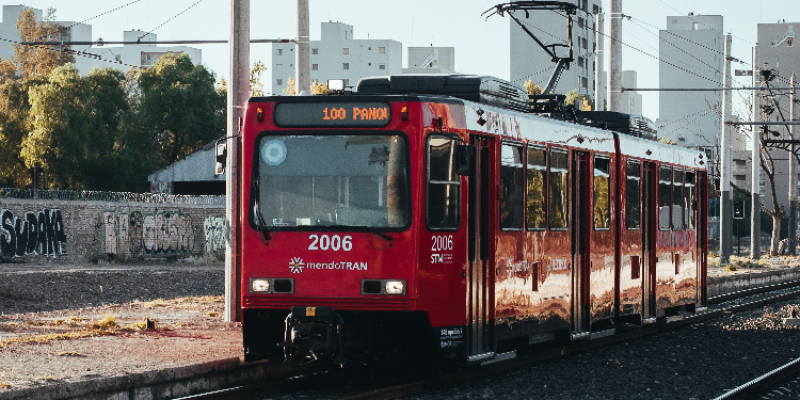
Getting around Mendoza is easier than newcomers tend to expect: the central city is compact and walkable, and the metropolitan network is integrated under a single platform, MendoTran, covering colectivos, the Metrotranvía light rail, and the BiciTRAN bike-share. The single most useful preparation for daily life is sorting out a SUBE card for buses and a Red Bus card for the Metrotranvía, since fares are low.
Getting around Mendoza is built around an integrated metropolitan network rather than a single mode. The official platform is MendoTran, which centralizes route search, service updates, and operational news across the metropolitan area, covering Ciudad de Mendoza along with neighboring departments such as Godoy Cruz, Las Heras, Maipú, and Guaymallén. Behind it, the Sociedad de Transporte de Mendoza (STM) operates the Metrotranvía light rail, electric buses, CNG buses, and the BiciTRAN bike-share, while the Subsecretaría de Transporte regulates the system and the Ente de la Movilidad Provincial (EMOP) monitors frequencies, routes, and cleanliness.
The framework that ties all of this together is the Plan de Movilidad Sostenible para el Área Metropolitana de Mendoza 2030, which aims to reduce pressure on the microcentro, strengthen intermodal connections, and favor walking and cycling over private cars. For newcomers, the practical takeaway is that one card and one app handle most daily journeys. If you run into trouble, the main user channels are the MendoTran website, the provincial line 148, option 7, and the SUBE national WhatsApp number 011 6677 7823.
Colectivos are the workhorse of daily commuting in Mendoza, serving the city and surrounding departments under the MendoTran umbrella. The regular urban fare is set at ARS 960 under Resolution 1656/25, with a reduced fare of ARS 797 during off-peak working-day windows of 9:00 to 11:00 and 14:30 to 16:00. A frequent-user discount kicks in from trip 81 onward, which matters if you commute five days a week.
Payment is flexible: physical and digital SUBE, bank cards, QR codes, mobile phones, and smartwatches are all accepted on buses. The shift toward contactless has been rapid, with digital-payment validations rising from 7,534 in March 2025 to 444,690 in June 2025. The MendoTran Cuándo Subo app handles real-time schedules and route planning.
Several fare-benefit abonos reduce or eliminate the fare for specific groups: primary students receive a 60% discount, secondary students 50%, university students 50%, older adults 50%, and people with disabilities travel free. Teachers and school support staff get 100%, and over-70s travel free for 30 monthly trips. To obtain an abono, applicants need an updated address in Mendoza Province on their DNI (national ID document); the requirement does not apply to people with disabilities, and differential metropolitan services are excluded from both abonos and free fares. For intercity and long-distance travel, the Terminal de Mendoza is the central hub, with operator ticket offices alongside more than 160 commercial premises.
Join the Mendoza community
Get regular tips and advice to make the most of your expat life
Trams and light rail in Mendoza
The rail-based service is the Metrotranvía Mendoza, a surface light-rail line integrated with the provincial transport network. The single line, Línea 100, runs the corridor Gutiérrez to Godoy Cruz to Ciudad de Mendoza to Las Heras, with 15 operating stops across Maipú, Godoy Cruz, the City of Mendoza, and Las Heras. For residents living along this axis, it is often the fastest way to cross between departments without dealing with bus traffic.
The Metrotranvía operates with a flat fare of ARS 1,000 per trip. Payment works differently from the bus network: validations are made with the authorized Red Bustransport card, and the system does not accept coins. The validating machine does not issue a paper ticket, so you need to keep the card and check the balance through the official channels. Real-time schedules are available through the MendoTran Cuándo Subo app.
The system is being expanded and modernized: expansion works were more than 73% complete as of May 2026, with new units, free Wi-Fi via fiber optics, and integration with the 911 video-surveillance monitoring system. New paradores inteligentes (smart stops) are being rolled out, equipped with automated platform doors designed to prevent access to the tracks and improve safety. The fifth station within the City of Mendoza, Belgrano station, was commissioned on March 3, 2026, extending coverage in the urban core.
How to pay for transport in Mendoza
The Tarjeta SUBE is the principal payment method for public transport across the Mendoza metropolitan area. It works on buses and serves as the gateway to fare benefits, while bank cards, QR codes, mobile phones, and smartwatches are also accepted as alternative contactless options on the bus network. The Metrotranvía operates on its own Red Bus card, so most regular users carry both.
SUBE can be managed online through the MendozaxMi portal or in person at SUBE Management Units. In Ciudad de Mendoza, in-person service points include the Ventanilla Única at Casa de Gobierno, the Terminal de Ómnibus (locales 107 and 132), and Rivadavia 110. Card top-ups, balance queries, and benefit registrations all run through these channels.
To activate fare-benefit abonos, applicants must have an updated address in Mendoza Province on their DNI, except for people with disabilities. School-cycle and similar benefits also require presenting documentation at enabled service points and then validating the benefit at SUBE Automatic Terminals, on vehicle validators, or through the SUBE app. Differential metropolitan services do not accept abonos or free fares, so check the route category before assuming a discount applies. For help, the MendoTran site, the provincial line 148 (option 7), and the SUBE national WhatsApp number 011 6677 7823 are the official channels.
Taxis and ride-hailing in Mendoza
Mendoza has both classic metered taxis and remises, the local equivalent of a pre-booked private hire service, alongside ride-hailing apps. Taxi and remis fares are regulated by the provincial transport authority, not set freely by drivers, and tend to change several times a year. In June 2026, the Mendoza Government approved a 21.11% increase through Resolution 748, and a further floor of 25% was announced shortly afterward, so it is worth checking the meter or app quote before each trip rather than assuming yesterday's rate still applies.
For Gran Mendoza, the current tables set the following:
Taxi, daytime: flag drop ARS 1,257; ficha ARS 67; waiting per minute ARS 67.
Taxi, nighttime: flag drop ARS 1,503; ficha ARS 82; waiting per minute ARS 82.
Remis, daytime: flag drop ARS 1,294; ficha ARS 75; waiting per minute ARS 75.
Remis, nighttime: flag drop ARS 1,562; ficha ARS 81; waiting per minute ARS 81.
Uber and Cabify operate legally under Mendoza's mobility framework, which regulates electronic-platform passenger transport at the provincial level. Drivers may only accept app-dispatched trips and are expressly prohibited from picking up street hails like taxis or remises. Trips cannot be dispatched for more than 8 continuous driving hours or 12 split hours in one day. Vehicles must be registered in the Province of Mendoza, carry a maximum of 8 passengers, and be no more than 5 years old from first registration, with the limit extended to 10 years for electric vehicles. In practice, ride-hailing is widely available in the urban core and is often the simplest option late at night or with luggage.
Cycling and walking in Mendoza
The central city is well-suited to walking. Broad tree-lined boulevards, five interconnected plazas, a pedestrian shopping promenade, and the Andes backdrop make the microcentro pleasant to cross on foot, and most daily errands within Ciudad de Mendoza are walkable. The sustainable mobility plan explicitly aims to discourage private-car use in this area and to favor walking and cycling as part of the intermodal network.
For longer trips, BiciTRAN is the public bike-share, with more than 500 bicycles and 90,000 registered users, described by the provincial government as the second-largest system of its type in Argentina. It is integrated with the wider MendoTran ecosystem alongside electric buses, CNG buses, and the Metrotranvía, and connects with more than 400 km of ciclovías across the metropolitan area. That density of bike lanes is unusual for an Argentine city and makes commuting by bike between adjoining departments realistic for many residents.
The trade-off is maintenance. Local media documents complaints about potholes and lack of upkeep on certain ciclovías, so inspect your usual route before committing to it daily. Daily traffic diversions and street closures are common in the city center, and the municipal and provincial press regularly publish cortes de calles y desvíos notices that pedestrians and cyclists should check before commuting.
Driving in Mendoza
For day-to-day life in the city center, owning a car is rarely the easiest option. Traffic diversions, parking pressure in the microcentro, and active enforcement all weigh against it, and the bus and Metrotranvía network covers most regular journeys. A car does become useful, however, for trips to the wine country and the Andes, where public transport thins out quickly.
Driving licenses in Argentina are national but issued by the municipality of residence. The Municipalidad de la Ciudad de Mendoza operates the local Centro Emisor de Licencia Nacional de Conducir, along with the Escuela de Educación Vial and the Laboratorio de Seguridad Vial. Residents under 66 can process renewals or duplicates of Class A or B private licenses online. A Certificado de Legalidad de la Licencia is only required if the existing license belongs to another jurisdiction, and renewal costs should be checked with the municipality of domicile. All renewal applicants must pass a psycho-physical medical examination covering physical, visual, auditory, and psychological fitness.
Fines are calculated in Unidades Fijas (UF), currently set at ARS 54 per unit. Light offenses carry a fine of ARS 5,400, serious offenses ARS 37,800, very serious offenses ARS 54,000, and multiple offenses ARS 81,000. Payment within three working days carries a 40% discount.
Alcohol enforcement is strict. Driving with ablood alcohol level from 0.5 g/l to 0.99 g/l, or 0.2 g/l for bicycles, motorcycles, and mopeds, carries 30 to 180 days of disqualification, fines from ARS 162,000 to ARS 324,000, and license retention. Above 1 g/l, fines range from ARS 216,000 to ARS 486,000, the vehicle is retained, disqualification runs from 90 to 365 days, and arrest of up to 30 days applies, with no early-payment discount.
Mendoza is served by Aeropuerto Internacional Gobernador Francisco Gabrielli, known locally as El Plumerillo, located 11 km from the city in the neighboring Las Heras Department. There is no dedicated airport rail link, so transfers run on the same network used for daily transport.
The realistic options, ranked roughly from most convenient to cheapest, are:
Taxi or remis from the official rank: the most straightforward door-to-door option with luggage. Fares are metered for taxis and tabulated for remises under the regulated provincial tariff.
Ride-hailing through Uber or Cabify: priced by the app, often cheaper than taxis at off-peak hours.
Local bus via the MendoTran network: the lowest-cost option, paid with SUBE (physical or digital), bank card, or QR. Real-time arrivals are available through the MendoTran Cuándo Subo app, and the official guidance is to use the route planner rather than a static airport-transfer timetable.
If you arrive late, with bulky luggage, or without local data on your phone, taxi, remis, or ride-hailing is the practical choice. Use the official taxi rank or open the ride-hailing app inside the terminal; do not accept rides from unlicensed drivers approaching arriving passengers in the hall, a common pain point at Latin American airports.
We do our best to provide accurate and up to date information. However, if you have noticed any inaccuracies in this article, please let us know in the comments section below.
A journalist, holder of the DALF C1 and C2 and a diploma from the University of Mauritius, I have nearly twenty years of writing experience. After six years in the Mauritian press, I joined Expat.com, where I have been working for over a decade, including five years as editorial assistant, and now as editorial manager.