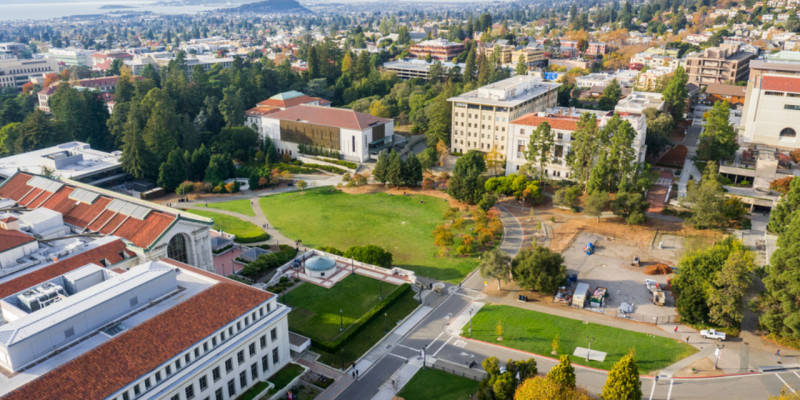
San Francisco, with its vibrant culture, world-renowned universities, and natural beauty, is an enticing destination for expats looking to further their education. Whether you're considering undergraduate or postgraduate studies in San Francisco, this city has the attraction of some prestigious universities as well as Silicon Valley's more renegade spirit. International students in San Francisco will benefit from the diverse and inclusive community as well as the exciting opportunities available within world-renowned programs and companies. However, living and studying in the city come with their challenges. San Francisco is a very expensive place to live; housing can be hard to find, and tuition fees are hefty. Figuring out how to cope with the high cost of living is a must if you're going to study in The Golden City.
If you want to work in the tech industry, there is probably no better place to get started than San Francisco. The city is one of the world's most well-recognized tech hubs, home to Silicon Valley, and the base of some of the very biggest names in the industry, like Apple, Facebook, and Google.
Students in the Bay Area come from all over the world. If accepted into a university in the city, you will likely be studying in a vibrant, academically competitive and multicultural setting. If you value academic rigour, talented fellow students, and the opportunity to learn in one of the most innovative cities in the world, then it's time to start working on your application.
As well as being home to high-profile universities and tech businesses, San Francisco is a center of art, culture, music, and all things creative. The city's openness to new experiences and different forms of expression has all contributed to fostering a truly unique atmosphere that you won't find elsewhere in the world.
While San Francisco is a relatively small city (covering an area of just 50 square miles), it is home to over 20 colleges and universities, including some of the best and most selective universities in the United States.
Stanford University
Stanford is one of the most well-known universities in the United States. According to the latest QS World University Rankings, it is ranked 3rd globally. Admission is highly competitive, with an acceptance rate of about 3.7% and the student population is around 17,000. Stanford has seven schools: earth sciences, engineering, education, business, medicine, law, and humanities and sciences.
Undergraduate tuition and fees for 2024–25 are about $62,484 per year.
Berkeley University
Berkeley is consistently ranked among the top universities worldwide. According to QS World University Rankings 2025, it is ranked 10th globally. Admission rates are competitive at about 11.6% and student enrollment is about 45,000. Tuition is $15,444 in-state and $48,018 out-of-state.
Santa Clara University
Santa Clara is a private Jesuit university at the southern tip of the San Francisco Bay. It ranks within the top 150 nationally in the QS USA University Ranking 2025. The current acceptance rate sits at about 45% and tuition for 2024–25 is approximately $61,000 per year.
Most students here study business, management, marketing, journalism, social sciences, and psychology.
Academy of Art University
The Academy of Art University is the largest private art and design school in the US. It has a very open admissions policy, with an acceptance rate of 100%. Average undergraduate tuition for 2024–25 is around $26,000 per year.
San Francisco State University
San Francisco State University is part of the California State University system. It's a huge school, offering 118 bachelor's degrees, 94 master's degrees, and 5 doctoral degrees. Out-of-state tuition is about $19,002 per year; in-state tuition is about $7,522. The acceptance rate is generous at about 92%.
Get regular tips and advice to make the most of your expat life
Tuition costs in San Francisco
It's worth explaining how tuition costs work in the US. The term “in-state tuition” applies to students who are legal residents of the state where the university is located. These rates are heavily subsidized by state governments and are much lower. “Out-of-state tuition” applies to students from other US states and is significantly higher.
International students are generally charged the same as out-of-state students, unless they receive scholarships or special aid through the university. Private universities, which don't differentiate between state residency, typically have one flat tuition rate for all students, domestic or international.
Applying for a student visa to study in San Francisco
The first step in studying in the United States is getting accepted by a university. You can't actually apply for a student visa until you have an official admission letter from a school that is certified by the Student and Exchange Visitor Program (SEVP). Once admitted, the university will issue you a document called Form I-20 (for F-1 and M-1 visas) or Form DS-2019 (for J-1 visas). You'll need this form to start your visa application. After that, you pay the SEVIS fee, complete the online DS-160 visa application, and book a visa interview at your nearest U.S. embassy or consulate. At the interview, you'll need to show your admission letter, as well as financial evidence that you can afford tuition and living costs as well as proof of your intent to return home after your studies.
Once you have received your visa, you will need to stay enrolled in the university and keep up good grades in order for your visa to remain valid.
Students on F-1 visas may work up to 20 hours per week during academic terms, and up to 40 hours per week during school breaks.
J-1 visas are intended for exchange programs and internships, and are valid only for the program duration. M-1 visas are for vocational study and generally do not allow employment.
General requirements for entry to a university or college in San Francisco
Different colleges and universities in San Francisco may have different acceptance conditions. This is why you should check the admission rate at your desired university. Getting into a university like Stanford would be exceptionally hard compared to, for instance, San Francisco State University.
Here are the main requirements for applying to a university in San Francisco:
You will need good grades equivalent to the GPA requirement at the university you are applying to.
If there is a big academic gap, you can take a pathway program.
According to QS Best Student Cities, San Francisco currently ranks 41st globally and remains a popular international student destination.
Scholarships for international students in San Francisco
While tuition and living costs in San Francisco are famously high, international students do have access to merit-based and need-based scholarships through local universities, as well as some other external opportunities.
University of San Francisco (USF) offers merit scholarships for first-year international students (up to $38,000) and transfer scholarships (up to $20,000). Full details can be found at USF Scholarships.
San Francisco State University (SFSU): Some small International Student Scholarships (around $1,500) are available to undergraduates and graduates. Details of this aid can be found at SFSU International Programs Scholarships.
Academy of Art University: International students may qualify for academic, portfolio, or need-based scholarships (these can cover up to $5,000 per semester).
Golden Gate University (GGU): Offers International President's and Dean's Scholarships (up to $15,000) and welcome grants for new students. Information on how to apply can be found through their financial aid directories.
San Francisco Bay University (SFBU): There are some tuition scholarships based on GPA available to international students.
International students can also apply for scholarships that aren't connected with their specific university, usually these are offered in their home countries to enable study abroad or through international programs like Fullbright.
Student housing in San Francisco
Finding suitable student housing, or any kind of housing, in San Francisco can be a challenging experience due to the city's high cost of living and competitive rental market.
On-campus housing
Many universities and colleges in San Francisco offer on-campus housing, which may include dormitories or apartments, sometimes with meal plans. Options are limited and in high demand, so apply early.
As a guide, on campus housing in SF generally ranges from $1,200 to $2,500 per month, depending on the university and the style of room you are in. Adding meal plans can incur another $400 to $800 a month.
SFU has several resident halls and apartment-style housing options. USF is the same with dorms, suites and apartments. Some schools, like City College of SF, do not have their own dorms. Your university should be able to advise you on the best options.
Off-campus housing
Most students, including expats, live off-campus due to limited on-campus options.
Apartments are common but expensive, with the current average rent for a one-bedroom apartment at $3,200–$3,800/month.
Shared housing is very common, with costs of $1,200–$1,800 per person per month.
Homestays can be affordable, as well as providing a cultural exchange. Subleasing from students on exchange or internships is a good way to find temporary and more affordable arrangements.
Short-term or student housing options include: Found Study San Francisco, Minna Student Housing, and Sutro Tower Residences (USF-owned). For longer-term housing support, check directly with university housing offices at SFSU, USF, or UCSF.
As an international student in San Francisco, managing your finances is crucial, and one way to ease any money woes is by taking advantage of the numerous student discounts available in the city.
On-campus discounts apply to services like fitness centers, cafeterias, and campus events. Always have your Student ID with you, as it's your key to accessing these savings.
Off-campus discounts are available at cultural institutions (e.g., the de Young Museum), gyms and wellness centers, and restaurants. You can use platforms like UNiDAYS and Student Beans to discover your local discounts. These change often, and many establishments will do student promotions or deals at certain times or for limited periods.
Student leisure
Beyond your academic life, the city offers a wealth of leisure activities to help you unwind and make the most of your time in the USA. Whether you join clubs and sports teams at your university or branch out into the wider community, there are lots of options on offer.
Many universities in San Francisco also have student clubs and societies that make it easy to meet people and explore the region. Outdoor and environmental clubs are especially popular: UC Berkeley's Cal Hiking and Outdoor Society, Stanford's Alpine Club, and SFSU's Outdoor Adventures group all organize regular hikes, kayaking trips, and weekend camping adventures around Northern California. If you're not into the outdoors, there are also clubs for music, film, volunteering, international culture, and tech.
The Koret Health and Recreation Centre (University of San Francisco) offers fitness, recreation, and team sports.
At SFSU the Mashouf Wellness Centre has wellness services and relaxation spaces.
Herbst Natatorium is a major aquatic center in the city.
Indoor climbing gyms are common and are a popular social activity.
Golden Gate Park, Ocean Beach, and Baker Beach are great spots for outdoor activities, sports and gatherings.
Live music and cultural venues such as The Fillmore, The Independent, and smaller neighborhood clubs host regular concerts. Check out San Francisco Music and Concert Calendar for up-to-date events.
Easy access to Northern California's nature is a big attraction for outdoorsy students and students often take weekend trips to Muir Woods, Point Reyes, or the wider Bay Area for hiking, surfing, and exploring.
We do our best to provide accurate and up to date information. However, if you have noticed any inaccuracies in this article, please let us know in the comments section below.
Thanks for your post. I only recommend you can include having foreign credentials evaluated too, into U.S. equivalent. It is still a requirement for most colleges and universities.