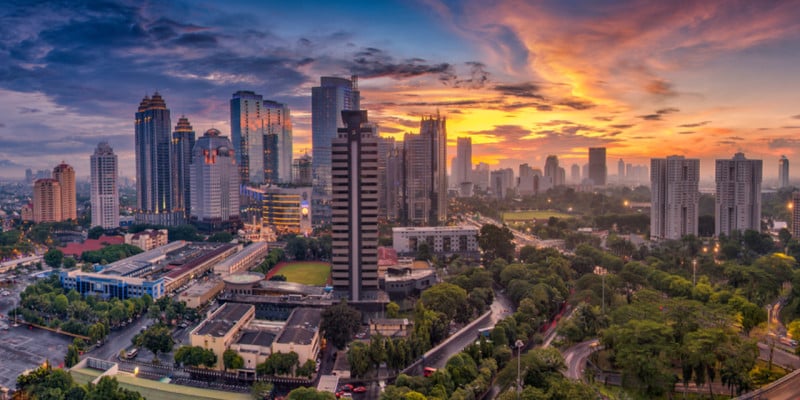
The vibrant and fascinating capital of Indonesia is a place that leaves no one indifferent. Jakarta is a huge metropolis with more than 11 million inhabitants from diverse religious, ethnic and socio-economic backgrounds. Known as a city that never sleeps, Jakarta boasts a wide array of professional opportunities, fascinating experiences, and dynamic social interactions, not to mention its cultural and historical heritage. With so much to discover, it's no wonder that expats and Indonesians alike are drawn to this bustling city.
Due to its proximity to the equator, Jakarta tends to experience high temperatures that can reach up to 39 °C year-round. The city also has an average humidity of 80%. So pack your sunscreen, as Jakarta's UV index averages 11 or higher.
Jakarta has a tropical monsoon climate, with a drier season from June to September and a rainy season from October to May, peaking in January and February. During this period, be wary of flooding, which is common in many parts of the city. While local authorities do their best to minimize flooding each year, it is almost inevitable as the city sinks at an alarming rate.
Jakarta is located on the northwest coast of the island of Java, the most populous of the Indonesian islands. The city is the capital of Indonesia and its largest city, covering more than 600 square kilometers. The name Jakarta comes from Jayakarta, its ancient name, which means "victorious city" in Sanskrit.
The city is an incredible metropolis that serves as Indonesia's economic, political, and business hub. In addition to being the seat of the country's government and the secretariat of the Association of Southeast Asian Nations (ASEAN), Jakarta is also home to Indonesia's most important financial institutions, such as Bank Indonesia and the Indonesian Stock Exchange, as well as the headquarters of many local companies and branches of multinationals.
Join the Jakarta community
Get regular tips and advice to make the most of your expat life
Population and language in Jakarta
Jakarta, with a population of over 11 million, is an ethnic, religious and socio-economic melting pot. This vibrant mix is visible in the city's rich architectural and cultural heritage. Jakarta is home to a large Muslim population that coexists peacefully with other religions.
For everyday communication, Bahasa Indonesia is the official language of the capital, but you will hear many other languages and dialects throughout the city.
Social life in Jakarta
Indonesians are very warm and welcoming. They do not hesitate to greet foreigners and smile at people they do not know. As an expat in Jakarta, feel confident that you will be able to converse with the locals without any problems. Most people in the city have a basic grasp of English. Naturally, politeness will be the little extra that will allow you to integrate, as Indonesians are very friendly.
Your social life will depend greatly on what you like to do. In Jakarta, there is no shortage of places to interact with other expats and locals, from clubs to workshops to events to cafes to bars. Note that embassies often organize cultural exchanges, which can be an excellent opportunity to develop your social network in the capital city.
While it may be a little difficult to breathe some fresh air in this bustling city, Jakarta has many hidden treasures.
To enjoy some fresh air, head to Merdeka Square, which surrounds the iconic Monumen Nasional (Monas). Alternatively, Suropati Park and Menteng Park, located in central Jakarta, offer a chance to breathe in the green.
You can also visit Cattleya Park in West Jakarta, Taman Mini Indonesia Indah in East Jakarta, Kalijodo Park in North Jakarta and Setu Babakan in South Jakarta. The mangrove forest of Pantai Indah Kapuk in North Jakarta is also an ideal setup for a relaxing weekend. A short train ride away is the world-famous Bogor Botanical Gardens in Bogor, 60km south of Jakarta. It's a biodiversity hotspot and South East Asia's oldest botanical gardens.
If you prefer the beach and the sea, check out Ancol, which has several stunning beaches as well as themed amusement parks. On weekends, you can also visit some of the most beautiful islands in Kepulauan Seribu. Among the most famous islands are Bidadari Island, Pramuka Island, Ayer Island, Tidung Island, Harapan Island and Putri Island.
Getting around Jakarta
The city has an efficient and relatively reliable transportation system. In the city, hop on the famous Transjakarta bus or take advantage of the new MRT system. You can also get around Jakarta by cab, bajaj, bemo, angkot and ojek. This last means of transportation can be booked online through a mobile application. Like many large cities, Jakarta suffers from heavy traffic congestion, especially during rush hour. There are certain times of the day when you should avoid traveling by road – 7:00 am to 9:00 am in the morning and 5:00 pm to 8:00 pm in the evening.
Expat life in Jakarta
As previously mentioned, Jakarta is one of the most popular cities for expats in Indonesia. Expect to spend about IDR 12 million per month, or about USD 700, not including rent. Overall, the cost of living in Jakarta is lower compared to other major cities worldwide.
Jakarta is also the country's most developed city, which means that you can live comfortably with an efficient transportation system, modern housing, large shopping malls, restaurants, quality educational facilities, etc.
Despite Jakarta's hectic and bustling nature, it is a welcoming city once you get your bearings.
Just smile, smile and smile! Indonesians are known as the world's most smiling people for a reason. So don't be surprised to see strangers smiling at you on the street: it's simply a greeting. Smile back with a slight nod. Refusing to smile back can make you look rude and unfriendly.
Speaking a few words in the local language can also help you to integrate better. Indonesians are always delighted when a foreigner attempts to speak their native language.
So here are some simple Bahasa words to use in everyday life:
Good morning (informal) - Halo / Hai
Good morning (morning) - Selamat pagi
Good morning (afternoon) - Selamat siang
Good evening - Selamat sore
How are you? - Apa kabar?
Please note that when greeting a woman, especially a Muslim woman, it is best to wait for her to extend her hand before shaking it. If the person you are greeting is not used to handshakes, a slight nod will be enough.
The meaning of hand gestures in Jakarta
Avoid using your left hand when interacting with locals, as it is considered unclean. But if your right hand is busy and you really need to use your left hand, say "Maaf", meaning sorry.
Likewise, avoid pointing at people. This gesture is considered rude in Jakarta. Instead, use your open palm or thumb.
Honoring the elderly in Jakarta
As in other Asian countries, Indonesians place great value on social hierarchy. Everyone has a status, both within the family and in the neighborhood. Not respecting this rule is "kurang ajar", bad manners.
At the top of this hierarchy are the elderly or high-ranking people:
Elder / older - Bapak / Pak
Elderly / older - Ibu / Bu
Same age / young adult male - Mas / Kakak / Kak
Same age / young adult female - Mbak / Kakak / Kak
Younger - Adik / Dik
Good to know:
The titles "Adik / Dik" should only be used for people who are visibly younger than you, such as children and teenagers. If you are not sure of the person's age, use Mas, Mbak, or Kakak instead.
Eating with the locals in Jakarta
When sharing a meal with Indonesians, one should wait for the elders or the host to start eating before touching the food, and before eating, one should also wish "Mari makan", which is the equivalent of "enjoy your meal".
Just like in India, people often eat with their hands in Indonesia. This is an unmissable experience when you are on Indonesian soil. However, if you have difficulties, do not hesitate to ask for a spoon and a fork. Indonesians usually hold the spoon in their right hand and the fork in their left. Knives are rarely part of the cutlery in Indonesia.
The dress code in Jakarta
Compared to other cities in Indonesia, Jakarta is rather lenient on dress codes. But be careful to avoid revealing clothing and favor modesty when visiting religious sites. At work, the international standard is generally applied.
Visiting people in Jakarta
Another thing to remember about the Jakartans is that they love to visit people and entertain their guests. These practices are an integral part of Indonesian culture. It is called "silahturah", which can be translated as strengthening the bonds between friends, relatives and neighbors.
When you move into your neighborhood, don't be shocked to see your neighbors visit you and bring you gifts, usually in the form of food or small trinkets. This is how Jakartans greet and welcome their new neighbors!
Jakartans love to have people over, and so you will be invited very often, especially during vacations. Your hosts don't expect anything in return unless it's a potluck, where you have to bring a dish. In any case, remember to bring a small gift to thank your hosts for receiving you!
Don't forget to take off your shoes before entering, and greet everyone, starting with the oldest person present.
Public displays of affection in Jakarta
Showing affection in public is usually not looked upon favorably. Kissing, called "Cipika-cipiki" in Indonesian slang, is acceptable between friends of the same sex, but it is forbidden to kiss your partner's lips... Instead, you will be allowed to hold hands!
The importance of dignity is deeply felt by Indonesians. Saving face means considering others' dignity and avoiding humiliating them, whether in private or in public. Indonesians generally avoid expressing their displeasure publicly. Instead, they do it in private, always with a view to preserving dignity.
In Jakarta, avoid public confrontations and seek to discuss disagreements in private. Openly expressing displeasure or anger, especially in an explosive manner, is considered very rude.
We do our best to provide accurate and up to date information. However, if you have noticed any inaccuracies in this article, please let us know in the comments section below.