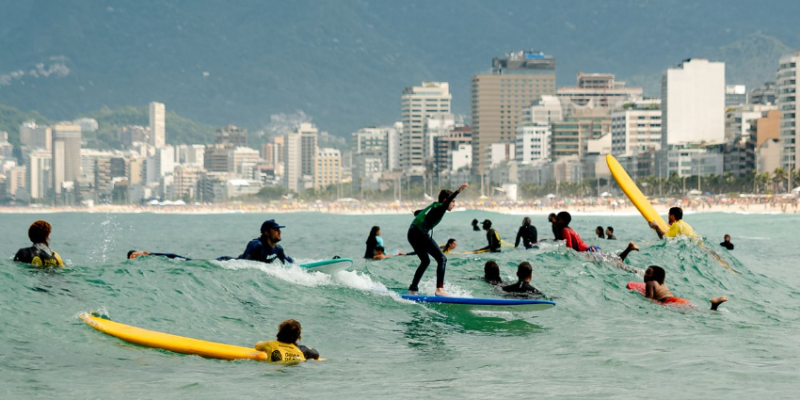
Rio de Janeiro offers beach games, football, outdoor training, and a broad choice of organized sports. You can run around Lagoa, join a coached group on the sand, take swimming lessons, or follow one of the city's football clubs. Free municipal programs and private facilities serve different needs, with access, schedules, and costs that vary by activity and neighborhood.
Sport in Rio de Janeiro extends well beyond the stadium. Ipanema beach, Aterro do Flamengo, and Lagoa Rodrigo de Freitas offer very different settings for a regular workout, a team practice, or a game with friends. Football, volleyball, and surfing are part of this landscape, alongside activities you might be trying for the first time.
On Ipanema beach, you can discover footvolley, or futevôlei, played over a volleyball net without using the hands or arms. In frescobol, two players use paddles to keep a rally going together. The aim is cooperation rather than winning points against a partner.
Your neighborhood will strongly influence how you exercise. The municipal vilas olímpicas are neighborhood sports centers with free activities, while private clubs bring several facilities together under their own membership and enrollment rules. A nearby center may be more useful than a larger club across the city, especially when classes have fixed start times.
Rio's football clubs include Flamengo, Fluminense, Botafogo, and Vasco da Gama. Their stadiums include Maracanã for Flamengo and Fluminense, Nilton Santos for Botafogo, and São Januário for Vasco, though the venue depends on the fixture.
Ticket sales often begin with sócios-torcedores, members of a club's supporter program. General sales depend on what remains. Prices vary by match, stadium sector, and any discount you qualify for, so there isn't a single standard price for seeing a game.
For Flamengo games at Maracanã, the official ticket announcements lead to the sales platform and explain entry requirements. Facial-recognition registration must be completed in advance, and spectators must bring original photo ID. Foreign spectators use their passport. Fluminense's Maracanã ticket instructions also require facial recognition, with the club's own registration and supporting-document procedures.
Stands can be allocated to specific supporters, and some areas are seated only. Families need to establish what identification a child needs, whether free admission applies, and how to keep the child in the accompanying adult's sector. Match instructions can also restrict supporter clothing. Arriving early leaves time for the entrance checks.
Basketball and volleyball offer other ways to watch club sport. FlaBasquete competes in Novo Basquete Brasil, the national basketball league, with games at Maracanãzinho, depending on the fixture. Sesc RJ Flamengo plays in the women's Superliga volleyball, using Tijuca Tênis Clube and Maracanãzinho. Fluminense also has a women's volleyball team.
Join the Rio de Janeiro community
Get regular tips and advice to make the most of your expat life
Joining team sports in Rio de Janeiro
At Aterro do Flamengo, courts accommodate football, volleyball, and basketball. Joining a pickup game depends on the players already there. Organized beach volleyball lessons provide a more structured introduction, with practice in serving, receiving, and attacking.
Municipal centers offer another way to join a regular group. Mato Alto in Praça Secaoffers basketball, futsal, and handball, while Waldir Pereira in Recreio offers volleyball. Groups vary by age, schedule, and available spots. The center office handles enrollment information and whether a trial session is possible.
For football, a pelada is an informal recreational game. Club competition follows a different route: clubs organize their own training and recruitment. The Rio de Janeiro state football federation's club and league directory lists amateur clubs in the capital and municipal leagues, but clubs arrange team entry.
Foreign cricket players can contact Carioca Cricket Club, which brings together international players and invites people to join its games and training. The club describes training along the Lagoa shore and matches in Itaguaí, about a 90-minute drive from Zona Sul, according to its own estimate. Contact the club before traveling for the next session, location, and fees.
Gyms and fitness in Rio de Janeiro
A gym is called an academia in Portuguese. Chains such as Smart Fit and Bodytech offer weight training, cardio equipment, and group classes, but the scope of a membership depends on the plan.
At Smart Fit Cidade Nova, the Fit plan costs BRL 149.90 a month and Black costs BRL 159.90 a month. Commitment plans differ from no-commitment offers. A reduced first-month price, a joining fee, and optional extras can also affect your total cost. The full contract explains the term, renewal, notice requirements, and any early-exit fees.
Bodytech's plans include single-branch and multiple-branch access, with swimming as an option. BT Pass lets you pay for training days used. Special plans for people ages 12-25 and those 70 and older have restricted hours, which matters if you intend to exercise before work or in the evening.
The timetable is as important as the equipment if you're looking for classes. Ultra Laranjeiras offers yoga, Pilates, functional training, indoor cycling, and martial arts. It operates 24 hours from Monday through Thursday, with shorter hours on other days. In Barra da Tijuca, Techset offers conditioning, Pilates, and CrossFit-type training. Enrollment in a specialist activity may be separate from weight-room access.
Running and cycling in Rio de Janeiro
The loop around Lagoa Rodrigo de Freitas, the paths and green spaces at Aterro do Flamengo, and the waterfront offer several running options. Ipanema beach extends roughly 2 km between Arpoador and Jardim de Alah. A run's actual distance depends on where you start and which connecting sections you include.
If you prefer coaching and a regular group, an assessoria esportiva combines organized training sessions with follow-up. BLC works with running, cycling, and swimming at Lagoa, Aterro, and Copacabana. Its options distinguish group sessions in selected disciplines from individually tailored training.
Cycling routes also follow the coast, Lagoa, and Aterro. Sunday leisure road closures add space along sections of the waterfront. The connections deserve attention: an outing can involve crossings, intersections, and stretches shared with cars as well as dedicated paths. A maintained bicycle, a helmet, and a pace that allows for pedestrians are practical essentials.
Using Bike Itaú
Bike Itaú in Riois operated by Tembici, and you don't need to be an Itaú bank customer. Through the app, you create an account, select Rio, buy a plan, and unlock a bicycle. The app shows available bikes and docking spaces. A trip ends when you return the bicycle to a station and confirm the lock. A single mechanical-bike ride starts at BRL 7.90 for 15 minutes. Monthly plans start at BRL 43.90 and allow up to four trips a day, each subject to the plan's time allowance; renewal is automatic. The Lazer option starts at BRL 32.90 for 48 hours. These products have different allowances, and overtime, additional trips, and electric bicycles can incur extra charges. The included riding time matters more than how long the pass stays active.
Swimming in Rio de Janeiro
Municipal swimming is generally organized around scheduled classes, with enrollment and limited spots. The 50 m pool at Parque Oeste Ana Gonzaga in Inhoaíba has groups from babies through adults, with free swimming and aqua aerobics lessons. Other municipal pools include those at Mato Alto and Jornalista Ary de Carvalho. A class spot doesn't include unlimited pool access, and waiting lists may apply.
You can also take swimming lessons at a private club without buying full membership. At Tijuca Tênis Clube's heated pool, children and adults can enroll as nonmembers. Swimming twice a week costs BRL 249 a month for nonmembers and BRL 164 for members. Nonmembers also pay BRL 43 for a club card and BRL 57 for the club medical examination. Enrollment requires a medical certificate, and the club examination is valid for four months. Children take an assessment, while adults interview with the teacher to determine their placement.
Coached open-water training at Copacabana offers a different experience from pool swimming. Water quality, waves, and currents are separate considerations. Instituto Estadual do Ambiente (INEA), the state environment institute, monitors bathing-water quality by beach sector and issues area-specific bulletins.
A favorable water-quality classification doesn't establish that sea conditions are safe. Follow lifeguard instructions and flags, and avoid entering the sea under a red flag. The Rio de Janeiro fire and rescue service's drowning-prevention guidance also reinforces the need for close supervision of children, even after they have taken pool lessons.
Racquet sports in Rio de Janeiro
Tennis and beach tennis, played on sand, are both available in Rio. Aterro do Flamengo has public tennis courts. For private lessons, Rio Tennis Academy in Laranjeiras accepts players without club membership, but you must contact them in advance to arrange access.
Group lessons and internal competitions offer ways to meet players of a similar standard. The academy's tennis programs and rankings include categories by ability, sex, and age, with provision for beginners. Its 60-minute private lessons can be taught in Portuguese or English. That language option applies to private lessons and shouldn't be assumed for every group program.
Techset at Vogue Square in Barra da Tijuca has three padel courts and tennis courts. Padel, tennis, and beach tennis are different sports, so specify which you want when booking. Court rental, lessons, and racket rental may be charged separately. Rain-cancellation terms also matter for outdoor bookings.
Outdoor sports in Rio de Janeiro
The city's outdoor options include hiking, surfing, paddling, and instructional flights. In Tijuca National Park, Pedra Bonita offers a relatively short walk from the trailhead. The journey to the trailhead is separate from the walk itself. The area is also used for instructional hang-gliding and paragliding flights, which depend on the weather and arrangements with the professionals involved.
Pedra da Gávea is a much more demanding outing: the hike takes about 5 hours and includes exposed, vertical sections. It requires fitness, experience, and appropriate safety equipment, with guidance suited to your experience. Allow a full day for the outing. The sector closes at 5 p.m., by which time you must have returned, and the latest permitted trail start is 2 p.m. That cutoff isn't a suggested start time for a 5-hour hike.
Surfing options include Ipanema and western Rio. Hawaiian outrigger canoeing involves paddling as a coached team, while Lagoa has rowing and canoeing. Beginners should know the expected swimming ability and what the session includes: equipment, a life jacket where relevant, instruction, and any transfer. Weather can affect water outings, and rain can also affect trail conditions.
Sports for children in Rio de Janeiro
Free municipal programs can help families establish an after-school routine. Mato Alto in Praça Seca and Jornalista Ary de Carvalho in Vila Kennedy offer activities such as futsal, basketball, swimming, and martial arts. Groups are organized by age and schedule. The trip from school to the center is an important factor when choosing an activity, especially if siblings have different class times. Municipal registration requirements have included the child's identification, the guardian's documents, proof of address, and proof of school enrollment. Prepare copies and establish any medical-document requirements with the center.
Rio Tennis Academy's Tennis Kids program offers groups for ages 4-6, 6-8, and 8-10, using slower balls and age- and ability-appropriate courts. Enrollment involves finding the right group, a suitable timetable, and a price quote. Tijuca Tênis Clube's swimming school also accepts young children after assessment, with the nonmember fees described above. Confirm English instruction for the specific children's class.
Schools can be a starting point for information about extracurricular sports, but their activities and admission conditions vary by school. During school vacations, municipal recreation programs known as colônias de férias include football, basketball, volleyball, and water games. Ages, dates, registration arrangements, and any priority for existing students vary by center.
Carioca Digital's free sports information service covers municipal sports centers, vilas olímpicas, neighborhood projects, and adapted sports for people with disabilities. Enrollment takes place at the activity venue. The municipal information number is 1746.
At private clubs, distinguish full membership from enrollment in a particular sport and occasional facility use. The term não associados means nonmembers and can identify activities available without joining the whole club, such as Tijuca's swimming lessons. A football supporter-program card doesn't automatically give access to a club's sporting facilities.
Football is central to Rio's sporting life, with Flamengo, Fluminense, Botafogo, and Vasco da Gama. Volleyball and surfing also feature in the city's beach sports scene.
Choose a fixture and follow the home club's official ticket announcement. Flamengo and Fluminense play at Maracanã, Botafogo at Nilton Santos, and Vasco at São Januário, but check the venue for that game.
Use the club's official announcement for the particular sport and fixture. Football supporter-program members get priority access before general sales. Prices and entry conditions depend on the match and sector. Basketball and volleyball have their own ticket announcements.
Lagoa Rodrigo de Freitas, Aterro do Flamengo, and the waterfront are practical options for different routes. Ipanema beach extends about 2 km from Arpoador to Jardim de Alah. Your running distance depends on your starting point and which sections you include.
The coast, Lagoa, and Aterro offer cycling routes, and Sunday leisure road closures add space along parts of the waterfront. Routes can also involve intersections and sections shared with cars, so pay attention to connections, crossings, and pedestrians.
Bike Itaú uses an app to create an account, select Rio, buy a plan, and unlock a bike. Return it to a station and confirm the lock. A single mechanical-bike ride starts at BRL 7.90 for 15 minutes. Monthly and 48-hour options have their own allowances and extra charges. You don't need to be an Itaú bank customer.
Municipal sports centers, organized beach lessons, and coached groups offer ways to get into regular practice. Competitive football clubs handle recruitment themselves. Carioca Cricket Club invites international players to contact it about games and training; ask about the next session, fees, and location before traveling.
Both sports have facilities in the city. Rio Tennis Academy in Laranjeiras offers tennis without club membership, and Techset at Vogue Square in Barra da Tijuca has three padel courts as well as tennis courts. Tennis, padel, and beach tennis are distinct sports.
Municipal centers such as Mato Alto and Jornalista Ary de Carvalho offer free programs subject to availability, age, and schedule. Private options include Rio Tennis Academy's Tennis Kids groups and swimming at Tijuca Tênis Clube.
ℹ️
We do our best to provide accurate and up to date information. However, if you have noticed any inaccuracies in this article, please let us know in the comments section below.
A journalist, holder of the DALF C1 and C2 and a diploma from the University of Mauritius, I have nearly twenty years of writing experience. After six years in the Mauritian press, I joined Expat.com, where I have been working for over a decade, including five years as editorial assistant, and now as editorial manager.