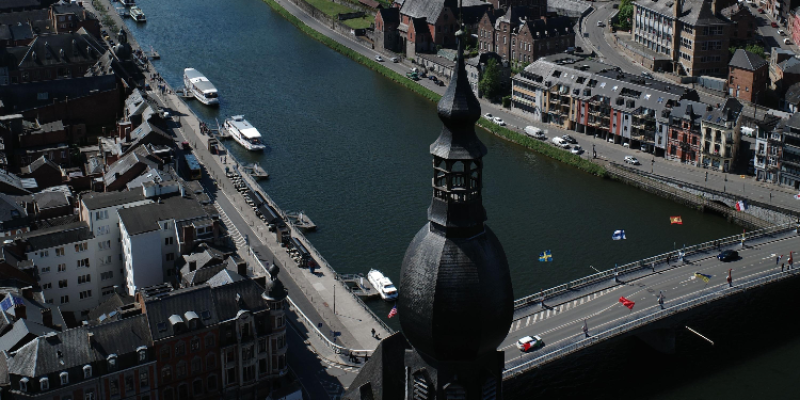
Namur has no metro or underground rail network: daily public transport in the city runs entirely on TEC buses and SNCB trains, two distinct systems with separate apps and ticketing. That split is the first practical reality newcomers need to understand before their first commute. The city's historic center is walkable, and a shared bike scheme alongside riverside cycling routes make car-free daily life viable for centrally located residents. A car, meanwhile, is becoming less convenient as staged pedestrianization works reshape central streets through to 2028, progressively restricting access routes and parking options. For arrivals at Brussels Airport, a direct SNCB train reaches Namur station in approximately 71 minutes for around EUR 6.90, with no vehicle change needed.
Two separate networks handle most journeys in Namur: TEC buses for local and regional trips within Wallonia, operated by LETEC, and SNCB trains for intercity connections and airport access. Neither covers the other's territory, so the practical first step on arrival is to set up two tools rather than one. Install the LETEC app or bookmark letec.be for bus journey planning and ticket purchase, and the SNCB app or belgiantrain.be for train travel.
For commuters who drive in from outside the city, Namur operates park-and-ride (P+R) facilities, including Namur Expo, where drivers park and continue into the center by TEC bus. A MoBIB card is required to access the bundled bus connection at those sites, so setting up the card before your first commute is worthwhile.
Within the historic center, walking is practical, and cycling is increasingly viable. The city has progressively extended its pedestrianized zone and is developing cycling infrastructure along riverside routes and near the station. One practical note for newcomers: LETEC's mobility pages, disruption notices, and local parking rules are almost entirely in French. SNCB's station pages and the Li Bia Vélo bike-share app do offer English interfaces, which helps considerably for routine journey planning.
LETEC publishes live service updates, including event diversions and weather-related adjustments, on its app and website. Checking the feed before leaving for an unusual journey is a reliable habit, particularly during periods of extreme heat or major events when afternoon services in the Namur-Luxembourg area may be reduced.
LETEC, operating as TEC Namur-Luxembourg, is the sole bus operator serving the city and surrounding region. Around 10 frequent urban lines connect central Namur with the main peripheral neighborhoods, and roughly 20 lines in total stop near Namur station or the University of Namur campus. That total includes long-distance Express services toward destinations including Couvin, Hannut, and Bastogne, which function as regional connectors rather than urban commuter lines.
Namur station serves as the central interchange point: all urban TEC lines converge there, making it the natural transfer hub between buses and trains. For in-person help with timetables, tickets, or after-sales queries, the Maison du TEC is located at Boulevard Ernest Mélot 15b, 5000 Namur.
A standard single ticket (the Classic fare) costs EUR 2.80 when bought in advance and is valid for 90 minutes across the entire TEC network, excluding Express lines. Buying on board costs EUR 3.30, a EUR 0.50 premium that makes setting up the app or MoBIB card before your first trip immediately worthwhile. A Classic day pass is available for EUR 6.00 in pre-sale.
TEC line 27 specifically connects the Namur Expo park-and-ride to Namur station. Commuters using that site need a MoBIB card loaded with the Parking + TEC 24h title and must activate it within 30 minutes of entering the car park. On late Friday, Saturday, and Sunday nights, limited night bus departures run from the TEC space at Namur station, including services after midnight. Frequency and reliability are adequate for everyday use near the center, but service can be reduced or rerouted during disruptions, major events, or extreme weather; checking the LETEC app before heading out is a sensible habit.
Join the Namur community
Get regular tips and advice to make the most of your expat life
How to pay for transport in Namur
Belgium's multi-operator smart card, the MoBIB card, costs EUR 6 to obtain and can store TEC tickets, TEC season passes, and SNCB products in the same place. Order it online or collect it at an SNCB station ticket office before your first commute. The card works across Belgian public transport in a similar way to a tap-and-go transit card: load credit or season passes, then validate at the reader on boarding. If you prefer a fully digital setup, the TEC+ app lets you buy and validate TEC tickets without a physical card; LETEC directs riders in the Namur-Luxembourg area to use the app or letec.be for both journey planning and ticketing.
The on-board price penalty (EUR 3.30 versus EUR 2.80 pre-sale) makes early setup worthwhile. Beyond the single trip, the Classic fare ladder gives regular riders several options for reducing the per-journey cost:
Annual pass: EUR 420.00 for ages 25-64 (equivalent to 10 monthly passes)
Residents aged 18-24 can access an annual Express subscription covering all TEC lines, including long-distance services, for EUR 12. Residents aged 65 and over pay the same EUR 12 annual rate; those with BIM status, Belgium's preferential social tariff for lower-income households, receive the annual Express subscription free of charge.
For commuters who travel into Namur by train and continue by TEC bus, a combined SNCB + TEC Classic season ticket is available through SNCB channels, covering both legs in a single product. Direct contactless bank-card payment on Namur bus validators is not yet operational; pre-purchase via the TEC+ app or MoBIB card remains the standard approach.
Taxis and ride-hailing in Namur
Taxis work best in Namur for occasional trips or late-night journeys when the bus network runs at reduced frequency rather than as a daily commuting option. The city-regulated fare starts at a base charge of EUR 3.00 and runs at EUR 1.65 per kilometer; a short trip of around 2 km costs approximately EUR 8. Uber and Bolt both operate in Namur, with pricing broadly in line with licensed taxis.
Surge pricing applies occasionally at night and during events, and not all taxis accept card payment, so carrying some cash for late-night or short trips is a practical precaution. Availability can be thin late at night, particularly outside the city center; for airport or long-distance transfers outside the rail timetable, booking in advance with a licensed operator is more reliable than looking for a taxi on the street. Tipping is not customary in Belgium; rounding up the fare is appreciated but not expected.
Cycling and walking in Namur
Pedestrian access across the historic center has expanded since the city began extending its piétonnier (pedestrian zone), with priority streets including rue des Croisiers, rue des Carmes, rue Saint-Jacques, and parts of rue de Bruxelles and rue Émile Cuvelier. Further phases are planned for rue Godefroid and, subsequently, for rue de Fer and the "4 coins" junction. Before your first walk across the center, check the current circulation map on pietonnier.namur.be, because access routes and one-way movements have changed and continue to evolve as new phases are completed.
Riverside routes along the Meuse and Sambre rivers are well-surfaced and traffic-free, suited to both walks and cycle commutes that align with the water. These are similar in character to UK towpath or greenway cycling: flat, reliable, and practical for the segment of the city they cover. The wider commune includes hilly terrain, however, and some cross-city routes on mixed-traffic streets require a more defensive approach, especially near junctions or construction zones tied to the ongoing pedestrianization works. Testing any such route outside rush hour before committing to it daily is advisable; use the Namur mobility portal to check the current street layout before your first cycle commute.
Li Bia Vélo is Namur's municipal shared bike scheme, with approximately 25 to 29 docking stations across the city. The Libiavelo app lets you locate available bikes, unlock them, and pay by bank card; customer service is available in both French and English. The first 30 minutes of each trip are included in the subscription cost. A day pass costs approximately EUR 1.60 and an annual subscription approximately EUR 25; additional use beyond the included 30 minutes costs approximately EUR 0.50 per extra 30-minute block.
For longer-term cycling needs, Pro Velo Namur at Place de la Station 1 offers Namicyclette long-term city-bike rentals alongside an electric-bike trial program. Collection, returns, and maintenance are all handled on-site. Secure bicycle parking is also available across the city: a place in a collective box costs EUR 45 per year, and an individual box costs EUR 60 per year. SNCB season-ticket holders and TEC subscribers using P+R sites can use secure bike boxes on Belgian Rail land free of charge.
Driving in Namur
Driving into central Namur is becoming progressively less convenient. Staged pedestrianization works are actively changing access routes and one-way patterns: streets currently affected include rue des Croisiers, rue des Carmes, part of rue de Bruxelles, part of rue Émile Cuvelier, and rue Saint-Jacques, with further phases targeting rue Godefroid and later rue de Fer and the "4 coins" junction. Driving through these areas without first checking the current circulation map risks dead ends; check the city's mobility pages before any journey that crosses the center.
There is no congestion charge for passenger cars entering Namur, and the Belgian road pricing system for heavy goods vehicles does not apply to ordinary cars on the E42 and E411 motorways around the city. Fuel runs at approximately EUR 1.96 per liter for E10 petrol, set at the national maximum price that applies uniformly across Belgium. On-street parking in the central red zone costs EUR 1.00 per hour. For longer stays, the Namur station B-Parking P1 flex option is listed at EUR 29.30 per day. Commuters who prefer to avoid city-center parking altogether can use the P+R sites at Namur Expo and Bouge, park at the edge, and continue by TEC bus.
Once you register a vehicle in Belgium, a carte de riverain (resident parking card) allows parking in your home sector's blue and metered zones on favorable terms. The card requires the vehicle to be registered in Belgium, which matters for newcomers who arrive with a car registered abroad; re-registration is a prerequisite before applying for the card.
For most newcomers settling near central Namur, the practical recommendation is to hold off on buying a car for at least the first month. Test TEC buses, SNCB trains, the Li Bia Vélo scheme, and the P+R options first; a car becomes genuinely useful only if your home, workplace, school run, or regular weekend destination sits outside the center or in an area poorly served by public transport. For occasional out-of-city trips without the commitment of ownership, peer-to-peer rental platforms near the station offer city cars from around EUR 39 per day, with broader market rates running up to approximately EUR 70 per day.
Good to know:
Belgium drives on the right. The Belgian kilometer charge applies only to heavy goods vehicles; ordinary passenger cars on the E42 and E411 motorways around Namur are not charged.
Getting around Namur by cable car and river shuttle
Two local transport options stand out as practically useful for specific journeys. The Namur Citadel cable car (téléphérique) connects Place Maurice Servais in the city center to the Citadel esplanade in under 7 minutes, eliminating a steep climb on foot. Anyone living, working, or studying on the Citadel plateau will find this a practical shortcut. The adult one-way fare (ages 16-64) is EUR 5.50; a return ticket costs EUR 8.00. Reduced fares apply for seniors, students, children, and visitors with reduced mobility, and children under 4 travel free.
The Namourette is a seasonal passenger river shuttle operated by the City of Namur, linking Jambes port to Salzinnes via the city center across a limited number of riverside stops. It serves specific points along the river rather than the full city, making it better suited to occasional use than to a daily commute.
Brussels Airport (BRU), approximately 60 km from central Namur, is the most convenient international gateway. Its railway station sits directly beneath the terminal, so there is no shuttle bus or transfer between the gate and the platform. The direct SNCB train to Namur station takes approximately 71 minutes and costs around EUR 6.90 including the Brussels Airport Supplement. That combination of a single vehicle, no changes, and luggage staying with you throughout makes it the most practical option for families and anyone arriving with significant baggage during operating hours.
Brussels South Charleroi Airport (CRL) requires a two-step journey: a TEC bus from the airport to Charleroi-Central station, then an SNCB train onward to Namur. No fixed through-journey time is published by the operators for this combination, so check schedules for your specific travel day on the SNCB Charleroi Airport page before you travel.
For late-night arrivals that fall outside the rail timetable, a pre-booked private transfer between Brussels Airport and Namur costs approximately EUR 120 to EUR 157. Book in advance with a licensed operator and confirm availability for your specific arrival time. At the airport, use only the official taxi rank or your pre-booked vehicle; drivers who approach unsolicited inside the terminal are not the regulated option, and prices will not be set by the city tariff.
Frequently asked questions
For most daily trips, the combination of TEC buses and walking covers central Namur well. Namur station is the main interchange point where TEC bus lines and SNCB trains converge, making it the natural reference point for planning any journey. Installing the LETEC app for bus travel and the SNCB app for trains before you arrive gives you the two tools that cover the vast majority of journeys in and around the city.
The TEC bus network is adequate for trips within the city and along main corridors, but services can be rerouted or reduced during major events, extreme weather, or planned works. LETEC publishes real-time service alerts on its app and website, so checking before you leave is a sensible habit rather than relying on a fixed timetable. For intercity travel, SNCB trains run on a regular timetable with direct connections to Brussels and other Belgian cities.
Yes. Setting up the TEC+ app or obtaining a MoBIB card (EUR 6) before your first commute saves money immediately: a Classic single ticket bought in advance costs EUR 2.80, versus EUR 3.30 if purchased on board. The MoBIB card can also store SNCB products and is required at some park-and-ride facilities to access the bundled bus connection. Both options are available before you travel, so there is no reason to pay the on-board premium.
Namur has no metro or urban underground network. All local public transport runs on TEC buses and SNCB trains. If you see metro references in Belgian transport apps, they relate to Brussels, not Namur.
Both Uber and Bolt operate in Namur, but availability can be limited, especially late at night or during busy periods. Surge pricing applies occasionally at night and during events, and not all taxis accept card payment, so carrying some cash as a fallback is advisable. For routine commuting, TEC buses and cycling are more predictable options.
The historic center and riverside routes along the Meuse and Sambre rivers are genuinely walkable and increasingly cycle-friendly. The city's shared bike scheme, Li Bia Vélo, operates around 25 to 29 docking stations and can be unlocked via the Libiavelo app. Before your first cycling commute across the center, check the current circulation map at pietonnier.namur.be, as ongoing pedestrianization works have changed access and direction on several central streets.
Walking is free for short trips within the center. For bus travel, the lowest adult fare is EUR 2.80 for a Classic single bought in advance; a Multi6 pack of 6 trips costs EUR 13.40, bringing the per-trip cost to EUR 2.23. Regular commuters should compare the monthly pass (EUR 42) and the annual pass (EUR 420) against their actual trip frequency, since the annual pass is equivalent to 10 monthly passes, effectively making 2 months free.
The typical pattern combines walking or cycling within the center, TEC buses for cross-town trips, and SNCB trains for Brussels or longer intercity journeys. Commuters who drive in from outside the city often use park-and-ride facilities such as Namur Expo, transferring to TEC bus line 27 into the center. Your most practical option depends heavily on where you live relative to Namur station and the main bus lines.
A car is genuinely useful if you live outside the center, have a school run, or commute to destinations poorly served by public transport. For central Namur, daily driving is increasingly inconvenient due to ongoing pedestrianization works, restricted parking, and progressively limited on-street access. The practical approach is to test TEC buses, trains, cycling, and park-and-ride options for at least a month before committing to car ownership.
From Brussels Airport, the direct SNCB train to Namur station takes approximately 71 minutes and costs around EUR 6.90 including the airport supplement; the railway station sits directly under the airport terminal, so no shuttle bus is needed. From Brussels South Charleroi Airport, take a TEC bus transfer to Charleroi-Central station and then an SNCB train to Namur, checking current schedules for your travel day. For late-night arrivals outside rail operating hours, a pre-booked licensed transfer costs approximately EUR 120 to EUR 157; always use the official taxi rank or a confirmed booking and avoid drivers who approach unsolicited inside the terminal.
ℹ️
We do our best to provide accurate and up to date information. However, if you have noticed any inaccuracies in this article, please let us know in the comments section below.
I fell in love with words at an early age After a break to focus on my studies, I rediscovered the joy of writing while keeping a blog during my years between London and Madrid. This passion for storytelling and for exploring new cultures naturally inspired me to create Expat.com, a space for my own reflections as well as for anyone wishing to share their experiences and journeys abroad.