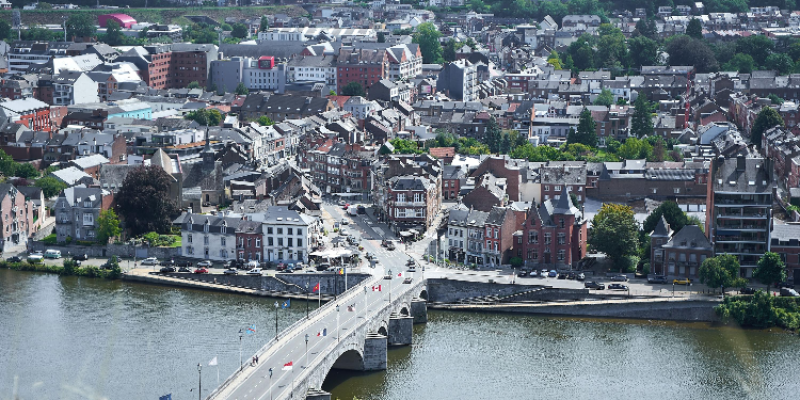
Expats who settle in Namur say afterward that they underestimated two things: how quickly the city's compact scale becomes a genuine advantage in daily life, and how much French matters from the very first week. Namur is the capital of Wallonia, Belgium's French-speaking southern region, set at the confluence of the Meuse and Sambre rivers. For a regional capital, it operates at a human scale: walkable, quieter than Brussels, and considerably more affordable, with studios from EUR 495 and a realistic single-person monthly budget of around EUR 1,900 all-in. Direct rail connections keep Brussels under an hour away, making Namur a practical base for hybrid workers and families.
At the confluence of the Meuse and Sambre rivers, Namur functions as the capital of Wallonia, Belgium's French-speaking southern region. Its role as a regional administrative, political, and institutional center gives the city a stable, year-round urban rhythm that goes well beyond a tourist stop. What strikes most newcomers is the scale: the historic core, the hilltop Citadelle, the university campus, and the main services are all within walking distance of each other, making daily life feel considerably gentler than in Brussels or Antwerp.
The city draws residents primarily for four reasons: a calmer pace, housing costs that sit below those of Belgium's largest cities, access to nature and green space, and direct rail connections to Brussels (under an hour), Liège, and Luxembourg. Heritage, student life at the Université de Namur, and the river setting give Namur a cultural density unusual for its size, while the Citadelle doubles as a park and leisure destination accessible on foot from the center.
Everyday life in Namur tends to organize itself around short distances. Morning errands happen on foot or by bicycle through the central pedestrian zone, lunch is a genuine midday break, and evenings center on local bars, riverside terraces, and cultural programming rather than a large-scale nightlife scene. Residents consistently describe the work-life balance as good. The most common early adjustment challenge for newcomers who are not already French-speaking is the practical weight of the language: municipal administration, housing paperwork, healthcare appointments, and neighborhood contact all operate in French, which slows settling in for those who arrive without it.
Namur's neighborhoods fall into a few distinct lifestyle profiles rather than a uniform urban fabric. Understanding which district suits your situation saves time when searching for housing and sets realistic expectations about daily convenience.
Centre-ville, the compact historic core around the pedestrian streets, shops, cafés, and the Meuse-Sambre confluence, is the natural first choice for newcomers who want daily errands, cultural venues, and the railway station all within walking distance. Rents sit at the higher end of the Namur market, but no car is needed. The ongoing pedestrianization project is progressively replacing car-dominated streets with pedestrian, cycle, play, and green space through the end of 2029. The adjacent Quartier des Carmes shares the same central price tier and suits professionals, students, and remote workers who prioritize walkability and street-level activity.
The Rue de Bruxelles area, centered on the Université de Namur campus, is the most practical first base for exchange students, researchers, and interns. Campus facilities and city-center services sit close together, and shared housing is more readily available here than in the fully central streets. For residents seeking something more affordable and community-oriented, Saint-Servais offers a dense, mixed neighborhood with intercultural and intergenerational activity supported by the city's Vie de Quartier (neighborhood-life) program. Bomel, also within the Vie de Quartier network, gives central Namur access at a lower price point than the commercial core and attracts students, young workers, and budget-conscious renters.
Across the Meuse from the center, Jambes is one of the city's main residential areas, popular with families, public-sector workers, retirees, and professionals who want calmer surroundings while staying connected by bridge and bus. Salzinnes offers a quieter mid-range residential base for longer-term residents: families, professionals, and retirees who want neighborhood living without the density of the commercial center. Both districts sit at mid-range price levels. Further out, the Citadelle heights appeal to car-owning families and outdoors-oriented residents for the parkland and views, though everyday practicality varies significantly by exact address; step-free daily errands are harder here than in the flat center.
Get regular tips and advice to make the most of your expat life
Cost of living in Namur
Namur's overall cost of living is moderate by Belgian standards, making it a more accessible option than Brussels or Antwerp for both individuals and families. A single person's realistic all-in monthly budget, including rent, falls between roughly EUR 1,826 and EUR 1,901. That figure covers rent, food, transport, utilities, and home internet, but excludes health insurance top-ups. Joining a Belgian mutualité (mutual health insurer) is a compulsory monthly cost for residents not covered by employer group insurance, and it does not appear in standard cost-of-living estimates, so factor it into your actual budget from the start.
Rent is the largest variable. Studios run EUR 495 to EUR 650; one-bedroom apartments range from EUR 550 to EUR 800; two-bedroom apartments are around EUR 800. Central locations command the higher end of each range, while neighborhoods like Saint-Servais and Bomel consistently sit at the more affordable end. Beyond rent, budget EUR 150 to EUR 240 for utilities (electricity, heating, and water, with winter bills toward the upper end of that range) and around EUR 43 for home internet.
For everyday spending, a monthly TEC public transport pass costs around EUR 59. An inexpensive restaurant meal for one runs around EUR 21, and a monthly gym membership around EUR 30. Numbeo's Namur cost-of-living data is a useful reference when planning a budget before arrival. Namur uses the euro (EUR), so costs for non-euro earners depend on exchange-rate movements rather than local currency volatility.
Climate and weather in Namur
Namur has a temperate oceanic climate (Cfb classification): mild summers, cool winters, and rainfall distributed throughout the year with persistent cloud cover. There is no pronounced dry season, and the weather changes frequently even in summer.
The summer mean temperature is 17.5°C, with around 7 days per year exceeding 30°C. The winter mean is 3.4°C, with around 60 frost nights per year. Annual precipitation totals 817 mm, with winter being the wettest season at around 230 mm. Readers from the UK will recognize this pattern immediately: it is broadly similar to southern England in its greyness and variability. Those arriving from sunnier climates should plan for significantly fewer sunny days and a persistent dampness that shapes daily routines indoors and out. The most comfortable outdoor period runs from late spring through early autumn; even then, showers and variable conditions are common.
Practically, prioritize apartments with good insulation and heating over those with air conditioning: winter energy bills are the bigger concern, sitting at the upper end of the EUR 150 to EUR 240 utility range. Waterproof outerwear, warm layers, and practical footwear for wet sidewalks are everyday items year-round. Two climate risks are worth factoring into housing choices: flooding and heavy rainfall in low-lying and river-adjacent areas (Wallonia recognized a natural calamity for flooding events affecting Namur in 2025), and increasing summer heat episodes in housing without air conditioning. The Royal Meteorological Institute of Belgium publishes the country's climate atlas for detailed seasonal data. Check whether a prospective property sits in a mapped flood zone before signing a lease.
Getting around Namur
Most daily needs in Namur's center are reachable on foot. The ongoing pedestrianization of the historic core (the Corbeille) is progressively reducing car traffic and creating more cycling and pedestrian space, reinforcing a genuinely walkable daily rhythm for central residents.
Cycling is practical throughout the city and connects to the RAVeL network (Réseau Autonome de Voies Lentes), Wallonia's long-distance greenway following river corridors along the Meuse and Sambre. The city provides bike parking across the center and promotes cycling alongside walking as a primary daily mode. For residential areas beyond the walkable center, TEC buses (Transports en Commun, Wallonia's public bus network) are the main option, though frequency can be limited in outer areas: residents without a car in peripheral districts report that some bus links are sparse.
A car adds convenience for outer districts, evening travel, and regional trips, but is not essential for residents near the center or station. From January 1, 2026, streets in the Corbeille outside designated zones are classified as red parking zones, so central car use requires advance planning. For on-demand journeys, Uber operates in Namur alongside conventional taxis. The TEC app covers Walloon bus routes and ticket purchasing.
French is the administrative and everyday public language of Namur, without exception. Municipal services, housing contracts, healthcare, school communications, and neighborhood interaction all operate in French. This applies regardless of a resident's origin or the language of their employer.
English has a moderate presence in university and some international professional contexts, but is unreliable for routine municipal, housing, medical, and small-service interactions. Non-francophones who rely on English will find even basic administrative tasks significantly slower and more frustrating. Namur also has notable foreign-nationality communities, including Italian, Romanian, Moroccan, and Spanish residents, making the city modestly international for its size; but these communities do not form a large English-first expat scene.
Walloon, a recognized regional Romance language, is part of local cultural identity. In daily life, residents use standard Belgian French; Walloon appears in heritage contexts, local humor, place names, and cultural events rather than in administration or service interactions. Communication style in Namur follows a formal-to-neutral register for first contact: greeting with Bonjour, Madame/Monsieur, and using the formal vous is expected when approaching officials, housing agents, and shopkeepers. The register becomes warmer and less formal once a personal relationship is established, but this takes time and repeated contact rather than happening at a first meeting.
Several providers offer French as a Foreign Language (FLE) courses in Namur for adults at all levels. Université de Namur runs FLE integration weeks before each semester for exchange students and researchers. EICPN (École industrielle et commerciale de la Province de Namur) takes new students in September and January. ILFoP offers intensive daytime FLE learning across four or five half-days per week. CFEP Namur organizes FLE and literacy training plus conversation tables, with enrollment by appointment typically opening in August. EAFC Namur-Cadets (Place de l'École des Cadets 6) offers French for non-francophones, with additional pathways for jobseekers registered with FOREM. Vis à Vis targets foreign and foreign-origin non-French-speaking residents, often through referrals from social services such as the CPAS (Centre Public d'Action Sociale).
Culture and social norms in Namur
Namur's cultural identity is built around its heritage, river setting, walking routes, the Citadelle, museums, local gastronomy, and a deliberately calmer city-center experience. The city treats culture as a driver of community connection rather than a purely tourist layer, which means that festivals, neighborhood events, and cultural programming are genuinely woven into resident life rather than staged for visitors.
In administration and first social contact, formal polite forms are the norm. Interactions become warmer and more informal once a relationship is established, but this takes time and repeated contact. The social style here rewards consistency over projection: newcomers who show up reliably at the same café, club, or neighborhood event over several weeks tend to build connections more effectively than those who make a strong first impression and disappear. Families and retirees often find Namur's smaller scale an easier social entry point than larger Belgian cities, precisely because the distances are shorter and community activities more visible.
The most effective integration routes are repeated participation in cultural events, university activities, neighborhood associations, sports clubs, or volunteer organizations. The city's Fêtes de Wallonie festival each September, along with the broader calendar of events run through the municipal Culture and Leisure Department, provides concrete occasions to participate in local life from the first months of arrival.
Belgium has 10 official public holidays per year. On these days, banks, most offices, administrations, and many shops close or run reduced hours, while hospitality and tourism activity increases. Planning municipal appointments and housing visits around these dates avoids unnecessary trips.
Pace of life and work culture in Namur
Residents consistently describe Namur as calm, manageable, and family-friendly rather than fast-paced or metropolitan. It combines the institutional weight of a Walloon regional capital with a compact, walkable feel that is noticeably gentler than life in Brussels or Antwerp. The city functions as a proper administrative center from Monday to Friday, then quiets noticeably at weekends, particularly in winter.
Work culture in Namur follows a structured weekly rhythm as in the rest of the country: fixed service hours, a genuine midday break, and a clear separation between professional and personal time. Late-evening office culture is not the norm. Work-life balance is rated positively by residents and is consistently cited as one of the city's practical attractions for international professionals and families. Those arriving from cultures where longer working hours and after-hours connectivity are standard may find the pace slower, though the transition tends to be experienced positively rather than as a constraint.
Daily life shifts visibly with the seasons. From spring through early autumn, the old town, riverside quays, Citadelle, and cultural calendar fill with outdoor events, street arts, markets, and festivals. The Fêtes de Wallonie in September serves as the city's main community celebration and one of the largest recurring events in Namur's yearly calendar. Winter is quieter and more indoor-oriented, with culture, cafés, and institutional routines carrying the city's social pace. Remote work is a growing pattern in Namur, making it an increasingly practical home base for professionals who want a calmer setting with reliable rail access to larger employment centers.
Food culture in Namur
Namur's food identity draws on Walloon and Belgian culinary traditions: beer culture, bistro dining, local market produce, cheeses, game, and freshwater fish, combined with a compact restaurant scene covering traditional Belgian, Italian, and market-cuisine options. The city's gastronomy is treated as part of everyday quality of life rather than a purely tourist attraction, which means the most interesting food experiences in Namur are not always the most prominent ones.
The main weekly social and shopping ritual is the Saturday market in the city-center squares (Place du Marché aux Légumes, Place de l'Ange, and Grognon), one of the largest regular markets in Wallonia. An organic market also runs at La Plante on Fridays from 15:00 to 18:30. Seasonal markets, including the Ascension Market in Jambes, extend the calendar through the year.
Mealtimes follow a European pattern: lunch is a genuine midday break, and dinner is evening-oriented and social. The evening food-and-drinks rhythm centers on bars, wine spots, and cafés around Rue de Bruxelles, Rue des Brasseurs, and Place du Vieux rather than a very late-night dining culture. International dining is moderately available for a city of Namur's size, but the range is narrower than in Belgium's larger cities. Residents accustomed to a wide variety of Asian, Middle Eastern, or Latin American cuisines should plan to supplement eating out with cooking from international supermarkets.
Leisure and social life in Namur
The Citadelle and river setting anchor leisure in Namur year-round: walking viewpoints and park areas, guided heritage visits, boat and waterside activities on the Meuse and Sambre, museum visits, weekly markets, and seasonal events on the river quays. The city's proximity to the Ardennes hills also makes day-trip hiking and outdoor excursions a regular part of resident life, not just an occasional treat.
The arts and cultural calendar is solid for a city of Namur's size. The Théâtre Royal de Namur, the Delta contemporary music and performance venue, and the Citadelle esplanade anchor a steady program of theater, heritage exhibitions, concerts, and public events, coordinated through Namur Culture. The municipal Culture and Leisure Department organizes major annual events including the Fêtes de Wallonie (September), the Corso de Jambes, the July 20 fireworks, the July fair, and the Nuit blanche, an annual all-night culture event involving the city's main museums and venues.
Summer brings Quai Novèle, a waterside event from June to late August on the Meuse and Sambre quays, featuring concerts, an ephemeral bar, and cultural programming. It is one of the most accessible social entry points for newcomers arriving in the summer months, as it draws a broad cross-section of residents rather than a self-selecting cultural audience.
Namur's nightlife is compact and moderate rather than large-scale. Social life after dark concentrates on craft beer bars, wine and cocktail spots, live music, and karaoke venues around the historic center streets, particularly Rue de Bruxelles, Rue des Brasseurs, Rue de la Croix, and Place du Vieux. The ongoing pedestrianization of central streets reinforces a terrace-centered, pedestrian evening pattern rather than a large club district. Main outdoor social spaces include the Citadelle park, the Meuse and Sambre quays, the pedestrian zone, Parc Louise-Marie, and Parc Astrid in Jambes. The Visit Namur events calendar is the practical reference for keeping up with seasonal programming across the year.
Family life in Namur
At the municipal-services level, Namur is strongly oriented toward families. The city offers 1,300 childcare places for children aged 0 to 3 in crèches (subsidized nurseries) and with accredited childminders, 22 municipal nursery and primary schools distributed across the commune, after-school care (accueil extrascolaire), homework schools, and year-round sports and artistic activities. The compact scale and walkable center are consistently cited by residents as family advantages over larger Belgian cities.
The City of Namur parent portal is the primary entry point for families: it covers childcare registration, school enrollment, school meals, after-school reception, and youth activities. Families with three or more children, where at least two are in ONE-approved subsidized childcare settings, benefit from reduced charges.
Public schooling in Namur is entirely French-medium. For non-francophone children arriving at secondary level, Institut Notre-Dame de Namur runs a DASPA program (Dispositif d'Accueil et de Scolarisation des élèves Primo-Arrivants), the reception and schooling pathway for newly arrived pupils not yet French-speaking, with a standard week of 32 hours.
Family-friendly neighborhoods include Jambes (residential, well-connected across the Meuse, practical for everyday services), Salzinnes (a quieter mid-range base near the center), and the Citadelle heights (green and scenic, better suited to car-owning families). Families arriving through the university can access additional support: UNamur's campus life service notes available nursery, primary, and secondary school options for members' children, and organizes activities for members' children during school vacations.
Safety in Namur
Namur is generally safe for daily life. The main everyday risks are petty theft, bag snatching, and pickpocketing, particularly in popular visitor and shopping areas. Large demonstrations occasionally disrupt transport and essential services across Belgium; residents should avoid protest crowds and monitor mobility updates when demonstrations are announced. During severe weather alerts, the city issues temporary access restrictions to parks and green areas.
Practical precautions for daily life: keep bags and phones secured in busy central and tourist areas; treat late-night routes along quiet river or park areas with extra caution; and follow Ville de Namur Prévention and Sécurité notices during storm warnings. During daylight hours in residential areas, standard urban awareness is sufficient for most situations.
Emergency contacts: call 112 (free, 24/7, from any phone) for ambulance, fire, or police emergencies. Call 101 for urgent police-only situations. The 112 BE app is the most practical tool for new residents: it lets users select the type of emergency help needed and can transmit their location automatically, which is particularly useful in an unfamiliar city. The Ville de Namur Prévention and Sécurité service (Hôtel de Ville, 5000 Namur; +32 (0)81 24 62 46) covers municipal prevention, social-prevention work, intrafamily violence support, and extremism prevention. The Espace VIF at the Province de Namur is the specialist provincial service for high-risk intrafamily violence situations.
Environment in Namur
Green space is an active urban-policy priority in Namur rather than an incidental amenity. The city runs a dedicated Nature and Espaces Verts (nature and green spaces) service, and the ongoing pedestrianization project is progressively replacing car-dominated streets with landscaped areas, pedestrian space, and cycle-priority zones. The RAVeL greenway network runs along river corridors through the city, connecting residents directly to extended cycling and walking routes beyond the urban core.
Tap water in Namur is safe to drink. The city's water distributor, SWDE (Société Wallonne des Eaux), serves postcode 5000 and confirms that any temporary cloudiness during network interventions is caused by air bubbles and has no impact on water quality. Air quality is monitored through Wallonia's Wallonair network. The everyday band in Namur is moderate to good; the main contributors to air pollution in Wallonia are road traffic, domestic heating, energy and industrial emissions, and agriculture, with air quality significantly better than in densely industrialized regions.
Two environmental risks are worth factoring into housing decisions. Flooding in low-lying and river-adjacent areas is a documented concern: Wallonia recognized a natural calamity for flooding events affecting Namur in 2025, and checking whether a prospective property sits in a mapped flood zone before signing a lease is sensible housekeeping. Increasing summer heat episodes also matter in housing without air conditioning; the Province of Namur is implementing urban heat-island resilience measures in response. In terms of neighborhood character: the Corbeille and central streets offer strong walkability but carry some construction disruption during pedestrianization works; streets near the station and ring roads have the most traffic noise; and areas near the Citadelle, parkland, and RAVeL corridors are quieter and greener.
The case for Namur as a place to live is specific and genuine, but it does not suit everyone. Understanding both sides clearly helps avoid mismatched expectations before making the move.
On the positive side, the city's calmer pace and smaller scale give it a walkable, human-scale daily life that Brussels or Antwerp cannot match, combined with direct rail connections to larger employment centers and quick access to the Ardennes and riverside nature. Housing costs are consistently below those of Brussels for comparable apartments, making Namur one of Belgium's more accessible urban options. Its family infrastructure is genuinely strong: 1,300 childcare places, 22 municipal schools, and a compact, safe-feeling environment that residents consistently rate above larger Belgian cities for family life. Despite its size, the cultural calendar, anchored by the Fêtes de Wallonie, the Nuit blanche, Quai Novèle, the Théâtre Royal, Delta, and multiple museums, is active enough that cultural participation feels like a normal part of resident life rather than a special occasion.
The practical limitations are equally specific. Residents who work in person in Brussels should plan for a realistic door-to-door commute of around one hour each way: manageable for hybrid schedules but tiring as a daily routine. A Luxembourg commute is not practical from Namur. French is non-negotiable for daily life: administration, housing, healthcare, schooling, and neighborhood contact all operate in French, and non-francophones who do not invest in the language early will find even routine tasks significantly slower and harder. Namur's private-sector job market and international networking scene are limited compared with Brussels; people who need a broad international job market, an English-first professional environment, or a dense international social scene may find the city too small. Finally, public transport outside the center is uneven: car-free residents in outer districts may find bus links sparse, making central or station-adjacent housing an important factor when deciding where to live.
Overall, Namur suits French-speaking professionals and families looking for a manageable Walloon city, students at UNamur, remote and hybrid workers who value a quieter home base with rail connectivity, and retirees seeking a slower, walkable city with genuine cultural provision. It is less well suited to daily commuters to Brussels or Luxembourg, newcomers expecting an English-dominant environment, people seeking constant metropolitan nightlife or a large international community, and car-free residents planning to live in outer districts.
Have questions about moving to Belgium? Join the Expat.com community to connect with expats who have been through the process.
Frequently asked questions
Namur works well for remote workers who want a calm Belgian base with good rail connections rather than a large-city expat scene. The walkable center, café culture, access to nature, moderate cost of living, and home internet averaging around EUR 43 monthly make it a practical remote-work base. The main limitations are a smaller international networking scene and fewer large coworking spaces than in major Belgian cities. It suits nomads who prioritize quality of life and stability over energy and scale.
Not really. The city operates entirely in French: all municipal services, housing contracts, healthcare, and neighborhood interactions run in French. English is usable in university and some professional settings but is unreliable for routine municipal or street-level interactions. For comfortable daily life beyond a short stay, French is what actually matters.
A single person's realistic all-in monthly budget, including rent, falls between approximately EUR 1,826 and EUR 1,901, covering food, transport, utilities, and internet. A more comfortable budget that allows for regular restaurant meals, weekend travel within Belgium, cultural events, and health insurance top-ups realistically means planning for EUR 2,200 to EUR 2,500 monthly. Couples and families will need significantly more, particularly when seeking a two- or three-bedroom apartment in a well-connected district. These figures exclude savings and exceptional expenses.
Namur does not have designated unsafe districts for expats. The most practical approach is to choose a well-lit, well-connected area close to daily needs: the city center and station-side areas for walkable access, or residential districts like Jambes and Salzinnes for a quieter pace. Visiting at different times of day, checking walking routes to the station or bus stops, and prioritizing buildings with secure entry are more useful than searching for a specific safe quarter.
Namur rewards long-term living more than short-stay visits. The historic center, Citadelle, and river setting are immediately enjoyable, but the city's real appeal builds over time through its slower rhythm, manageable scale, community integration, and access to nature. People seeking constant metropolitan nightlife may prefer a larger city; families, professionals, students, retirees, and remote workers typically find Namur increasingly rewarding as they settle in.
The most common positive surprise is how compact, scenic, and calm Namur feels for a regional capital, combining administrative importance, student life, heritage architecture, and riverside access without the intensity of Belgium's larger cities. The most common practical surprise is how much French matters in everyday administration and housing: even newcomers who expected to manage with English find they need French much sooner than anticipated. The city's cultural calendar also tends to be richer than its size suggests.
Namur is generally less stressful than Belgium's larger urban centers. The compact scale, walkable center, access to rivers and green space, and calmer social rhythm contribute positively to daily quality of life. The most common stress factors are administrative: dealing with French-language paperwork, finding housing remotely before arrival, and navigating bus connections in outer districts without a car. The city itself is not a source of chronic urban stress.
Foreigners can rent in Namur, but securing a lease before arrival is harder because landlords typically want proof of income, identity documents, and references. A practical approach is to prepare those documents in advance, book short-term accommodation for the first weeks, and view apartments in person. Rental prices are lower than in Brussels, but well-located central apartments move quickly, so starting the search early is worthwhile.
The main downsides are: a smaller private-sector job market and international networking scene; the requirement to function in French for most administrative and everyday tasks; a quieter evening and nightlife offer than larger Belgian cities; commuting friction if your work is regularly in Brussels; and weather, with grey, wet winters and a short summer that requires genuine adaptation for newcomers from sunnier countries. Car-free residents in outer districts may also find bus links sparse.
ℹ️
We do our best to provide accurate and up to date information. However, if you have noticed any inaccuracies in this article, please let us know in the comments section below.
I fell in love with words at an early age After a break to focus on my studies, I rediscovered the joy of writing while keeping a blog during my years between London and Madrid. This passion for storytelling and for exploring new cultures naturally inspired me to create Expat.com, a space for my own reflections as well as for anyone wishing to share their experiences and journeys abroad.