Most people assume that Ghent is simply a quieter alternative to Brussels or a smaller version of Bruges. The reality is that Ghent operates on its own terms: a Flemish university city of nearly 274,000 residents where 34% of the population is in their twenties or thirties, where cycling is genuinely faster than driving in the historic center, and where Dutch is the language of every administrative interaction regardless of how well-developed the city's English-facing web presence appears. The rental market moves fast and rewards preparation, childcare waiting lists are long, and the city's Circulation Plan makes car-reliant habits actively inconvenient. For those who arrive ready to engage with those realities, Ghent offers cultural density, a compact and walkable center, and a social scene that runs on cyclists, students, and café terraces rather than on metropolitan budgets.
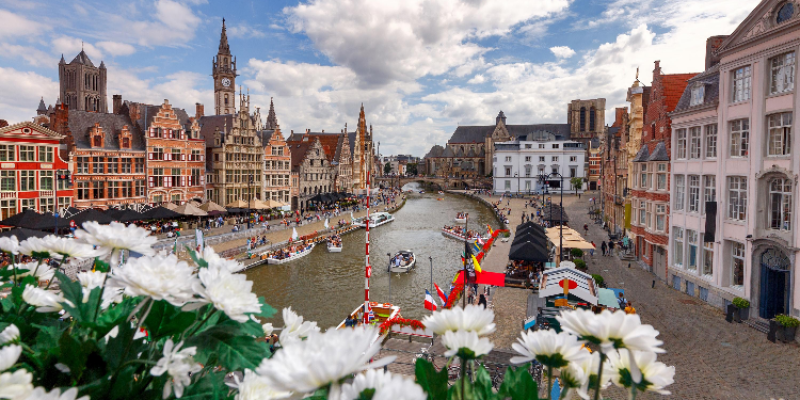
With just under 274,000 residents and a population that skews strikingly young, Ghent punches well above its size in terms of cultural life, mobility infrastructure, and urban energy. Around 34% of residents are in their twenties and thirties, compared with 24% across Flanders as a whole, which gives the city a constant sense of activity that quieter mid-sized cities rarely achieve. The historic core, threaded by canals and anchored by the Castle of the Counts, St. Bavo's Cathedral, and the Ghent Belfry, gives newcomers a first impression of cultural density more associated with larger European capitals.
What makes daily life in Ghent distinctive is the deliberate design of the city around non-car mobility. The Circulation Plan divides the center into six sections connected only via the inner ring road, making it genuinely impractical to cut through the historic core by car. In practice, this means that cycling and walking are not just options but the fastest and most logical choices for almost any journey within the center. The city's own sustainability identity reinforces this: Ghent was the first Belgian city to present a local action plan targeting 60% plant-based nutrition, and is internationally recognized as a veggie capital. Sustainable shops, specialty coffee bars, and plant-forward restaurants are threaded through the everyday streetscape rather than concentrated in a single district.
The city presents itself as neither a satellite of Brussels nor a tourist destination that empties at dusk. Cultural life, food, markets, and university activity give the streets a lived-in quality throughout the year. During term time, the center feels particularly alive; during the Gentse Feesten in July, it briefly transforms into something closer to a festival site. For newcomers, the practical starting point for all city questions is the city's expat portal, with Gentinfo (09 210 10 10) as the accessible English-language contact point for anything involving city services.
Adaptation challenges are real and worth understanding before arrival. Municipal administration operates in Dutch even where English-facing web pages exist. The housing market moves fast, particularly in the weeks before the academic year starts. Car-reliant habits become a source of friction rather than convenience inside the ring road.
The historic center, roughly the area enclosed by the waterways, is Ghent at its most walkable. It contains the main heritage landmarks, canal-side restaurants, museums, and the tightly packed streets of Patershol, the culinary quarter near the Castle of the Counts. Patershol is a practical reference point for anyone who wants to live close to the full range of dining options: Flemish, Japanese, Indonesian, Turkish, Italian, and Spanish restaurants occupy a cluster of narrow medieval streets that feels like a separate village within the city. Car access through the center is restricted, so residents here rely almost entirely on cycling, walking, and tram.
South of the center, near the university campuses, the Overpoort strip is Ghent's main student nightlife zone. It is energetic but brings the noise and crowds associated with alcohol-heavy late-night settings; anyone searching for housing in the surrounding streets should visit at different times of day before committing.
The Gent-Sint-Pieters station area, to the southwest, is the city's main intercity rail hub and a convenient base for commuters who travel regularly to Brussels, Bruges, or Antwerp. Like most busy station districts, it warrants standard urban awareness, particularly late at night and around ATMs.
Outer residential districts offer more space and lower noise levels than the historic core. Sint-Amandsberg, Sint-Denijs-Westrem, and Oostakker are family-oriented areas with access to green space and city-run childcare facilities in each district. The Nieuw Gent-UZ area, adjacent to the university hospital campus, is a practical reference for internationally mobile families: it is close to the International School Ghent and within easy reach of the university ecosystem.
Join the Ghent community
Get regular tips and advice to make the most of your expat life
Cost of living in Ghent
Housing is the largest variable in any Ghent budget. Student rooms and studios run roughly EUR 490 to EUR 650 per month; private apartments start from around EUR 800 at entry level, with well-located or furnished options considerably higher. The rental market is competitive, particularly in the weeks before the academic year begins, so arriving without pre-arranged accommodation creates real practical difficulty. Searching on Immoweb well in advance is the standard starting point for the private rental market.
For families with young children, city-run childcare centers (kinderdagverblijven) use an income-related daily rate of EUR 6.47 to EUR 35.89 (2025 tariff), which translates to roughly EUR 130 to EUR 720 or more per month depending on the number of days used and the family's income. Demand consistently exceeds supply, so the city advises registering through Kinderopvangpunt Gent as early as possible, ideally well before the child is born, to avoid long waiting lists, especially for babies. For families using the International School Ghent (De Pintelaan 258, 9000 Gent), current tuition fees are published directly on the school's website and are positioned as competitive relative to other international schools in Belgium.
Transport costs are modest for residents who commit to cycling and public transit. Many central Ghent residents avoid car ownership entirely, sparing themselves the Low Emission Zone compliance requirements, parking costs, and the general inconvenience of driving in a city designed to discourage it. For those who do drive, vehicles with foreign license plates must be registered before entering the Low Emission Zone inside the ring road: a one-off administrative step that catches many newcomers by surprise.
Climate and weather in Ghent
A temperate maritime climate means mild, changeable, and frequently damp conditions year-round. January averages a high of 6.2°C and a low of 0.6°C; July averages a high of 23.4°C and a low of 12.9°C. Annual rainfall reaches 747 mm, with October, December, and November the wettest months. Sunshine totals around 1,608 hours per year, considerably less than southern Europe.
The most comfortable months for outdoor daily life, cycling errands, and settling into a new neighborhood are May, June, and September: mild temperatures, reasonable daylight hours, and less of the persistent grey dampness of the November-to-February stretch. Summer peaks in July and August can bring real heat, and many older Belgian homes were not designed with active cooling in mind, so Royal Meteorological Institute (RMI) heat alerts for East Flanders apply directly to central Ghent.
The practical implication for housing searches is concrete: prioritize insulation, double glazing, ventilation, and damp control. Top-floor apartments in older buildings can overheat during summer heat events; ground-floor or poorly ventilated older properties can feel damp through the winter months. Weather in Ghent does not follow stable seasonal blocks. A compact, waterproof rain jacket is a year-round necessity, and planning indoor social activities and daylight exposure in the darker months makes a real difference to routine and mood.
Getting around Ghent
Cycling is the default mode of transport for most daily journeys in central Ghent. Five covered public bicycle parking facilities in the center offer 1,700 spaces, and bike hire is available at both main train stations and in the city center itself. Investing in a good-quality bike and a sturdy lock is a day-one priority; a well-secured bike is essential infrastructure rather than an optional extra.
The Circulation Plan makes most short center-to-center car trips impossible by the direct route, so cycling or walking is almost always faster than driving for journeys within the historic area. Public transit is operated by De Lijn, which runs Ghent's tram and bus network; check the De Lijn app for live departures and route planning, especially during major events or periods of public works when services change.
Intercity rail from Gent-Sint-Pieters and Gent-Dampoort connects Ghent to Brussels in approximately 30 minutes, as well as to Bruges and Antwerp. Both stations serve as covered bike parking hubs, and a bike supplement ticket allows bikes on Belgian trains during off-peak hours (SNCB/NMBS). For those who do own a car, the Low Emission Zone inside the ring road requires pre-registration for foreign-plated vehicles before entering the zone.
Dutch (Flemish Dutch) is the official administrative language of Ghent, and it governs every interaction with the city's institutions: municipal registration, housing contracts, school enrollment, neighborhood services, and most local employment. English-facing web pages on the city's portal are a navigation aid, not a parallel administrative system; the documents, forms, and in-person interactions they lead to are in Dutch.
English works well within university-linked and international professional settings, but it becomes insufficient within the first few months for anyone who needs to sign a lease, enroll a child in school, navigate neighborhood life, or communicate with local employers outside the academic and tech sectors. Treat English as a starting point; Dutch as a practical necessity.
The local spoken environment is Flemish Dutch, which differs from classroom Dutch in pronunciation and informal vocabulary, particularly in shops, neighborhoods, and relaxed workplace settings. Newcomers who have studied Dutch elsewhere may still find the local accent disorienting at first.
Concrete options for learning Dutch in Ghent include: the University Language Centre (UCT) at Ghent University, which offers Dutch for speakers of other languages at multiple levels; HOGENT, which directs students to preparatory Dutch courses; and the city's own language-course page, which points newcomers to local options. For anyone who wants structured integration support, Amal Gent provides Dutch-learning pathways alongside school-search help, diploma recognition, and broader settling-in assistance.
A few phrases worth knowing immediately: Goedemorgen (Good morning), Spreekt u Engels? (Do you speak English?), Ik leer Nederlands (I am learning Dutch), Dank u wel (Thank you), and Waar is het stadskantoor? (Where is the city office?). Making an effort with basic Dutch, even imperfectly, is generally well received.
Culture and social norms in Ghent
Ghent's civic identity is built around a self-image of independence, informality, and openness. The city positions itself through cultural life, food, festivals, and a visible sustainability ethic rather than through formal social hierarchy or religious identity. That said, the national public calendar carries Christian-origin holidays, and the city's major churches are central cultural landmarks that shape the rhythm of public life for everyone living here.
Belgium observes 10 public holidays each year, including Easter Monday, Labor Day (May 1), Belgian National Day (July 21), All Saints' Day, and Christmas. Most shops, public services, and many restaurants close on these days; factoring them into the logistics of registration appointments and early settling-in tasks matters more than it might seem in the first weeks.
Social relationships in Ghent build through repeated contact rather than immediate warmth. First interactions are polite and measured; deeper friendships develop through shared activities: cycling groups, language classes, sports clubs, neighborhood cafés, and volunteering. Punctuality matters in formal settings: city offices, university services, housing visits, and work meetings are time-specific, and arriving prepared and on time is the operating standard.
Ghent University runs structured welcome sessions for new international students and staff before each semester, making it a practical first social anchor for newly arrived academics and their families. Beyond the university, the Ghent Events platform lists current activities across all categories in English and is a useful tool for finding social entry points in the first weeks.
Pace of life and work culture in Ghent
The standard Belgian working-time baseline of 8 hours per day and 38 hours per week applies across Ghent employers, with sectoral and company-level variations. For lifestyle purposes, the practical result is a working day that typically ends by early evening, leaving time for cycling, cultural activities, and restaurants rather than extending into late-night work culture.
Flexible and hybrid working is publicly offered by major Ghent employers. Ghent University and UZ Gent both list teleworking and flexible hours among their employment terms, with the caveat that arrangements depend on role and sector. Belgian employers more broadly have been tightening office-presence expectations, so the actual degree of flexibility varies considerably by workplace.
The city's tempo shifts visibly with the academic calendar. During term time, the center feels younger and more culturally active; in summer, particularly during the Gentse Feesten in July, the center briefly transforms into a festival zone where ordinary logistics around transport, parking, and noise are substantially disrupted. For residents, this ten-day period each July requires either acceptance or a temporary step back from central routines.
Ghent holds the title of "veggie capital of Europe," and the city's food scene reflects this consistently: meat-free eating is easy across both dedicated vegetarian and vegan venues and ordinary restaurants, making it a practical reality of daily life rather than a specialty quest. The city sits within the broader Flemish comfort-cooking tradition, so Flemish cuisine remains a strong strand alongside the plant-forward identity.
Patershol is the culinary center of gravity for fine and international dining. Japanese, Indonesian, Turkish, Italian, and Spanish cuisines sit alongside traditional Flemish restaurants in a dense cluster of narrow streets near the Castle of the Counts. Booking in advance for popular restaurants, particularly on Friday evenings, is strongly advisable.
Dining hours follow a northern European rhythm: restaurant kitchens typically open from around 18:00 and stop taking orders before 22:00. University campus canteens serve from around 08:00 to 15:00 on weekdays. Newcomers from countries with late dinner cultures will need to adjust expectations and plan bookings accordingly.
Market culture is embedded in everyday food life. Recurring neighborhood markets serve as social and experiential anchors as much as functional shopping. The annual Gent Smaakt food festival covers Flemish, French, international, gastronomic, wine, and street-food concepts across dedicated city zones. Everyday international food access is broad: Belgian, Lebanese, Indian, Nepali, Ethiopian, and Asian restaurants are all present, alongside local staples like the frituur (fries stand), waffles, and chocolate.
Leisure and social life in Ghent
Canal-side cycling routes, heritage sites, cafés, terraces, street-art trails, and boat trips on the waterways are accessible without planning or high cost, woven into the city's physical layout so that moving between them takes minutes rather than requiring transit planning. The compact scale is one of Ghent's most practical everyday advantages.
Blaarmeersen Sports and Recreation Parkis the city's main large outdoor leisure area: swimming, sports, nature walks, and outdoor recreation are all available there, and designated barbecue areas make it a genuine social space rather than purely a green corridor. City parks permit barbecues in designated zones, making them a regular feature of weekend social life.
The arts and museum scene is consistently active. MSK Gent (fine arts), STAM (city history), and regular late-night museum events make cultural access a routine part of Ghent life. Nightlife is active and varied, concentrated around Overpoort, the center, and canal-side areas, with the scene strongest on weekends and during the academic year.
For current social activities across all categories, the Ghent Events platform lists music, theater, cinema, workshops, exhibitions, guided tours, and talks week by week in English. Ordinary weekends in Ghent are event-led without being overwhelming; during peak events, particularly the Gentse Feesten, the center transforms into a festival district that is energizing for some residents and disruptive for others.
Family life in Ghent
Childcare demand in Ghent consistently exceeds supply, and the city is explicit about this: parents are advised to register as early as possible, ideally well before the child is born, because waiting lists are long, especially for babies. Applications through Kinderopvangpunt Gent for regular childcare are processed in July for a start date nine months later. Urgent starts within one month require contacting the childcare location directly within 7 calendar days.
City-run daycare centers cover children from 8 weeks to 3 years, using an income-related daily tariff of EUR 6.47 to EUR 35.89. Individual childminders are also available, with a maximum of 8 children per adult. The full map of locations, including options in Sint-Amandsberg, Sint-Denijs-Westrem, and Oostakker, is searchable through the Kinderopvangpunt portal. Holiday childcare (vakantieopvang) for preschoolers and children in the first two years of primary school runs from 07:00 to 18:00 during school holidays, with fixed application windows per holiday period. The service closes during the Gentse Feesten and between Christmas and New Year, except for central emergency care.
School enrollment for primary-age children is managed through Ghent's regulated school-choice channels. Amal Gent helps newcomers find a school for their child and handles requests for primary school places. The city portal notes that children born up to March 1 of a given year can typically start preschool from September 1 of the same year; children born up to May 9 can start from November of the same year.
The International School Ghent (De Pintelaan 258, 9000 Gent) is the only English-language international school operating within the city. It offers a private, non-profit curriculum and publishes current tuition fees on its website. Families considering both the local Belgian school system and International School Ghent should research both options before arrival, as places at ISG are limited. Key family support contacts include Gentinfo (09 210 10 10 or Gentinfo@stad.gent) for childcare questions, Amal Gent for school searches and diploma recognition, and Opvoedingswinkel (opvoedingswinkel@stad.gent) alongside CLB for parenting support and child wellbeing questions.
Safety in Ghent
Recorded crime in Ghent fell by 10% in 2025 compared with 2024 (Local Police Ghent). For everyday life, the city does not carry high violent-crime risk; the practical picture centers on ordinary urban caution around theft, nuisance incidents, and online fraud.
Online and ICT-linked fraud is one of the specifically highlighted risk categories in Ghent: 2,732 ICT-linked offenses were recorded in 2025. This risk is relevant from the very start of the housing search process, before arriving in the city. Treat online rental deposits, second-hand purchase payments, and messages from unknown senders with particular caution.
Two areas warrant extra awareness at night: the Gent-Sint-Pieters station surroundings, especially late at night and around ATMs, and the Overpoort nightlife strip, where alcohol and substance-related nuisance is more common in crowded late-night settings. Both are manageable with basic urban awareness. During the Gentse Feesten, when the city receives very large visitor numbers, use extra care around pickpocketing and bag security in crowded festival zones.
For cyclists, drivers, and pedestrians: verify current Belgian and Ghent-specific traffic rules before relying on habits from abroad. Traffic-law changes affecting both cyclists and drivers came into effect from July 1, 2026. Belgian emergency numbers to save on arrival: 112 for urgent ambulance or fire assistance (the pan-European emergency number), and 101 for urgent police assistance.
Environment in Ghent
Tap water in Ghent, supplied by Farys, meets drinking quality standards continuously monitored across more than 60 properties. Newcomers do not need to buy bottled water for daily drinking.
The city connects the historic center to outer green areas through eight green-climate axes and five green poles at the city edge, a network designed for pedestrians, cyclists, fauna, and flora. Most residents have practical access to green space by bike or on foot without leaving the wider city area. Ghent's sustainability identity extends to its physical streetscape: façade gardens, green roofs, greened bus shelters, and small street gardens reflect a municipal policy that treats urban greenery as part of everyday infrastructure.
The city's climate-adaptation plan identifies drought, heat, and water nuisance and flooding as the three main climate risks being managed. In practical terms, some streets and older properties can experience flooding risk in heavy rain, and summer heat episodes can be uncomfortable in homes without cooling. When viewing homes, checking drainage, structural condition, and ventilation is worth the time, particularly for ground-floor and older properties.
The Low Emission Zone (LEZ) covers the area inside the ring road and restricts access for high-emission vehicles. Vehicles with foreign license plates that meet entry standards must still be registered before entering the zone. Check and register via the Visit Gent LEZ page before driving into central Ghent.
Expat community in Ghent
The city maintains a dedicated expat portal, aimed at people who have recently moved or are about to move, covering childcare, housing, greenery, language courses, and city contacts. Gentinfo (09 210 10 10) is the English-accessible central contact for any question about city services.
Ghent University is the most structured entry point for international community life. Welcome days for new international students and staff take place before each semester, creating immediate opportunities to connect within the university ecosystem of students, researchers, visiting academics, and their families. For non-academic newcomers, Amal Gent is the most practical single starting point: it helps with Dutch learning, school searches, diploma recognition, and meeting people.
Beyond formal institutions, the international community is most naturally built through repeated engagement: cycling groups, language classes, cultural venues, neighborhood markets, and the weekly event calendar. The Ghent Events platform lists current activities in English and serves as a practical social discovery tool for newly arrived residents.
Ghent offers genuine cultural density at human scale: UNESCO heritage, a strong museum circuit, an internationally recognized food scene, and a packed festival calendar, all within a city that can be cycled across in roughly 20 minutes. The cycling-first mobility infrastructure, backed by the Circulation Plan and five covered bike parking hubs in the center, means that daily life, including shopping, commuting, and socializing, is genuinely faster and cheaper on two wheels for most central residents. The city's demographic skew toward people in their twenties and thirties creates a social environment that feels unusually active for its size, with university, cultural, and food ecosystems generating constant opportunities for engagement.
Against this, the housing market is tight and competitive. From September 2026, Ghent University no longer provides accommodation for visiting staff and guest researchers, adding further pressure to a private market that already moves fast. Newcomers who arrive without housing pre-arranged or without a local income reference face real difficulty. The Dutch-language requirement is not negotiable for integration: municipal administration, housing paperwork, school communications, neighborhood life, and local employment all operate in Dutch, and newcomers who resist engaging with the language find their options narrowing within months. The July Gentse Feesten period brings ten days of noise, crowding, and transformed mobility in the center that some residents find energizing and others find reason to leave temporarily.
Ghent suits people who want urban cultural richness without metropolitan scale, are comfortable with cycling and public transit as primary mobility, and are willing to engage with a Dutch-speaking environment. It is less well-suited for those who need immediately affordable housing without local references, expect all services in English, or need frequent access to the wider international business network that Brussels provides.
Domande frequenti
Gand funziona bene per chi lavora da remoto e cerca una città vivace, a misura d'uomo e adatta alle biciclette, con una forte cultura dei caffè e meno intensità rispetto a Bruxelles. Il principale ostacolo è trovare casa: il mercato degli affitti è competitivo e i proprietari di solito chiedono la prova di un reddito stabile o un garante belga. Chi prenota l'alloggio con anticipo, dispone di un reddito da remoto sicuro e tratta Gand come base a medio termine ottiene i risultati migliori.
Il nederlandese è la lingua ufficiale e amministrativa di Gand. L'inglese funziona in molti contesti universitari e professionali internazionali, ma non è sufficiente per la registrazione all'anagrafe, la gestione dei contratti d'affitto, la comunicazione con le scuole, la vita di quartiere e l'impiego locale a lungo termine. La maggior parte degli espatriati si arrangia in inglese nei primi mesi, ma il nederlandese diventa via via necessario nell'arco delle prime settimane di vita universitaria o lavorativa.
Chi affitta un appartamento privato a uso singolo deve mettere in conto un affitto ben superiore a 1.000 EUR al mese; aggiungendo utenze, spesa alimentare, trasporti, assicurazione sanitaria e tempo libero, il totale per una vita confortevole si avvicina a 2.500-3.000 EUR netti o più. Chi divide l'appartamento o è studente può vivere con cifre sensibilmente inferiori. Per le famiglie, l'asilo nido aggiunge tra 130 e 720 EUR o più al mese, a seconda della tariffa legata al reddito applicata e dei giorni di utilizzo.
La criminalità a Gand è calata del 10% nel 2025 e nessun quartiere presenta un rischio elevato di criminalità violenta per gli standard europei. La zona intorno alla stazione di Gent-Sint-Pieters e il tratto notturno di Overpoort richiedono maggiore attenzione di sera, soprattutto in tarda notte. Il centro storico e i quartieri residenziali ben collegati rappresentano il punto di partenza più indicato per la maggior parte dei nuovi arrivati.
Gand premia chi ci vive a lungo: il suo fascino cresce attraverso le abitudini quotidiane, le strade ciclabili, la familiarità con i quartieri, la vita culturale e i rapporti sociali costruiti nel tempo. I soggiorni brevi sono piacevoli e funzionali per studenti e tirocinanti, ma le difficoltà nel trovare casa e la necessità di registrarsi e ottenere referenze locali rendono i trasferimenti improvvisati costosi. Le infrastrutture ciclabili, i mercati, il calendario culturale e la scala umana della città si apprezzano sempre di più con il passare del tempo.
La sorpresa positiva più comune è la ricchezza culturale e la bellezza della città rispetto alle sue dimensioni: il centro storico colpisce costantemente i nuovi arrivati. Le sorprese negative più frequenti sono invece la competitività e la velocità del mercato degli affitti, il fatto che usare l'auto in centro sia davvero scomodo, e quanto rapidamente il nederlandese diventi necessario oltre le prime settimane di vita universitaria o lavorativa.
La vita di tutti i giorni a Gand è generalmente gestibile e a misura d'uomo. Una volta trovato l'alloggio, la maggior parte degli espatriati trova la città molto meno stressante di una grande capitale: i tragitti in bici sono brevi, le opzioni culturali sono vicine e il ritmo è attivo senza essere frenetico. I principali momenti di stress si concentrano nella fase iniziale: trovare casa, completare la registrazione e abbandonare le abitudini legate all'uso dell'auto.
Gli stranieri possono affittare, ma il processo non è privo di difficoltà. Il mercato si muove in fretta, i proprietari di solito chiedono la prova di un reddito stabile, un impiego a lungo termine o un garante belga, e i nuovi arrivati senza domicilio registrato o senza contratto locale incontrano spesso ostacoli concreti. Iniziare la ricerca prima dell'arrivo, preparare i documenti reddituali e i documenti d'identità, e usare piattaforme consolidate come Immoweb migliora sensibilmente le possibilità di successo.
I tre svantaggi citati più spesso sono: il mercato degli affitti ristretto e competitivo, particolarmente difficile per chi arriva dall'estero senza referenze locali; l'ambiente amministrativo in nederlandese, che richiede un impegno concreto per l'integrazione; e la scomodità dell'auto in una città volutamente progettata per scoraggiarne l'uso. Per alcuni residenti, anche la disruzione della Gentse Feesten a luglio e il clima persistentemente grigio incidono sulla qualità della vita.
Entrambe le situazioni coesistono. Studenti, ricercatori, lavoratori da remoto e professionisti del settore tecnologico possono vivere in gran parte all'interno di ambienti internazionali di lingua inglese, soprattutto attraverso il sistema universitario. L'integrazione nella vita locale di Gand è più probabile per chi impara il nederlandese, partecipa alle attività di quartiere o nei club sportivi e ha una prospettiva a lungo termine. I circoli internazionali sono più facili da frequentare subito; le amicizie con i locali richiedono più tempo e impegno costante.
ℹ️
We do our best to provide accurate and up to date information. However, if you have noticed any inaccuracies in this article, please let us know in the comments section below.
I fell in love with words at an early age After a break to focus on my studies, I rediscovered the joy of writing while keeping a blog during my years between London and Madrid. This passion for storytelling and for exploring new cultures naturally inspired me to create Expat.com, a space for my own reflections as well as for anyone wishing to share their experiences and journeys abroad.