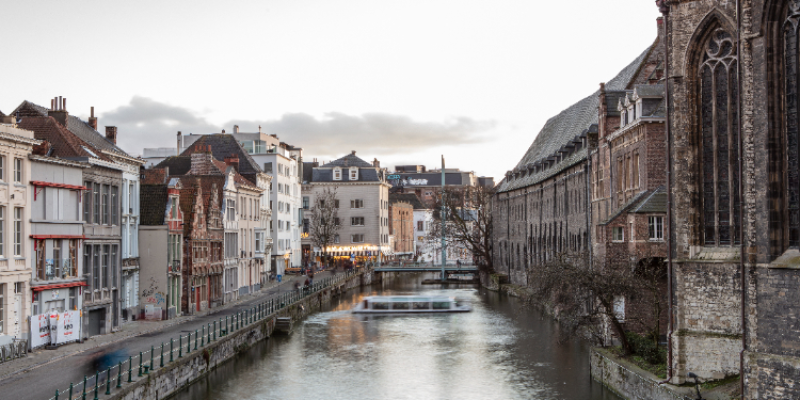
Where to live in Ghent
Ghent is a compact city, and for most newcomers the practical question of where to live comes down to two factors: how close you need to be to your workplace or university, and what type of lease you qualify for. Unlike larger metropolitan areas, Ghent does not have a single expat quarter; instead, demand for rental housing is spread across the city, with a particularly dense concentration of student-oriented housing near the two major universities. The city's historic center and the neighborhoods surrounding Ghent University's main campuses are the most sought-after locations for professionals and students alike, while families tend to look further into the residential districts where apartments with more floor space and quieter surroundings are more available.
Ghent's walkable scale means that almost any address within the city limits puts you within cycling distance of the center, which reduces the pressure to pay a premium for a central location. That said, supply is tight across the board. Both Ghent University and HOGENT explicitly warn incoming students that finding suitable housing is difficult because demand outstrips supply. Professionals and families should apply the same expectation: begin your search at least three months before your planned arrival date, not after you land.
Types of accommodation in Ghent
Apartments are the most common housing type in Ghent's private rental market. They cover a wide range: self-contained studios, one-bedroom and two-bedroom apartments, and larger multi-room units suitable for families or professional couples. In Belgian usage, what listings call a "flat" or "appartement" corresponds to what most foreigners would call an apartment; the terms are interchangeable.
A category that has no real equivalent elsewhere is the kot: a student room in a shared house, almost always rented by the room rather than the whole property. Kots are the standard housing format for enrolled students at both Ghent University and HOGENT. If you are not an enrolled student, kots are largely off-limits, either by contract terms or practical exclusion; landlords targeting the student market are not looking for professional tenants. Non-students searching for house-shares will find that this segment of the market simply does not cater to them.
Furnished accommodation exists in Ghent but represents a smaller share of the overall market. It appears mainly in short-term and medium-term arrangements: furnished studios marketed through platforms like Spotahome, monthly-stay listings on Airbnb, and some coliving spaces. Standard long-term private-market apartments are almost always let unfurnished, so budget for furnishing costs if you are signing a longer lease. Coliving spaces and whole houses for rent also exist but represent a smaller slice than apartments and kots combined.
Digital nomads and those arriving for a few months before committing to a longer lease are best served by a temporary furnished studio or short-stay apartment while they search. The window for university-channel short-stay housing is narrowing as institutional eligibility tightens from September 2026, so the private market becomes the default for anyone who is not an enrolled student or PhD fellow.
Rental prices in Ghent
The clearest price reference for student housing comes from the university channel. A student room through Ghent University's own housing office runs around EUR 542 per month on an all-in basis, meaning electricity, water, and internet are included in that figure. A single-person student studio through the same channel costs approximately EUR 701 per month, again all-in. These prices reflect the university's own stock and do not represent the full private market.
On the private market, furnished studios are considerably more expensive. Furnished studios in Ghent are available at EUR 1,050 to EUR 1,250 per month, and these are typically let on short-term or medium-term terms rather than long-term leases. The gap between university-channel and private-market furnished options is substantial, so students who qualify for institutional housing have a clear financial reason to apply early.
Beyond the monthly rent itself, the first month of any private tenancy costs significantly more than subsequent months. The rental guarantee (called the huurwaarborg), which runs between 2 and 3 months' rent, arrives at the same time as your first rent payment. Add to that any initial utility setup costs and, for unfurnished apartments, the cost of basic furniture, and your move-in budget needs to be at least 3 to 4 times your monthly rent to cover the opening costs comfortably.
Good to know:
Belgian rental listings quote a monthly rent. Always ask whether the price is "all-in" (tout compris / alles inbegrepen) or excludes utilities and charges. An apparently lower rent can quickly become more expensive once energy, water, and building charges are added.
Finding accommodation in Ghent
The right platform depends on the type of housing you are looking for. For student rooms, start with Kotatgent, the City of Ghent's approved student-housing database. A broader marketplace with availability dates shown per listing is iKot.be, which covers the wider student-room market.
For standard long-term apartments and studios, Immoweb and Zimmo are the two main Belgian property portals. Estate agents are widely used and list on both platforms; searching them daily is the most effective way to catch new listings before they disappear. Both portals have English-language interfaces, though the underlying contracts and correspondence will be in Dutch.
For furnished short-term and monthly stays, Airbnb's monthly-stays section and Spotahome both cover Ghent. Spotahome's booking process transfers the first payment to the landlord only after you confirm the property matches the listing, which offers a degree of protection for anyone booking remotely.
Ghent University's Housing Office also rents units directly to eligible international students and PhD fellows. Places are limited and applications typically open in mid-May each year for the following academic year; check eligibility and apply as early as possible if you are in this category.
Treat the search itself as a job that requires preparation rather than reaction. Good rentals in Ghent move fast: listings can go from posted to signed within days. Before you start, prepare your identity document, proof of income or an employment contract, recent bank statements, and a short introduction letter describing who you are and why you are moving to Ghent. Having these ready means you can respond to a listing within hours, not days. If you are not yet in Belgium, ask a trusted local contact, whether a friend, a colleague, or a faculty contact, to view any property in person before you commit. Do not sign a Dutch-language lease unless you understand it fully.
Watch for rental scams in the student-room segment in particular. Red flags include requests for payment before a viewing has taken place, pressure to pay an informal cash deposit, and listings that cannot be traced on the original platform. Kotatgent listings carry a lower fraud risk precisely because they are inspected, which is one practical reason to start there.
Allow at least one month of temporary accommodation after arrival as a realistic buffer. Searches in Ghent have been known to last anywhere from three weeks to six months depending on the type of housing sought. Treating one month of housing overlap as a minimum rather than a worst case will reduce the pressure on your search considerably.
How renting works in Ghent
The default lease in Flanders is a 9-year main-residence lease, which surprises many newcomers used to shorter standard terms elsewhere. In practice, this is more flexible than it sounds for tenants: you can leave at any time by giving 3 months' written notice. The catch is that if you exit within the first three years, you owe the landlord an early-termination payment: 3 months' rent if you leave in the first year, 2 months' rent in the second year, and 1 month's rent in the third. After three years, no such compensation applies.
Short-term leases are also legally possible but cannot exceed three years. Once a short-term lease goes beyond that limit, Flemish law automatically reclassifies it as a long-term lease. Students and shorter-stay renters often sign academic-year or fixed-term agreements that fall within the short-term category.
Long-term leases renew automatically unless either party gives valid notice. The landlord must give at least 6 months' notice to end the lease, and only on valid grounds: owner occupation, major renovation works, or termination without motive at the end of a three-year period, in which case the landlord owes the tenant compensation.
The standard rental guarantee is 2 to 3 months' rent, with 3 months being the legal cap under Flemish private rental rules. This guarantee is held through the federal e-DEPO system rather than paid directly to the landlord. Release of the guarantee at the end of the tenancy requires both parties to act through e-DEPO, which protects tenants from a landlord unilaterally retaining the deposit. Renters who cannot cover the full deposit upfront may apply to OCMW Gent (the public social welfare center), which can advance up to 3 months' guarantee for eligible applicants.
Agency fees in Ghent are paid by the landlord, not the tenant. If an agent is involved, they represent the owner; you should not be paying agency commission. Avoid any charges not explicitly set out in your lease or a lawful cost schedule.
To apply for most private rentals in Ghent, you will need to provide:
- A passport or national identity document.
- Proof of income or a signed employment contract.
- Recent bank statements showing you can cover the deposit and first rent.
- A short introduction letter.
- A previous landlord or employer reference where available.
Without Belgian income history, some landlords or agencies may also ask for a guarantor. This is an informal practice in competitive applications rather than a legal requirement, but it does happen.
At the start of every tenancy, a detailed plaatsbeschrijving (inventory report) must be drawn up by both parties, and both the lease and the inventory must be formally registered. Registration is the landlord's legal responsibility. Since October 1, 2023, Ghent also requires a conformiteitsattest (conformity certificate) for new rental contracts on dwellings older than 30 years. Ask to see this certificate before signing; its absence is a signal that the property may not meet the legal rental standard.
Challenges for expats renting in Ghent
Searching from abroad adds a layer of risk that is worth taking seriously. Good listings disappear quickly, and there is a meaningful scam risk in the student-room segment. The safest approach is to arrange a trusted local contact, whether a friend, a colleague, or a faculty contact, to visit any property in person before you commit to it from abroad. Do not pay any deposit, informal or formal, before a physical viewing has taken place.
Moreover, Ghent is a university city with a large student population, and housing demand consistently exceeds what the market offers. HOGENT advises students to begin searching at least three months before arrival; that same lead time applies equally to incoming professionals and families. Starting late means competing for what others have already passed over.
Rental administration in Ghent operates in Dutch. Lease templates, inventory reports, the conformiteitsattest, housing-office websites, and the city's housing advice desks all function primarily in Dutch. Platforms like Immoweb and Spotahome have English-language interfaces, but the underlying contracts will be in Dutch. Bring a Dutch-speaking contact to viewings and for any formal steps where the document content matters; signing a contract you cannot read is a significant risk.
Foreign renters with no Belgian income history may face additional scrutiny. Without local pay slips or Belgian tax returns, landlords sometimes ask for extra evidence of savings or, informally, a guarantor. This is not a legal requirement but reflects the competitive environment, where a landlord with several applicants will favor those who present the lowest financial risk on paper. Being prepared with a complete, well-organized application dossier from the outset helps offset this.
For disputes, unclear clauses, or questions about repairs and landlord obligations, the Woonwijzer housing desks, run by the City of Ghent, provide free advice to any resident on tenancy questions. Woonwijzer Zuid is located at Woodrow Wilsonplein 1, 9000 Gent. The Huurdersbond Vlaanderen (the Flemish tenants' association) also provides tenant-law information on repairs, landlord obligations, and ending a tenancy, and refers readers to legal-help services for individual cases.
Utilities and bills in Ghent
Ghent operates within Belgium's liberalized energy retail market, which means you choose your own electricity and gas supplier from a range of competing providers. The physical distribution network for all Ghent addresses is operated by Fluvius, but Fluvius is the grid operator, not the supplier; you do not contract with them for energy. The main retail suppliers active in Ghent include ENGIE Electrabel, Luminus, TotalEnergies, Eneco, and Mega. When you move in, record your meter readings immediately, then contact your chosen supplier to open a contract in your name.
Drinking water in Ghent is handled by a separate utility: Farys supplies drinking water to Ghent addresses and can be contacted directly to open an account. Farys offers online account management and bill payment through its MyFarys platform.
Combined energy and water costs for a typical Ghent dwelling run between EUR 136 and EUR 260 per month. The range reflects differences in dwelling size, insulation quality, and how many people share the space. On top of that, fixed residential internet is available from Proximus, Telenet, Orange, Scarlet, and others; entry-level plans start around EUR 33 per month and rise to approximately EUR 78 per month for higher-tier fiber packages. Actual availability depends on your address and the technology infrastructure in your street. For mobile connectivity, the main networks are Proximus, Orange Belgium, Telenet/BASE, and DIGI, with many budget MVNO brands operating on those networks; SIM-only plans typically range from EUR 5 to EUR 25 per month.
Whether utilities are included in your rent depends entirely on the type of tenancy. Furnished short-term rentals, coliving arrangements, and serviced apartments almost always include utilities in the stated price. Standard long-term unfurnished leases almost always require the tenant to set up and pay for energy, water, and internet separately, sometimes through monthly provisions that are reconciled annually against actual usage. Before comparing any two rental options, confirm which utilities are and are not included; an apparently cheaper unfurnished apartment can easily cost the same or more once utilities are added.