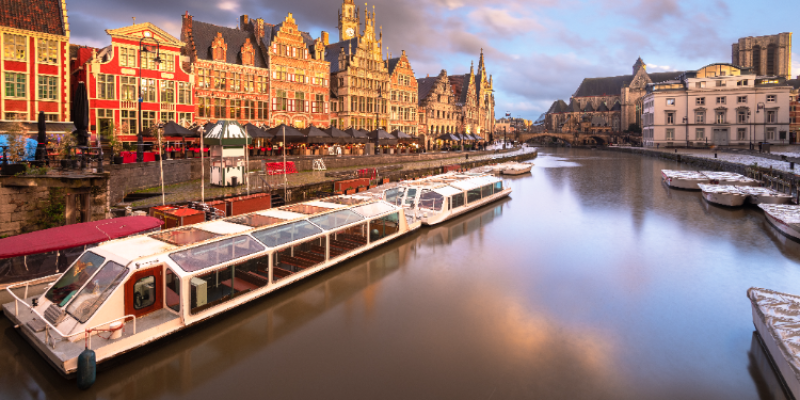
Settling into a new city means figuring out how to get around before almost anything else. In Ghent, that question has a clearer answer than in most European cities of similar size: cycling already accounts for 33.5% of all trips, the historic centre is divided into traffic sectors that make driving through it impractical, and a four-line tram network run by De Lijn connects the key hubs. The practical consequence for a newcomer is that a car is optional, not essential, and that getting mobile from day one requires little more than a contactless bank card and the De Lijn app.
Four modes of transport cover virtually every trip you will make in Ghent: De Lijn trams and buses for cross-city journeys, cycling for most short to medium urban trips, walking for the largely car-free historic center, and SNCB/NMBS trains from Gent-Sint-Pieters or Gent-Dampoort for destinations outside the city. A car is optional rather than essential for anyone living centrally.
The single most practical first step before your first commute is installing the De Lijn app. It plans routes, tracks vehicles in real time, alerts you when to get off, and sells digital tickets, all in English. It covers not just De Lijn services but also SNCB and other regional operators, so it works as a single planning tool across the city.
Ghent's circulation plan shapes the daily reality of moving around the city. The inner city is divided into six traffic sectors around a restricted-traffic area: cars cannot drive directly between sectors and must instead use the R40 inner ring road. In practice, this makes cycling and the tram faster than driving for most central trips, and it keeps the historic streets largely free of through-traffic. Always check the De Lijn route planner for current works and service changes before commuting, particularly if your route runs through the city center.
Good to know:
The CityCard Gent includes unlimited De Lijn tram and bus travel within the city, but it is only valid inside the city boundary. For regular daily commuters, a De Lijn subscription on a MOBIB card is more cost-effective than the CityCard.
De Lijn operates all bus services in Ghent as part of the Flemish public transport network. Bus and tram tickets are interchangeable: a single journey covers any De Lijn bus or tram, and a free transfer to another De Lijn service is included within 60 minutes when paying by contactless bank card or device.
Buses are the primary connection between the city's park-and-ride sites and the center for areas not served by the four tram lines. Key park-and-ride bus connections include: bus 12a/12b from Oostakker running every 15 minutes; bus 6 from Muide and Lübeck every 20 minutes; and bus 11 from Watersportbaan to Sint-Pietersstation every 10 minutes.
De Lijn also provides dedicated evening connections to Ghent's suburbs under its evening transport network. Services run until late at night; check the route planner for the last departure on your specific route before making plans that depend on late-night travel. The De Lijn Ghent local page lists route planners, network maps, and the City Pass, a De Lijn product for people who live or work in Ghent and regularly travel within the city by bus and tram.
To board, hold a contactless bank card, smartphone, or smartwatch within 4 cm of the white terminal on board; a green tick confirms payment and stores the ticket for inspection. Alternatively, activate a ticket in the De Lijn app before or immediately upon boarding.
Join the Ghent community
Get regular tips and advice to make the most of your expat life
Trams in Ghent
Four tram lines, T1, T2, T3, and T4, connect different sides of the city through the center and are the fastest public transport option for cross-city commuting. Key hubs on the network include Gent-Sint-Pieters, Gent-Dampoort, Gent-Zuid, and Korenmarkt. For anyone living or working near one of these stops, the tram is a reliable daily choice.
The tram network also feeds the city's park-and-ride system at the urban fringe. T1 serves P+R The Loop/Expo every 10 minutes and P+R Ledeberg every 5 minutes; T2 connects P+R Gentbrugge Arsenaal and P+R Gentbrugge E17 every 8 minutes; T3 links P+R Hekers from Zwijnaarde Bibliotheek. This makes the tram a useful bridge even for those who occasionally drive in from outside the low-emission zone.
Tram service is subject to temporary changes, particularly during infrastructure works and major events. During the Gentse Feesten festival, De Lijn publishes a special tram network arrangement covering the festival period. Ongoing infrastructure works affect T1 and T3 through specific corridors, including Koophandelsplein; check the De Lijn route planner or your stop timetable before traveling, especially if your route passes through the city center. The same ticket, contactless payment, and app used for buses are valid on trams, and the 60-minute free transfer applies across both modes.
Good to know:
Tram tracks are the main cycling hazard on central streets. Cross rails at a perpendicular angle, avoid riding in the groove, and slow down in wet weather.
How to pay for transport in Ghent
A single De Lijn trip costs EUR 3.00, valid on buses and trams. A return costs EUR 6.00. Paying by contactless bank card, smartphone, or smartwatch on board includes a free 60-minute transfer to another De Lijn bus or tram, provided you tap the same payment medium again at the next boarding.
Multi-trip options reduce the per-journey cost considerably. A 10-journey ticket costs EUR 22.00, bringing each trip to EUR 2.20. A day ticket costs EUR 9.00 for passengers aged 12 and over, or EUR 4.50 for children aged 6-11. A 3-day ticket costs EUR 18.00 for those aged 12 and over, or EUR 9.00 for ages 6-11.
Regular commuters benefit most from a De Lijn subscription loaded on a MOBIB card. The monthly Omnipas for ages 25-64 costs EUR 62; the monthly Buzzy Pazz for ages 12-24 costs EUR 40. Annual versions cost EUR 499 (Omnipas) and EUR 262 (Buzzy Pazz ages 12-17) or EUR 165 (ages 18-24). A EUR 10 MOBIB administrative fee applies to all subscription orders. Seniors aged 65 and over pay EUR 71 per year for the Omnipas 65+, plus the EUR 10 card fee. Ghent residents aged 6-18 can apply for a free Buzzy Pazz.
Contactless payment on board accepts Belgian and foreign Maestro/Mastercard and VPAY/Visa bank cards, as well as Apple Pay, Google Pay, Fitbit Pay, and Garmin Pay. Tickets can also be bought through the De Lijn app, on the De Lijn website, at Lijnwinkel ticket shops (at Gent-Sint-Pieters station, Korenmarkt, and Gent-Zuid at Woodrow Wilsonplein), at card-only stop machines, by SMS to 4884 before boarding, and at local supermarkets and newsagents for 10-journey tickets. If your phone battery is flat or your internet connection is unstable, carry a contactless bank card as backup: you still need a valid ticket regardless of the technical issue.
Taxis and ride-hailing in Ghent
Ghent has two categories of taxi. Stand taxis operate from designated ranks at fixed City of Ghent tariffs, making them the most predictable option for price. Street taxis set their own tariffs and must display them through their app or inside the vehicle; because rates vary by operator, confirm the price before the ride. App-based street taxi requests must be made at least 15 minutes in advance.
Stand taxi fares follow two tariff bands. Tariff A (standard) applies a EUR 10.00 boarding fee covering the first 3 km, then EUR 2.60 per km. Tariff B (evenings and events) applies a EUR 12.00 boarding fee and EUR 3.00 per km; it runs Thursday, Friday, and Saturday evenings from 19:00 to 06:00, during the Gentse Feesten festival, and on New Year's Eve.
Official taxi ranks are at Sint-Pietersstation, Station Dampoort, Korenmarkt, Woodrow Wilsonplein/Zuid, and Flanders Expo. Taxis can also be booked by phone directly with operators including ABC Taxi, Taxi 222, EBS BV, Taxi Gent, Taxi4you, and V-Tax; contact details are published on the Visit Gent taxis page.
For airport transfers, City of Ghent regulated stand-taxi fares are fixed: EUR 120 from Ghent to Brussels Airport (Zaventem), EUR 170 to Charleroi Airport, and EUR 115 to Oostende. These are regulated fares, not estimates, and include the night surcharge. App-based rides are available in Ghent but are best treated as a backup rather than a primary commute option; for consistent pricing on longer journeys, stand taxis from official ranks are more reliable.
Cycling and walking in Ghent
Cycling already accounts for 33.5% of all trips in Ghent, up from 22% in 2012, and the city's cycling infrastructure reflects that reality: 513 km of cycling infrastructure, including 19.9 km of bicycle streets and 61 bicycle bridges and underpasses. For most central commutes, a bicycle is faster and cheaper than any other mode.
The signed cycling network covers the entire city and connects to regional cycling highways and the East Flanders node network. Blue-grey wayfinding signs show estimated travel times, making navigation straightforward even in the first week. A free Fietsplan Gent map available from the city shows the full network, including routes to outer districts. The city also provides 5 public covered bicycle parking facilities in the center with a combined capacity of 1,700 places, free for residents and visitors, plus over 32,000 bicycle parking spaces on public land. De Fietsambassade manages bicycle parking and operates the main bike-rental service.
For newcomers who have just arrived, shared bikes are the quickest way to start cycling before committing to a purchase or longer-term rental. The City of Ghent lists four shared bike providers: Blue-bike, well-suited to station-to-destination trips (EUR 1.00 per 30 minutes for a city bike, EUR 2.00 per 30 minutes for an e-bike, with a maximum of EUR 2.50 for the first 12 hours on a city bike or EUR 5.00 for an e-bike; annual membership costs EUR 12); Donkey Republic, which operates fixed parking hubs across the city; and electric bike providers Bolt and Dott. All providers require their own app for borrowing and returning bikes to fixed parking points.
For longer-term rental, De Fietsambassade Gent offers city bicycles at EUR 14 per day, EUR 55 for 30 days, or EUR 250 for a year; electric bicycles cost EUR 28 per day, EUR 140 for 30 days, or EUR 990 for a year. Maintenance for normal wear is included.
In bicycle streets, cyclists have priority: cars may enter but may not overtake cyclists and may not exceed 30 km/h. School streets close to motor traffic during morning and evening school peaks. Several central streets are reserved for pedestrians between 11:00 and 18:00: Mageleinstraat, Kalandestraat to Koestraat, Langemunt, and Donkersteeg. Graslei is also traffic-free from June to September daily between 11:00 and 18:00. Riding a bicycle, moped, or any vehicle through these streets during those hours results in a EUR 55 fine; dismount and walk instead.
Ghent's historic center is highly walkable: the circulation plan prevents through motor traffic, designates pedestrian streets, and includes regular crossings and lower curbs. Major works on the Petercelle axis, covering Veldstraat, Koophandelsplein, Ketelbrug, Nederkouter, Kortrijksepoortstraat, and adjoining streets, are scheduled to continue until summer 2029; pedestrian and cycling routes through this corridor are affected, so plan alternative routes. The city also has 118 recognized trage wegen (slow routes for pedestrians and cyclists) in its green areas, including Drongen, Sint-Denijs-Westrem/Afsnee, Zwijnaarde, and Gentbrugse Meersen. Some are unpaved and difficult for wheelchairs or strollers; check the surface before planning a route that requires full accessibility.
Driving in Ghent
For most central trips in Ghent, a car is a slower and more expensive option than cycling or the tram. The combination of the circulation plan, the low-emission zone, paid parking across four tariff zones, and limited cross-sector routing means driving in the inner city involves more friction than most newcomers expect.
The low-emission zone covers the inner city within the R40 ring road. Vehicle compliance is checked automatically by camera when entering; foreign-registered vehicles must be registered online before driving into the zone. Non-compliant vehicles receive a fine. Check your vehicle's eligibility before making any central trip.
On-street parking operates across four tariff zones. From April 2026, the city introduced paid parking on Sundays and public holidays in the orange and red zones, along with higher peak tariffs on Saturdays and major events. Parking meters require entering the license plate number. For stays of more than a few hours, a car park or one of the free park-and-ride sites at the city's edge is usually cheaper. Residents can apply for a bewonerszone (residents' parking permit), valid only in the specific zone assigned to their home address, not across the whole city.
Park-and-ride (P+R) sites outside the low-emission zone offer free parking with onward tram or bus connections to the center. P+R The Loop/Expo has 165 spaces and 2 EV charging points; P+R Hekers has 68 spaces and 18 EV charging points. Both connect to central stops by tram. Note that P+R The Loop requires registering a center visit for access; barriers are in place for those continuing by public transport or shared bike.
Ghent has also introduced a rotation tariff at public EV charging points between 08:00 and 22:00: if an electric car remains connected for more than four hours after charging is complete, an extra charge applies. Move your car once it has finished charging to avoid the fee.
A car makes most practical sense in Ghent for trips to outer districts, regional travel, moving bulky items, households with mobility needs, or commutes where public transport connections are genuinely weak. For daily life in Ghent and around the historic center, cycling, tram, and walking are consistently faster, cheaper, and unrestricted by the sector system.
Brussels Airport (BRU) at Zaventem is the main airport for Ghent, around 65 km away. Its train station sits directly under the terminal, a 5-minute walk from arrivals, making onward connections straightforward to navigate on arrival.
The SNCB/NMBS train from Brussels Airport to Gent-Sint-Pieters takes 55 minutes and is the most cost-effective option for most arriving passengers. Every ticket to or from Brussels Airport includes a Brussels Airport Supplement of EUR 6.90 unless already included in the ticket. Buy tickets through the SNCB app or website before traveling.
For arrivals at Brussels South Charleroi Airport (CRL), Flibco operates a direct shuttle bus between Charleroi Airport and Ghent, the simplest route that avoids routing through Brussels. Book in advance through the Flibco website or app.
For families with heavy luggage or late-night arrivals when train schedules no longer align, a pre-booked taxi or airport transfer is the most practical door-to-door option. Fixed stand-taxi fares from Ghent are EUR 120 to Brussels Airport and EUR 170 to Charleroi. At Brussels Airport itself, use only official taxis identified by a license plate with a "T" and a blue-and-yellow logo; unlicensed drivers who approach passengers in the arrivals area charge unregulated rates.
For most newcomers, the practical daily combination is walking or cycling for short trips and De Lijn trams or buses for cross-city journeys. The city centre is largely car-free and well-suited to pedestrians and cyclists. Install the De Lijn app before your first commute: it handles route planning, real-time tracking, and ticket purchase in one place.
Ghent has an established tram and bus network operated by De Lijn, with four tram lines and a broad bus network covering the city and its outer districts. Services run from early morning until late evening, including weekends. Always check live departures in the De Lijn app before commuting, as works and service adjustments can affect individual lines.
You do not need a dedicated transport card for occasional use: a contactless bank card tapped on the white terminal on board is enough for a single trip at EUR 3.00, with a free 60-minute transfer included. The De Lijn app is the most practical first tool for daily commuting, combining ticket purchase and journey planning. If you travel every day, a subscription on a MOBIB card reduces the per-trip cost significantly, with a monthly Omnipas for adults at EUR 62.
Ghent has no metro system. Daily urban public transport runs on trams (T1 through T4) and buses operated by De Lijn. For trips beyond the city, SNCB/NMBS trains from Gent-Sint-Pieters or Gent-Dampoort connect Ghent to the wider Belgian rail network.
App-based rides are available in Ghent but are best treated as a backup rather than a daily commute option. For predictable commuting, cycling and De Lijn tram or bus are more consistent and cheaper. Stand taxis at official ranks at Sint-Pietersstation, Korenmarkt, Dampoort, Woodrow Wilsonplein, and Flanders Expo offer fixed city tariffs and are more predictable for price than app-only options.
Ghent has 513 km of cycling infrastructure and cycling already accounts for 33.5% of all trips in the city. The historic centre is largely car-free, pedestrian streets are common, and a signed cycling network makes navigation straightforward even for newcomers. The main hazard to watch for is tram tracks: cross them at a perpendicular angle and slow down in wet weather.
Walking is free and practical for most central trips. For regular travel, cycling is the lowest-cost flexible option: De Fietsambassade rents city bikes from EUR 55 for 30 days or EUR 250 for a year. A De Lijn 10-journey ticket costs EUR 22 at EUR 2.20 per trip, and a monthly Omnipas subscription for adults costs EUR 62. For occasional trips, a contactless single at EUR 3.00 with a 60-minute free transfer is the simplest starting point.
Daily commuting in Ghent is multimodal: many short urban trips are made by bicycle or on foot, while trams and buses cover longer or weather-dependent journeys. The city's transport policy prioritizes cyclists, pedestrians, and public transport over car traffic in the centre. Residents near Gent-Sint-Pieters or Gent-Dampoort also use SNCB trains for regional commuting.
For most newcomers living centrally, a car is a complication rather than a necessity. The centre has car-free areas, a low-emission zone, paid parking with four tariff zones including Sundays and public holidays in some zones, and a circulation plan that prevents cross-sector driving. A car is most useful for families in outer districts, bulky shopping, regional travel, or trips where public transport takes significantly longer.
From Brussels Airport (BRU), the direct SNCB train to Gent-Sint-Pieters takes 55 minutes and is the clearest first-choice option; the station sits directly under the terminal. A Brussels Airport Supplement of EUR 6.90 applies unless already included in your ticket. From Charleroi Airport (CRL), the Flibco shuttle runs a direct bus service to Ghent. A pre-booked stand taxi is the best option for families with heavy luggage or late-night arrivals, with a fixed regulated fare of EUR 120 from Ghent to Brussels Airport and EUR 170 to Charleroi.
ℹ️
We do our best to provide accurate and up to date information. However, if you have noticed any inaccuracies in this article, please let us know in the comments section below.
I fell in love with words at an early age After a break to focus on my studies, I rediscovered the joy of writing while keeping a blog during my years between London and Madrid. This passion for storytelling and for exploring new cultures naturally inspired me to create Expat.com, a space for my own reflections as well as for anyone wishing to share their experiences and journeys abroad.