Ghent's food scene spans four distinct registers: Flemish comfort classics, a plant-based dining culture that earned the city an official identity as Europe's veggie capital, a lively café culture woven into everyday social life, and a contemporary gastronomy wave where young chefs operate in medieval settings. For newcomers, understanding those registers is practical from the first week: dinner service opens at 18:00, kitchens close earlier than most European cities, and reservations matter even on weekday evenings. The city's Donderdag Veggiedag (vegetarian Thursday) initiative placed plant-based eating at the center of local dining years before it became mainstream elsewhere, and its effects remain visible across the restaurant scene, from casual eateries to guide-listed fine dining.
Few cities of comparable size carry such a defined culinary identity. Four forces shape daily eating in Ghent: Flemish-Belgian comfort classics, a plant-based dining scene that has earned the city an official reputation as Europe's veggie capital, a deeply social café and beer culture, and a contemporary gastronomy movement where young chefs work in centuries-old settings. These dimensions make the food landscape immediately practical for newcomers: there is genuinely something for every appetite and budget across the same streets.
The plant-based dimension runs deeper than a marketing label. Ghent was among the first cities in Europe to introduce a weekly Donderdag Veggiedag (vegetarian Thursday), and its official tourism identity still foregrounds vegetarian and vegan food as a core feature of the restaurant scene rather than a niche. Newcomers notice this quickly: vegetarian options appear on menus at venues that would not otherwise advertise themselves as plant-friendly.
Flemish classics remain central to how residents actually eat. Dishes such as waterzooi (Ghent's emblematic creamy stew), stoofvlees (beer-braised beef stew), vol-au-vent, mussels with fries, and witloof (chicory) gratin appear regularly on menus and in local food conversations. These are part of everyday restaurant culture.
Cafés are central to daily life in Ghent in a way that goes beyond coffee. They serve beer, breakfast, lunch, and often dinner in a relaxed, all-day format, and are used for studying, meeting friends, and lingering. Many operate as hybrid eat-and-coffee-bar spaces, blurring the line between café, brasserie, and restaurant. Around the historic center, a venue entered for a mid-morning coffee may also be the place to return to for dinner that same evening.
One practical point that catches many newcomers off guard: dinner service in Ghent typically opens around 18:00-18:30, and many kitchens stop taking food orders before 21:00-22:00, even when the venue itself stays open later as a bar. Booking for 19:00-20:30 gives the widest choice; arriving at 21:30 expecting a full kitchen will often disappoint.
Food functions as a social institution in Ghent more broadly. The annual Gent Smaakt festival brings free culinary programming into the historic center over the Ascension weekend each year, mixing local street food, world cuisine, and Ghent drinks. Modern dining trends also include a strong casual-international current: Nepali, Lebanese, Indian, Persian, and fusion restaurants all feature in current local recommendations, alongside a fine-dining scene that positions itself around young-chef creativity.
The most reliably local dish on any Ghent restaurant menu is Gentse waterzooi: a creamy stew made with chicken or fish and vegetables, traditionally associated with the city. Both the chicken and fish versions exist; the chicken version is the more common today. It appears across the restaurant spectrum, from brasseries to fine-dining venues, and ordering it is the single most direct way to eat something genuinely Ghentian.
Ganda ham is a dry-cured local ham named after Ghent's Latin name, Ganda. Served sliced in many restaurants and cafés, often paired with local beer, it is also available in supermarkets and butcher shops for home preparation. The Ganda ham tasting experience offered through Visit Gent combines it with beer and chocolate in the historic center, which provides a practical introduction to how these local products are consumed together.
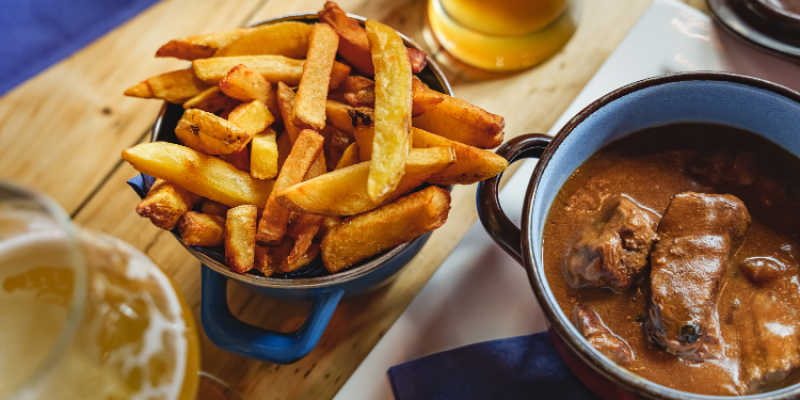
Stoverij, also called carbonnade flamande, is the Flemish beer-braised beef stew found in traditional restaurants and brasseries across Ghent. Slow-cooked with Belgian ale and served with fries, it is the dish that defines what Flemish comfort food actually means in practice. A fritkot (street fry stall) is the other pillar of everyday Ghent eating: Belgian fries are thicker and double-fried, served with mayonnaise or a range of sauces, and represent the most accessible quick meal in the city at any hour.
For sweets, cuberdons, known locally as Gentse neuzen ("Ghent noses"), are the city's most distinctive confection: cone-shaped sweets with a firm outer shell and a syrupy raspberry center. They appear on market stalls and in local tasting programs and are closely identified with Ghent. The mastel, a sticky glazed ring-shaped pastry, is another local specialty worth seeking out in the historic center. Artisan pralines and chocolates round out the sweet side of Ghent's food identity, sold throughout the center and included in local tasting walks alongside cuberdons and beer.
Local Belgian beer is woven into the food culture at every level: it pairs with Ganda ham, features in stoverij recipes, and accompanies tasting walks through the historic center. For non-drinkers, local food programs at events such as Gent Smaakt also offer mocktails and non-alcoholic alternatives alongside Ghent gin tonics, so engaging with the local food culture does not require drinking.
Join the Ghent community
Get regular tips and advice to make the most of your expat life
Types of dining in Ghent
The everyday anchor of Ghent's dining scene is the café and eetcafé (eating café): a hybrid format that serves coffee, beer, breakfast, lunch, and often dinner in a single all-day space. These venues are the most versatile option for newcomers settling in, since they rarely require advance booking for a quick meal and operate across a wide range of price points. The line between café, brasserie, and restaurant blurs considerably in Ghent's historic center, which means that many mid-range sit-down meals happen in venues that do not self-identify as restaurants.
For a more structured sit-down dinner, brasseries and mid-range restaurants are the default. A three-course dinner for two without drinks runs around EUR 100 (range EUR 65-120). Casual Asian and Indian restaurants generally come in at a EUR 20-35 average spend per person, making them the practical choice for regular evenings out without the cost of a full brasserie meal.
At the higher end, gastro-bistros and fine-dining restaurants in Ghent commonly structure their offer around fixed tasting menus of 4-6 courses rather than fully à la carte. This is the standard format at well-regarded venues: a 3-course lunch at Publiek is priced at EUR 59 per person; a 6-course evening menu at Raaf lists at EUR 63; Restaurant Sin runs 4-course at EUR 69, 5-course at EUR 79, and 6-course at EUR 89, with optional wine pairings from EUR 30. The 2026 Michelin Guide for Belgium and Luxembourg lists 764 restaurants and 139 with at least one Michelin Star nationally, confirming that serious special-occasion dining is accessible in and around the city.
At the budget end, a meal from a fritkot stall is one of the cheapest quick options available. A fast-food combo meal at a chain outlet costs around EUR 14 (range EUR 12-15). Food markets in Ghent function as eating destinations as well as shopping venues: covered market halls combine fresh produce, street food, craft beer, local products, and on-site eating, making them a practical weekend meal option that sits outside the restaurant category entirely.
Neighborhoods for food in Ghent
Patershol, the medieval quarter west of the Gravensteen castle, is the most concentrated restaurant district in the city. Its narrow streets hold a dense cluster of venues covering traditional Flemish cuisine alongside Japanese, Indonesian, Turkish, Italian, and Spanish options. Booking ahead is essential on most evenings; turning up without a reservation and expecting a table at a popular venue is rarely a workable strategy here.
The historic center around Korenmarkt, Graslei and Korenlei, Vrijdagmarkt, and the pedestrian streets connecting them is the most walkable all-in-one food zone. Cafés, brasseries, chocolate shops, beer cafés, and restaurants sit within minutes of each other. For newcomers still finding their way, starting in this area makes practical sense: the density of options means that even without a plan, there are workable choices across a range of budgets and styles.
Dok Noord, a former industrial dock area north of the center, has become one of Ghent's more active newer food hubs. It houses a brewery-restaurant-bar, a fresh market, international and sharing-food concepts, and chocolate and patisserie workshop spaces. The atmosphere is more relaxed and group-oriented than Patershol; it works well for informal weekend eating without the pressure of a booking-required restaurant.
The Overpoortstraat and Sint-Pietersnieuwstraat axis is Ghent's student belt, with a different character from the historic center: pizza places, family-run international restaurants, casual lunch spots, and cafés at prices oriented toward everyday budgets. For residents outside the center who want routine affordable eating rather than destination gastronomy, this zone is the most practical for daily meals.
The area around Sint-Jacobs functions as a relaxed, design-oriented social zone, better suited to casual drinks, coffee, and light food than formal dining. It connects easily to Patershol, making it a natural starting point for anyone combining browsing with a subsequent dinner. For the largest weekend market experience, Ledeberg, a sub-municipality southeast of the center, hosts Ghent's largest Sunday market with more than 60 stallholders covering fresh produce and casual street food.
International cuisine in Ghent
Visit Gent maintains a dedicated world cuisine (wereldkeuken) category listing dozens of international restaurants across the city. The 2026 Michelin Guide for Belgium and Luxembourg includes Ghent listings in categories such as Japanese, Thai, Spanish, Asian, and Italian, confirming that the international dining scene extends to guide-level quality rather than being limited to informal or tourist-facing options.
Asian cuisines are the most strongly represented international category. Thai, Japanese, Korean, Vietnamese, and Chinese restaurants all feature in official listings and local recommendations, with venues ranging from casual sharing-food concepts to guide-listed fine dining. The fusion scene draws on combinations of Japanese, Korean, Vietnamese, and Thai influences, with venues in modern settings in the city center; Dok Noord also hosts Asian-style sharing-food concepts.
Indian cuisine has a visible presence in central Ghent, with multiple restaurants including Moti Mahal, Masala Accent, and Masala King operating in the city center area. Italian cuisine is well represented across formats, from casual pizza and pasta restaurants to higher-end Italian listings in guide-level directories. Middle Eastern and Persian restaurants appear in Visit Gent's world-cuisine listings, and Latin American cuisine, including Peruvian, has an emerging presence in current local food discussions, though it remains less represented than Asian or Indian options.
Grocery shopping in Ghent
For the lowest grocery bills, Colruyt, Aldi, and Lidl are the consistently recommended budget chains in Ghent. Colruyt operates a loyalty card system (Xtra) that provides ongoing discounts on purchases; setting it up from the start is worth the few minutes it takes.
Albert Heijn, Jumbo (with a city-center location at Korenmarkt 16), and Carrefour represent the mid-range tier: wider variety and more convenience formats, but generally higher prices than the discount chains. Delhaize leans toward the premium and convenience end, with multiple formats including full supermarkets, Proxy Delhaize, and Shop & Go Delhaize locations. The Shop & Go at UZ Gent focuses on ready-to-eat items, fresh products, sandwiches, and drinks, making it practical for quick daily top-ups rather than a full weekly shop.
A realistic single-person monthly grocery budget in Ghent runs EUR 250-EUR 500. The lower end reflects consistent use of discount supermarkets and home cooking; the upper end reflects more convenience shopping and ready meals.
Ghent has several fresh-food markets distributed across the city. Key recurring options include a fresh-food market on Sint-Michielsplein, a market for fresh food and new merchandise on Vrijdagmarkt, and the large Sunday market in Ledeberg. For organic and short-chain produce, Ghent's short-chain food network connects residents with an organic market on Maria Hendrikaplein, the covered Lousbergmarkt, and the Moscou Market in Gentbrugge, all linked to local producers.
Vanier is an online local-food platform set up by Ghent's city government, connecting residents directly with producers from in and around the city; it is a practical tool for newcomers who want locally sourced ingredients without visiting markets in person. For standard online grocery ordering, both Delhaize and Carrefour offer home delivery through their own platforms, and Carrefour's Fast Delivery app provides same-day express delivery across Ghent.
Ghent's price range for eating out runs from a street-stall snack to a multi-course tasting menu, with several practical price points in between that will shape most daily decisions. A coffee (cappuccino) costs around EUR 3.86 on average, with a typical range of EUR 3.00-4.50. A domestic draught beer (0.5 liter) runs around EUR 5.00, with a range of EUR 3.50-6.50 depending on the venue.
For quick meals, a fast-food combo costs around EUR 14 (range EUR 12-15). A lunchtime set menu including a drink at a standard restaurant runs around EUR 18, which is the most cost-effective sit-down format for regular eating. A one-course sit-down meal at an inexpensive restaurant costs around EUR 20, with a range of EUR 15-30 depending on the venue and dish.
A mid-range three-course dinner for two, without drinks, costs around EUR 100 (range EUR 65-120). Casual Asian and Indian restaurants typically come in at a EUR 20-35 average spend per person, making them a reliable middle ground for regular evenings out. At the deliberate special-occasion end, a 3-course lunch menu at Publiek runs EUR 59 per person; full evening tasting menus at gastro-bistros such as Raaf and Restaurant Sin range from EUR 63 to EUR 89 per person, with optional wine pairings from EUR 30.
Dietary requirements in Ghent
Vegetarian dining is exceptionally well catered for in Ghent. The city is officially positioned as Europe's veggie capital, and vegetarian options are a standard feature of the restaurant scene rather than a specialist niche. Vegan options are visibly available across the city: the Gent Smaakt culinary festival explicitly includes vegan food, and the City of Ghent's requirements for food stands at Gentse Feesten mandate at least one vegan dish per stand at designated food zones.
Gluten-free eating is possible but requires venue-by-venue verification, especially for coeliac-level needs. Epiphany's Kitchen (Burgstraat 10, 9000 Gent) is listed by Visit Gent as 100% gluten-free and vegan, making it one of the few venues in the city where cross-contamination concerns can be set aside entirely. City food-stand requirements at some events also mandate a gluten-free dish per stand.
Halal food is available in Ghent but is venue-specific rather than widely labeled across the restaurant scene. ENTR (Ham 147, 9000 Gent) offers an extensive halal range alongside vegetarian dishes. Halal diners should confirm preparation standards directly with the restaurant before ordering, as labeling practices vary by venue.
Belgian law requires all food businesses, including restaurants, to provide accurate and complete allergen information for every dish, including non-prepacked food. Restaurants must be able to show or state which of the 14 major allergens are present in any dish. If the allergen card (allergenenkaart) is not displayed, ask for it; the obligation to provide this information is legally binding. For tasting menus and fixed-menu restaurants in particular, communicate dietary requirements at the time of booking rather than on arrival: venues such as 50 Fifty and Allegro Moderato explicitly ask guests to declare all allergies and restrictions with their reservation so the kitchen can prepare alternatives in advance.
Food delivery in Ghent
Three major platforms cover food delivery in Ghent: Takeaway.com (the widest restaurant network in Belgium), Deliveroo (with a dedicated Ghent restaurant and cuisine page), and Uber Eats (covering Ghent neighborhoods including Mariakerke, Ledeberg, Sint-Amandsberg, Wondelgem, Gentbrugge, and Drongen). All three are active and list current Ghent restaurants; the practical approach is to check each app directly for your specific address and time of day, as coverage varies by location.
Deliveroo's standard delivery fee in Belgium is EUR 4.99, though restaurants or grocery partners using their own delivery may set different rates. A service fee also applies and is shown in the basket before payment; minimum spend is around EUR 10, with additional fees on smaller orders. Delivery times from selected venues can be under 30 minutes: Carrefour confirms that orders placed through its delivery partners (Uber Eats, Deliveroo, and Takeaway) can arrive from selected stores in less than 30 minutes, though actual times depend on restaurant, distance, and time of day.
Grocery delivery is available across all three platforms. Uber Eats' grocery category and Takeaway.com's Gent groceries page both list grocery options, while Carrefour's Fast Delivery app offers same-day express home delivery directly. For newcomers still setting up their apartment or needing supplies outside market hours, the combination of these platforms means basic grocery delivery is consistently available.
Getting a table in Ghent without a reservation is reliably difficult. Visit Gent states explicitly that finding a restaurant last minute is "not easy," and popular restaurants fill up on weekday evenings as well as weekends. For groups, calling ahead is essential; most establishments require reservations for parties. The practical rule for newcomers is to book any restaurant you actually want to eat at.
When booking last-minute, TheFork lists current Ghent restaurants with live availability for online reservations. Tablefever gift vouchers are accepted at some venues. For reservations within 24 hours at some restaurants, a direct phone call is required rather than the online booking form; check the restaurant's own social media pages for the most current status.
Dinner service opens at 18:00-18:30 at most Ghent restaurants, and kitchens stop taking food orders between 21:00 and 22:30, sometimes earlier; venues may stay open as bars after the kitchen closes. Booking for 19:00-20:30 gives the widest options. Many mid-to-higher-end restaurants operate on fixed menus of 4-6 courses rather than fully à la carte, and some are open only by reservation on specific evenings. Terrace seating, even at otherwise bookable restaurants, is commonly first-come, first-served.
Card payment is standard practice across Ghent. Belgian businesses must offer at least one electronic payment method; Bancontact is the dominant debit network and is accepted almost universally across the city. Not every venue accepts all international credit cards; having a Belgian bank account with a Bancontact card simplifies payments at all venues. When dining at fixed-menu or tasting-menu restaurants, declare allergies and dietary restrictions at the time of booking, not on arrival.
Tipping is not obligatory in Ghent or in Belgium more broadly. Restaurant staff are not primarily paid through tips, and rounding up or leaving a small amount for notably good service is common but not expected. There is no social norm equivalent to a fixed percentage tip; not adding a tip is not considered impolite.
Good to know:
The dagmenu (dish of the day or set lunch) is the most affordable way to eat at a sit-down restaurant in Ghent. It typically includes one or two courses and a drink at a price well below the evening menu, and is available at most brasseries and mid-range restaurants at lunchtime.
We do our best to provide accurate and up to date information. However, if you have noticed any inaccuracies in this article, please let us know in the comments section below.
I fell in love with words at an early age After a break to focus on my studies, I rediscovered the joy of writing while keeping a blog during my years between London and Madrid. This passion for storytelling and for exploring new cultures naturally inspired me to create Expat.com, a space for my own reflections as well as for anyone wishing to share their experiences and journeys abroad.