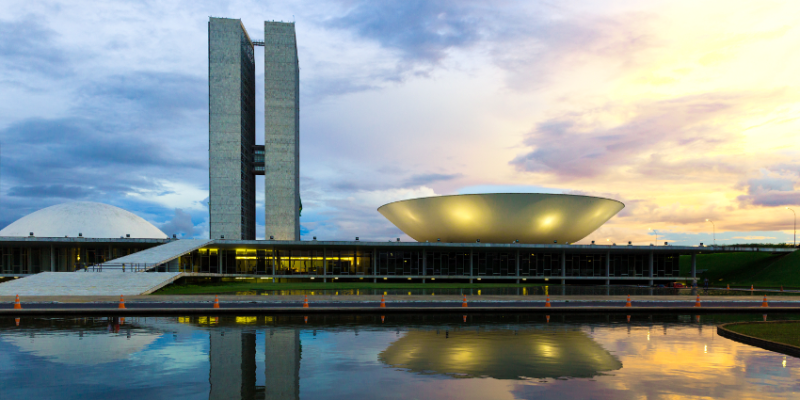
Living in Brasília can mean a tree-filled residential block, a high-rise beside the metro, or a house near the lake. Your address shapes the cost and rhythm of everyday life, from commuting to school runs and evenings out. The capital offers parks, cultural activities, and an international community, but you'll need to factor in distances and a pronounced dry season when planning.
Your daily experience of Brasília depends largely on where you settle. Brazil's capital brings together national institutions, modernist landmarks, and residential areas with very different ways of life. The Plano Piloto, designed by Lúcio Costa, and major buildings by Oscar Niemeyer give the city its broad avenues and open views. The Esplanade of Ministries, Congress, and monumental squares dominate the capital's familiar images. For residents, shops, schools, and outdoor spaces soon become just as important.
It helps to distinguish the Plano Piloto from the wider Federal District. Asa Norte and Asa Sul are the two residential wings of the original plan. Elsewhere, Águas Claras, Guará, Taguatinga, and Ceilândia have their own centers and local routines. Moving to Brasília might mean an apartment among trees, a high-rise near a metro station, or a house some distance from the nearest shops.
In the original residential wings, the superquadras are large residential blocks with open space, trees, and local shops. Many buildings stand on columns, leaving space beneath them. Public access between buildings is part of the design. Some errands can be done on foot, even when work or an evening with friends involves traveling to another part of the city.
Work connected with government institutions, diplomacy, and the university brings people to the capital, while parks and outdoor sports can make exercise part of the week. Making this lifestyle work over the long term comes down to finding a home that fits both your budget and your regular journeys.
For a student or someone working at the University of Brasília, Asa Norte puts the Darcy Ribeiro campus, cafés, and Plano Piloto shops within the same part of town. Asa Sul has a similar pattern of residential blocks, with metro access in some areas. In either wing, an older building's details matter: an elevator and usable parking can make as much difference as its location. That is especially true for retirees and parents getting a stroller in and out each day.
Sudoeste and Noroeste offer more upscale housing close to the center. Sudoeste has established shops and is near Parque da Cidade. Noroeste's appeal includes newer apartment buildings, garages, and shared facilities, although these amenities also affect the rent and building charges.
Águas Claras has a denser, high-rise feel, with services and several metro stations. It can be convenient when the line connects where you need to go. Guará mixes houses and apartments, with metro access depending on the address. Taguatinga is a substantial residential and commercial center where prices are generally lower than in the most expensive central districts. If your work is in the Plano Piloto, however, the journey can take a significant part of the day.
Lago Sul and Lago Norte are options for people who want a house and more space. Some international schools are close to Lago Sul, which can influence a family's choice. House maintenance and motorized travel add to the expense of living in these areas. Before choosing between a house near the lake and an apartment in the Asas, try the journey to work or school at the times you would actually travel.
Join the Brasília community
Get regular tips and advice to make the most of your expat life
Cost of living in Brasília
Housing can make a substantial difference to your monthly spending, even between relatively central districts. The local currency is the Brazilian real, abbreviated BRL. The apartment rents below are FipeZAP asking-rent benchmarks for Brasília, expressed per square meter per month. Condominium charges and other housing expenses are additional.
Area
Monthly asking rent per m²
Approximate USD equivalent per m²
Sudoeste
BRL 89.80
USD 16.35
Asa Norte
BRL 66.90
USD 12.18
Águas Claras
BRL 54.40
USD 9.90
Asa Sul
BRL 41.40
USD 7.54
Taguatinga Sul
BRL 33.00
USD 6.01
For a long-term rental, agencies review your identification, income, and rental guarantee, including the guarantor's documents where relevant. You'll also need a CPF, Brazil's taxpayer identification number. A fiador guarantees that the rent will be paid. If the landlord agrees, a cash security deposit or insurance covering unpaid rent can be an alternative. Under Brazil's rental rules, a cash deposit cannot exceed three months' rent and must be held in a savings account. Only one type of guarantee can be required for the same lease.
Across resident profiles in the Federal District, average reported monthly expenditure across all categories is BRL 4,920, or about USD 896. Housing and travel costs differ considerably between a central superquadra apartment, a house in the lake districts, and a home near the metro in Taguatinga. Among residents who incur each category of expense, monthly averages in the Federal District are BRL 1,090 (about USD 198) for groceries and BRL 640 (about USD 117) for recurring bills, including water, electricity, Internet, and digital subscriptions. Ready-made meals and eating out account for BRL 350 (about USD 64), while leisure spending averages BRL 470 (about USD 86).
If you earn in another currency, exchange rates and transfer fees affect the amount you have available in reais. Rent and bills are payable in local currency. The index and review interval written into your lease determine how the rent changes during the tenancy.
Climate and weather in Brasília
The biggest seasonal adjustment is between the dry months, generally May through September, and the rainy season, which usually begins around October and continues through April. At Brasília's weather station, 1,159 meters above sea level, monthly average temperatures range from about 19.5°C in June and July to 23.3°C in October. Cool mornings can give way to much warmer afternoons, so a light long-sleeved layer is useful for an early outing.
Rainfall changes much more sharply: the station averages less than 2 mm in July and more than 240 mm in December. Humidity in the Federal District can drop below 20% during the dry season. Walking and exercise are more comfortable away from the hottest hours. During the rains, outings need some protection from showers and footwear suited to wet conditions.
The weather also changes what to look for in an apartment. A bedroom in the afternoon sun will feel different from a shaded room of the same size. Room orientation, sun protection, and ventilation all affect comfort. Windows and signs of water intrusion deserve attention too, since the home needs to work through both seasons.
Getting around Brasília
Buses cover more of the Federal District than the metro. Metrô-DF runs from the center of the Plano Piloto through Guará, Águas Claras, and Taguatinga, with branches toward Ceilândia and Samambaia. It serves Asa Sul, but not Asa Norte. A metro journey costs BRL 5.50 (about USD 1), payable with a contactless bank card or a BRB Mobilidade card.
With the BRB Mobilidade card's integrated fare, you can make up to three boardings within three hours for up to BRL 5.50, provided you continue in the same direction. This doesn't cover a round trip. Getting the card requires a CPF. You can pre-register online and collect it at a service point.
A car-free routine is possible when your home is well connected to your destinations. Some superquadras and areas around stations allow local errands on foot, though major roads require suitable crossing points. Cycling works on equipped routes and in parks. Taxis and ride-hailing services can fill gaps, especially after an evening out. A house in the lake districts or a family schedule involving several distant destinations makes a car much more useful.
Language and communication in Brasília
Portuguese is the language you'll use for everyday shopping, local services, and administrative matters. Embassies and international schools create settings where other languages are spoken, but these won't cover every appointment or transaction. If you're just beginning Portuguese, language help at an important appointment can make it easier to deal with the details. Keeping your full address and useful documents on your phone also helps prevent misunderstandings.
Brasília's Portuguese reflects the mix of people from different Brazilian regions, with local variations in pronunciation. Two useful phrases are “Pode repetir, por favor?” (“Could you repeat that, please?”) and “Pode falar mais devagar?” (“Could you speak more slowly?”). Addresses take some getting used to: keep the sector, quadra (residential block area), bloco (building block), and number together when sharing one.
UnB Idiomas offers Portuguese courses for foreigners at the Darcy Ribeiro campus in Asa Norte, including for people who aren't part of the university. There are separate learning paths for Spanish speakers and speakers of other languages. A placement test is required to enter above the first beginner level. For intermediate learners, a conversation and culture course provides further practice with everyday exchanges.
Culture and social norms in Brasília
The people who built and settled Brasília brought traditions from across Brazil. That history remains in the city's food, accents, and meeting places. Northeastern Brazilian culture is particularly visible in Ceilândia, while local shopping streets help shape neighborhood life in the Plano Piloto. Spending time in different administrative regions gives you a broader experience of the capital than staying around its monuments and institutions.
Religious traditions also shape the calendar. October 12, dedicated to Nossa Senhora Aparecida, and Corpus Christi are public holidays in the Federal District. Brasília celebrates its anniversary on April 21.
Pace of life and work culture in Brasília
Federal institutions and diplomacy are prominent in Brasília's working life, alongside universities, companies, and service businesses. Where you work shapes the rest of your day: living nearby can leave room for an errand or a walk after work, while a long journey across the Federal District reduces that flexibility. For a couple working in different areas, an address halfway between them only helps if the connections work for both people.
In the Federal District, most work is done in person, and the average reported working week is around 40 hours. Remote and hybrid arrangements exist, but commuting remains part of many residents' routines. Exact schedules depend on the employer and the role. An administrative office, a shop, and a healthcare facility can each organize the day quite differently.
The city's main north-south road becomes the Eixão do Lazer when it is reserved for recreation on Sundays and public holidays from 6 a.m. to 6 p.m. People can walk, run, cycle, roller-skate, and skateboard where cars normally travel.
Food culture in Brasília
Brasília's food reflects its residents' regional traditions. At Feira Central de Ceilândia, dishes from northeastern Brazil include buchada de bode, made with goat offal; sarapatel, an offal stew; and mocotó, made with cow's foot. These foods belong to family traditions and the social life of the market, as well as offering something for visitors to try.
In Asa Norte and Asa Sul, cafés and restaurants line local shopping streets between residential blocks. At a por quilo lunch buffet, you serve yourself, have your plate weighed, and pay by weight. Restaurants around workplaces offer this during the midday break. Other places have à la carte menus with a price for each dish. Lunch and dinner hours vary by establishment.
International cooking is part of neighborhood dining too. Beirute serves Arabic food at 109 Sul and 107 Norte, continuing a history of Middle Eastern restaurateurs from the capital's early years. Restaurants and bars along Lake Paranoá offer another setting for a meal or a drink.
Leisure and social life in Brasília
Parque da Cidade Dona Sarah Kubitschek has walking and running paths, sports courts, and open spaces for spending time outside. Lake Paranoá offers canoeing and stand-up paddleboarding, with operators arranging departure points and equipment rental. In hot, dry weather, the cooler parts of the day are better for physical activity.
For exhibitions, films, and performances, Centro Cultural Banco do Brasil, usually called CCBB Brasília, provides an indoor cultural option. Admission arrangements vary with the activity. Even a free session may require a ticket.
Saturday music can also be an outdoor outing. At Choro no Parque, students and teachers from the Escola Brasileira de Choro meet from 11 a.m. to 1 p.m. at parking lot 10 in Parque da Cidade. The gathering is free and open to musicians, beginners, and anyone who wants to listen. Choro is a Brazilian instrumental music tradition. Clube do Choro also hosts concerts and Saturday musical lunches, with separate ticketing arrangements.
Family life in Brasília
For families, Asa Norte and Asa Sul offer the possibility of living near shops and open spaces, while Sudoeste provides access to Parque da Cidade. Houses can give children more private outdoor space, but school and activities may involve more driving. Journeys between home, school, and work often matter more than property size.
Several international schools are in the southern part of the urban area. TheLycée français François Mitterrandis in Lago Sul at QI 21.Escola Americana de Brasília is in Asa Sul at SGAS 605, and Brasília International Schoolis at SGAS 914, also in Asa Sul. The latter offers an American educational program with a Christian orientation. Teaching language, curriculum, admissions, and the school's educational approach all need to suit your child. Choosing a school can therefore directly affect where you live.
To apply for a nursery place in the public or partner network, call156. The regional education coordination office then checks the application. Families must provide documents showing that they meet the criteria used to prioritize applications. Cartão Creche can fund a place at an approved private nursery when a public place isn't available. Access depends on the child's eligibility and position in the priority ranking. The documents needed for Cartão Creche include identification, the child's CPF, proof of residence or work, and the requested health documents. A place isn't guaranteed immediately for every newly arrived family.
Young migrant, refugee, stateless, or asylum-seeking children cannot be refused public enrollment because they lack personal or school documents, sworn translations, or migration documents. The education coordination office handles the request using the documents available, and placement depends on school vacancies.
For time together outside school, CCBB's free Rolê Cultural program includes reading, games, visits, and workshops. Some activities are open to visitors in the dedicated spaces; others require a ticket or reservation.
Safety in Brasília
Everyday safety starts with a home's immediate surroundings: the entrance, lighting, and route to public transportation. A shopping street can become much quieter after businesses close. When walking home, prefer well-lit routes with other people around, and keep valuables discreet. Pay attention around parking areas too.
On public transportation and in busy places, keep bags closed and put your phone away when you aren't using it. For evenings out, plan a return journey that avoids long, deserted stretches between a stop and your door. Don't resist if you're assaulted. These precautions matter regardless of how expensive the neighborhood is.
Theemergency numbers are 190 for police, 192 for medical emergencies, and 193 for firefighters. Give the full address and a landmark, including the sector and building block where possible. For routine information about public services, call 156 rather than an emergency line.
Environment and livability in Brasília
Green space and open views are part of the Plano Piloto's appeal. At home, though, shade, access to a park, and the distance from major roads all affect comfort. A balcony beside a busy road will have a different noise level from an apartment facing into a superquadra. Visiting at different times of day helps reveal both traffic noise and indoor heat.
During the dry season, dust and particles from traffic and vegetation fires can build up in the air. Hydration, keeping humidifiers clean when using them, and adjusting outdoor plans become part of the routine, especially for families with young children and people with respiratory sensitivities. On smoky or exceptionally dry days, moving exercise or another activity indoors may be more comfortable.
Embassies, international organizations, and foreign schools give Brasília an international dimension. The community includes people on diplomatic assignments, families, professionals involved in international cooperation, and foreign students. For people moving through these routes, school, university, and work provide opportunities to make contacts.
English speakers looking for conversation with other language learners can try Clube Poliglotas da Asa SUL. Its Friday gatherings start at 7 p.m. at Xique-Xique, SCLS 107, with tables for English, Portuguese for foreigners, and other languages. All levels are welcome, and no reservation is needed.
For French speakers or people learning French, the Alliance française de Brasília in Asa Sul offers courses and Francophone cultural activities. UnB's Portuguese classes are another way to meet fellow learners. Open musical gatherings in Parque da Cidade offer regular opportunities to join residents around a shared interest, whether you play an instrument or simply enjoy listening.
Brasília can suit remote workers who want outdoor activities and nearby shops. Asa Norte and Asa Sul offer life in residential superquadras, while Águas Claras combines apartments, services, and metro access. Suitability also depends on the Internet connection at the particular property and the journeys needed for your activities.
Other languages can help in some international settings, but Portuguese makes it easier to handle administrative matters, shop, and get to know your neighborhood on your own. UnB Idiomas accepts non-students in its Portuguese courses for foreigners.
A short stay gives you time to explore Plano Piloto's architecture and leisure spaces. For a longer move, the district and your regular journeys become more important. Asa Sul can suit a routine linked to the metro, Asa Norte puts you near the Darcy Ribeiro campus, and Lago Sul offers houses near some international schools.
The distances between destinations and the sector, quadra, and building-block address system take some adjustment. You may be able to walk to local shops from a superquadra but still need transportation for another activity. Low humidity during the dry season also affects comfort at home and when you exercise.
A home well connected to work and leisure can make the week pleasant. Long commutes and multiple family journeys can make it more demanding. Parks and the Eixão do Lazer offer regular opportunities to unwind, but your home's location still shapes much of your daily travel.
Foreign nationals can rent, but approval depends on the application the landlord or agency accepts, including identification, a CPF, proof of income, and a rental guarantee. Without a local guarantor, you may be able to use a cash deposit or insurance covering unpaid rent if the landlord agrees. A cash deposit is capped at three months' rent. If your income comes from abroad, confirm the agency will accept it at the start of the search.
Urban sprawl, housing costs in some districts, and very dry air for part of the year are practical challenges. Metro coverage is limited and doesn't extend to Asa Norte. A house in the lake districts also brings more motorized journeys and maintenance.
ℹ️
We do our best to provide accurate and up to date information. However, if you have noticed any inaccuracies in this article, please let us know in the comments section below.
A journalist, holder of the DALF C1 and C2 and a diploma from the University of Mauritius, I have nearly twenty years of writing experience. After six years in the Mauritian press, I joined Expat.com, where I have been working for over a decade, including five years as editorial assistant, and now as editorial manager.