Buenos Aires concentrates Argentina's services economy, with private registered employment in the city standing at 1,670,456 jobs in August 2025 according to GCBA data. The job market leans heavily toward tertiary activity: real estate and business services, commerce, finance, and a growing technology cluster anchored in Parque Patricios. For expats, the most accessible openings tend to sit in multinationals, IT, shared services, and cross-border roles, while inflation running at 32.4% year-on-year shapes how salaries are negotiated and reviewed.
Buenos Aires concentrates the country's services economy, and recent official data points to a labor market that is service-heavy, formal-sector-oriented, and operating below its 2023 employment peak. According to an official GCBA economic monitoring report, private registered employment in CABA stood at 1,670,456 jobs as of August 2025, down 0.5% year-on-year and 3.1% below the November 2023 peak of 1,726,124, a difference of 55,668 jobs. The same document records the stock of private firms in the city at 127,679, with modest growth in commerce (+521 firms) and hotels and restaurants (+219), while transport (-317) and real estate and business services (-313) contracted.
At the metro level, the national Encuesta de Indicadores Laborales for March 2026 reports flat monthly employment for Gran Buenos Aires and a 1.5% annual decline, signals consistent with cautious hiring and replacement-only recruiting in larger private firms.
The sector composition reflects a strongly tertiary structure. An official GCBA prospectus document shows real estate and business services at 19.9%, community and personal services at 19.9%, commerce, hotels and restaurants at 18.4%, financial services at 14.6%, production at 12.5%, and transport, storage and communications at 9.4%. Three sectors account for 89% of the city's service exports: transport and storage (42%), information and communications (31%), and professional services (16%). This export profile underpins the relevance of bilingual, cross-border roles for newcomers.
Inflation remains a defining feature of the Buenos Aires job market. The IDECBA price index registered 2.5% in April 2026, 11.6% accumulated over the first four months of 2026, and 32.4% year-on-year. In practice, salary negotiation, indexation, and review cadence carry significant weight in compensation discussions. For expats, the most accessible entry points tend to be roles tied to internationally tradable services, the city's tech cluster in Parque Patricios, and remote work for foreign employers, while purely local regulated professions typically require credential recognition and Spanish-first workflows.
Office and corporate activity in the city is spread across several recognizable submarkets, each with its own professional character. This section covers only the business geography within the Autonomous City of Buenos Aires (CABA) and excludes industrial or logistics hubs in the surrounding Greater Buenos Aires conurbano.
Microcentro and the downtown core
The Centro / Microcentro area, covering San Nicolás and Montserrat, is the traditional financial and political core, described by the city's official tourism site as the downtown business and financial center. The City is running a Plan de Transformación del Microcentro Porteño, encouraging conversion and mixing of uses, including from offices to housing. In practice, this may reduce traditional office concentration and redistribute demand toward other submarkets.
Catalinas, Retiro, and Puerto Madero
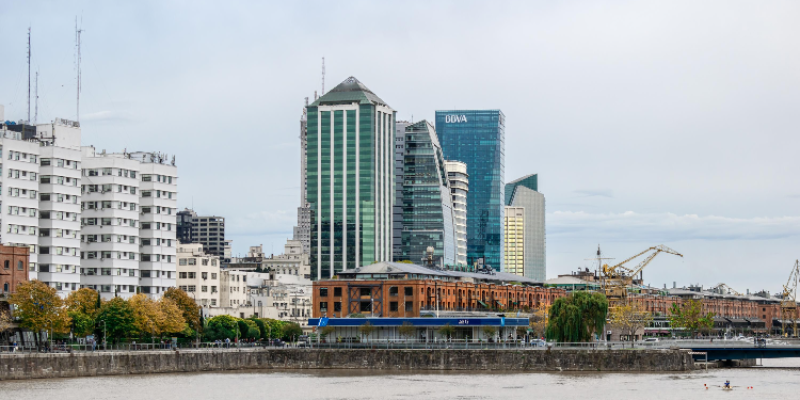
Catalinas Norte, in Retiro, is a corporate cluster of Class A office towers. Its location in Comuna 1, close to train and Subte hubs, makes it a high-density corporate area with heavy peak-hour commuting. Puerto Madero, including Dock 1 and the northern waterfront, is a premium mixed-use district associated with AAA office buildings and the presence of national and international firms.
Distrito Tecnológico in Parque Patricios
The Distrito Tecnológico in Parque Patricios (Comuna 4) is a tech and back-office hub designated by the city as a center for promoting and developing technology, innovation, and knowledge. It is connected via Subte Line H, Metrobus, and the Autopista 25 de Mayo. The cluster hosts a concentration of firms tied to the district and is one of the most relevant geographies for IT delivery, shared services, support, and vendor ecosystem roles.
Distrito Audiovisual, Distrito de las Artes, and Barracas
The Distrito Audiovisual covers Chacarita, Villa Ortúzar, La Paternal, and parts of Palermo and Colegiales, and hosts production companies and TV, advertising, animation, and video game studios. Recent industry coverage cites companies relocating studios and offices to Palermo Hollywood, reinforcing the area's positioning as an audiovisual hub. The Distrito de las Artes, covering La Boca and parts of San Telmo, Constitución, and Barracas across a 429-hectare perimeter, is oriented to cultural industries and creative production rather than corporate offices. Barracas itself houses the Centro Metropolitano de Diseño, a 14,000 m² design center supporting the city's creative economy.
Join the Buenos Aires community
Get regular tips and advice to make the most of your expat life
Top employers in Buenos Aires
Several major companies maintain a strong presence in Buenos Aires across energy, finance, technology, telecoms, and aviation.
YPF (energy) is headquartered in Torre YPF in Puerto Madero.
Telecom Argentina maintains its corporate and investor relations operations in the city.
Aerolíneas Argentinas, the state-linked national airline, operates under the national transport secretariat.
Accenture operates a Buenos Aires office at 24 de Noviembre 2120 in Parque Patricios, with an agreement supplying the building with 100% renewable energy via YPF Luz.
JPMorgan Chase & Co. typically maps to service-center roles requiring English proficiency and familiarity with global processes.
IBM partnered with TD SYNNEX to inaugurate a Centro de Excelencia in Buenos Aires in 2026, reflecting active enterprise-tech investment.
Mercado Libre opened a highly automated logistics hub in the Buenos Aires metropolitan area, with robotics and AI shaping the city's logistics and operations labor market.
On the public sector side, the City Government of Buenos Aires (GCBA) is itself a major administrative employer, with its Casa de la Ciudad located in Parque Patricios. The startup ecosystem is also significant: StartupBlink ranks Buenos Aires among the top 100 global startup ecosystems, with 594 startups listed on the city's ecosystem page.
Finding jobs in Buenos Aires
Spanish is the default working and recruitment language for most roles in Buenos Aires. English-only positions exist but cluster in multinational environments, technology, remote work, and some customer-facing tourism and hospitality positions. For most local roles, candidates should expect Spanish to be used in interviews and on-the-job documentation.
Official portals and government channels
The city government runs Trabajo BA, a free job portal for residents and companies. At the national level, Portal Empleo is a public and free platform connecting job seekers with positions and training.
Main online job platforms
LinkedIn Jobs is widely used for corporate, tech, and multinational recruiting.
Zonajobs is a major Argentina-wide board for corporate, administrative, and commercial roles.
Bumeran lists positions across Capital Federal and Buenos Aires.
Indeed Argentina aggregates listings for cross-checking and volume.
Get on Board focuses on tech and startups, often publishing salary ranges in USD and offering remote or hybrid roles.
Recruitment agencies
Several international recruitment firms are present in Buenos Aires and operate professional, corporate, bilingual, and executive pipelines. These include Randstad Argentina, Manpower Argentina, Adecco, and Michael Page. Recruiter-led processes can be faster for in-demand profiles, but still require Spanish-language interview readiness.
Networking
Networking is a high-leverage channel for professional roles, since many opportunities circulate through referrals and recruiters before reaching public postings. Practical steps include shortlisting 20 to 40 target employers, following their LinkedIn pages, and applying directly through their career sites to avoid duplicate or expired listings. Building two CVs and LinkedIn versions, one in Spanish and one in English, helps when applying to postings in either language.
Good to know:
Many Buenos Aires postings are written in Spanish even when the workplace operates partly in English. Attaching a Spanish CV by default when the posting is in Spanish is the more reliable approach.
City-level income figures provide a useful baseline. According to the IDECBA income report published in April 2026, the average income from the main occupation in Q4 2025 was ARS 1,571,777, with a median of ARS 1,200,000, and individual income (all labor and non-labor income) reaching ARS 1,546,473. At the national level, RIPTE, a social security remuneration indicator, stood at ARS 1,775,664. The statutory minimum wage, Salario Mínimo, Vital y Móvil, was ARS 363,000.
Salary ranges by sector
The Michael Page Argentina salary guide sets out gross monthly ranges in millions of Argentine pesos for senior professional roles commonly based in CABA, with annual bonuses expressed in number of salaries.
Finance: Administration and finance manager in small or medium companies ranges from ARS 8M to 11M (2 to 3 salaries bonus); in large companies, ARS 11M to 15M (3 to 5 salaries bonus). A finance and treasury manager runs ARS 6.2M to 9M in small or medium firms (1.5 to 2.5 bonus) and ARS 8.5M to 13M in large firms (2 to 4 bonus).
Technology: Systems or IT manager ranges from ARS 7.5M to 10M in small or medium firms (2 to 3 bonus) and from ARS 10M to 14M in large firms (3 to 4 bonus). An infrastructure manager runs ARS 5.8M to 8M (small or medium, 2 to 3 bonus) and ARS 7M to 9.5M (large, 2.5 to 3.5 bonus). Data manager in large firms ranges from ARS 8.3M to 11M (2.5 to 3.5 bonus).
In technology, demand is concentrated in highly specialized roles such as software architects, DevOps and SRE, cloud engineers, cybersecurity, and AI-linked talent, with companies prioritizing senior profiles. Remote international work has lost attractiveness relative to local offers, providing more stability, benefits, and career development.
Benefits and review cadence
In finance, the top benefits valued by professionals are performancebonuses, hybrid work, and health plans. In technology, the leading three are health plans, performance bonuses, and hybrid work. These are common market expectations for professional roles, particularly outside collective bargaining agreements.
Under Ley 20.744, paid leave must be paid at the start of the vacation. After six months of service, the entitlement is 14 consecutive days; with less than six months worked, the entitlement is one vacation day per 20 days of effective work; and vacation must be granted between October 1 and April 30.
Given the city's inflation trajectory, employers and candidates often anchor negotiation to expected inflation and to the cadence of reviews, which can be monthly, quarterly, or semiannual. For professional roles, negotiating review frequency and variable-pay terms can materially change real purchasing power.
Work culture in Buenos Aires
Standard office hours run Monday to Friday, typically 9:00 to 18:00, with a one-hour lunch break. Argentine labor law caps the standard work week at 48 hours and 8 hours per day.
Lunch tends to be treated as a real break in many Buenos Aires office environments, often eaten later than in North America. Sector-specific collective agreements show lunch scheduled formally into the workday, supporting the broader pattern that the midday break is operationally planned rather than skipped.
Argentine telework law, Ley 27.555, explicitly recognizes the right to digital disconnection: the right not to be contacted, or to disconnect, outside working hours and during leave. Enforcement varies by employer and sector, but the statutory right exists for hybrid and remote workers.
Sector differences
Corporate and multinationals follow more structured schedules and meeting norms aligned with international practices.
Startups and technology show a visible coworking and flexible-work ecosystem, with hybrid arrangements common in the city's tech zones.
Hospitality and shift-based roles follow rotating shifts and weekend work, with shift patterns such as 6 to 18 and 18 to 6 illustrated in collective agreements.
Professional behavior and hierarchy
Business culture in Buenos Aires is widely characterized as relationship- and trust-driven. Time can feel fluid compared with stricter time cultures, and meetings may start later than scheduled as conversations and rapport-building take priority. Punctuality is valued for professional appointments, though small delays are not unusual. The cheek-kiss greeting is common in social and some professional contexts; in formal settings, beginning with a handshake and following the local lead on physical greetings is the practical approach.
Decision-making tends to be concentrated at the top, particularly in traditional local firms and large organizations, and less so in startups and some multinational team cultures. Trust-building through informal conversation about family, sports, or social life is fundamental in developing business relationships. This can surprise newcomers expecting faster, agenda-first meetings. Expect meetings to allocate genuine time for relationship-building before moving to business decisions.
Dress codes vary by sector. Finance, law, and client-facing corporate roles tend to be more formal; business-casual is common in many multinational back-office roles; and startup, tech, and coworking environments skew casual but neat, particularly for investor or client meetings.
Daily mobility in Buenos Aires relies on a dense bus and subway network, supplemented by commuter trains, ride-hailing, and a growing cycling infrastructure.
For office-based professionals, commute convenience is typically best when living close to or on direct Subte and bus corridors to the main office concentrations: Microcentro, Retiro and Catalinas, and Puerto Madero. Living in the north or inner north with good Subte access tends to reduce day-to-day friction because the network is structured around fast access to downtown. Living farther from Subte coverage pushes commuters toward bus-heavy routines, with greater variability amid congestion and service disruptions. Puerto Madero is part of the central business district but has limited bus routes and no direct subway line into the neighborhood, which can increase last-mile walking or reliance on taxis and ride-hailing for some commuters.
The SUBE card is the standard payment method for buses (colectivos), the Subte, and commuter trains. The Red SUBE system integrates multiple modes (colectivos, Metrobus, trains, and Subte) and provides automatic discounts for combined trips, applied at the time of travel. Subte fares are published officially with effective dates on the city's fare page. For route planning, the city promotes BA Cómo Llego as the official trip planner for addresses and routes. The city also positions cycling as a mainstream mobility option, with a network of cycle lanes and the public bike system EcoBici.
Expect heavy crowding at major Subte trunk stations and on busy bus corridors during weekday peaks, and significant travel-time variability for car or ride-hailing commutes due to congestion typical of large capitals.
IT services, financial services, professional and business services, health, construction, tourism, and creative industries are strategic sectors. IT employs more than 103,000 people across over 3,560 companies in the city, while health accounts for 7.5% of city employment. Buenos Aires also concentrates 58% of Argentina's service exports, which supports demand for bilingual roles tied to foreign clients.
The traditional corporate core covers Catalinas-Retiro, Puerto Madero, Microcentro, and the 9 de Julio corridor. Palermo has emerged as a creative and tech-adjacent hub, while Parque Patricios hosts the Distrito Tecnológico and Barracas hosts the Distrito de Diseño. A Distrito de Inteligencia Artificial was announced in Microcentro in March 2026.
Combine the City's TrabajoBA portal and the national Portal Empleo with private boards such as LinkedIn, Bumeran, ZonaJobs, and Computrabajo. For mid and senior-level roles, work with recruiters such as Michael Page, Randstad, Adecco, or ManpowerGroup. Bilingual candidates can add chambers of commerce networks as an additional channel, and most postings require a CV in Spanish tailored to the role.
The SIPA national average for registered private-sector employees was ARS 2,110,147 in February 2026, and the average wage for registered private-sector workers in CABA stood around ARS 2,864,000 as of June 2025. Actual pay varies significantly by sector and seniority. Inflation makes periodic adjustments common, and many candidates negotiate indexation or staged reviews rather than a single annual raise.
Traditional expat packages with housing allowances, schooling, and relocation benefits exist mainly in multinational corporate roles. Most locally hired positions are offered on local contracts in ARS, with statutory benefits under the Ley de Contrato de Trabajo and employer-linked health coverage through the obra social system. Hard-currency exposure, either through a foreign employer or export-oriented work, tends to be the main driver of higher effective purchasing power.
Spanish is the dominant administrative and hiring language. Public administration, HR processes, and most local postings are in Spanish. English-only roles exist in some multinational environments, tech teams, and international education or NGOs, but Spanish proficiency materially expands access and is generally expected in day-to-day operations.
Commute patterns are radial, with strong inbound flows toward the central business areas. Most commuters use the Subte, colectivos, and commuter rail, with payment integrated through the SUBE card and RED SUBE discounts. Living near a Subte line or close to your office cluster significantly shortens daily travel, and registering a SUBE card unlocks lower fares for frequent users.
Public-sector roles are generally more limited than private-sector options because they often require local credentials, residency requirements specific to each posting, and strong Spanish for administrative work. A practical entry point is to monitor TrabajoBA and to target public-adjacent employers such as universities, hospitals, or contractors, depending on your field.
ℹ️
We do our best to provide accurate and up to date information. However, if you have noticed any inaccuracies in this article, please let us know in the comments section below.
A journalist, holder of the DALF C1 and C2 and a diploma from the University of Mauritius, I have nearly twenty years of writing experience. After six years in the Mauritian press, I joined Expat.com, where I have been working for over a decade, including five years as editorial assistant, and now as editorial manager.