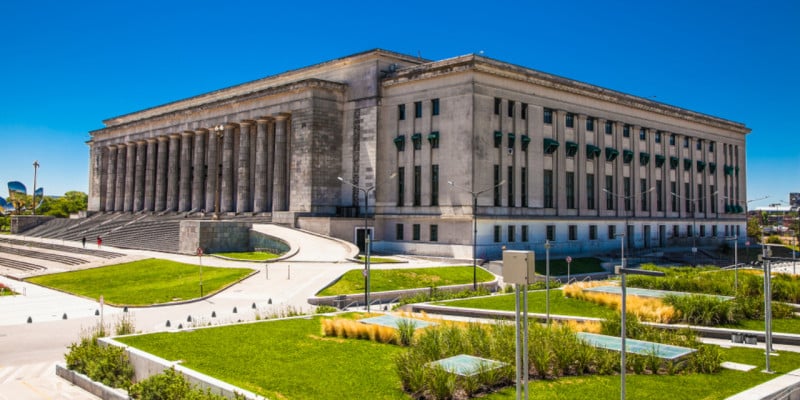
Buenos Aires ranks first in Latin America and 32nd globally in the QS Best Student Cities 2026, with around 500,000 students enrolled across 42 universities in the metropolitan area. The city combines a large tuition-free public sector anchored by Universidad de Buenos Aires with a wide range of private institutions, from comprehensive universities to specialized tech, business, and health schools. Costs, language requirements, and onboarding procedures vary considerably between institutions, and international students navigate parallel visa, residency, and credential recognition tracks.
Buenos Aires holds a prominent international position as a student city, leading Latin America and ranking 32nd globally in the QS Best Student Cities 2026. The same QS World University Rankings 2026 place Universidad de Buenos Aires (UBA) at #84 globally, an institutional anchor that shapes the city's academic profile. Across the wider metropolitan area, roughly 500,000 students study at 42 universities, and the City of Buenos Aires markets itself as a regional university hub through its Study Buenos Aires program.
The system combines a large, tuition-free public sector anchored by UBA, which UBA Internacional describes as a "massive" and "arancel cero" model, with a layer of private universities ranging from comprehensive (UADE, USAL, UCA, UB) to specialized tech, business, and health institutions. UBA reports more than 300,000 students and 72 research institutes within the university alone. Universidad de San Andrés reports receiving 200+ international students annually through its exchange office, and ITBA runs a structured Buddies Program to support incoming exchanges.
Lately, public-university life has been shaped by demonstrations, public classes, and strikes tied to debates over university funding, with mobilizations across Buenos Aires in May 2026. The protest context can affect academic calendars in certain weeks at public universities.
The starting reference for verifying whether an institution is part of Argentina's official university system is the Ministry's Dirección Nacional de Gestión Universitaria Registros Públicos. The city contains both major public universities and a wide range of private universities.
Public institutions
Universidad de Buenos Aires (UBA): a multi-faculty comprehensive public university with a central international office at Ayacucho 1245, CABA, and faculty-level international units (for example, the Faculty of Law at Figueroa Alcorta 2263).
Instituto Universitario de Seguridad de la Ciudad (IUSE): a city higher-education institution specializing in security, with 22 classrooms and three specialized labs across 6,480 m².
ITBA (Instituto Tecnológico de Buenos Aires): a private institute focused on engineering, technology, and management, with mature incoming infrastructure and explicit English-taught course availability.
Universidad del CEMA (UCEMA): a private university centered on economics, business, and finance, with sites at Suipacha 664, Reconquista 775, Av. Córdoba 374 and 637, and Av. Leandro N. Alem 882.
Universidad de Palermo (UP): a private university with an Estudiantes Internacionales pathway and ISEP exchange channels.
Universidad Católica Argentina (UCA): a private Catholic university with its main campus in Puerto Madero.
Universidad de Belgrano (UB): a private university in the Belgrano district, with a March 2026 intake.
Universidad del Salvador (USAL): a private Catholic university headquartered in CABA.
Universidad CAECE: a private university with its Sede Central at Av. de Mayo 866.
Universidad Maimónides: a private health-focused university in Caballito offering more than 25 undergraduate programs and 30 postgraduate programs.
Instituto Universitario CEMIC: a private health institute at Valdenegro 4337 with specialisation and residency programs for 2026.
Universidad de la Marina Mercante (UdeMM): a private university with a maritime and engineering identity.
Instituto Universitario Hospital Italiano de Buenos Aires: a private health university institute linked to Hospital Italiano.
UTDT (Universidad Torcuato Di Tella) is also active in the CABA private landscape, particularly in social sciences, law, and business.
Language of instruction
Among institutions with explicit international pathways, ITBA is the clearest case of English-taught course availability, with concrete language certificate rules (B1 Spanish for Spanish-taught courses, B2 English for English-taught courses, and no Spanish required for students taking only English-taught classes). At most other institutions in Buenos Aires, Spanish is required unless a specific program states otherwise. For example, UBA Law states that classes are taught entirely in Spanish and that it does not offer classes taught in English.
Join the Buenos Aires community
Get regular tips and advice to make the most of your expat life
Admissions and fees in Buenos Aires
University admissions in Buenos Aires are not centralized. Each institution, and often each faculty, manages its own admission process and calendar. UBA uses a tiered scheme via the CBC (Ciclo Básico Común) or UBA XXI, with a three-stage sequence: Preingreso UBA, campus and shift selection in CBC, and document submission. Spanish proficiency must be accredited under the provisions in force from the Consejo Superior. Private universities such as UTDT handle admission through application and interview, with entry without exam or via an entry course, depending on places available and academic performance.
Document requirements for international students
Foreign secondary or tertiary credentials must be processed through Argentina's Reconocimiento de Estudios Extranjeros procedures, with different routes for countries with and without a bilateral education agreement.
Country with agreement: applicants present a DNI or passport and school documentation legalized by the educational authorities of the country of origin and, for non-Hague countries, by the Argentine Consulate.
Country without agreement: identification (passport or cédula) plus documentation in a foreign language translated in Argentina by a Traductor Público de Registro and legalized before the Colegio de Traductores of the relevant jurisdiction.
For UBA CBC entrants, applicants who completed secondary school in a country with an agreement must present a Convalidación issued by the Argentine Ministry of Education as part of the Preingreso process.
Student visa and residency
Two parallel official channels apply. The Cancillería student visa (365 days) requires a passport valid for at least 6 months with at least 2 blank pages and proof of sufficient funds. Minors require authorization from both parents and a designated guardian in Argentina. The Dirección Nacional de Migraciones temporary student residency is governed by Ley 25.871 art. 23 inc. j), Decreto 616/2010, and Disposición DNM 2802/2023, and applies Hague Convention apostille or consular legalization rules depending on the country of origin. A DNM disposition categorizes students into Estudiantes MERCOSUR (temporary residence for 2 years, renewable) and Estudiantes Temporales NO MERCOSUR (up to 1 year, renewable).
Fees and scholarships
UBA undergraduate study at the faculty level operates on the tuition-free public model, but postgraduate and continuing education at UBA can carry fees. The Facultad de Derecho UBA publishes postgraduate aranceles with an hourly structure where the payable amount is calculated as an hourly fee multiplied by total course hours, with variations by modality and by the origin of the undergraduate degree. It also lists a "Cursos Presenciales Egresados para Extranjeros" item at ARS 11,000. Private fee structures vary.
Scholarship options at the faculty level include FIUBA's Beca de Ayuda Económica para Ingresantes and the FADU UBA "Becas UBA" aggregator. International applicants should expect documentation lead times for legalization, apostille, and sworn translation requirements, as well as a multistep onboarding process at UBA that combines Preingreso UBA, the CBC platform, and document submission.
Support for international students in Buenos Aires
Support is typically split between a central university-level international relations office and faculty-level units that handle concrete onboarding. At UBA, the Secretaría de Relaciones Internacionales manages mobility, while faculties run their own offices. The UBA Facultad de Derecho International Relations Office runs a mandatory welcome meeting one week before classes, manages course registration through the international office, and publishes a Guía de Bienvenida for international students.
Private universities run more centralized structures. Universidad de San Andrés provides international students with sports, a buddy program, student organizations, and an Intensive Spanish Program. UTDT publishes an Incoming Students area with a direct International Programs contact and pairs each incoming student with a local buddy who organizes monthly integration activities.
Spanish language support
UBA's Laboratorio de Idiomas at Filo UBA offers Spanish courses for foreigners and administers the CEB, CEI, and CEA certificate exams for non-native speakers who need certification for academic or professional reasons. UdeSA's Intensive Spanish Program is open to incoming exchange students with specific course dates.
Immigration, health insurance, and accessibility
Some institutions explicitly require health and life insurance for exchange students during their stay. UBA also maintains a Programa Universidad y Discapacidad describing institution-wide accessibility work and participation in interuniversity disability networks (CIN), though faculty-level implementation varies.
Faculty fee tiers for exchange students may differ based on their home institution's agreement status.
Where to live as an international student in Buenos Aires
Student neighbourhoods
Housing decisions usually start from faculty location and Subte access. Palermo (including Palermo Soho and Hollywood, and the Av. Santa Fe corridor) suits students who want nightlife, cafés, parks, and direct Subte Line D access linking Recoleta, Palermo, Colegiales, Belgrano, and Núñez. Recoleta and Barrio Norte tend to be quieter and more residential while staying central, with Subte Line H reaching a northern terminus at Facultad de Derecho.
Belgrano and Núñez are common choices for students commuting to Ciudad Universitaria, which is located on the coast of Belgrano in northern CABA. Caballito and Almagro work as central-west commuter bases that combine reasonable distances to multiple universities with bus and Subte connections.San Telmo, Monserrat, and the Microcentro suit students whose daily life is concentrated in the historic center, where walkability and older-stock apartments are attractive, but late-night routes and building security warrant more attention.
For safety context, CABA recorded a homicide rate of 2.53 per 100,000 inhabitants for 2025 in the official Mapa del Delito Resumen Ejecutivo. The City also publishes a Delitos open dataset for incident-level lookups. Practical guidance applies across barrios: prioritize well-lit avenues and transit corridors, building entry controls, and predictable routes between transit stops and home.
Student accommodation
Universities in Buenos Aires generally do not provide on-campus housing. Private student residences operate as an alternative. CLEI, in San Telmo, is a residence for university-age men aged 18 to 28 with Wi-Fi, common spaces, breakfast and merienda, weekly linen and towel changes, and weekly cleaning. Casa Buenos Aires, for example, publishes monthly rates of ARS 300,000 for a shared room and ARS 360,000 per person in a double room.
Independent rentals operate under Argentine rental rules. Contracts must be in writing, and payment periods cannot be shorter than one month. Moreover, the deposit cannot exceed one month of rent per year of the agreed lease term. Tenants typically pay expensas (building charges) and utilities on top of the rent. A guarantee is not legally mandatory, but owners may require one and set their own requirements.
Good to know:
Booking platforms for shared rooms or student-oriented residences are useful for arrival weeks, but verify any listing independently before transferring deposits, especially when offers arrive through informal channels.
The single largest pressure on a student's budget in Buenos Aires is housing. Average asking rents in CABA for used apartments are at ARS 538,595 for a studio (1 ambiente), ARS 721,267 for a one-bedroom (2 ambientes), and ARS 1,091,451 for a three-room unit. These figures exclude expensas and utilities and vary significantly by barrio.
Furnished student rentals are often priced "all-in" by international platforms. Typical ranges run roughly USD 550 to USD 750 per month for a private room in a shared apartment, and USD 750 to USD 1,000 or more for a studio or private apartment. These market figures should be treated as indicative and rechecked close to the move date, as ARS prices shift with inflation and the exchange rate.
Renting a furnished room in a shared apartment, choosing less-central barrios with longer commutes, and cooking at home are the most effective levers for saving money. A fast-food combo meal in Buenos Aires is around ARS 15,996.
Student jobs in Buenos Aires
The official student temporary residency procedure grants residence for 1 year (or 2 years for MERCOSUR students), renewable, but does not specify a student-specific weekly working-hour limit on the residence page.
The part-time work ecosystem available to students in Buenos Aires is more formal and career-linked than typical casual work, organized mostly through university-managed channels. UBA CBC runs an Inserción Laboral y Pasantías area, the Facultad de Ingeniería UBA operates a Bolsa de Trabajo, and the Facultad de Derecho runs a virtual Feria de empleos with CV upload windows. Universidad Torcuato Di Tella's Di Tella Gateway connects students to job and internship opportunities through agreements with more than 500 organizations and publishes structured timelines.
The dominant offer through these channels is internships and junior professional roles rather than casual campus jobs. Documentation requirements add a practical barrier: apostille or consular legalization, plus sworn translation into Spanish by a traductor público nacional with legalization by the Colegio de Traductores, create lead times that can delay access to formal hiring processes.
Student life in Buenos Aires is urban and commuter-based rather than concentrated on a single residential campus. UBA, for example, holds activities at faculty buildings spread across the city, including Económicas, Derecho, Medicina, and Veterinaria. Political engagement is evident at public universities: FIUBA notified its community of the 12 May 2026 Marcha Federal Universitaria, with measures such as no-absence and no-exam allowances. Public classes and mobilizations are part of the academic year's rhythm.
Student representation at UBA flows through faculty-level centros de estudiantes and the city-wide FUBA federation, which groups 13 centros, one per UBA faculty. The Centro de Estudiantes de Ingeniería (CEI) is a concrete example that represents FIUBA students within FUBA. Private universities lean more on structured extracurricular programming: UTDT's Área de Deportes y Tiempo Libre runs sport, recreation, and cultural activities with specialized instructors, and competes in the interuniversity sports body ADAU, which also hosts events at Universidad de San Andrés.
Regarding cultural activities, international students will be delighted to discover the BAFICI, the Buenos Aires Festival Internacional de Cine Independiente, run by the city's Ministerio de Cultura, and the Feria Internacional del Libro. The nightlife and electronic music circuit is concentrated in Palermo, with venues such as Crobar Club hosting weekend events.
Most students rely on the SUBE-based public transport network of Subte and buses. The official CABA tariff table sets the Subte fare effective from 1 April 2026 at ARS 1,414.00 for trips 1 to 20 in a month with a registered (nominalized) SUBE card, against ARS 2,248.26 without nominalization. Per-ride pricing drops after 20 monthly rides: ARS 1,131.20 for rides 21 to 30, ARS 989.80 for rides 31 to 40, and ARS 848.40 for rides 41 and above. The GCBA system also applies automatic combination discounts across AMBA modes (colectivos, Metrobus, trains, Subte) when paying with SUBE.
For students at qualifying institutions, the Boleto Educativo sets eligibility conditions for tertiary and university students at local or national institutions with a seat in CABA, subject to study modality and funding criteria such as cuota cero or subsidized programs. Eligibility is institution-dependent, so confirm with your university's student services office.
For cyclists, the city's public bike system EcoBici introduced updated rules effective 5 May 2026 through Boletín Oficial 7359, including an Educativa bonus category granting up to 40% off certain paid passes for students and staff of institutions that have a convenio with GCBA, alongside a Cultural bonification on specified passes.
Good to know:
Registering (nominalizing) your SUBE card is the simplest budget move on arrival because it nearly halves the per-ride Subte fare, and the integrated discount applies automatically across combined trips.
Have questions about studying in Buenos Aires? Join the Expat.com community to connect with international students and expats who have been through the process.
Frequently asked questions about studying in Buenos Aires
UBA states that foreign applicants do not need to sit an admission exam for degree entry, though Spanish-language requirements and faculty-specific procedures apply. Start with the central foreign students page and then contact the faculty's international office for your specific program, since each faculty manages its own admissions calendar and document checks.
Requirements vary by institution and faculty. UBA Law's Fact Sheet requires a C1 Spanish certificate for incoming students, while ITBA accepts B1 Spanish for Spanish-taught courses and waives Spanish entirely for students taking only English-taught classes. Always check the specific faculty Fact Sheet or international office page for the program you are applying to.
UBA Facultad de Derecho publishes intake-specific deadlines for incoming exchange students through its international relations office. For one recent semester intake, the deadline was set at 18:00 on the day of closing. Check the international office page and the current Fact Sheet PDF for the exact date that applies to your target semester.
UBA Facultad de Derecho calculates postgraduate fees as an hourly rate multiplied by total course hours, with different per-hour figures by modality and by where the undergraduate degree was obtained. A specific "Cursos Presenciales Egresados para Extranjeros" item is listed at ARS 11,000 per hour. Confirm the rate that applies to your course on the faculty's aranceles page before budgeting.
Faculty-level scholarships are available at UBA, including FIUBA's Beca de Ayuda Económica para Ingresantes and the FADU "Becas UBA" aggregator, though most are designed primarily for enrolled students rather than for incoming international applicants. Some private universities also offer means-tested half-fee scholarships, such as UTDT's Programa de Cine awards. Check each faculty or program page directly.
A guarantee is not legally mandatory in CABA, but private landlords commonly require one and set their own conditions, which can be difficult for newly arrived international students to meet. Many students start in private student residences or furnished room rentals where guarantees are not required, then move to a standard lease once they have local references. Deposits cannot exceed one month's rent for each year of the agreed lease term.
Rental contracts must be in writing with payment periods of at least one month, and tenants are responsible for expensas and utilities on top of the rent. Independent verification of any landlord or platform before transferring funds is essential, and exchange-rate movements mean monthly costs in foreign currency terms can shift quickly. Check with your university's international office for guidance on local banking procedures linked to your visa status.
University-managed channels are the main route, including UBA CBC's Inserción Laboral y Pasantías area, FIUBA's Bolsa de Trabajo, Derecho's virtual Feria de Empleos, and UTDT's Di Tella Gateway. These channels focus on internships and junior professional roles rather than casual jobs. Verify your right to work under your visa category with the Dirección Nacional de Migraciones before accepting a position.
Public universities in Buenos Aires have experienced periods of demonstrations and strikes in 2026 tied to funding and salary disputes, which can affect specific weeks of the academic calendar at public faculties. Monitor your faculty's official channels for announcements about class suspensions, public classes, or rescheduled exam dates. Private institutions are generally not affected.
ℹ️
We do our best to provide accurate and up to date information. However, if you have noticed any inaccuracies in this article, please let us know in the comments section below.
A journalist, holder of the DALF C1 and C2 and a diploma from the University of Mauritius, I have nearly twenty years of writing experience. After six years in the Mauritian press, I joined Expat.com, where I have been working for over a decade, including five years as editorial assistant, and now as editorial manager.