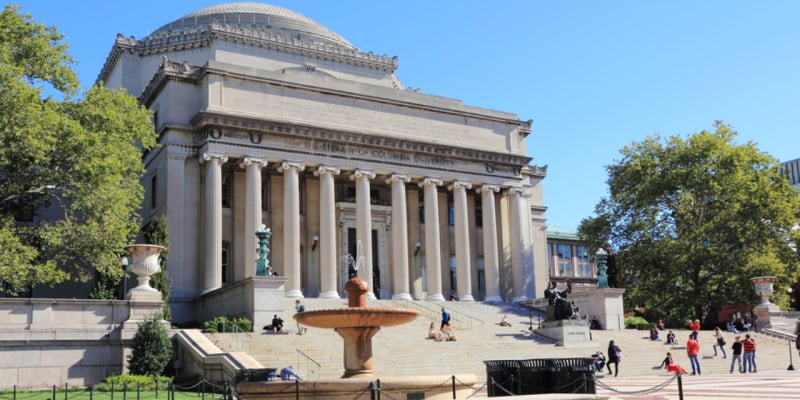
New York City has some of the best universities in the country, from world-famous private schools to more affordable public options. Studying here is exciting and full of opportunity, though it can also be pricey. Here's a quick look at some of New York's most popular universities and what student life is like in the city.
There are many reasons why you may choose New York as your education destination – but here are our top five:
Academic excellence: New York state is home to over 140 universities and colleges and the city itself has around 30. Options include extremely prestigious institutions like Columbia and Cornell. The city's diverse range of universities ensures you'll find the perfect fit for your academic pursuits.
Career prospects: With 43 Fortune 500 companies, a thriving startup ecosystem, and many internship and post-graduate employment options, New York presents unparalleled career opportunities. While competition can be fierce, possessing a degree from a local university opens doors to the city's professional landscape.
Global student community: In the 2024–25 academic year, about 115,800 international students studied at New York State institutions, that's a massive 16% of the student population. New York is undeniably a hub for students worldwide. This vibrant community fosters cross-cultural connections, enabling you to broaden your social circle with individuals from around the globe.
Diverse entertainment: From world-renowned museums, theatres, and art centers to top-notch restaurants and clubs, New York provides an endless array of recreational options. No matter your preference, the city ensures you'll always find activities to unwind and enjoy your downtime.
Unique life experience: Studying in the dynamic tapestry of New York offers an unparalleled life experience. The city's fusion of cultures, languages, religions, and people, coupled with abundant opportunities, creates an extraordinary environment that prepares you for the exciting journey into adulthood.
New York is home to some of the best universities in the world. The city's top-rated institutions are private universities and colleges, and this means that tuition rates can get very high. With that, most colleges have financial aid programs and specialized scholarships for students with outstanding academic achievements.
Here are some of the best private universities and colleges in New York.
Columbia University
Columbia University, established in 1754, is one of the Ivy League schools and has consistently ranked among the top 25 in global rankings as of 2025. It has a highly competitive acceptance rate of under 4%. The university, located in Manhattan, has a student body of approximately 32,000. Tuition for 2025–2026 is $70,170 per year.
Barnard College
Barnard College is a private all-women liberal arts college closely affiliated with Columbia University. Students at Barnard College can generally use Columbia University's facilities — and vice versa. If you graduate from Barnard College, your diploma will read, “Columbia University, Barnard College”. Some of the college's most popular majors include social sciences, biology, English language and literature, visual and performing arts, and psychology. The admission rate at Barnard College is 9%. Tuition and fees for Barnard College are $70 644 for 2025–2026.
New York University
New York University (NYU), founded in 1831, has branches worldwide and is less exclusive than Columbia, with an acceptance rate of about 13%. NYU has over 50,000 students and ranks among the world's top 50 universities. Undergraduate tuition for 2025–2026 is $65,622 per year.
Fordham University
Fordham is a Jesuit research university dating back to 1841. It was actually named after the Fordham neighborhood in the Bronx, where the university's original campus was located. Fordham's alumni include US senators, governors and ambassadors, royalty, Academy Award-winning actors, and even current US President Donald Trump. Fordham's undergraduate tuition and fees are $62,990 for 2024–2025.
The Juilliard School
The Juilliard School is a private conservatory for performing arts and is one of the hardest performing arts schools to get into, with an acceptance rate of about 7%. The tuition fees for 2025–2026 are around $55,500.
Manhattan College
Manhattan College, based in the Bronx, offers programs in business, arts, engineering, science, and education. Undergraduate tuition for full-time students in 2025–2026 is $50,400 per year.
The New School
The New School is another private university located in Greenwich Village. The New School was founded a century ago and is primarily focused on the arts, including music, theatre, and design. The Parsons School of Design, its branch dedicated to applied arts, is considered to be the best in the country in its field. Tuition and fees for 2025–2026 at The New School are $58,694.
Sarah Lawrence College
Sarah Lawrence College is a private liberal arts college in Yonkers, New York. The college is ranked #72 in National Liberal Arts Colleges. The college's campus is set in a suburban area, and over 80% of its undergraduate students live on campus. The college focuses its educational approach on one-on-one student-faculty tutorials (after the Oxford/Cambridge model). Tuition and fees for 2025–2026 are $86,522.
Get regular tips and advice to make the most of your expat life
Private universities in the wider New York State area
The private institutions we have mentioned above are located in New York City. However, several notable institutions within driving distance of New York should be considered as study options.
Cornell University is located in Ithaca, New York, and is one of the best institutions in the country. Cornell is consistently ranked in the global top 20 as of 2025 and has a selective acceptance rate. The university's best graduate schools are the SC Johnson Graduate School of Management, Law School, College of Engineering, and Weill Cornell Medical College. Its College of Veterinary Medicine is one of the top-ranked in the country, and the School of Hotel Administration is also highly rated. Cornell is located within a 4-hour drive from New York City, with regular buses departing from New York to Cornell twice daily. Tuition for most undergraduate colleges at Cornell in 2025–2026 is $71,266 per year.
Colgate University is a top-rated private university located in Hamilton, New York. It is a relatively small institution with about 3,200 undergraduate students. Some of the university's most in-demand majors include economics, political science, government and research, and psychology.
Hamilton College is a private liberal arts college founded in 1793. The college's campus is located in Clinton and is actually considered to be one of the most beautiful college campuses in New York State: it is set on a hilltop overlooking a picturesque village.
Public universities in New York
The City University of New York is a public university, and with over 240,000 students, it is the largest urban university in the country. It comprises 25 institutions, including six community colleges. CUNY undergraduate tuition for 2025–2026 is $7,410 per year for New York State residents, and $15,360 for out-of-state students, varying slightly by college.
Some branches of SUNY, the State University of New York, are also located in Manhattan, namely those dedicated to marine studies and optometry. CUNY and SUNY are two independent institutions, although they are funded by the state of New York.
Specialized institutions in New York
Regardless of your dream job or the field you like, you will find a school in New York that focuses on your field! The city has dozens of private institutions that specialize in different subjects.
For example, the New York Academy of Art, the Vaughn College of Aeronautics & Technology, the New York School of Interior Design, and the Manhattan School of Music.
When planning to study in the United States, securing a student visa is essential. Most full-time students apply for an F-1 visa to study at American universities or higher education institutions. Maintaining this visa requires full-time enrollment and good academic standing. F-1 visa holders can work on campus for up to 20 hours per week. Off-campus work requires an application to the USCIS.
Other options: The J-1 visa is intended for those on exchange, pursuing internships, research, or similar activities. It's valid only for the program's duration. M-1 visas are for technical or specialized study programs outside academic institutions. M-1 visa holders cannot work in the US.
Secure admission to your chosen program before applying for a student visa. The application process involves submitting your offer of study and other required information to USCIS. You will then have to have an in-person interview. Usually, students must prove they will have sufficient funds for tuition and living expenses throughout their study duration.
Preparing for university entry in New York: What you need to know
Entering a college or university in New York has varying requirements and acceptance rates across institutions. While prestigious private universities can be challenging to enter, community colleges often offer more accessible conditions. Here are the key requisites for applying to a New York university:
Academic excellence: Strong academic performance is crucial. Your high school diploma or undergraduate degree grades should align with the GPA expectations of your chosen university. If your GPA falls short of bachelor's program requirements, consider a pathway program — an opportunity to catch up on the American school curriculum and gain skills for higher education.
English proficiency: A solid grasp of the English language is vital. Most universities demand proof of English language proficiency if you're not from an English-speaking country. Typically, a TOEFL or IELTS test is required before application. Increasingly, Duolingo language testing is also accepted. If your English skills need improvement, consider taking a preparatory language course either at home or in New York.
Thorough research: Understand your chosen university's unique offerings, costs, and life in New York. Engage with international student forums to glean insights into city life. Many universities provide admissions counselors who guide you through the process and ease your transition upon arrival.
Once you are accepted into a New York university, you will have to address the accommodation issue that plagues all aspiring New Yorkers. As a student, you're going to be hunting for housing that suits your budget – and your level of study makes a difference, too.
Undergraduates or students without a bachelor's degree are more likely to live on campus or in dorms, whereas postgraduates generally live independently off campus.
When considering university accommodation in New York, it's essential to know the associated costs. The average cost of student housing in New York ranges from about $15,000 to $25,000 per year, depending on amenities and location. On-campus housing is in high demand, so always apply and request early. The exact price depends on factors such as the type of accommodation, location, and amenities offered. New York offers a variety of options, including on-campus dormitories, off-campus apartments, and shared living spaces. Depending on the university, there will usually be several types of housing on campus: shared rooms, single rooms with a kitchen, and international residences.
Of course, undergraduates can also live off-campus in a flatshare or other independent living situation. Universities generally have websites that can connect students with accommodation, and sites like Craigslist and Roommates.com are very helpful for finding shared houses and other living arrangements.
Your university campus will be a busy place with events, concerts, political groups, clubs, and activities tailored to students' interests happening all the time. This is especially true for those residing in university accommodations, where movie nights, sports tournaments, concerts, and many other activities keep students busy.
In the true American spirit, holidays and celebratory events are often marked in style. Halloween, St Patrick's Day, Gay Pride, Christmas, Valentine's Day, and big sporting events will all provide opportunities for costumes and parties (with drinking sometimes playing a large part in proceedings).
Students can also join clubs that cater to their passions. From choirs and outdoor education to badminton and poetry, many student organizations have sprouted up on American campuses, offering a platform for students to engage in their interests while finding like-minded peers. Amid academic pursuits, these clubs add excitement to student life and provide a good respite from academia.
Living in New York as an international student comes with expenses. On average, the cost of living can range from approximately $25,000 to $35,000 per year, encompassing accommodation, food, transportation, and personal expenses. While New York's cultural offerings are unmatched, it's essential to budget wisely and explore cost-saving measures. Making use of student discounts, exploring affordable dining options, cycling or taking public transport, and avoiding expensive hobbies can make sure you are sticking to a budget and keeping your head above water.
School fees
For expats and international students, most universities in New York (and the US generally) charge the higher "out-of-state" tuition rate, not the lower "in-state" rate. In-state tuition is only available to citizens or permanent residents who have lived in the state (and often the county or city) for at least a year.
To begin with, aspiring New York students need to know that registration and course fees are much more expensive at North American universities than in many European countries. For instance, the cost of tuition at the public State University of New York (SUNY) is around $18,000 for out-of-state students (and $8,000 for in-state), which is considered quite affordable. If you plan to study at a private university, be prepared for far higher costs — for example, the cost of tuition at Columbia University is currently around $70,000. Depending on your university, you may be eligible for scholarships that can help offset the high cost of living in New York.
Student discounts
New York is an expensive city where the cost of living is one of the highest in the world. If you want to participate in activities without draining your wallet, check out discounts for students; many shops, museums, and even restaurants provide student rates. There are many people with limited budgets living in New York, and it is possible to eat cheaply if you know where to look. For outings to bars, using happy hour can make a big difference to your bill. Great sources of student discount info include Student Beans and UNiDAYs.
Working while on a student visa
For expats studying in New York, understanding the regulations around employment on a student visa is crucial. On an F-1 visa, international students can work on campus for up to 20 hours a week during the academic year and full-time during breaks, which can be invaluable when faced with the high cost of living in the city.
Off-campus employment is not automatically allowed. F-1 students may only work off-campus after completing one academic year and must qualify for and receive separate authorization under specific programs such as Curricular Practical Training (CPT) or Optional Practical Training (OPT).
Maintaining a healthy balance between work and studies is important, and your job should not come at the cost of your academic success; however, having that income in New York can be necessary. Finding the right balance will look different for everyone, but your university should have international student advisors and financial advisers to help you figure out a budget.
We do our best to provide accurate and up to date information. However, if you have noticed any inaccuracies in this article, please let us know in the comments section below.