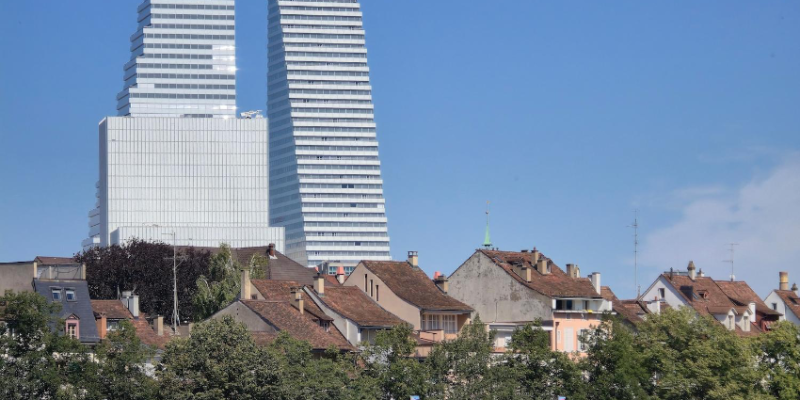
The first decisions that shape a career move to Basel are made before the job search properly begins: which sector to target, which campus to live near, and whether a work permit needs to be in place before an offer can be accepted. Basel'sjob market is organized around a concentrated cluster of pharmaceutical, biotech, and diagnostics employers rather than a generalist economy, which makes it unusually legible for candidates with the right profile and unusually narrow for those without one. Roche and Novartis together account for a significant share of private-sector professional employment, with the Bank for International Settlements adding a distinct international-finance niche near Basel SBB. Getting oriented early, well before arrival, is the practical advantage most successful expat job seekers share.
Life sciences is the gravitational center of employment in Basel.Pharmaceutical research and development, chemical manufacturing, diagnostics, and medtech form the city's dominant employer base, organized around distinct campus zones rather than a single business district. Understanding where those campuses sit, and what kinds of roles each concentrates, shapes not only your job search but also which neighborhoods make the most sense to live in.
The largest single employment site is the Roche campus along Grenzacherstrasse in Kleinbasel. Roche covers the full value chain from early research through production and marketing at this location, and the site is consolidating workplaces that were previously spread across the city. For anyone in research and development, manufacturing, quality assurance, data science, or advanced analytics targeting a large employer, the Wettstein and Grenzacherstrasse area is Basel's primary professional address in pharmaceuticals. Roche separates school-leaver, student, and graduate pathways from professional tracks on its careers portal, so it is worth checking which stream fits your profile before applying.
Just across the city in the St. Johann district, the Novartis Campus on Fabrikstrasse functions as both a corporate headquarters and a life-sciences innovation location. The Switzerland Innovation Park Basel Area maintains a presence on site, making the campus relevant for candidates at a range of career stages, from researchers to corporate affairs, legal, and digital functions. Job listings span a broad set of disciplines, and relocation support varies by role.
Tech Park Basel, located in the Kleinhüningen area on Hochbergerstrasse, serves a different type of candidate: those targeting smaller biotech, biopharmaceutical, and software-enabled life-sciences firms rather than established headquarters. The park hosts early-stage and scale-up companies, including biotech and pharmaceutical startups. Lonza also maintains a presence nearby at the Stücki Technology Park, making this northern Kleinbasel strip useful for candidates who prefer the pace of a smaller organization.
Rosental Mitte, currently developing on the Rhine's north bank, is emerging as a cluster for technology companies in chemistry and biotech. Its company directory already includes University of Basel units and established technology organizations, so candidates looking beyond Roche and Novartis should treat it as a serious secondary target rather than a speculative one.
Outside life sciences, the most concentrated employer in Basel is the Bank for International Settlements (BIS), whose offices sit at Aeschenplatz 1 near Basel SBB. The BIS is the primary target for candidates with macroeconomics, central-bank-facing, compliance, legal, or international-organization backgrounds; it is in effect Basel's equivalent of a central-bank or international-financial-institution employer, with a genuinely international workforce and recruiting culture. Roles here are narrower in volume than at the pharmaceutical campuses but represent a high-value niche for the right profile.
The Messe Basel and Rosentalanlage area hosts MCH Group's trade-fair and congress infrastructure. Employment tied to this area, in event management and hospitality-linked services, tends to follow fair and congress schedules rather than running as year-round office work, making it a different proposition from the pharma campuses or BIS.
The most direct route into Basel'slife sciences job market is through employer career portals. Roche Careers Basel/Kaiseraugst lists roles across research and development, manufacturing and supply, quality, digital, and data science with postings available in English; German matters mainly for apprenticeships and local-facing positions. Novartis Career Search lists Basel roles in R&D, quality, finance, biomedical research, data, legal, and trainee functions, with listings updated regularly. Both portals have candidate-specific entry points for students and graduates as well as experienced professionals, so check each track individually. LinkedIn is widely used by recruiters at both companies, and English-language profiles and applications are standard across their corporate and scientific functions.
For broader market coverage, the Swiss public employment portal Job-Room is accessible through the Basel-Stadt jobs page and lists vacancies subject to Switzerland's job-registration rules. It is most useful for candidates already in Switzerland or holding valid work authorization. The regional platform jobbasel.ch focuses on the Basel employment area and gives a clearer picture of local employer demand beyond the largest multinationals; it is most practical for applicants comfortable searching in German.
Public-sector roles appear on the Arbeitgeber Basel-Stadt Stellenmarkt, covering cantonal administration, education, justice, social services, finance, public safety, culture, and technical services. Filters by workload, department, and contract type make the portal easy to navigate, though most roles and the portal itself operate in German, which limits its accessibility as a first channel for candidates without solid German.
Staffing agencies are a realistic and well-populated channel for Basel's market. Hays Switzerland is strong across life sciences, pharmaceutical research, medical-device development, engineering, IT, finance, and project-based specialist roles, with listings in both English and German depending on the client. Randstad Basel-Stadt places candidates across pharmaceuticals, biotechnology, operational production, cleaning, hospitality, construction, security, and technical facilities, offering temporary, permanent, and temporary-to-permanent contracts. The Adecco Group covers life sciences, industry and technology, medical permanent placement, and office and administration in Basel. Manpower Basel also lists medical, chemistry, life-sciences, laboratory, and temporary roles, including care and technical positions.
A standard international CV format and a targeted, evidence-based cover letter are expected in Swiss recruitment. Describe what you delivered rather than listing responsibilities, and tailor each application to the employer rather than sending a generic document. Plan for a job search horizon of several months if you are applying from outside Switzerland, particularly if you are targeting a narrow niche or lack German. Temporary and contract roles, which appear regularly in pharma and operational functions through agency listings, are a practical entry point that can convert to permanent employment once you have local references.
Non-EU/EFTA nationals need a work permit tied to a specific job offer before taking up employment in Basel. Employer sponsorship is a prerequisite, not an afterthought, so confirm a prospective employer's willingness to sponsor before investing heavily in a long application process.
Join the Basel community
Get regular tips and advice to make the most of your expat life
Salaries and benefits in Basel
The best tool for benchmarking any offer is Salarium, the Swiss federal salary calculator built on the national Earnings Structure Survey. It lets you filter by region (including Basel), occupation, age, education level, and responsibility, making it the most reliable reference for checking whether a gross salary figure aligns with the market. Use it before accepting any offer.
The floor for employment in Basel-Stadt is the cantonal minimum wage of CHF 22.20 (USD 27.31) per hour. On a standard 42-hour week, that floor corresponds to roughly CHF 4,040 (USD 4,970) gross per month before tax, social deductions, and health insurance. In practice, specialist roles in pharmaceuticals, life sciences, IT, finance, and advanced engineering sit substantially above that floor; candidates entering at research, quality, data, regulatory, or corporate functions within established multinational employers should expect compensation well above cantonal minimums.
Swiss salaries are paid monthly. Before comparing two offers, confirm whether a 13th-month salary, annual bonus, or salary review cycle is included in the quoted gross annual figure. A 13th month is not required by law; it applies only if the contract or a collective agreement stipulates it. Similarly, Swiss salary statistics sometimes incorporate a portion of special payments into standardized monthly gross measures, so the headline figure and the regular monthly payment can differ.
Statutory minimum annual leave is 4 weeks (20 working days on a standard 5-day week) for employees over 20; workers aged 20 or under receive at least 5 weeks. Many employers in Basel's professional sectors exceed the statutory minimum. Basel-Stadt observes 9 statutory public holidays per year: New Year's Day, Good Friday, Easter Monday, Labor Day, Ascension Day, Whit Monday, Swiss National Day, Christmas Day, and St. Stephen's Day.
Employee social-security deductions total at least 6.40% of gross salary: 5.30% for the AHV/IV/EO (state old-age, disability, and loss-of-earnings insurance) and 1.10% for unemployment insurance on salary up to CHF 148,200 (USD 182,300) per year. Occupational pension (second pillar) and non-occupational accident insurance add further deductions that vary by employer and pension fund.
The Swiss pension system operates across three pillars. The first pillar (AHV) is state-run and contribution-based. The second pillar (BVG, the occupational pension) is employer-arranged and mandatory above an earnings threshold; employer contribution rates vary, and checking what percentage your prospective employer contributes to the second pillar is a meaningful part of comparing offers, not a detail to overlook. The third pillar is voluntary private savings. This structure differs from many employer-sponsored schemes expats may be familiar with from their home countries, so it pays to understand it before evaluating compensation packages.
Mandatory health insurance is not an employer benefit in Switzerland. Every resident arranges and pays for their own policy individually. This is a significant recurring cost that must be budgeted separately; job offers that appear strong on gross salary often look different once this expense is factored in alongside deductions.
Statutory maternity leave runs for at least 14 weeks after birth, compensated through the Swiss income-compensation system at 80% of average prior income, capped at CHF 220 (USD 271) per day. Paternity leave is 2 weeks (10 working days), to be taken within 6 months of the child's birth, compensated at the same 80% rate and daily cap. Sick-leave protection has no fixed statutory number of days; if an employee cannot work through no fault of their own, salary continuation depends on length of service, contract terms, and any applicable collective agreement. Daily sickness-benefit insurance is not legally mandatory but is often included in employment contracts, so check each offer for this cover.
Statutory notice periods for indefinite private-sector contracts are: 7 days during probation; 1 month in the first year of service; 2 months from the second to ninth year; and 3 months from the tenth year onward. Contracts and collective agreements may set longer periods. Basel-Stadt as a public employer publishes its employment conditions and salary tables openly, allowing transparent comparison; the canton offers 16 weeks of maternity leave and 20 days of paternity or same-sex-partner leave, and the University Hospital Basel pays in 13 monthly installments with above-average pension contributions.
Work culture in Basel
Full-time working hours in Basel run between 40 and 42.5 hours per week, a longer standard working week than many expats from countries where 37.5 hours is the norm. Adjusting expectations around weekly hours is one of the more concrete practical differences newcomers encounter, particularly in the first few months.
Punctuality is a baseline professional expectation, not a courtesy. Arriving on time for meetings, interviews, and the start of the workday signals reliability; arriving late without advance notice is difficult to recover from quickly, especially early in a role. The same expectation extends to delivering on commitments: confirm verbal agreements in writing, meet deadlines exactly as stated, and keep meetings concise. Brevity in written communication is the expected register, not a sign of coldness.
Management style in large Basel companies and public institutions tends to be process-conscious and evidence-based, with clearly defined responsibilities, documented working-time rules, and formal sign-off procedures. Research and university-adjacent teams often give employees significant autonomy over how they organize their tasks, but they still expect clear role ownership and reliable delivery. The practical implication for new arrivals: ask in your first week how working time is recorded, how overtime is handled, and how home-office days are scheduled, rather than assuming informal arrangements.
Hybrid and remote work exist across office-based, university, and knowledge-sector roles, but they are employer-governed, not automatic entitlements. The University of Basel states that home-office work should not exceed 40% of contractual hours for employees resident in Switzerland. Cross-border workers may have different arrangements, but tax and social-security implications for home-office work from another country need separate verification. Clarify both the percentage of remote work permitted and your residential status before accepting an offer, since the two interact.
Dress expectations are business casual for most office environments. Interviews, client-facing work, finance, legal, and senior corporate settings call for more formal dress; research, technology, and laboratory-adjacent teams are typically more relaxed once you are employed. The broader point is that local and international employers in Basel differ in language and cultural feel, but both operate inside Swiss workplace norms around reliability and role clarity. Working for an English-language employer does not mean informal expectations around processes and deadlines.
Trust is built through consistency: follow through on agreed actions exactly, respect colleagues' time, and let informal relationships develop gradually through repeated professional contact rather than trying to accelerate social bonding before establishing a professional track record. Probation periods run up to three months (or longer by agreement), giving both sides a structured period in which first impressions accumulate quickly.
Getting to work in Basel
The average one-way commutefor Basel residents is around 26 minutes, reflecting a compact city where most employment is reachable by foot, bicycle, or a short tram ride. Where you choose to live relative to your workplace makes a measurable difference: workers based inside Basel benefit from short, low-friction daily journeys, while those commuting in from surrounding municipalities or cross-border add significantly more time.
Matching your neighborhood to your workplace campus is the most practical approach. Workers at the Roche campus find the shortest commutes in Wettstein, Breite, Clara, and Matthäus, which minimize Rhine-crossing and reduce tram dependence. Novartis Campus employees at St. Johann find the most direct options in St. Johann, Volta, and Kannenfeld. The Tech Park Basel and Stücki area suits candidates living in Kleinhüningen or Klybeck, though this trades some distance from Basel SBB and central amenities. Rosental Mitte and Messe-area workers travel well from Clara, Matthäus, Wettstein, and Rosental. For the BIS and Aeschenplatz cluster, central Grossbasel, St. Alban, Gundeldingen, and Breite are the most practical choices, all offering walkable office commutes and direct rail access.
Residents make 42% of their daily trips on foot and 21% by bicycle, with public transport at 16% and car or motorcycle at 20%. For workers commuting in from outside Basel, public transport is the dominant mode at 56%, followed by car at 31% and cycling at 13%. This resident mode split reflects a city built for active mobility: terrain is flat, routes are well-maintained, and cycling is a genuine primary commute option rather than a recreational activity. Test your specific route before committing to a daily cycle commute, paying attention to tram corridors and busier junctions.
Rush hour is manageable but noticeably busier around main rail and tram interchanges, with the morning peak running roughly from 07:00 to 08:00. Travel times for both public transport and motor traffic increased between 2022 and 2024, so add buffer time at Basel SBB and central transfer points on interview days or early-start mornings. Basel has three railway stations: Basel SBB, Basel Bad Bf, and Basel Badischer Bahnhof, which together give the city strong regional and cross-border rail connections. The tram and bus network is operated by BVB (Basler Verkehrs-Betriebe) and integrates with regional rail services. For regular travel within Switzerland, the GA (Generalabonnement) offers unlimited national public transport travel; the Halbtax (half-fare card) gives 50% off individual tickets and suits those who travel frequently but not daily on long-distance routes.
Starting car-free is the practical default for newcomers whose workplace is inside Basel. The resident mode split shows walking and cycling comfortably ahead of car use, and the three-station rail network covers most regional commuting needs. Car ownership becomes more relevant for frequent intercantonal travel or commuting routes that are poorly served by trams and buses.
Frequently asked questions
Basel's job market is specialized and competitive, strongest for candidates in life sciences, pharmaceuticals, chemistry, diagnostics, research, insurance, and finance. Competition is highest for generalist office roles; candidates with regulated, scientific, or technical profiles who already hold Swiss or EU/EFTA work eligibility have a significantly better chance of finding relevant openings. German is a practical advantage outside English-speaking multinational environments. Non-EU/EFTA nationals need a work permit tied to a specific job offer before starting employment, so securing employer sponsorship is a prerequisite.
The core industries are life sciences, pharmaceuticals, chemicals, and diagnostics, supported by university and applied-research institutions. Insurance forms a major part of the local financial sector, and digital transformation is increasingly important in both life sciences and insurance. Expats with pharma, biotech, regulatory, clinical, data, or insurance-technology profiles will find the most relevant openings, while generalist office candidates face significantly stronger competition.
Employment in Basel is organized around campus zones rather than a single central business district. The main areas are the Roche campus near Wettstein and Grenzacherstrasse, the Novartis Campus in St. Johann, Tech Park Basel in Kleinhüningen, Rosental Mitte for chemistry and biotech, and Aeschenplatz for the Bank for International Settlements and professional services. Public-sector roles are handled through the Basel-Stadt cantonal administration rather than a geographically distinct district.
The largest private-sector employers for expats are Roche and Novartis, which together dominate the life-sciences landscape. Other significant employers include the Bank for International Settlements, the University of Basel, University Hospital Basel, and major insurance and logistics firms. Basel-Stadt itself is a substantial public employer with openly published salary tables and employment conditions, making it easier to compare offers transparently.
Start with the direct careers portals of Basel's major employers: Roche Careers and Novartis Career Search list roles across research, quality, digital, and corporate functions. Swiss and regional platforms such as Job-Room and jobbasel.ch broaden coverage, and specialist agencies including Hays, Randstad, Adecco, and Manpower place candidates in pharma, life sciences, and operational roles. LinkedIn is widely used by Basel-based multinationals and recruiters, and English-language profiles and applications are standard at the city's large pharmaceutical employers and international agencies. Plan for a search horizon of several months if applying from outside Switzerland, and ensure employer-sponsored work authorization is secured before accepting an offer.
The cantonal minimum wage in Basel-Stadt is CHF 22.20 per hour, but specialist roles in pharmaceuticals, life sciences, IT, finance, and engineering sit substantially above this floor. Use the free federal Salarium calculator to benchmark by occupation, experience level, and region before evaluating an offer. When comparing packages, confirm whether a 13th-month salary or annual bonus is included in the quoted gross annual figure, and budget separately for mandatory health insurance, which every resident arranges and pays for individually rather than receiving as an employer benefit.
Expect a structured, punctual, and process-conscious environment where communication is direct and task-focused. Large multinationals such as Roche and Novartis operate in English and feel internationally oriented, but still follow Swiss workplace norms around reliability, working-time compliance, and clear role ownership. German remains important in local administration, smaller employers, and client-facing roles even within predominantly English-language organizations. Trust is built through consistent delivery and punctuality rather than social bonding, so lead with what you do and follow through on every commitment.
The average one-way commute for residents is around 26 minutes. Residents travel primarily on foot (42% of trips) and by bicycle (21%), with public transport accounting for 16%; for those commuting in from outside Basel, public transport handles 56% of inbound journeys. Living inside the city generally means a short, low-friction commute, while commuting from further out requires reliable rail or tram access to your specific workplace. Starting car-free is the practical choice for most workers based inside the city.
Hybrid work exists across office-based and knowledge-sector roles, but it is employer-governed rather than an automatic entitlement. The University of Basel, for example, caps home office at 40% of contractual hours for Switzerland-resident employees. Cross-border workers may have access to home-office arrangements, but the tax and social-security consequences depend on individual circumstances and need separate verification. Clarify remote-work terms, working-time recording practices, and your residential situation with the employer before accepting any offer.
Yes, but public-sector roles are more language- and eligibility-sensitive than multinational private-sector positions. Most roles require German, and some require Swiss-specific qualifications, making them significantly harder to access for English-only candidates. Expats with German-language skills and specialist profiles in IT, data governance, health, education, or engineering are best positioned. The Basel-Stadt Arbeitgeber Stellenmarkt publishes all open cantonal positions with filters for department, workload, and contract type, enabling straightforward searching.
ℹ️
We do our best to provide accurate and up to date information. However, if you have noticed any inaccuracies in this article, please let us know in the comments section below.
I fell in love with words at an early age After a break to focus on my studies, I rediscovered the joy of writing while keeping a blog during my years between London and Madrid. This passion for storytelling and for exploring new cultures naturally inspired me to create Expat.com, a space for my own reflections as well as for anyone wishing to share their experiences and journeys abroad.