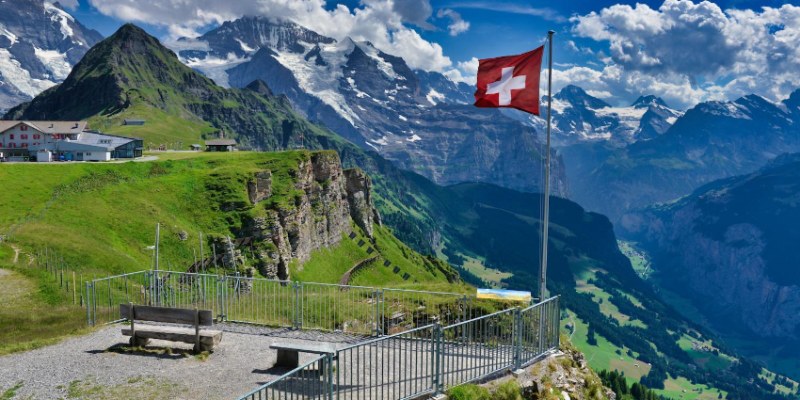
Switzerland naturalizes foreign residents through one of the longest ordinary residency requirements in Europe: 10 years, with at least 3 of them in the 5 years before applying, plus a settlement permit C and proof of integration that goes well beyond a language certificate. For anyone who has already built a life there, whether through years of residence, a Swiss spouse, or a Swiss parent, the practical question is less about eligibility on paper and more about what citizenship actually changes day to day, since a C permit already secures work, healthcare, and schooling on equal terms. What sets Switzerland apart is its dual nationality policy: Swiss law imposes no renunciation requirement at all, which shifts the real risk entirely onto the applicant's country of origin and its own rules on keeping or losing a first passport.
Citizenship vs. permanent residency in Switzerland
A foreign national who has spent enough years in Switzerland to hold the settlement permit C already has most of what daily life requires: unrestricted access to the labor market, the same compulsory health insurance rules as everyone else, and children enrolled in the same cantonal school system as their Swiss classmates. Old-age and survivors' insurance and other major social-insurance schemes are residence- and employment-based, so citizens and settled foreign residents are covered under the same conditions once they meet the requirements. What Swiss citizenship adds sits almost entirely in the political and administrative layer, not the everyday one.
Only Swiss citizens aged 18 or older can vote at the federal level and launch or sign federal referendums and initiatives; a C permit gives no federal voting rights, although some cantons and communes allow foreign residents limited local voting. Only citizens can hold a Swiss passport and identity card, since a residence permit is an immigration status, not a nationality-linked travel document. The practical gap widens further with mobility: citizenship carries an unconditional right to remain in the country, while a C permit can lapse after six months of continuous absence unless a suspension is arranged in advance, and even an approved suspension is capped at four years. This distinction closely resembles what many readers already know from the United Kingdom, where Indefinite Leave to Remain secures permanent residence and full work rights, but only naturalization adds a British passport and the vote; the split between a Swiss C permit and Swiss federal citizenship works the same way.
Citizens abroad can also register with a Swiss consular representation for protection and services; a permanent resident who is not Swiss remains a national of another country and depends on that country's own consular network instead. A handful of public functions require federal political rights or Swiss nationality outright, something a C permit alone does not open up. None of this means naturalization is a strict upgrade in every dimension: a C permit already grants residence for an unlimited period and stable labor-market access comparable, in daily working life, to what a citizen has.
Citizenship is not necessarily permanent once granted, either. A completed naturalization can still be annulled for false statements or concealment of essential facts for up to eight years after it becomes final; after an annulment, a new application can be filed only after a two-year wait. A dual national can also be stripped of Swiss citizenship if their conduct seriously harms Switzerland's interests or reputation, with war crimes or terrorism convictions given as example grounds. Since 1992, Swiss law has allowed dual and multiple nationality without restriction, so naturalization does not by itself require giving up an existing nationality; whether it is retained depends on that other country's rules. Weighed together, citizenship suits residents who want federal political rights, a Swiss passport, an unconditional right to remain, and a status they can pass on to their children; a C permit may suit those who want stable residence and work rights without the added integration scrutiny, cantonal residence requirements, fees, and nationality questions that come with naturalizing.
Ordinary naturalization through residency is the route almost every foreign resident will use, since it is open to anyone who has lived in the country long enough. Descent and marriage offer separate, faster tracks, but only for people who already have a Swiss parent or spouse.
Naturalization through residency requires at least 10 years of residence in Switzerland, including 3 years within the 5 years before applying, and a settlement permit C. Federal fees run CHF 100 (about USD 125) for an adult, CHF 150 (about USD 185) for spouses applying jointly, and CHF 50 (about USD 62) for a minor; cantonal and communal fees come on top.
Citizenship by descent (ius sanguinis) is acquired automatically at birth through a Swiss mother or father and does not require a naturalization procedure at all. Being born on Swiss territory does not confer citizenship by itself; what matters is having a Swiss parent, not the place of birth.
Citizenship by marriage works through a distinct facilitated-naturalization route open to the foreign spouse of a Swiss citizen, with a shorter residency requirement than the ordinary route.
Reacquisition is available to people who previously lost Swiss citizenship. For an applicant living in Switzerland, the fee is CHF 900 (about USD 1,107), or CHF 650 (about USD 800) for a minor filing independently; for an applicant living abroad, it is CHF 600 (about USD 738), or CHF 350 (about USD 431) for a minor filing independently. These fees are paid in advance and are not refunded if the application is refused.
Facilitated naturalization, the federal route used for spouses of Swiss citizens and certain descent-based cases, moves faster than the ordinary procedure but still applies integration, public-order, constitutional-values, and security conditions. Ordinary naturalization is filed with the commune or canton of residence, which reviews the file and forwards it, with a report, to the State Secretariat for Migration (SEM) for federal authorization, after which the cantonal authority issues the final decision. Facilitated naturalization and reacquisition, by contrast, are handled directly by SEM, with Swiss representations abroad managing the consular stage for applicants living outside the country.
Join the Switzerland community
Get regular tips and advice to make the most of your expat life
Naturalization through residency in Switzerland
The 10-year residence figure quoted everywhere is not a single countdown; it depends on permit type, cantonal add-ons, and a set of integration checks that run in parallel. Ordinary naturalization requires 10 years of residence in Switzerland and a settlement permit C, though years lived in the country between ages 8 and 18 count double. Even with that double counting, applicants must still have actually lived in Switzerland for at least 6 years. Within that 10-year window, 3 years must fall in the 5 years immediately before filing, and cantonal law adds a further minimum local residence period, typically 2 to 5 years in the specific commune and canton.
Not every residence permit counts equally toward the 10 years. Time on a B permit or C permit counts in full, as does time held under an FDFA legitimation card or a Ci permit. Time on an F permit counts at half value, while time under an N permit (asylum procedure) or a short-stay L permit does not count toward naturalization at all.
Beyond the residence clock, applicants must meet a set of substantive conditions:
Participation in economic life or in education and training.
No social assistance received in the 3 years before filing, unless it has been fully repaid.
No outstanding debt-enforcement proceedings, certificates of loss, or unpaid taxes.
Respect for public security and order; a criminal-record entry or pending proceedings are, in principle, an obstacle, and SEM suspends the procedure while a criminal case is pending.
Ability to communicate in everyday life in a Swiss national language, at minimum B1 oral and A2 written.
Familiarity with Swiss living conditions, including basic knowledge of geography, history, politics and society, participation in social and cultural life, and contacts with Swiss people.
These add up to what Swiss law calls "successful integration," a standard combining language ability, respect for public order, respect for constitutional values, economic or educational participation, and support for family members' integration; cantons may layer on further criteria of their own. Switzerland does not require applicants to renounce their original citizenship to naturalize; whether they keep it depends on the applicant's country of origin, not on Swiss law.
Procedurally, the commune and canton of residence examine the application first and prepare a naturalization report. If the canton, and where required the commune, supports the file, it moves to SEM for federal authorization, and the cantonal authority then makes the final decision within one year of that authorization. The applicant obtains the form from, and submits it to, the competent authority at their place of residence, since the local procedure runs under cantonal law.
Good to know:
Double-counting years lived between ages 8 and 18 can meaningfully shorten the effective wait for people who arrived as children or teenagers, but it never removes the 6-year floor of actual physical residence.
Citizenship by descent in Switzerland
Citizenship by descent through a Swiss parent is the most common way people acquire Swiss nationality, and it happens automatically at birth without any naturalization procedure. A child of married parents becomes Swiss automatically if either parent is Swiss, and the same applies to a child of an unmarried Swiss mother. For a minor child of an unmarried Swiss father and a foreign mother, citizenship follows once the legal parent-child link to the father is established, either through recognition before the child turns 18 or through a court judgment establishing paternity.
There is no general entitlement to Swiss citizenship simply because a grandparent, or a more distant relative, was Swiss. Current routes cover descent through a parent, plus specific simplified-naturalization cases for children who did not acquire citizenship automatically, including certain older cases involving a Swiss mother and children born before January 1, 2006, to an unmarried Swiss father. Anyone building a citizenship case on a Swiss grandparent should expect no automatic entitlement and should instead identify whether one of these narrower, defined routes applies.
A child born abroad to a Swiss parent who also holds another nationality loses Swiss citizenship at age 25 unless, before that birthday, the birth is reported to a Swiss authority, the person reports themselves, or they declare in writing their wish to keep Swiss citizenship. Anyone who previously lost Swiss citizenship this way, or through other circumstances, can apply for reinstatement through a Swiss representation abroad within 10 years of the loss, provided they can show close links with Switzerland.
Foreign children of a naturalized Swiss parent who did not acquire citizenship automatically must apply for simplified naturalization before their 22nd birthday, showing 5 years of total residence in Switzerland, including the 3 years immediately before applying. Children of a Swiss mother or a qualifying Swiss father under the separate descendant route must show successful integration if resident in Switzerland, or close links with Switzerland if resident abroad.
Citizenship by marriage in Switzerland
Marrying a Swiss citizen shortens the residency clock considerably, from 10 years down to 5, but it does not bypass the integration and public-order checks used in ordinary naturalization. This route, called facilitated naturalization, is a naturalization procedure with its own conditions, not an automatic grant of citizenship or residence.
For a spouse living in Switzerland, the requirement is 3 years of marital union with the Swiss spouse and 5 years of total residence in Switzerland, including the year immediately before applying. For a spouse living abroad, the bar is higher: 6 years of marital union plus demonstrated close ties with Switzerland. Applicants in Switzerland must show B1 oral and A2 written ability in a national language, while applicants abroad only need to demonstrate oral communication ability as part of proving close ties.
The same integration conditions used in ordinary naturalization apply here too: no social assistance in the 3 years before applying unless fully repaid, no tax arrears, no debt-enforcement proceedings or unpaid-debt certificates, and no criminal-record entries. Facilitated naturalization through marriage also requires a real, stable marital union at the same address, with no intention to separate or divorce; if that shared life no longer exists, the conditions are not met even if the marriage remains legally valid on paper. The application is excluded outright if both spouses were foreign nationals at the time of marriage and one later became Swiss only through ordinary naturalization, or if the Swiss spouse died before the application was submitted.
Dual citizenship policy in Switzerland
Switzerland removes its own side of this question almost entirely: Swiss law allows dual and multiple nationalitieswithout restriction, whether citizenship is acquired by naturalization, descent, or marriage. People who become Swiss by naturalization do not have to renounce their previous nationality, and Swiss citizens who later acquire another nationality abroad do not lose Swiss citizenship under Swiss law.
The real compliance work sits with the applicant's country of origin, not with Switzerland. Some countries' laws cause automatic loss of the original nationality the moment a person voluntarily acquires another one; Swiss authorities cannot advise on this, since it depends entirely on foreign law. This must be checked directly with the country of origin's own competent authority before applying for Swiss citizenship. Swiss citizens who acquire another nationality without triggering renunciation requirements from that other country keep both; those registered with a Swiss representation abroad are expected to report the new citizenship to it.
Military-service obligations for dual nationals are generally decided by domicile at the time of recruitment, and consular protection can be more limited for dual nationals: Swiss consular protection in the country of a person's other nationality may only be available if that state does not oppose it.
The United States does not require a citizen to choose between passports, and naturalizing abroad does not put U.S. citizenship at risk unless done voluntarily with the intent to give it up. The United Kingdom permits dual citizenship without restriction. Canada's immigration authority confirms that a person can hold Canadian and another citizenship simultaneously. Australia's foreign affairs department provides only limited consular assistance to dual nationals while they are in the country of their other nationality. Irish citizen registration formally recognizes "dual citizen" status. South Africa is the outlier among these: adult citizens must obtain prior permission to retain South African citizenship before acquiring a foreign one, or they lose it automatically. None of these rules are set by Switzerland; each must be confirmed with the relevant country's own authority.
Citizenship test and language requirements in Switzerland
The federal minimum looks modest on paper, B1 oral and A2 written in a Swiss national language under the Common European Framework of Reference, but proving it is stricter than the numbers suggest, and cantons may set the bar higher still. Only certificates on SEM's official list of recognized language certificates count as proof; course-attendance confirmations and online placement tests are not accepted. Proof is also accepted without a certificate for applicants who speak and write a Swiss national language as a mother tongue, who completed at least 5 years of compulsory schooling in a Swiss national language, or who completed upper-secondary or tertiary education in one.
Language proof is normally documentary, and a separate personal interview assesses "familiarity with Swiss living conditions": basic knowledge of geography, history, politics, and society; participation in social and cultural life; and contacts with Swiss people. This interview is not a substitute for the language certificate; both are required.
Applicants with a disability, illness, or major learning, reading, or writing difficulties that make language proof or economic participation impossible or very difficult can have this taken into account, provided they submit confirmation from a medical specialist or comparable documentation. The competent authority decides how much weight to give it. Taken together, the federal baseline is not automatic in practice: applicants need both a documented language certificate and a successful integration interview, and local rules can raise the threshold further.
Application process for citizenship in Switzerland
Ordinary naturalization moves through three separate reviewing authorities in a specific order, and the file is examined twice at the cantonal level before the federal government even weighs in. The process breaks down into the following steps:
Confirm eligibility: 10 years of Swiss residence (3 within the last 5 years), a settlement permit C, and the additional cantonal or communal residence period.
Obtain the application form and document checklist from the competent authority at the commune or canton of residence, since the local requirements follow cantonal law.
Complete the language requirement: a certificate from SEM's recognized list, or documented mother-tongue or schooling equivalence, proving at least B1 oral and A2 written ability.
Attend the cantonal integration interview covering familiarity with Swiss living conditions; some cantons or communes add local knowledge checks.
Submit the completed application to the commune or canton of residence.
The cantonal authority examines formal requirements, integration, and familiarity with Swiss living conditions, and prepares a naturalization report.
If the canton, and commune where required, supports the application, the file and report go to SEM, and the federal fee is paid: CHF 100 (about USD 125) for an adult, CHF 150 (about USD 185) for spouses applying jointly, or CHF 50 (about USD 62) for a minor.
SEM issues the federal naturalization authorization once federal formal and substantive conditions are met.
The cantonal authority must issue the final decision within one year of that authorization, after which the authorization expires; the canton can still refuse if new facts emerge that would have blocked the federal authorization.
In cantons that require it, such as Geneva and Vaud, the applicant attends an oath-taking ceremony that closes the procedure and, for adults, fixes the date Swiss nationality is acquired.
Once naturalization is final, the new citizen applies for a Swiss passport and/or identity card.
Legal advice is most useful in cases with a complex residence history, a criminal-record issue, a social-assistance repayment question, a debt-enforcement problem, a disputed integration assessment, or a dual-nationality or renunciation concern tied to the applicant's home country. SEM's ordinary naturalization page and citizenship FAQ, its language-requirements page listing recognized certificates, and the Federal Department of Foreign Affairs' dual-citizenship guidance are the primary official references for the entire process.
Processing times and fees in Switzerland
The federal fees are fixed and modest, but they are only one layer of the cost: cantonal and communal fees are set locally under cantonal law and are not published centrally. For ordinary naturalization, the federal fee is CHF 100 (about USD 125) for an adult, CHF 150 (about USD 185) for spouses applying jointly, and CHF 50 (about USD 62) for a minor. For facilitated-naturalization or reinstatement cases handled from abroad, additional costs can include representation fees billed by time spent, civil-status authority fees for verifying foreign documents, and certified translation for documents not already issued in German, French, or Italian.
Timing is the least predictable part of the process. The only firmly published deadline is that the competent cantonal authority must issue its naturalization decision within one year after SEM grants the federal authorization; otherwise, the authorization expires. No total end-to-end duration for the full commune-canton-federal process is published, because cost and timing vary by canton, given that the file runs through three separate examination stages with locally set fees and procedures.
For facilitated naturalization or reinstatement handled abroad, the Swiss representation typically sends its investigation report to SEM within 12 months, and SEM typically decides within a further 12 months of receiving the complete file. During that period, applicants must report any change of address or civil-status event, including marriage, separation, divorce, birth, death, or adoption, to the competent Swiss representation while the application is pending.
Rights and benefits of citizenship in Switzerland
Beyond the widely cited passport ranking, Swiss citizenship adds concrete benefits over a settlement permit C: federal political rights, consular protection abroad, an unconditional right to remain, and freedom from periodic permit renewal. The Swiss passport ranked 3rd in the Henley Passport Index, offering visa-free or visa-on-arrival access to 186 destinations; a standard adult passport issued in Switzerland costs CHF 140 (about USD 172) plus CHF 5 (about USD 6) postage.
Citizens aged 18 or older living in Switzerland can vote at federal, cantonal, and communal levels, and can launch or sign federal referendums and initiatives; those living abroad can vote at the federal level once registered through a Swiss representation, and some cantons also allow cantonal or communal voting for citizens abroad. Federal political rights also include standing in National Council elections, something no residence permit, however long-standing, opens up.
Parents of a child born abroad who want to secure Swiss nationality permanently should register the birth with a Swiss embassy or consulate, or with the civil register office of the Swiss place of origin. Switzerland is not part of the European Union, MERCOSUR, or the Commonwealth, so Swiss citizenship does not create EU, MERCOSUR, or Commonwealth citizenship rights alongside it; the Swiss passport's strong ranking stands on its own, without any supranational travel or work layer attached.
Citizenship ceremony and oath in Switzerland
Several cantons close ordinary naturalization with a mandatory oath that also fixes the legal date of acquiring Swiss nationality for adults. In Vaud, the applicant takes an oath at a ceremony organized by the canton, at which point Swiss nationality is acquired. In Geneva, adult candidates acquire Swiss nationality on the date of the oath-taking ceremony, while minors acquire it on the date of the Council of State's naturalization order.
Geneva's procedure runs a final check of the criminal record and financial independence after the commune's opinion and the federal authorization are received; if that check is validated, the Council of State issues an admission order, and adult candidates then take the oath at an official ceremony that closes the process. About 14 days after the oath, the new citizen can order a Swiss passport or identity card, and cantonal administrations are informed of the new citizenship within about 10 working days of acquisition. Geneva also issues a certificate of Geneva citizenship right for CHF 30 (about USD 37), sent by post within 10 working days of the request.
Naturalization triggers a set of follow-up actions, almost none of which happen automatically. New citizens can apply for a Swiss passport and identity card online, by phone, or at a cantonal passport office; those resident abroad apply online and then attend a Swiss representation for biometric data capture, including a facial image, signature, and fingerprints for a passport. Delivery takes up to 10 working days within Switzerland or 30 working days abroad after approval.
Adult passports and identity cards are valid for 10 years, while documents for people under 18 are valid for 5 years, and neither can be renewed by simple extension; a new application is always required. In Switzerland, an adult passport costs CHF 140 (about USD 172) plus CHF 5 (about USD 6) postage, an adult identity card CHF 65 (about USD 80) plus CHF 5 (about USD 6) postage, and a combined passport and identity card CHF 148 (about USD 182) plus CHF 10 (about USD 12) postage. Starting in November 2026, citizens can also request a new biometric identity card; existing non-biometric cards remain valid until their printed expiry date, subject to acceptance by the destination country.
Once naturalized, Switzerland itself places no further nationality requirement on the new citizen, but dual nationals should be aware of what the other side of their citizenship demands in practice. In the United States, dual nationals remain bound by U.S. tax law and must use a U.S. passport to enter and leave the country, and may also be liable for military service in their other country of nationality. The United Kingdom permits dual citizenship, but its Foreign, Commonwealth and Development Office offers only limited consular support to British dual nationals in the country of their other nationality, including in cases of compulsory military service there. Canada's immigration authority confirms that a person can be both Canadian and a citizen of another country without conflict. Australia's foreign affairs department provides consular help to dual nationals in the country of their other nationality only in exceptional circumstances. South Africa requires dual citizens to enter and leave the country on a South African passport. Beyond these specific points, any country may still require its own citizens to travel on its own passport, so checking both sets of rules before international travel is worth the extra step.
Swiss citizenship is also the basic requirement for Swiss military service. Swiss men are generally liable for enlistment at 18, but citizens living abroad are exempt from recruitment and compulsory service, though they may volunteer. A dual national who has already fulfilled military or alternative service obligations in their other country of nationality is not required to also perform Swiss service, but may still be liable for the Swiss military-service exemption tax. On the tax side, becoming a citizen does not trigger a general income-tax surcharge; the one specific exception is expenditure-based taxation, a special regime available to certain foreign residents, which ends no later than the tax period in which the person acquires Swiss nationality, after which ordinary income tax applies.
Citizens abroad can also exercise federal voting rights and vote in National Council elections by correspondence once registered with a Swiss representation; the relevant electoral municipality is the last municipality of residence in Switzerland, or the person's place of origin if they never lived there. In practice, after naturalizing and moving abroad, the mandatory step is to register with a Swiss representation within 90 days and keep contact and civil-status details current; applying for a passport and registering to vote from abroad remain optional, done only when needed.
Have questions about moving to Switzerland? Join the Expat.com community to connect with expats who've been through the process.
Frequently asked questions
Ordinary naturalization requires at least 10 years of residence, including 3 years during the 5 years before applying, and a C settlement permit. Years lived between ages 8 and 18 count double, but you still need at least 6 actual years of residence. Cantons and communes may add their own minimum residence periods, commonly 2 to 5 years.
Yes, for ordinary naturalization: the applicant must hold a C permit after 10 years of residence. Facilitated naturalization for spouses and certain descendants follows different rules and does not always require a C permit.
Switzerland allows dual nationality without restriction, but keeping another citizenship also depends on that country's own law. Check both Swiss rules and your current country's nationality law before applying.
Yes. Naturalization requires proof of the ability to communicate in a Swiss national language, at a minimum of B1 oral and A2 written under the Common European Framework of Reference. The specific language and proof method can depend on the canton and pathway.
There is no single national written test. Instead, a personal interview and cantonal or communal review assess familiarity with Swiss geography, history, politics, and society, as well as participation in social and cultural life.
A criminal record can seriously affect an application: applicants must respect public security and order, and a criminal-record entry is in principle an obstacle to naturalization. Whether a specific record blocks the application depends on the offense, timing, and the authorities' assessment.
Federal fees for ordinary naturalization are CHF 100 for an adult, CHF 150 for spouses applying jointly, and CHF 50 for a minor; cantonal and communal fees are additional and vary locally. Facilitated naturalization for a spouse living abroad costs CHF 600, paid in advance and non-refundable if refused.
Ordinary naturalization is examined first by the commune and canton, then forwarded to the federal government if locally approved. The only firm deadline is that the canton must issue its final decision within one year of the federal authorization. Total time depends heavily on the canton, commune, and document completeness.
Children do not become Swiss simply by being born in Switzerland to foreign parents. Special facilitated routes exist for some children, including third-generation foreign nationals and children of a naturalized parent, but each has its own conditions.
Only in specific legal situations, through a parent, not through a general ancestry program for anyone with a distant Swiss ancestor. Facilitated naturalization and reinstatement cover defined family links to Swiss citizens; you must identify the exact route and document the family chain before assuming eligibility.
No. Marriage to a Swiss citizen provides access to facilitated naturalization if statutory conditions are met, including a genuine marital union and satisfaction of integration and security requirements, but it does not automatically grant citizenship.
Yes, in limited circumstances: naturalization obtained through false statements or concealment of essential facts can be annulled for up to eight years afterward, and a dual national can be deprived of citizenship in grave cases that seriously harm Switzerland's interests, such as war crimes or terrorism.
Swiss citizenship gives access to a Swiss passport, ranked 3rd in the Henley Passport Index with visa-free or visa-on-arrival access to 186 destinations, along with the political rights and duties attached to citizenship. Always check destination-specific entry rules before travel.
Swiss citizenship brings voting rights at federal, cantonal, and communal level once registration formalities with the commune, or for citizens abroad a Swiss representation, are completed. New citizens should confirm registration details with their commune right after naturalization.
There is no single nationwide ceremony rule, but several cantons, including Geneva and Vaud, close ordinary naturalization with a mandatory oath-taking ceremony, which for adults also fixes the legal date of acquiring Swiss nationality. Check with the competent cantonal or communal authority for local requirements.
Approval is not guaranteed, and you will not receive a refund of some facilitated-naturalization fees if the application is rejected. If rejected, review the authority's reasons, deadlines, and appeal or reapplication options with the canton, commune, or a qualified adviser.
ℹ️
We do our best to provide accurate and up to date information. However, if you have noticed any inaccuracies in this article, please let us know in the comments section below.
I fell in love with words at an early age After a break to focus on my studies, I rediscovered the joy of writing while keeping a blog during my years between London and Madrid. This passion for storytelling and for exploring new cultures naturally inspired me to create Expat.com, a space for my own reflections as well as for anyone wishing to share their experiences and journeys abroad.