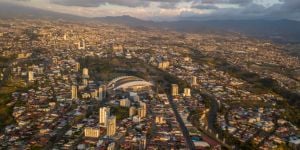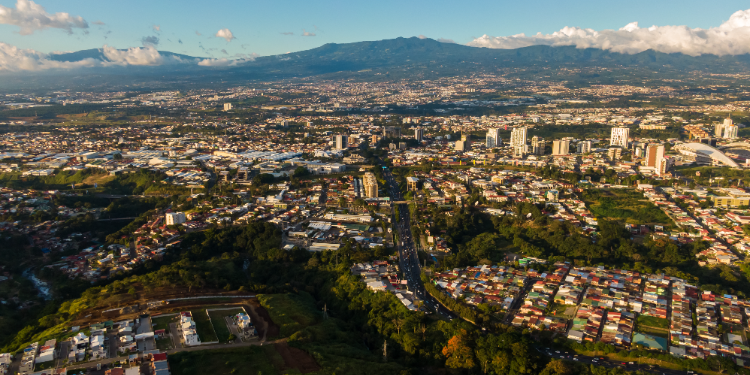
San Jose is not the kind of city that reveals itself immediately. Affectionately known as "Chepe" by locals, Costa Rica's capital can feel dense and congested on arrival, but it rewards those who stay. Surrounded by green mountains and sitting at a comfortable altitude that keeps temperatures mild year-round, it serves as both the country's economic engine and its cultural heart. For expats, it offers a rare combination of world-class healthcare, strong international school options, a lively food scene, and easy access to the rest of the country.
Overview of San Jose
San Jose is the capital and largest city of Costa Rica, functioning as the country's political, economic, and cultural hub. The city proper is compact, spanning just 44.62 square kilometres, but it sits at the centre of a much larger Greater Metropolitan Area with an estimated population of 1,522,000, according to Macrotrends. That density shapes everything from traffic patterns to the variety of services available, and it is worth understanding before you arrive.
Expats are drawn to San Jose for practical reasons: a concentration of private hospitals, a professional job market anchored by multinational companies and free trade zones, and the highest density of international schools in Costa Rica. The city also functions as a strategic base for exploring the rest of the country, with both Pacific and Caribbean coastlines reachable within two to three hours by car. First-time visitors often focus on the traffic and the utilitarian architecture, but those who spend more time here tend to find a genuinely cosmopolitan city with excellent museums, a thriving restaurant scene, and a population that is broadly welcoming to foreigners.
Neighbourhoods and districts in San Jose
Where you live in San Jose will define much of your expat experience, and the city's neighbourhoods vary considerably in character, price, and lifestyle. The western suburbs are where the largest concentration of expats settles, while the inner districts offer a more integrated urban experience.
Escazú, located just west of downtown, is the city's premier expat enclave. Often described as the most upscale district in Costa Rica, it offers luxury condos, English-friendly services, top-tier private hospitals, including Hospital CIMA, and a wide range of international restaurants and shopping centres. It is convenient and comfortable, though it comes at a price and can feel somewhat removed from everyday Costa Rican life.
Santa Ana, situated further west, appeals strongly to expat families. It has a slightly warmer microclimate than central San Jose, more spacious homes and gated communities, and good proximity to international schools. It is a quieter, more suburban setting that suits families who prioritise space over urban buzz.
Rohrmoser and La Sabana form a more urban, mid-tier option favoured by diplomats, young professionals, and those who want to be close to Parque La Sabana, the city's largest green space. The area features mid-rise apartments, trendy cafés, and a generally walkable streetscape.
Barrio Escalante, east of downtown, is the city's most fashionable residential and dining district. It has become a magnet for younger expats and digital nomads, particularly along Calle 33, which is lined with craft breweries, independent restaurants, and creative businesses. It offers the most integrated urban lifestyle of any expat-friendly area in the city.
The downtown core, including the historic Barrio Amón with its Victorian-era architecture, is rich in culture and history, housing the city's best museums and the iconic Teatro Nacional. However, it is generally considered less suitable for long-term residential living due to congestion and inconsistent street safety. Certain districts, including Pavas, La Carpio, León XIII, and Desamparados, experience higher crime rates and are best avoided, particularly after dark.
Cost of living in San Jose
San Jose holds the distinction of being the most expensive city in Central America, a fact that surprises many expats arriving from elsewhere in the region. That said, costs remain significantly lower than in major North American cities. According to Numbeo's cost of living data for San Jose, rent in the city runs roughly 68.6% lower than in Los Angeles, giving expats from the US or Canada real purchasing power despite the regional premium.
A single person's estimated monthly expenses are around CRC 457,221 (USD 969), excluding rent, while a family of four should budget roughly CRC 1,691,749 (USD 3,587) per month before housing costs, based on Numbeo figures. For rent, a one-bedroom apartment in the city centre averages CRC 463,748 (USD 910) per month, dropping to around CRC 316,472 (USD 620) outside the centre. A three-bedroom apartment in a central location costs approximately CRC 815,282 (USD 1,600) per month.
Day-to-day food costs are manageable if you eat locally. A meal at a traditional "soda" (a small local eatery) costs about CRC 5,000 (USD 10), while a sit-down dinner for two at a mid-range restaurant runs around CRC 29,148 (USD 57). The single biggest cost driver for expats tends to be imported goods, which carry heavy import taxes. Shopping at the weekend feria (farmers' market) for fresh local produce, cooking at home, and adapting to a local diet are the most effective ways to keep the monthly budget under control.
Climate and weather in San Jose
One of San Jose's most appealing qualities is its climate. Sitting at an altitude of 1,170 metres in the Central Valley, the city escapes the intense heat and humidity of Costa Rica's coasts and instead enjoys what locals call an "eternal spring." Temperatures are remarkably consistent throughout the year, typically ranging from a low of 16°C (61°F) in February to a high of 26°C (79°F) in May. Air conditioning and heating are both largely unnecessary in most San Jose homes, which also keeps utility costs low.
The year divides into two clear seasons. The dry season runs from December through April, bringing clear skies and minimal rainfall. This is peak tourist season and the most comfortable time to be outdoors. The wet season, or Green Season, runs from May through November. Rain in San Jose during this period tends to arrive as heavy, intense afternoon downpours rather than persistent all-day drizzle. October is the wettest month, averaging around thirty rainy days. Locals adapt by planning outdoor activities for the morning and simply accepting that afternoons will often be wet.
Expats moving to San Jose should pack light layers for cooler mountain evenings and invest in a good rain jacket and umbrella for the wet months. The climate is otherwise very forgiving and rarely disrupts daily routines in a meaningful way.
Getting around San Jose
San Jose's transport options range from very cheap public buses to ride-hailing apps, with traffic congestion being the city's most significant daily challenge. Public buses are extensive, reliable, and extremely affordable, with urban fares rarely exceeding CRC 650 (around USD 1.20). They are the primary mode of transport for most local residents. For expats who prefer more control over their journey, Uber is fully operational, widely used, and generally preferred over traditional red taxis for its transparent pricing and GPS tracking. DiDi is another ride-hailing option used locally.
A commuter train network, based at Estación Atlántico, operates during peak hours and connects the city to suburban areas including Heredia, Cartago, and Alajuela. It is a practical option for cutting through severe rush-hour congestion. For those who drive, the Waze app is used almost universally in Costa Rica for real-time traffic updates. Neighbourhoods like Barrio Escalante and the pedestrianised Avenida Central are walkable, though pedestrian infrastructure in many other parts of the city remains inconsistent, with narrow sidewalks and limited accessibility features.
Language and communication in San Jose
Spanish is the official language of Costa Rica and the language you will encounter in government offices, local markets, and public transport. In the expat-heavy western suburbs of Escazú and Santa Ana, English is widely spoken, and most international businesses, private hospitals, and tourism-sector staff communicate comfortably in English. However, stepping outside these enclaves makes the language barrier real and meaningful.
Learning Spanish is strongly recommended for any expat planning to stay beyond a short visit. Navigating bureaucratic processes such as residency applications and banking, understanding public transport options, and building genuine connections with Costa Rican neighbours all become significantly easier with even a working knowledge of the language. Costa Rican Spanish has a reputation for being relatively clear and polite. The formal "usted" is commonly used even in casual conversations between friends and family, which reflects a broader cultural emphasis on respect and courtesy.
Two phrases stand out as essential cultural vocabulary. "Pura Vida" (literally "pure life") functions as a greeting, a farewell, an expression of thanks, and a general affirmation that things are fine. "Mae" is the local colloquialism for "dude" or "mate," heard constantly in casual conversation. Using either phrase correctly will earn an immediate smile from locals.
Culture and social norms in San Jose
Costa Rican identity is shaped by a distinctive blend of history, values, and national pride, and San Jose, as the capital, concentrates all of it. The country abolished its military in 1948, redirecting public funding toward education and universal healthcare. That decision has had a lasting effect on the national character, producing a population that is broadly educated, peaceful, and proud of its social institutions.
The concept of "Pura Vida" extends well beyond a catchphrase. It reflects a genuine cultural philosophy that values optimism, community, and resilience in the face of difficulty. Expats who arrive expecting efficiency and directness may find the indirect, harmony-focused communication style takes some adjustment. Confrontation is strongly discouraged in Costa Rican social culture; locals often use indirect language to avoid saying "no" outright, and aggressive complaints or demands are viewed as rude regardless of the context.
Environmentalism runs deep in the national identity. Costa Rica generates around 99% of its electricity from renewable sources, including hydroelectric, wind, and geothermal power, and eco-conscious habits form a genuine part of daily social norms. Religious identity, predominantly Catholic, continues to shape public holidays and some social customs, though San Jose functions as a secular, cosmopolitan city in practice.
Dress codes in San Jose are more conservative and urban than in the beach towns. Adults typically wear long trousers rather than shorts for everyday errands or professional settings, and appearing dressed appropriately for a working capital signals respect. Hospitality toward foreigners is genuine, and it is common for strangers to greet each other on the street, particularly outside the busiest downtown areas.
Pace of life and work culture in San Jose
San Jose operates at a noticeably faster pace than Costa Rica's beach towns, but it still runs on a more relaxed rhythm than major North American or European business capitals. The national concept of "la hora tica" (Tico time) means that arriving fifteen to thirty minutes late for a social gathering is entirely normal and not considered impolite. In corporate settings, however, and especially in companies with international clients or management structures, punctuality is expected, and tardiness can reflect poorly.
Work culture prioritises interpersonal relationships and team harmony. Taking time for small talk before getting into business matters is considered standard etiquette, not a waste of time. Bluntness and aggressive efficiency can come across as disrespectful. Standard working hours run from 8:00 AM to 5:00 PM, Monday to Friday. Government and administrative services can move slowly, and expats accustomed to fast digital bureaucracy should build in extra time and patience for any official process, whether applying for residency, opening a bank account, or dealing with utility companies.
Food culture in San Jose
Costa Rican cuisine is hearty and unpretentious, and the food scene in San Jose runs from deeply traditional to inventively modern. The everyday staple is the "casado," a generous plate of rice, black beans, fried plantains, salad, and a protein such as chicken, fish, or beef. At a local "soda," a casado typically costs between USD 5 and USD 8 and represents one of the best value meals in the city.
The Mercado Central, San Jose's historic Central Market, is a must-visit for food lovers. Its labyrinthine interior is packed with stalls serving inexpensive traditional dishes alongside vendors selling tropical fruits, aromatic spices, and fresh coffee. It gives an unfiltered view of everyday urban Costa Rican food culture.
Barrio Escalante has emerged as the city's modern dining hub. The neighbourhood features indoor-outdoor food courts, vegan cafés, craft breweries, and creative restaurants offering international cuisine. Food spaces like Jardín de Lolita have become social anchors for the city's younger, cosmopolitan crowd. Specialty coffee is another genuine cultural touchstone; Costa Rica produces some of the world's most respected arabica beans, and independent coffee shops drawing on local single-origin roasts are easy to find throughout the city.
The weekend feria is an institution for expats and locals alike. These open-air farmers' markets offer extraordinary value for fresh tropical produce, including mangoes, papayas, and pineapples, along with artisan goods. Annual events like the Food Fest Costa Rica also showcase the city's evolving culinary landscape through food trucks and live entertainment.
Leisure and social life in San Jose
San Jose's leisure options are more varied than many newcomers expect. Parque La Sabana, the city's largest green space, functions as the social heart of weekend life. Its lake, running paths, and open lawns attract families, joggers, and amateur sports teams every weekend, and entry is free. It sits adjacent to the Rohrmoser and La Sabana neighbourhoods, making that district particularly appealing for those who value outdoor space within the city.
For cultural life, the neoclassical Teatro Nacional stages world-class performances and is one of the most beautiful buildings in Central America. The Museo del Jade and the Museo de Oro Precolombino offer deep dives into pre-Columbian history and are among the region's best museums. The Festival Internacional de las Artes (FIA) transforms the city's parks into stages for international music, theatre, and visual art on a regular basis.
Nightlife divides between Barrio Escalante, which draws a mixed local and expat crowd to its craft beer bars and restaurants, and San Pedro, the university district, which has a more youthful and energetic party atmosphere. One of San Jose's most underrated leisure advantages is its geography: on any given weekend, expats can take inexpensive buses to cloud forests, active volcanoes like Poás, or the Pacific coast, all within a few hours.
Family life in San Jose
San Jose is the top choice for expat families relocating to Costa Rica, and the reasons are concrete. The city concentrates the country's best international schools, its highest-quality private healthcare, and its most secure residential infrastructure. For families making the move, this makes it the practical default.
Escazú and Santa Ana are the most popular family neighbourhoods, offering gated communities with gardens, swimming pools, and reliable private security. Both areas are close to major supermarkets, private hospitals, and the main international school campuses. The western suburban corridor effectively functions as a self-contained, family-oriented ecosystem.
The city hosts more than a dozen reputable international schools offering American, British, and IB curricula. Well-regarded institutions include Lincoln School, Country Day School (part of the Nord Anglia network), and Blue Valley School. Annual tuition fees at top-tier schools range from USD 10,000 to USD 25,000 per child, and waitlists can be long, so families should apply several months before their planned arrival date. Bilingual private schools offering Costa Rican Ministry of Education certification alongside significant English instruction exist as a more affordable middle-ground option.
Healthcare for children and families is well-served by private facilities. Hospital CIMA in Escazú provides state-of-the-art pediatric and maternity care and is the facility most commonly used by the expat community. Expats with legal residency are also eligible to enrol in the public CCSS (Caja) system, which offers comprehensive coverage at an income-based monthly contribution.
Safety in San Jose
Costa Rica ranks 54th out of 163 countries on the Global Peace Index, making it the safest nation in Central America. That national context matters when assessing San Jose, though safety in the city is meaningfully uneven depending on where you are and when.
The primary risk for expats is opportunistic petty crime: pickpocketing in crowded areas, phone snatching, and car break-ins. These are manageable risks with standard urban precautions. Violent crime, while it exists, is largely concentrated in gang and drug-related hot spots that expats rarely frequent. The safest residential areas, with strong security infrastructure and gated communities, are Escazú, Santa Ana, Rohrmoser, and Barrio Escalante. Areas to actively avoid, particularly after dark, include Pavas, La Carpio, León XIII, Los Guido, and the immediate vicinity of the downtown bus terminals.
Practical safety habits make a significant difference in San Jose. Using Uber rather than hailing street taxis at night removes a common risk point. Avoiding visible displays of expensive phones, cameras, or jewellery in public reduces the likelihood of opportunistic theft. Women living alone generally report feeling safe in the recommended expat neighbourhoods, provided they apply the same level of awareness they would in any large urban environment.
Environment in San Jose
Costa Rica's environmental credentials are genuinely impressive at a national level. The country runs on roughly 99% renewable electricity, generated through hydro, wind, and geothermal sources, and eco-conscious behaviour is embedded in everyday social norms. Tap water in San Jose is treated with chlorine and reverse osmosis and is considered safe to drink. Some expats choose to use a filter, not out of health concern, but because the water's hard mineral content affects the taste.
The city's main environmental challenge is localised air and noise pollution caused by traffic congestion in the downtown core. Heavy daily vehicle traffic on inadequate road infrastructure makes air quality noticeably worse in central areas during peak commute times. The surrounding Central Valley mountains and the green spaces of Parque La Sabana provide accessible relief from the urban density, and the city's altitude means temperatures never push the pollution problem into the extreme range experienced in some other Latin American capitals.
Expat community in San Jose
San Jose is home to a large, established, and diverse expat community, drawn primarily from North America, Europe, and South America. The majority settle in the western suburbs of Escazú and Santa Ana, where English is widely spoken, Western grocery items are available, and the infrastructure is built around international residents. This concentration of foreigners creates a ready-made social environment on arrival, but it can also insulate expats from authentic local life if they are not intentional about venturing beyond it.
Younger professionals and digital nomads tend to choose Barrio Escalante or Rohrmoser for a more integrated urban lifestyle, with greater daily contact with local residents and a more walkable neighbourhood character. Community life for expats is supported by active social organisations and regular meetup groups covering hiking, book clubs, language exchange, and volunteering. These groups provide practical entry points into local life and are one of the most effective ways to build a genuine social network beyond the immediate expat bubble.
For expats who want to move beyond surface-level integration, learning Spanish and engaging with local community events, markets, and cultural institutions makes a substantial difference. San Jose rewards the effort; Ticos are genuinely warm and welcoming toward foreigners who show an interest in the culture.
Pros and cons of living in San Jose
San Jose is a city that suits a specific kind of expat well, and understanding that fit honestly is more useful than a generic endorsement.
On the positive side, the city offers access to world-class private healthcare and a well-funded public system, the largest concentration of international schools in Costa Rica, and a consistently mild climate that requires almost no seasonal wardrobe adjustment. The expat community is large and well-organised, making it relatively easy to build a social network quickly. And the city's position in the Central Valley means that volcanoes, cloud forests, and two coastlines are all accessible on a single weekend.
The drawbacks are equally specific. San Jose is the most expensive city in Latin America, and heavy import taxes mean that maintaining a Western consumption pattern is genuinely costly. Traffic congestion is severe and a daily reality for anyone commuting across the metropolitan area. Petty crime requires ongoing vigilance, particularly in and around the downtown core. Bureaucratic processes, from residency applications to utility connections, move slowly and can be frustrating for expats used to efficient digital services.
Professionals, diplomats, and families who prioritise safety, healthcare access, and educational quality will find San Jose delivers reliably on all three. Those seeking a low-cost, beachfront lifestyle or who struggle with slow administrative systems may find the city's trade-offs harder to accept.
Frequently asked questions about living in San Jose, Costa Rica
Is the tap water safe to drink in San Jose?
Yes, tap water in San Jose is treated with chlorine and reverse osmosis and is considered safe to drink. The water has a relatively high mineral content, which some newly arrived expats find affects the taste. Using a basic filter resolves this for most people, and it is not a health concern for the majority of residents.
What is the average rent for an apartment in San Jose?
A one-bedroom apartment in the city centre averages around CRC 463,748 (USD 910) per month, while an equivalent apartment outside the centre costs roughly CRC 316,472 (USD 620), according to Numbeo. A three-bedroom apartment in a central area runs approximately CRC 815,282 (USD 1,600) per month. Prices vary significantly by neighbourhood, with Escazú and Santa Ana commanding a premium over more central districts.
Do I need a car to live in San Jose?
A car is not strictly necessary if you live in a walkable neighbourhood like Barrio Escalante or Rohrmoser, where public buses and Uber cover most transport needs at low cost. For expat families based in Santa Ana or other suburban areas, a vehicle, ideally a 4x4, becomes significantly more practical, particularly for school runs, weekend travel, and navigating roads that are not well-served by public transport.
How does healthcare work for expats in San Jose?
Expats who obtain legal residency in Costa Rica are required to enrol in the public CCSS system, commonly called the Caja, which provides comprehensive healthcare coverage for a monthly income-based contribution. Many expats supplement this with private health insurance to access top-tier English-speaking private hospitals like Hospital CIMA in Escazú, bypassing the wait times associated with specialist appointments in the public system.
Which neighbourhoods are the safest for expats?
Escazú, Santa Ana, Rohrmoser, and Barrio Escalante are consistently considered the safest areas for expat residents, offering better security infrastructure, gated communities, and private guards. Standard urban precautions against petty theft remain necessary in all of these areas, but the risk profile is meaningfully lower than in the downtown core or peripheral districts.
When is the rainy season, and how bad does it get?
The rainy season runs from May through November, with October being the wettest month and averaging around thirty rainy days. In San Jose, rain during this season typically arrives as heavy afternoon downpours rather than sustained all-day drizzle, which means mornings are usually clear and outdoor plans can be scheduled accordingly. A good rain jacket and umbrella are essential items during these months.
Are there good international schools in San Jose?
San Jose has the highest concentration of international schools in Costa Rica. Well-regarded options include Lincoln School, Country Day School, and Blue Valley School, offering US, British, and IB curricula. Tuition fees at top-tier institutions range from USD 10,000 to USD 25,000 per child annually, and waitlists at the most popular schools are long, so applying well in advance of your planned move is strongly advisable.
Is Uber safe to use in San Jose?
Yes, Uber is widely used and actively preferred by most expats and visitors over traditional street taxis. It offers transparent pricing, GPS tracking, and a clear record of each trip, which removes the risk of fare disputes or late-night safety concerns. DiDi is a secondary ride-hailing option also available in the city, and both apps work reliably in most San Jose neighbourhoods.
Have questions about moving to San Jose or Costa Rica? Join the Expat.com community to connect with expats who have been through the process.
We do our best to provide accurate and up to date information. However, if you have noticed any inaccuracies in this article, please let us know in the comments section below.