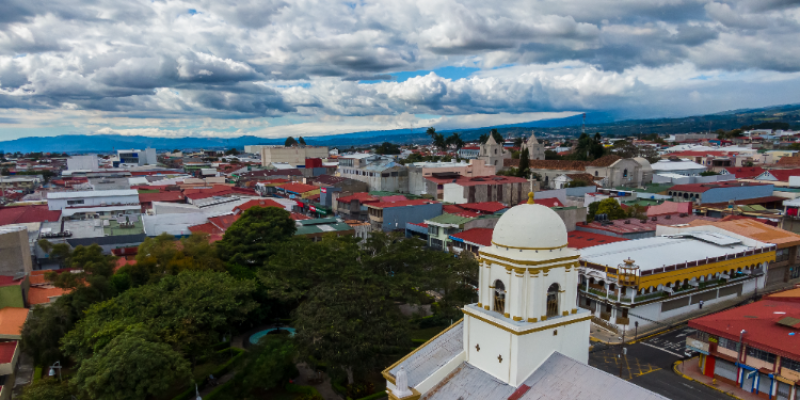
Tucked into Costa Rica's Central Valley at roughly 1,150 metres above sea level, Heredia sits just ten kilometres north of San José and punches well above its weight as a place to live. Known affectionately as the "City of Flowers," it blends colonial-era charm with a modern, outward-looking economy anchored by multinational technology companies and the National University of Costa Rica (UNA). The metropolitan area is home to nearly 364,000 residents, according to World Population Review, and that number keeps climbing. For expats weighing their options in Costa Rica, Heredia offers a compelling middle ground: the career infrastructure and international schools of a major urban centre, the safety and greenery of a smaller city, and a spring-like climate that rarely disappoints. This article walks you through what daily life actually looks like here.
Heredia's identity is shaped by two defining forces that coexist surprisingly well: a deep sense of local tradition and a dynamic, internationally connected economy. The city's historic centre still bears the marks of its colonial past, most visibly in El Fortín, the distinctive tower that has become the city's symbol, and in the parish church that anchors the central park. Yet within a short drive of those landmarks, you'll find the free trade zones that house global names like Intel, Microsoft, and Amazon, drawing a steady flow of professional expats and skilled workers from across the world.
That combination gives Heredia a texture that sets it apart from both the intensity of San José and the laid-back isolation of Costa Rica's beach towns. Expats who settle here often describe it as the best of both worlds: close enough to the capital to access its hospitals, airports, and cultural life, yet calm and green enough to feel like a genuine home rather than a transit point. The surrounding landscape, dominated by the forested slopes of the Barva Volcano, reinforces that sense of place and draws outdoor enthusiasts who want nature on their doorstep without sacrificing urban convenience.
Heredia is not a single, uniform city. Its various districts each have a distinct character, and choosing the right one depends heavily on your lifestyle, budget, and priorities as an expat.
The downtown core, known locally as Centro, retains the strongest local flavour. Historic landmarks, the Mercado de Heredia, and the university create a lively, walkable atmosphere that tends to attract younger expats, international students, and those who want to immerse themselves in everyday Costa Rican life rather than live in a bubble.
Moving outward, San Francisco, Barreal, and Belén form a corridor that appeals strongly to corporate expats and digital nomads. Their proximity to the tech parks, coworking spaces, and international supermarkets makes daily logistics straightforward, and transport links to San José are reliable.
Cariari occupies a different category altogether. This upscale district is known for its gated communities, golf courses, and tight proximity to Juan Santamaría International Airport, making it a natural fit for executives and affluent expats who prioritise security and convenience. The tradeoff is a certain remove from the authentic city feel that other neighbourhoods preserve.
Families and retirees frequently gravitate toward San Rafael, Santa Bárbara, and San Isidro, where the pace slows, the air is noticeably cooler, and residential streets feel genuinely secure. These areas offer larger homes with outdoor space, green surroundings, and a strong sense of community, while still sitting within a manageable distance of the city's services. The neighbourhoods section here gives a city-wide overview; the accommodation article covers rental specifics in more depth.
Join the Heredia community
Get regular tips and advice to make the most of your expat life
Cost of living in Heredia
Costa Rica is the most expensive country in Central America, and Heredia reflects that reality. For expats arriving from North America or Western Europe, however, the city still represents meaningful savings. According to Numbeo's cost of living data for Heredia, a family of four can expect monthly expenses of around CRC 1,859,381 (USD 3,929), excluding rent. A single person's estimated monthly costs sit at roughly CRC 497,469 (USD 1,051), again before housing.
Rent is where the gap with North America becomes most pronounced. Numbeo places Heredia's rental costs at roughly 68.6% lower than those in cities like Los Angeles, giving expats considerably more living space for their money than they would find back home. Local public transport is highly affordable, with bus fares typically ranging from CRC 500 to CRC 700 (USD 0.85 to USD 1.20) per trip.
Retirees considering the Pensionado visa should be aware that the residency requires proof of a minimum monthly pension income of USD 1,000. Visa holders must also enrol in the national CAJA public healthcare system and contribute between 7% and 11% of their declared income. However, keep in mind that figures from Numbeo are subject to change, so it is worth checking the source directly before making financial decisions.
One of Heredia's most consistently praised features is its climate. The city's elevation keeps temperatures remarkably stable throughout the year, with daily highs typically sitting between 17°C (63°F) at night and 28°C (82°F) during the day. It almost never drops below 15°C (59°F) or climbs above 29°C (85°F), which means the oppressive heat that defines much of tropical Central America is simply not part of life here.
The year is divided into two seasons. The dry season, which locals call summer, runs from mid-December through April and offers clear skies, low humidity, and ideal conditions for outdoor exploration. This is also the most popular window for relocating to the city. The rainy season stretches from May to November, bringing heavy afternoon downpours and average humidity levels around 80%. July and October are the wettest months, and expats moving during this period should pack proper rain gear and expect that some outdoor plans will need to flex around the afternoon downpours. Evenings can feel cool year-round at this elevation, so light layers are always worth having on hand.
Getting around Heredia
Heredia is well connected to the Greater Metropolitan Area, though traffic congestion is a genuine daily frustration for commuters heading toward San José. The most efficient option for that journey is the Tren Urbano, a commuter train managed by INCOFER that covers the route in roughly twenty minutes and sidesteps the worst of the highway gridlock. Fares range from CRC 500 to CRC 1,500 (USD 0.80 to USD 2.50).
Within the city, local buses are the most affordable way to get around, with fares in the same CRC 500 to CRC 700 range. Official red taxis operate on a metered system, with short intra-city trips typically costing between USD 3 and USD 6. Ride-hailing apps, including Uber, are widely used and generally considered safe. Downtown Heredia is walkable, but expats in the more suburban or mountainous districts generally find a personal vehicle practical for day-to-day life. For a full breakdown of transport options, refer to the dedicated transport article for the city.
Language and communication in Heredia
Spanish is the official language of Heredia, as it is throughout Costa Rica. What makes this city stand out is the notably high level of English proficiency among its residents. The EF English Proficiency Index rates Heredia at 576 (High Proficiency), a score that sits well above the national average of 516 and outpaces even San José, according to EF's proficiency data for Costa Rica. The presence of UNA and the multinational companies in the free trade zones drives this result, creating an environment where professional and academic English is genuinely common.
That said, relying solely on English will limit you in meaningful ways. Navigating local markets, using public transport, interacting with government offices, and building real relationships with Ticos all become significantly easier with at least conversational Spanish. Language schools, including Intercultura Costa Rica and Tico Lingo, offer immersive Spanish courses tailored to expats, combining classroom instruction with cultural exchange programmes. Investing time in the language pays dividends quickly in a city where local social life and bureaucracy still operate primarily in Spanish.
Culture and social norms in Heredia
Life in Heredia moves to the rhythm of "Pura Vida," the Costa Rican philosophy that loosely translates to "pure life" and functions as both a greeting and a worldview. It emphasises positivity, community, and an unhurried approach to daily existence. For many expats, this is a welcome shift; for others, it requires a genuine adjustment, particularly when it comes to punctuality. "Tico time" is real: social events and informal meetings rarely begin exactly on schedule, and pushing back against that norm will generate friction rather than compliance.
Social interaction in Heredia places genuine weight on personal relationships. Before getting down to business, whether in a shop, a government office, or a professional meeting, exchanging pleasantries and building a small moment of rapport is expected rather than optional. Skipping straight to the task can come across as cold or disrespectful. This relational style is one of the reasons Ticos are widely regarded as warm and hospitable hosts, but it also explains why bureaucratic processes can feel slower and more layered than expats from more transactional cultures might expect.
Heredia carries a strong traditional identity rooted in its colonial history and its deep ties to coffee farming. The Catholic faith shapes the city's calendar, with religious festivals and public holidays woven through the year and influencing the rhythm of community life. While the city is cosmopolitan enough to accommodate diverse lifestyles, newcomers who take time to understand and respect local customs tend to integrate far more smoothly.
Heredia occupies an interesting position in Costa Rica's workforce. The city hosts a cluster of free trade zones that bring a genuinely professional, internationally oriented work culture to what might otherwise feel like a quiet provincial town. Companies like Intel, Microsoft, and Amazon operate here, and their presence has shaped a local business environment where standard office hours, performance expectations, and professional norms align reasonably well with what expats from North America or Europe would recognise.
At the same time, the broader Costa Rican emphasis on work-life balance holds firm. A standard workday runs from 8:00 AM to 5:00 PM, and weekends are genuinely protected time for most residents. Compared to the congestion and intensity of San José, Heredia feels calmer and more community-focused, which is a significant draw for remote workers and digital nomads who want a productive base without the stress of a major capital city. The combination of decent infrastructure, reliable internet in most districts, and a temperate climate has made Heredia an increasingly popular choice for location-independent professionals.
Food culture in Heredia
Heredia'sfood scene reflects its dual identity as a traditional Costa Rican city and a hub for international residents. Local daily eating revolves around a handful of staples that appear reliably across the city's sodas, the small family-run restaurants embedded in markets and on side streets. Gallo pinto, the national breakfast of rice and black beans cooked together with herbs, anchors mornings, while the casado, a generous lunch plate combining rice, beans, meat, plantains, and salad, is the midday meal of choice for most residents. Chifrijo, a satisfying bowl of pork rinds, beans, rice, and pico de gallo, is another local favourite that turns up frequently.
The heart of traditional food culture in the city is the Mercado de Heredia, which has operated since 1889 and houses nearly 150 stalls selling fresh produce, herbs, and everyday goods, alongside a collection of sodas where you can eat well for very little money. Beyond the market, the international dining scene is lively and varied. La Lluna de Valencia draws a loyal crowd with authentic Spanish tapas, Caribbean Corner brings Afro-Costa Rican flavours to the table, and Kawah Café has built a reputation for premium locally sourced coffee and international dishes. For those who want to experience the coffee farming heritage that defines this region, venues like the Finca Rosa Blanca Coffee Farm, just north of the city, offer organic farm-to-table meals in a spectacular setting.
Leisure and social life in Heredia
Leisure in Heredia is shaped by the landscape as much as by the city itself. The slopes of the Barva Volcano, the La Paz Waterfall Gardens, and the historic coffee plantations scattered across the province give weekend life an outdoor, exploratory quality that distinguishes the city from more urban alternatives. Hiking trails, cloud forest walks, and visits to working farms are a standard part of the social calendar for many residents.
Within the city, the Oxígeno Human Playground is the main modern commercial hub, combining shopping, dining, and community events in a large, contemporary space. The Parque Central, officially named the Nicolás Ulloa Central Park, plays a more traditional role as the city's social heart, where locals gather to relax, listen to music, and enjoy the shade of mature trees beside the historic church.
Heredia's nightlife is more active than the city's modest size might suggest, driven in large part by the student population at UNA. Craft beer bars and modern lounges cluster in various districts, with spots like Artisan Brew Pub, KATTA Pub, and C Lounge in the Cariari area offering lively, sociable evenings. The mix of students, young professionals, and expats creates a social scene that feels accessible without being overwhelming.
Family life in Heredia
Heredia has earned a strong reputation as one of the most family-friendly cities in the Central Valley, and the practical reasons behind that reputation are easy to identify. The combination of relative safety, green residential neighbourhoods, access to quality international schools, and proximity to the capital's full range of services makes it a logical choice for expat families weighing their options in Costa Rica.
On the education side, the city and its surrounding districts are home to several well-regarded international schools. The Lincoln School in Santo Domingo offers a US curriculum alongside the International Baccalaureate programme, with annual tuition ranging from USD 10,754 to USD 12,566, as listed by local education specialists. The Pan-American School in San Antonio de Belén provides bilingual English-Spanish IB instruction in a modern campus setting, making it another strong option for families seeking continuity with international academic standards.
In terms of where to live, families most often settle in Belén, San Rafael, and Santa Bárbara. These districts combine secure, well-planned residential infrastructure with larger homes, private gardens, and easy access to nature, while keeping the capital's hospitals, airports, and cultural life within a reasonable commute. Childcare options and after-school activities are available throughout these areas, though as with most services in Costa Rica, navigating the local system is smoother with some Spanish and local connections.
Heredia stands out as one of the safest provinces in Costa Rica by a significant margin. Out of 833 homicides recorded nationally in 2025, Heredia accounted for only 33, making it the province with the lowest violent crime rate in the country, as reported by the Tico Times. Numbeo's indices give the city a Crime Index of 50.83 and a Safety Index of 49.17, placing it in a substantially safer position than the centre of San José for residential purposes.
The safest neighbourhoods for expats are consistently identified as San Rafael, Santa Lucía, and Cariari, all of which benefit from well-maintained infrastructure, active neighbourhood watch cultures, and private security within gated communities. The most common safety concerns are opportunistic in nature: petty theft and pickpocketing in crowded commercial areas or on busy public transport routes. Standard urban precautions, such as keeping valuables out of sight, using secure transport options, and ensuring your home has adequate locks and lighting, go a long way toward reducing risk. Heredia is not a zero-crime environment, but for expats coming from large Western cities, the day-to-day sense of security is often a pleasant surprise.
Heredia's natural setting is genuinely impressive, with protected forests, volcanic slopes, and coffee-growing landscapes forming a green backdrop to daily life. The city itself, however, sits within the Greater Metropolitan Area, and that brings a set of environmental pressures worth understanding before you arrive.
Traffic congestion is the most immediate issue. Vehicle numbers across the GAM have grown sharply over the past decade, straining road infrastructure and creating significant air quality concerns during peak commuting hours. Transportation, combining public and private vehicles, accounts for roughly 40% of Costa Rica's greenhouse gas emissions, creating localised pollution hotspots along the main commuting corridors connecting Heredia to San José.
Efforts to address this are underway. A major infrastructure project aims to modernise 50 kilometres of electrified railway linking Heredia, San José, and Cartago, with an estimated budget of USD 800 million. Progress has been uneven due to funding constraints, but the project reflects a genuine institutional commitment to reducing the environmental and logistical burden of the current transport system. Expats who prioritise air quality in their daily environment should factor peak-hour conditions into their neighbourhood and commuting choices.
Heredia hosts a well-established and genuinely diverse expat community, though its character differs noticeably from the coastal expat enclaves found in places like Tamarindo or Manuel Antonio. Here, integration with local life is more the norm than the exception. The university town atmosphere, the multinational workplace environment, and the everyday rhythms of a mid-sized Central Valley city all push toward interaction rather than separation.
The community currently spans several distinct profiles: retirees using the Pensionado visa who want modern conveniences without tropical heat, North American and European corporate professionals working in the free trade zones, digital nomads drawn by the climate and cost of living, and international students connected to UNA. These groups tend to cluster in different parts of the city, with corporate expats and retirees concentrating in Belén and Cariari while those seeking a quieter lifestyle gravitate toward San Rafael and San Isidro.
English-speaking social networks and online community groups provide practical support for newcomers navigating bureaucracy, finding housing, or simply meeting people. Over time, most expats find that the city's welcoming social culture makes deeper integration possible, particularly for those who invest in learning Spanish and engage with local community life rather than keeping exclusively to expat circles.
Frequently asked questions about living in Heredia
A family of four can expect to spend around CRC 1,859,381 (USD 3,929) per month on daily expenses, excluding rent, according to Numbeo's cost of living data for Heredia. Rent is generally around 68% lower than in major US cities. Heredia is more affordable than North America but remains one of the more expensive locations in Central America, and figures are subject to change.
Heredia is widely considered one of the safest provinces in Costa Rica. It recorded the lowest homicide count in the country in 2025, with thirty-three incidents out of 833 nationally. Violent crime is rare, especially in secure suburban areas like San Rafael and Cariari, though standard precautions against petty theft are always advisable.
Heredia enjoys a mild, spring-like climate year-round thanks to its elevation of 1,150 metres. Daily temperatures consistently range between 17°C (63°F) and 28°C (82°F) The dry season runs from December to April, and the rainy season lasts from May to November.
Yes, several private hospitals in the area, including Hospital Metropolitano, accept international health insurance and offer English-speaking staff and modern facilities. Expats on residency visas are also required to contribute to the national CAJA public healthcare system, so many residents maintain both private coverage and CAJA enrolment for full access.
Fluency is not a prerequisite, but basic Spanish is strongly recommended. While the EF English Proficiency Index rates Heredia as high proficiency, speaking only English limits your ability to navigate public transport, deal with government offices, and build genuine local relationships. Language schools in the city offer expat-focused courses that can get you functional quickly.
The Tren Urbano commuter train is the most efficient option, covering the journey in roughly twenty minutes and bypassing the worst of the highway congestion. Fares range from CRC 500 to CRC 1,500 (USD 0.80 to USD 2.50). Local buses and ride-hailing apps are alternatives for shorter journeys or when train schedules do not align.
Yes, the area is home to several strong options. The Lincoln School in Santo Domingo offers a US and IB curriculum, with annual tuition ranging from USD 10,754 to USD 12,566 as reported by local education specialists. The Pan-American School in San Antonio de Belén provides bilingual IB instruction. Both are well regarded within the expat community.
Costa Rica's Pensionado residency visa requires proof of a minimum steady monthly pension income of USD 1,000. Visa holders must also enrol in the national CAJA healthcare system and contribute between 7% and 11% of their declared income. Requirements are subject to change, so always verify the current rules with the Costa Rican immigration authority before applying.
ℹ️
We do our best to provide accurate and up to date information. However, if you have noticed any inaccuracies in this article, please let us know in the comments section below.
A journalist, holder of the DALF C1 and C2 and a diploma from the University of Mauritius, I have nearly twenty years of writing experience. After six years in the Mauritian press, I joined Expat.com, where I have been working for over a decade, including five years as editorial assistant, and now as editorial manager.