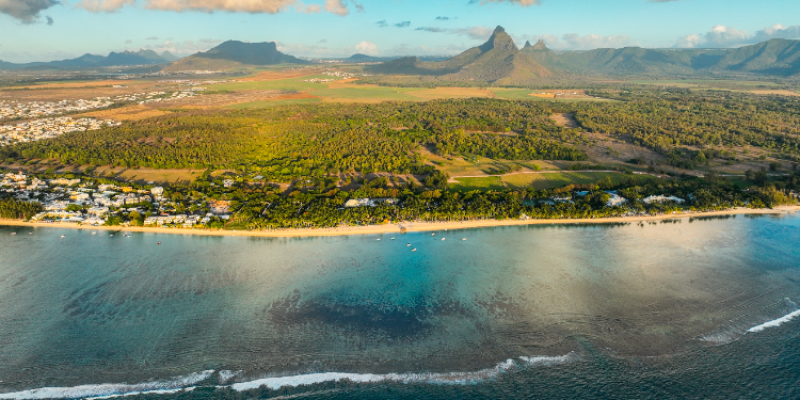
Mauritius is an island nation in the southeast Indian Ocean and part of Southern Africa. The Republic includes the main island, Rodrigues and other outer islands, and is home to about 1.2 million people from diverse cultural backgrounds. Known for its stability and diversified economy, Mauritius combines African, Indian, European and Chinese influences. This guide outlines the country's geography, history, economy and key facts.
Mauritius, located in the Southern Hemisphere, lies in the Southeast of the Indian Ocean, just north of the Tropic of Capricorn, at 20° South latitude and 57° East longitude. It is considered part of Southern Africa.
The island of Mauritius constitutes approximately 91% of the total area of the Republic of Mauritius, covering 1,865 km². The total area of the Republic of Mauritius is 2,040 km², which includes several islands, islets, and dependent reefs, notably Rodrigues Island and the archipelagos of Saint-Brandon and Agalega. Mauritius has around 330 km of coastline, surrounded by lagoons protected by coral reefs.
Port Louis, the capital of Mauritius, was initially founded during the Dutch period in the 17th century but was significantly developed under Mahé de Labourdonnais during the French colonial period in the 18th century. Labourdonnais undertook the expansion of the port to welcome ships in a naturally sheltered harbor, protected by surrounding mountain ranges. Today, the Government House, alongside other main government institutions and many financial entities, is located in Port Louis.
While Port Louis is the largest city on the island, there are also other important urban centers like Curepipe, Quatre-Bornes, Beau-Bassin/Rose Hill, and Vacoas/Phoenix. In addition to these cities, there are many villages distributed throughout various districts, contributing to the island's geographic and cultural diversity.
Districts
The island is divided into 10 districts:
Black River (West)
Flacq (East)
Grand Port (Southeast, home to Sir Seewoosagur Ramgoolam International Airport)
Moka (Center)
Pamplemousses (Northwest)
Plaines Wilhems (Center)
Port Louis (Northwest, home to the capital and the port)
Rivière du Rempart (Northeast)
Savanne (South)
Other Islands of the Republic
Rodrigues (capital: Port Mathurin)
Agalega
Saint-Brandon
Chagos Archipelago
Nine districts are located on the main island, the 10th district being Rodrigues Island, a dependency of the Republic of Mauritius located 550 km North-East of Mauritius. Since October 12, 2002, Rodrigues has been an autonomous district.
In the 5th century, Arab navigators visited the island and named it Dina Arobi. They did not colonize the island and only used it as a stop to rest and replenish food supplies.
1507–1512: The Portuguese found the island and named it Ilha do Cirne. They did not stay for long after struggling to adapt to the environment.
1598: The Dutch landed on the island and named it Mauritius, in honor of their Prince Maurice of Nassau. The island became a supply point for ships on route to India. The Dutch deforested the island of its endemic ebony trees to trade its precious dark wood. They also started the agriculture of sugarcane on the deforested land. They eventually abandoned the island because of the difficulty of adapting to the environment.
1721: The French arrived and renamed the island “Isle de France”. They brought enslaved Africans to work on their sugar plantations. French pirates and privateers also plundered English ships sailing nearby to go to India.
1735: François Mahé de La Bourdonnais was appointed Governor of the French colony, and his rule heralded a new phase in the development of the island, especially of the capital Port-Louis. Enslaved Africans as well as free Tamil (South Indian) artisans built the capital as we know it today.
1810: After a difficult battle, the British took possession of the island from the French.
1814: The island was officially attached to the British Empire and renamed Mauritius (its former Dutch name).
1835: Slavery was finally abolished, about 30 years later than in the rest of the British Empire.
1834 to 1910: The abolition of slavery pushed the colonists to hire indentured (contract) Indian laborers, who were also called “coolies.” This “Coolie Trade” provided the new workforce for the sugarcane industry. Although they were free men, the Indian immigrants worked under oppressive conditions. In the early 20th century, free Chinese immigrants also arrived and set up small shops in the capital and around sugarcane plantations.
1968: On March 12, Mauritius gained independence from the British Empire. It became a democratic nation-state, with Sir Seewoosagur Ramgoolam (after whom the airport is named) as the first Prime Minister.
1992: Mauritius became a full Republic, and Queen Elizabeth II stopped being the symbolic head of state.
Join the Mauritius community
Get regular tips and advice to make the most of your expat life
The Republic of Mauritius
The President of the Republic is the Head of State. Executive power is held by the Prime Minister, who heads the government. Members of Parliament are elected every 5 years by universal suffrage. Parliament is divided into 70 seats: 62 representatives are elected directly and 8 additional MPs, known as “Best losers”, are chosen from ethnic minorities to ensure a fair representation of the population.
The Mauritian Flag
The flag of the Republic of Mauritius has 4 horizontal stripes which are red, blue, yellow and green. The interpretation of these colors is subjective and depends on one's historical interpretation, but here are some common interpretations:
Red: like the flowers of the flamboyant tree, or like the blood spilled by the enslaved people and coolies (indentured Indian laborers) who built the island.
Blue: like the sky and the ocean. Also a symbol of the Mascarene islands.
Yellow: like the golden sand of Mauritian beaches. Also a symbol of sunlight.
Green: like the wide stretches of sugarcane fields that cover the island. Also a symbol of fertility.
The Mauritian National Anthem
The national anthem was written by Jean-Georges Prosper and its musical score was composed by Philippe Gentil in 1968 for the celebration of the independence of Mauritius. Only the English version is official, even if translations into French and Creole exist. Here is the official version:
Glory to thee, Motherland
O Motherland of mine,
Sweet is thy beauty,
Sweet is thy fragrance,
Around thee we gather,
As one people,
As one nation,
In peace, justice and liberty,
Beloved country,
May God bless thee,
For ever and ever.
Mauritian currency
The official currency is the Mauritian rupee; the generic sign of the Mauritian rupee is Rs, and the international code of the rupee is “MUR”.
The first Mauritian rupee banknotes were introduced in 1876, followed by coins a year later. The Bank of Mauritius issues banknotes in denominations of Rs 25, Rs 50, Rs 100, Rs 200, Rs 500, Rs 1,000, and Rs 2,000. Coins are available in Rs 1, Rs 5, Rs 10, and Rs 20, alongside smaller coins called cents: 20, 25, and 50 cents. The 5-cent coin was discontinued in 2013. Since then, banknotes have been printed on a polymer-based material, giving them a slightly transparent, durable quality.
It's important to note that the Mauritian rupee is only exchangeable within Mauritius. Currency exchange offices are available at the airport, and you can also exchange money at banks or currency exchange bureaus, which are scattered across the island. Be aware that only foreign banknotes can be exchanged—not coins!
Between 3 January and 4 December 2025, the rupee recorded an appreciation of 3.4% against the US dollar. Against the pound sterling, the decline was less pronounced, with the depreciation narrowing from 6% to 3.6%. While this creates additional financial pressure for those earning or saving in Mauritian rupees, it can be advantageous for those who earn or save in foreign currencies.
Most bank cards, including China's Union Pay cards, are widely accepted across Mauritius. However, you may incur foreign transaction fees when using an international card.
On the other hand, online banks like Wise and Revolut are not commonly used in Mauritius. While you can send or receive foreign currencies through their apps, they don't support the Mauritian rupee, and they don't offer cards that work locally. Similarly, services like Google Wallet and Apple Pay are rarely used on the island. However, local alternatives such as My.t Money (from Mauritius Telecom) and Juice (from MCB) are available for digital payments.
The Mauritian economy
In both the Mauritian public and private sectors, there is growing skepticism about relying solely on the tourism sector to measure the country's economic recovery. It is now widely acknowledged that true economic revival hinges not only on tourism, but also on the performance of other key industries, alongside advancements in emerging sectors like marine services.
The success of other small island economies with a tourism industry, notably the Seychelles and the Maldives, underscores the importance of sustained efforts to diversify and strengthen the Mauritian economy.
As previously mentioned, the depreciation of the Mauritian rupee is a persistent challenge. Addressing it demands a strong anti-inflation policy coupled with a re-evaluation of foreign currency management to stabilize the local currency. Another pressing economic problem is the brain drain and labor shortage. The emigration of young Mauritian talent to Canada, Australia, and France has created severe labor shortages in local industries, including tourism, agriculture, manufacturing, and construction. As a result, many Mauritian companies have turned to hiring expat workers from countries like Bangladesh, Nepal and Madagascar.
Inflation
In 2025, inflation in Mauritius gradually normalized, falling from 7.04% in 2023 to around 3.5% in November 2025, reflecting a lasting stabilization of prices. This improvement is mainly linked to a slowdown in increases across several essential categories, notably food and non-alcoholic beverages. As a result, the cost of living continued to rise, but at a much more moderate pace, partially easing the pressure on households.
Economic freedom in Mauritius
In the most recent Economic Freedom Index by the Heritage Foundation, Mauritius claimed the top position in Africa. With a score of 75.0, it ranks 15th out of 43 countries worldwide. This underscores the reputation of Mauritius as one of the freest and most business-friendly nations not only of its continent, but of the world. It highlights Mauritius' continued commitment to economic freedom, business-friendliness, and innovation on both regional and global levels.
The Global Innovation Index 2025 of the World Intellectual Property Organization (WIPO) also demonstrates that Mauritius has retained its status as the most innovative economy of the African continent. Here, the country ranks 53rd out 139 economies. Mauritius scores particularly high points for the strength of its institutions, its human capital and its market sophistication. The WIPO notes that it is among the national economies to have risen the most through the ranking in the last decade.
Find more detailed data about these emerging economic sectors on the website of the Economic Development Board (EDB).
The Mauritian population
Mauritius is a multicultural island enriched by diasporic links to multiple countries and cultures, and according to the latest figures, it is home to a population of around 1.2 million residents. The ethnic breakdown of the population is as follows:
Indo-Mauritians
Afro-Mauritians (Creoles)
Franco-Mauritians
The main religion practiced is Hinduism, followed by Catholicism and Islam.
Language(s) in Mauritius
While Mauritius doesn't have an official language declared in its constitution, English is the main administrative and parliamentary language because of the legacy of British colonialism. All official texts are written in English. Mauritian Creole and French are, however, the two languages most spoken by the population in everyday life. French is the main language of the media.
Outside of these three main languages, each ethnic group has its own languages, often an ancestral one. They are Bhojpuri (nowadays mostly spoken in the countryside), Hakka, Cantonese, Mandarin, Hindi, Urdu, Telugu, Marathi and Arabic. The last six are taught as optional subjects in public schools, while the first three are mainly taught within families. Some of these languages are supported by Speaking Unions and cultural centers, such as the Bhojpuri Speaking Union.
There is no malaria in the country. Only a few imported cases have been identified in recent years.
Chikungunya
The 2005–2006 chikungunya outbreak had been contained. However, in 2025, Mauritius once again recorded local transmission: a first confirmed case on 15 March, followed by more than 1,300 local cases up to July. Health authorities are maintaining heightened vigilance and strengthening vector-control measures.
Dengue
The number of dengue cases in Mauritius kept rising in 2025 after 5,903 dengue cases were reported in Mauritius and Rodrigues in 2024, according to official figures from the Ministry of Health. An official review reported more than 7,000 cases and 15 deaths in the region by the end of April 2025. In September 2025, the authorities reported an additional 470 confirmed cases and 1,319 suspected cases.
Pollution
It is primarily caused by exhaust fumes. The waste collection and treatment system is not yet efficient enough to handle the growing population, driven by tourism and new residents in Mauritius.
Rabies
There is no animal rabies in Mauritius. Note, however, that there are many stray dogs and cats without any vaccination and that one should be careful or consult a doctor in case of a bite.
AIDS
From January to June 2025, 268 new HIV/AIDS cases were detected in Mauritius. This represents a 3.9% decrease compared to the same period in 2024 (279 cases), but a 47.3% increase compared to 2023 (182 cases). In 2024, authorities recorded 279 cases in the first half of the year and 270 in the second, compared to 182 and 200 in 2023. With 268 cases reported in the first half of 2025, the country has already reached almost the same half-year levels as in 2024, confirming a continued rise in new HIV/AIDS detections. There are screening centers across the island, as well as rapid tests in pharmacies.
Needle exchange has been set up in Mauritius with the contribution of PILS (Prévention Information Lutte contre le Sida) in order to reduce the risks of contamination by injection.
No serological test for HIV infection is required for visitors entering the country. However, in order to obtain an Occupation Permit, a certificate of seronegativity must be produced and the test must be done in Mauritius.
Drug addiction
In the last few years, the drug addiction situation in Mauritius has reached a concerning level, particularly with the resurgence of drug use, especially heroin, reminiscent of its peak in the 1990s.
Moreover, the prevalent use of synthetic substances, crafted with chemicals sourced from China and mixed with everyday products like tea, tobacco, or herbs, has become widespread. These substances are cost-effective, making them easily accessible to young people who pool resources to afford doses at affordable prices.
According to the latest survey, around 12,000 people suffer from drug addiction, and 68% of people living with HIV contracted the virus through injection. To date, nearly 5,500 users are enrolled in methadone substitution treatment, while more than 5,000 others receive daily support from the Harm Reduction Unit, which operates 16 methadone distribution points.
Nevertheless, many experts contend that these figures likely underestimate the true extent of drug addiction in Mauritius.
ℹ️
We do our best to provide accurate and up to date information. However, if you have noticed any inaccuracies in this article, please let us know in the comments section below.
A journalist, holder of the DALF C1 and C2 and a diploma from the University of Mauritius, I have nearly twenty years of writing experience. After six years in the Mauritian press, I joined Expat.com, where I have been working for over a decade, including five years as editorial assistant, and now as editorial manager.