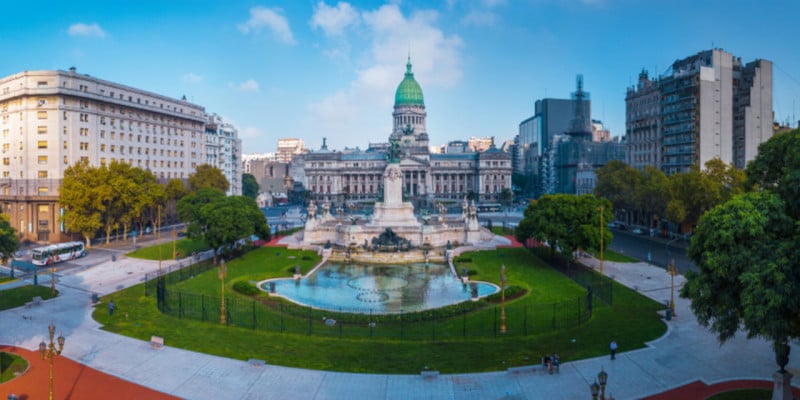
Buenos Aires combines the density of a global capital with the volatility of an economy in constant adjustment. The city covers just 200 km² but holds more than three million residents, while the wider AMBA concentrates 35% of Argentina's population. For newcomers, this means a high-amenity, late-schedule urban life inside Palermo, Recoleta, Belgrano, and a network of 48 official barrios, set against Spanish-first administration, monthly inflation of 2.6% in April 2026, and a rental market that shifts quickly.
Buenos Aires, the federal capital of Argentina and officially known as the Ciudad Autónoma de Buenos Aires (CABA), is a compact, dense capital that punches well above its administrative footprint. The city proper covers 200 km² and has a population of 3,121,707 according to the 2022 census, which translates to a density of more than 15,000 residents per square kilometer. Daily life, however, extends well beyond those boundaries: the broader Área Metropolitana de Buenos Aires (AMBA) concentrates around 35% of Argentina's population and more than 40% of national economic activity.
Buenos Aires is often described as eclectic and cosmopolitan, anchored by a dense cultural calendar, historic cafés, late dining, and a year-round program of festivals. In May 2026, for example, the city government promoted "BA Celebra Europa" on Avenida de Mayo, an event explicitly framed around the city's cosmopolitan profile. For newcomers, the day-to-day feel oscillates between energetic creativity in central districts and the practical friction of navigating administrative complexity and price volatility.
Buenos Aires is widely framed as a late-schedule city, with theatre, cafés, tango, milongas, museums, and football woven into the urban rhythm. Locals typically eat lunch between 12:30 and 15:00 and dinner between 20:00 and 23:00, with social activity often continuing well into the night.
Food culture carries a strong Italian imprint, reflecting historic immigration patterns, and modern dining concentrates in Palermo Soho, Palermo Hollywood, Puerto Madero, Las Cañitas, and San Telmo.
Buenos Aires is officially subdivided into 48 barrios, each mapped in downloadable A3 PDFs by the City Government. Most newcomers, however, concentrate in a smaller northern and central corridor that combines amenities, walkability, and access to public transport.
Palermo, with its sub-areas Palermo Soho, Hollywood, Chico, and Viejo, is the most common landing zone for first arrivals, remote workers, and the digital nomad crowd. It is high in cafés, restaurants, nightlife, and coworking density. Recoleta is generally described as upscale, polished, and quieter, with strong access to museums and parks; it is repeatedly recommended for families and longer stays. Belgrano reads as leafy and residential, also family-oriented. Villa Crespo is frequently suggested as a value alternative adjacent to Palermo, while Chacarita and Colegiales are described as up-and-coming, with a growing restaurant scene.
San Telmo offers historic, bohemian character with strong weekend tourist activity, though older building stock means maintenance varies. Puerto Madero sits at the premium end as a modern waterfront district with the highest rents in the city.
Students often consider Palermo, Belgrano, Recoleta, Villa Crespo, Colegiales, Monserrat, and Microcentro, while digital nomads cluster in Palermo, Recoleta, and Villa Crespo for coworking proximity.
Get regular tips and advice to make the most of your expat life
Cost of living in Buenos Aires
The cost of livingin Buenos Aires is shaped by ongoing price volatility. National CPI inflation reached 2.6% month-on-month and 32.4% year-on-year in April 2026 (INDEC, April 2026). At this pace, monthly budgets are inherently unstable, and expats commonly re-check recurring costs such as rent, transport, and utilities frequently.
For public transport, the Subte (metro) uses a tiered fare structure with a registered SUBE card:
Rides 1 to 20: ARS 1,414.00 (about USD 1.00)
Rides 21 to 30: ARS 1,131.20
Rides 31 to 40: ARS 989.80
Rides 41 and above: ARS 848.40
Premetro: ARS 494.90
Without a registered SUBE, the Subte fare jumps to ARS 2,248.26 (about USD 1.58) for the first 20 rides. Registering the card and achieving higher monthly ride counts are the most direct ways to keep transport costs predictable.
Climate and weather in Buenos Aires
Buenos Aires has four distinct seasons on a Southern Hemisphere calendar: summer runs from December to February and winter from June to August. The City Government explicitly notes that recent decades have brought higher temperatures, greater rainfall, more frequent heat waves, and increased flood risk linked to urban drainage stress.
The Servicio Meteorológico Nacional reported a heat episode affecting CABA and surrounding areas in January 2026. For newcomers, the shoulder seasons are typically more comfortable, while summer requires planning around heat waves and intense convective storms.
When choosing housing, two climate-related considerations matter. First, flood exposure: ask about past water ingress and inspect ground-floor units carefully. Second, heat resilience: check for cross-ventilation, shading, air-conditioning capacity, and the electrical reliability of the building during peak summer demand. For packing, summer calls for breathable clothing plus rain protection, while winter requires layers and a wind-resistant outer layer.
Getting around Buenos Aires
Daily mobility in Buenos Aires runs on three pillars: the Subte (metro), colectivos (buses), and taxis. Public transport requires a rechargeable SUBE card (Sistema Único de Boleto Electrónico). The official city tourism portal recommends using the "BA Cómo Llego" trip planner for routes by public transport, car, or on foot.
The city operates a public, free bike-share system, EcoBici, available 24 hours a day, every day of the year, with a maximum continuous-use window before a station return is required. Foreigners can use the system. For taxis, the City Government's official BA Taxi app allows direct booking and includes support contact channels.
Ride-hailing platforms such as Uber, Cabify, and DiDi operate in the city, though their regulatory situation is evolving: a May 8, 2026 ruling by the Buenos Aires city courts adjusts how these platforms must comply with habilitations, insurance, licensing, and tax obligations, without prohibiting their operation. Owning a car is generally not necessary inside CABA, though regulated street parking operates through the Blinkay app for those who do drive.
Language and communication in Buenos Aires
The administrative language of CABA is Spanish, and official communications and bulletins are published natively in Spanish. Locally, the variant spoken is Rioplatense Spanish, with two features that newcomers notice quickly: voseo, which uses "vos" instead of "tú" with distinct verb conjugations, and a merged "ll/y" sound often pronounced like "sh" or "zh" (yeísmo with rehilamiento).
Buenos Aires also has its own informal lexicon, lunfardo, which appears in casual speech and can produce misunderstandings even for proficient Spanish speakers from other regions. The EF English Proficiency Index 2025 lists a Buenos Aires city score of 594, indicating a meaningful presence of English in the city relative to much of Latin America, particularly in corporate functions such as project management and customer service.
Day-to-day digital communication leans heavily on WhatsApp, which is widely used for business interactions, customer service, and informal coordination in Argentina. Newcomers used to SMS or iMessage conventions should expect to install WhatsApp early.
Pace of life and work culture in Buenos Aires
The general daily pace skews late, with strong night-time social activity. The City Government's "BA 24" program structures nightlife into zones and time slots, with venues in Plaza Serrano and Paseo de la Infanta active Thursday and Sunday from 19:00 to 03:00, and Friday and Saturday from 19:00 to 06:00, while the Distrito Joven runs Friday and Saturday from 22:00 to 07:00.
Argentina's labor laws, which also apply in Buenos Aires (CABA), generally set the maximum working day at 8 hours and the working week at 48 hours under Law 11.544. Public sector employees under the SINEP regime follow a slightly different schedule, with a standard 40-hour workweek from Monday to Friday, while employees in the lower E and F categories may have reduced hours. In practice, however, working hours and workplace culture differ considerably depending on the industry and employer. Labor reform also remains a major political issue, as reflected in the May Day 2026 demonstrations in Buenos Aires, where proposed changes to labor laws sparked significant public debate.
Food in Buenos Aires is both routine and ritual. The official city tourism portal frames the city's food scene as ranging from steak and parrillas to pasta and experimental gastronomy, supported by a strong culture of fairs and markets. Restaurants typically open for lunch and then close until dinner service, which affects planning for anyone used to all-day kitchens.
The late-lunch, late-dinner schedule supports a strong merienda culture: a late-afternoon snack that doubles as a social moment, often described as "merienda hopping" between cafés (Cuisine.com.ar). The bares notables, a preserved network of historic cafés and bars, function as social institutions and have long hosted writers, musicians, and political figures, including Jorge Luis Borges and Carlos Gardel (GCBA: Bares Notables).
Iconic local dishes are reinforced through public festivals. The City Government's Fugazzeta Fest 2026 celebrates fugazzeta as a classic of porteño pizza identity, alongside fugazza and fainá. International street food is well integrated: Buenos Aires Market combines a food court and market format with vendors offering arepas, shawarma, Greek food, and tacos (Descubrir BA, January 2026). The San Telmo Market remains a central reference for browsing produce and casual eating in a historic indoor setting.
For grocery pressure, INDEC reported a 1.5% monthly increase in food and non-alcoholic beverages in April 2026, one of the more contained divisions that month (INDEC CPI April 2026).
Leisure and social life in Buenos Aires
The City Government centralizes cultural programming through its Agenda 2026, which lists major events, concerts, festivals, and museum programming. Among the most anticipated cultural nights is La Noche de los Museos, when hundreds of museums, cultural centers, and art spaces across the city open simultaneously (Noches BA).
Weekend rhythm is anchored in neighborhood life. The Feria de San Telmo operates every Sunday in Plaza Dorrego and along Defensa, combining antiques, street performers, and the historic Casco Histórico. For sports and physical activity, the City Government runs classes through 14 polideportivos (community sports centers), with the Dirección General de Deportes acting as the institutional authority (GCBA Deportes).
Green space matters in a city of this density. The Parque Tres de Febrero, known as the Bosques de Palermo, is the flagship urban park, with attractions including the Rosedal. The Costanera Sur Ecological Reserve, covering 350 hectares, is the city's largest and most biodiverse green space, with trails and wetlands inside the urban footprint. EcoBici provides 24/7 access to free city bikes, and the system is explicitly open to foreigners.
Family life in Buenos Aires
For families using the public school system, place requests are handled through the city's online enrollment system via miBA, including for children entering kindergarten and for students arriving from another jurisdiction or country (GCBA school enrollment). The Instituto de Vivienda de la Ciudad has provided in-person neighborhood help points for document verification tied to school pre-enrollment (IVC enrollment support).
For subsidized private schools that receive government funding in CABA, the City Government publishes maximum fee bands. Under the May 2026 schedule (Disposición 96/DGEGP/26), the Jornada Simple maximums at 100% subsidy include Inicial ARS 44,715, Primario ARS 49,326, Medio común ARS 56,814, and Medio técnico ARS 64,345 (Anexo I, Bandas Arancelarias May 2026). Non-subsidized private schools set fees freely; the city maintains a consultation portal for these schedules.
For early childhood care, CABA regulations define Jardín Maternal as serving children from 45 days to 2 years and Jardín de Infantes for ages 3 to 5 (Normativa BA). Private providers within CABA, including El Jardín de los Abrazos in Caballito and Kinder One on Avenida Federico Lacroze, advertise availability for the current cycle.
Recoleta and Belgrano are repeatedly described as quieter and more family-oriented than Palermo. Many internationally known "Buenos Aires" schools operate in Greater Buenos Aires rather than inside CABA proper, so verifying the physical address of any prospective school against the 48 CABA barrios is worthwhile before signing a lease.
Safety in Buenos Aires
The main day-to-day risk in Buenos Aires is opportunistic petty crime, particularly pickpocketing and snatch theft of bags, jewelry, and mobile phones, which can occur during the day (Smartraveller, May 2026). Numbeo's crowdsourced indices, updated in 2026, show a Crime Index of 62.98 and a Safety Index of 37.02, with perceived safety walking alone at night particularly low at 26.01 (Numbeo: Crime in Buenos Aires). These figures reflect perception, not official crime statistics, but they align with consular guidance.
France Diplomatie names Recoleta, Puerto Madero, Palermo, and Belgrano as residential areas where particular attention is recommended, and urges special caution in La Boca, where the advice is to stay close to Caminito and avoid drifting on football match days (France Diplomatie, April 2026). The City of Buenos Aires provides a dedicated Health and Security resource with access to the Tourist Ombudsman and Tourist Police.
Practical safety habits that consistently reduce exposure include keeping phones out of sight near curbs and traffic, wearing bags cross-body in crowds, staying alert at transport hubs and major sights, and using regulated taxis or ride-hailing for late-night returns. Key emergency contacts include:
Tourist Ombudsman (Defensoría del Turista): +54 11 5295 6906
Environment and livability in Buenos Aires
Environmental quality varies sharply by street and barrio. Major arterials and dense commercial corridors feel louder and more congested, while residential side streets and areas near large parks are noticeably calmer. The City Government operates an Air and Noise Monitoring Network through APRA, with public-facing map pages for continuous tracking.
Tree cover is a meaningful livability factor: the city reports approximately 432,000 public street trees, which provide shade and enhance walkability across many neighborhoods (GCBA, March 2026). For practical planning, the city's interactive map allows users to compare distance to parks and major avenues when choosing where to live.
For recycling, the city's open data portal publishes the locations of green containers for recyclables, which are useful for residents looking for the nearest drop-off point (Buenos Aires Data: Waste infrastructure). The City's Sustainable Mobility program ties transport policy to emissions reductions, which matters for daily exposure to noise and air pollution: choosing housing near reliable public transport reduces reliance on car or taxi trips and improves day-to-day comfort.
Buenos Aires hosts an active, visible expat community supported by a dense diplomatic presence and several binational business networks. The American Chamber of Commerce in Argentina (AmCham Argentina) maintains its headquarters in the city and runs a regular program of events and services for members.
The visible foreign community comprises diplomatic and consular staff, internationally connected business professionals who use chambers as hubs, and a substantial remote-worker and digital nomad scene anchored in Palermo and Recoleta. Coworking density in these neighborhoods makes them practical entry points for arriving remote workers, and the cafés that surround coworking clusters function as informal social mixers.
Integration realities are shaped by language. Spanish is the administrative default for everything from rental contracts to utility setup, so functioning long-term is meaningfully easier with Spanish proficiency. A common arrival pattern is to start in expat-dense areas with strong English-friendly amenities and progressively expand into other neighborhoods, local clubs, and Spanish-language professional contexts.
FAQ
You can function in expat-dense areas, but comfort is limited without Spanish. The EF EPI 2025 score for Buenos Aires is 594, indicating a meaningful presence of English in corporate contexts but not in most administrative tasks. Rental processes, utility contracts, banking, and dispute resolution run in Spanish, so a bilingual helper or steady Spanish learning makes daily life significantly easier.
Expat-focused guidance consistently points to Recoleta, Palermo, and Belgrano as the safest-feeling options, with Recoleta often described as the quietest of the three. Treat this as a practical consensus rather than an official barrio-by-barrio crime ranking. In any neighborhood, late-night habits and street-level awareness matter more than the area's broad reputation.
Short stays are simpler because they avoid the formal rental process, which involves deposits, advance payments, and guarantee requirements that can be hard to satisfy without local documentation. Long-term living rewards Spanish proficiency, a stable income strategy (often foreign currency income or a robust local career), and well-developed neighborhood routines.
The late-night rhythm catches many newcomers off guard, with dinners and social plans regularly starting at 21:00 or later. The other common surprise is rapid price change in pesos: rent quotes, restaurant menus, and service fees can shift between visits, requiring a more flexible mindset than in lower-inflation contexts.
It can be, mainly because day-to-day risk management and financial planning take more mental bandwidth than in more predictable cities. Many residents find that energy translates into a richer social and cultural life once routines stabilize, but the first months often involve more friction than newcomers expect.
Yes, but contract type matters. The city's tenant guide outlines typical upfront costs, including up to one month's deposit at the first-month value and up to one month of rent paid in advance, with signature certifications optional but sometimes agreed between parties (Instituto de Vivienda). Local guarantor schemes such as Garantía+Fácil are limited to CABA and typically require a DNI, which most newcomers will not yet hold, so many expats begin with temporary rentals or work with agencies that accept alternative guarantees.
ℹ️
We do our best to provide accurate and up to date information. However, if you have noticed any inaccuracies in this article, please let us know in the comments section below.
A journalist, holder of the DALF C1 and C2 and a diploma from the University of Mauritius, I have nearly twenty years of writing experience. After six years in the Mauritian press, I joined Expat.com, where I have been working for over a decade, including five years as editorial assistant, and now as editorial manager.
We have been living in the Barrancas Belgrano area for 1 1/2 years,...We feel very very safe. Of course, one should never dress like a rich tourist with Rolexes, etc.
The food is excellent and high quality in both restaurants and grocery stores. About 10 to 20% of the cost for same stuff in Switzerland.
It is surprisingly clean, orderly, and aside from the wearing of masks, every thing is same as before. All stores & restaurants, taxis, busses, trains, ---everything open & operating normally as of May 2021. Pugigalante