

Part of the problem is that many employees who work in the downtown area struggle to afford city apartments. As a result, they end up living quite a distance from where they work. However, there are some things you can do to make your commute easier and some other options for getting around town.
Transportation in Miami
 © shutterstock.com
The Miami work commute can be quite challenging, and the traffic here is considered to be some of the worst in Florida. Getting to and from work, especially if you're in the central areas of Miami-Dade, Palm Beach, and Broward counties, is particularly difficult on weekdays; these counties experience heavy traffic congestion during working hours. Morning commutes on US-1 can still take more than 90 minutes during rush hour, but new public transport projects like the Metro Express Bus Rapid Transit (BRT) are helping reduce travel times—cutting up to 40 minutes for some South Dade commuters.
In this article
The Miami expat guide
Updated in 2025, comprehensive and free
Read it now
Public transportation in Miami
SMART
Miami's transport future is currently being reshaped by the county's SMART Plan (this stands for the Strategic Miami Area Rapid Transit). It's a long-term plan that aims to expand the city's public transport network through new rapid-transit corridors and overall system upgrades. So even if your neighborhood isn't currently connected to the public transport network, there's a chance it might get linked up as part of this upgrade. More info about the plan can be found here: Miami SMART Plan .
The first of the major updates under this plan was launched in October 2025 with the Metro Express, the region's first all-electric Bus Rapid Transit (BRT) line. The service runs a dedicated 20-mile corridor from Florida City to Dadeland South. The BRT operates under Miami-Dade Transit and uses the same payment system and fares as other city transport options ($2.25 per standard trip, valid for three hours across services.)
Miami-Dade Transit offers various payment options, including the EASY Card and EASY Ticket, which can be preloaded with money and travel passes. All services also support contactless and mobile payments, allowing passengers to tap their phones or cards directly when boarding.
There are several updated apps available that provide real-time information on routes, schedules, and service changes. Use the Miami-Dade Transit Tracker or the Metro Express Tracker for live updates and route planning.
Miami's traffic can vary, so it's a good idea to plan your route and departure time, use the above-mentioned trip planning tools, avoid peak hours whenever possible to reduce congestion-related stress, and keep an eye on local news or transport alerts for disruptions or construction updates.
Metrorail and Metromover
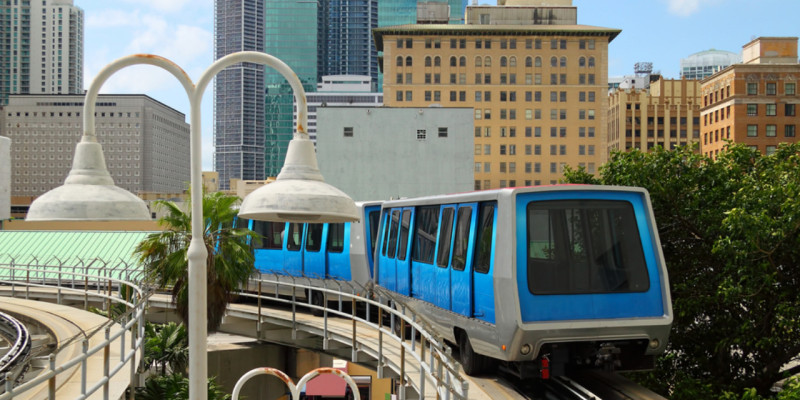
Metrorail is Miami's rapid transit system, providing a convenient way to travel across the city. The Metromover is a free automated people mover that connects key downtown areas. Upgrades to both systems are underway in 2025 to improve reliability. Miami-Dade Transit also operates these services, and fares remain the same at $2.25 per trip.
Metrobus
The Metrobus network covers a wide area, providing access to various neighborhoods and connecting to major transit hubs. It's a cost-effective way to navigate Miami's suburbs and downtown.
Trolley services
Miami offers free trolley services in specific neighborhoods, providing a convenient way to get around without spending a dime. These trolleys are especially popular in areas like Miami Beach and Coral Gables. The trolleys are entirely free to ride and available to everyone. Coverage continues to expand, with new routes linking Wynwood, Downtown, and Coconut Grove in 2025.
Tri-Rail
If you live farther from the city, Tri-Rail is a commuter rail service that connects Miami to neighboring cities and counties. It's an excellent option for those living in the suburbs who need to get to the city for work. The service now connects more directly with MiamiCentral and aligns with Miami's long-term SMART plan.
Join the Miami community
Get regular tips and advice to make the most of your expat life
Carpooling and ridesharing in Miami
To further beat the traffic, consider carpooling with colleagues or using rideshare services like Uber and Lyft. These options can help you save time and money on your daily commute.
Biking and walking around Miami
Depending on your location, biking and walking might be viable short-distance alternatives. Some areas are bike-friendly and have dedicated paths and lanes. Miami continues to expand pedestrian zones and protected bike lanes around transit hubs and along the upgraded SMART corridors.
Taxis in Miami
Taxis in Miami can be convenient, particularly when leaving the airport, but they can also be expensive. The fare is calculated based on the distance you travel per kilometre, averaging around $2.60 per kilometer. While taxis are readily available and easy to find, especially at the airport and city center, they may not offer the same level of reliability as rideshare services like Uber and Lyft.
In addition to traditional taxis, you'll also come across small electric cars known as “Freebee" around the Miami Beach area. These cars have ads on the top and sides and are completely free for passengers to use. It's a unique and cost-effective way to get around the area, particularly for short distances.
Remember that tipping your taxi driver is a customary practice and highly encouraged in the USA. Services like Uber and Lyft allow you to build the tip into the fare when using the app.
Useful links:
ℹ️
We do our best to provide accurate and up to date information. However, if you have noticed any inaccuracies in this article, please let us know in the comments section below.

Comments
Essential services for your expat journey

Choose the best health insurance
Protect your health and get easy access to treatment for expats in Miami.

Plan your international move
Facilitate your move to Miami by getting a quote from our top rated movers.

Open a bank account that suits you
Discover the best international banks to manage your money securely.

International life insurance
Simple term-life insurance covering you & your family across borders
Further reading
Buying property in Miami
Miami has one of the most dynamic real estate markets in the US. As Miami is Florida's most densely populated ...
Accommodation in Miami
Miami is one of the most popular cities in the US to visit—and it's not just about tourism; more and ...
International schools in Miami
Miami, or the Magic City, is one of the most exciting cities in America. Shaped by its Latin American, Caribbean, ...
Living in Miami
Miami is known for being one of the most dynamic cities in the United States, a place where Latin American, ...
The food scene in Miami
When you set foot in Miami for the first time, be prepared for an epicurean journey like no other. This city ...
Discover more
Join the Miami community
Get regular tips and advice to make the most of your expat life
Hot topics on the Miami forum
- Car insurance
- California driving test - steering techniques required?
- Driving in the US
- Driving licence permit
- US Car insurance, now living in Germany
- Splitting time between UK and USA
- International Drivers Permit - Online
- What kind of company car
- Soliom G1 Dual Dash Camera Review
- Financed Car - How to Sell it when moving out of USA
- Purchasing a car
- How to bring your car to the USA
- Buying a car in the USA
- Can someone take your airline ticket from you?
- Declining ports in U.S
- License doubt
- Driving license in the USA
- driving licence