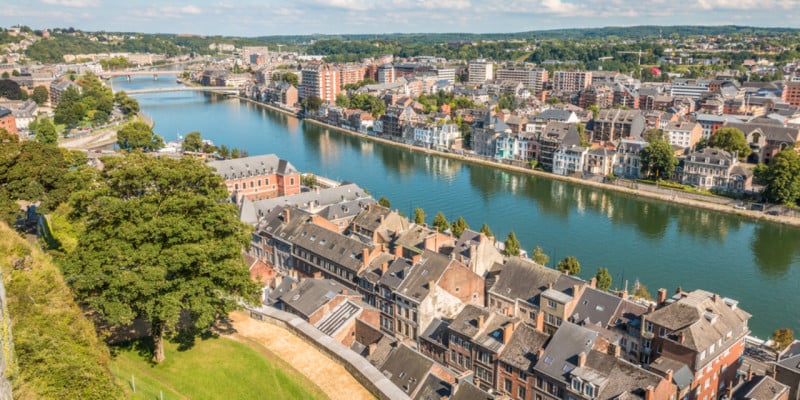
Your first job search in Namur quickly surfaces the defining feature of the city's labor market: nearly every recruiter, every vacancy portal, and every HR document operates in French, and the city's status as Wallonia's administrative capital means public institutions are among the largest employers in the area. That structural reality shapes both where jobs are concentrated and how to approach finding one. The University of Namur is the most internationally open employer, publishing vacancies in French and English, while other major recruiters span healthcare, transport and logistics, and the Walloon regional administration based in the Jambes district.
Wallonia's administrative capital status shapes almost every dimension of Namur's labor market. Public administration, regional institutions, and the education sector together anchor a significant share of city employment, and the private-sector activity that has grown around them fills out the rest.
Healthcare is one of the clearest hiring priorities in the province. Nursing is listed as a shortage occupation in Wallonia by Le Forem (the regional public employment service), with the province of Namur representing 6.1% of regional job opportunities in that role. For anyone with a nursing or allied-health background, the demand is structural rather than cyclical.
Transport and logistics also ranks among the actively recruiting sectors. The XPLORE JOB transport and logistics jobs fair, held in early autumn at Place Saint-Aubain, connects job seekers directly with sector recruiters from across Wallonia. Beyond those two priority areas, active hiring in Namur covers HORECA, IT, construction, scientific occupations, manufacturing, sales, and office administration.
The University of Namur (UNamur) is the city's most internationally oriented institutional employer, covering academic, scientific, administrative, technical, and management posts. With more than 7,200 students from nearly 70 nationalities, UNamur brings genuine international exposure to its workforce and publishes vacancies in both French and English, making it a practical first stop for foreign candidates in research, higher education, or university administration.
Public administration is geographically distributed across distinct districts. The Jambes district, on the east bank of the Meuse, hosts Walloon regional services including the Direction de la Promotion de l'emploi at Place Joséphine-Charlotte 2. The Belgrade district contains an SPF Économie federal building at Rue du Progrès 50. These employers suit candidates with policy, administration, regulatory, or public-service backgrounds who hold Belgian or EU work eligibility and strong French.
On the city's outskirts, four economic activity parks managed by BEP (Bureau Économique de la Province de Namur) concentrate industrial and specialized employers. Namur-Nord/Rhisnes and Namur-Sud/Naninne are general SME and industrial zones suited to logistics, technical operations, and manufacturing profiles. Ecolys, near Suarlée, targets environment and eco-construction businesses, while Care-YS in Bouge focuses on health, assistive technology, nutritional health, and e-health companies. Note that some of these northern parks face electricity-capacity constraints despite available land, which may slow the pace of new employer arrivals in those zones.
Good to know:
A dedicated employment and skills hub is under construction on the Rogier axis, about 500 m from Namur station at the junction of Rues Rogier and Lucien Namèche. Once open, it will concentrate employment guidance, skills development, and public employment services in a single location close to the main rail interchange.
The most efficient job search in Namur combines official public-service channels, the city's own municipal portal, university networks, and a handful of well-established recruitment agencies. French is the working default across virtually all employers; a French CV and cover letter (lettre de motivation) are expected for most formal applications. Preparing both before starting your search will save time and widen your options considerably.
Le Foremis the primary starting point for any job search in Namur. As Wallonia's public employment service, it holds the most complete set of Walloon job listings, handles jobseeker registration, and gives access to training programs. The Ville de Namur employment gateway groups all municipal employment channels in one place: the Agence Locale pour l'Emploi, Cité des Métiers, city roles, Police Zone vacancies, Zone Nage posts, and CPAS openings, making it a useful first stop for understanding the full range of public-sector roles physically based in the city.
Municipal positions with the City of Namur are advertised on the Gestmax recruitment portal, which has recently listed roles including librarian, administrative agents for the Sports department, IT security manager, and roadworks operatives, across open-ended (CDI), fixed-term (CDD), and replacement (CTR) contract types. Academic, scientific, administrative, technical, and management positions at the university are posted on UNamur Jobs, with recruitment material available in both French and English. Early-career candidates and recent graduates should also register with the UNamur Career Center, which connects recruiters with students and graduates across the five universities of the Wallonia-Brussels Federation through the JobTeaser platform.
Several international recruitment agencies have branches in Namur and place candidates across CDI, CDD, and interim (temporary) contracts. Adecco Namur is located at Avenue Prince de Liège 103 in Jambes; Randstad covers Namur listings; Manpower Namur operates from Rue de la Tour 21; SAM Interim is at Rue Pieds d'Alouette 39; and Equip by Job&Talent covers the Namur, Charleroi, and Mons regions. Using several agencies simultaneously is common and raises your chances of recruiter-mediated access to employers who do not always post vacancies publicly.
For broader private-sector searching, Jobs Wallonie aggregates Namur-area vacancies from employers and recruitment firms including the City of Namur itself. Indeed Belgium is useful for volume scanning, though most vacancy descriptions are in French. In all cases, verify salary, contract type, and any work-permit sponsorship directly with the employer, as these details are often absent from listings.
In-person networking shortens the trust gap in a smaller market like Namur. The annual Forum aux professions brings professionals from multiple sectors together for direct recruiter contact, while the XPLORE JOB transport and logistics fair at Place Saint-Aubain allows face-to-face conversations with sector recruiters and live demonstrations of industry roles. The CCI Namur is a further networking resource for business professionals looking to build local contacts.
Non-EEA candidates should check whether a job offer meets Wallonia's work-permit B salary thresholds. From January 1, 2026, the baseline for all work-authorization categories is at least the guaranteed average monthly minimum income, with higher annual gross thresholds applying to certain worker categories. The applicable threshold depends on the permit category and should be confirmed with the prospective employer before accepting any offer.
Join the Namur community
Get regular tips and advice to make the most of your expat life
Salaries and benefits in Namur
Belgium's national wage floor, the guaranteed average monthly minimum income (revenu garanti moyen mensuel minimum, or RGMMI), stands at EUR 2,189.81 gross per month (approximately EUR 13.29 per hour). Every private-sector contract in Namur must meet this floor at minimum, and most sectors set their own higher minima through sectoral collective agreements.
Job listings in Namur show a gross monthly range of roughly EUR 2,200 to EUR 2,882 at entry level and EUR 2,882 to EUR 4,098 at mid-level, across healthcare, manufacturing, sales, administration, and office roles. Logistics and transport positions cluster toward the higher end of the mid-range, with gross offers in the EUR 3,000 to EUR 3,500 band common for that sector.
Belgian wages are shaped by two mechanisms that work differently from many other labor markets. First, sectoral collective agreements are negotiated by a commission paritaire (joint committee) for each industry; the number of the joint committee appears on your employment contract and determines your wage scale, any supplementary benefits, and the pace at which your pay rises. Second, automatic indexation adjusts salaries upward periodically in line with the health index, so nominal pay tracks inflation without annual renegotiation. Before accepting any offer, ask the employer for the joint committee number: it unlocks the sector wage scale tables published by the federal employment service, and it also determines entitlement to extras such as a thirteenth-month bonus.
Belgian gross-to-net conversion is steeper than in many comparable labor markets. Employee social security contributions run at approximately 13.07% of gross, and income tax on top of that means mid-range salaries typically net down to around 60-70% of the gross figure. Running a Belgian net salary calculation before comparing offers is worth the few minutes it takes, as the headline gross can be misleading. Salaries are paid monthly, at the end of the month or as defined in the contract.
Rent in Namur gives a useful calibration for budgeting: a one-bedroom apartment costs around EUR 800 per month in the city center and EUR 675 outside it. At entry-level gross salaries, rent can absorb a significant share of take-home pay after Belgian deductions; mid-level salaries provide more headroom for everyday expenses meaningfully.
Statutory benefits under Belgian law cover the essentials. Full-time private-sector employees are entitled to 20 days of paid annual leave plus 10 statutory public holidays: January 1, Easter Monday, May 1, Ascension Day, Whit Monday, July 21, August 15, November 1, November 11, and December 25. Guaranteed pay during sick leave applies from the first day of incapacity, though the precise mechanics differ between blue-collar and white-collar worker statuses and by sector. Maternity leave for salaried workers covers 15 weeks in the standard case; birth leave (co-parent leave) is a statutory right requiring advance notice to the employer before the leave begins.
Beyond statutory minimums, a well-structured Namur job offer should include several common extras worth verifying in writing: a transport allowance covering commuting costs (required under many sector agreements), meal vouchers (chèques-repas), a remote-work allowance for days worked from home, group or hospitalization insurance, an annual end-of-year premium, and a training budget. A thirteenth-month bonus is widespread in Belgium but is not a national statutory right: entitlement depends on the applicable joint committee or the employer's own policy. Always check this and supplementary insurance coverage before signing, as they can materially change the value of a package beyond gross salary.
Work culture in Namur
Belgian federal rules anchor working hours firmly in the daytime: standard daily work must in principle take place between 06:00 and 20:00, and workers are entitled to at least a 15-minute break once their daily work reaches 6 hours. For most newcomers, this means the professional day is daytime-focused, and expectations of late-evening availability are not a feature of normal workplace life in Namur.
Punctuality is genuinely expected, particularly in public administration and institutional settings. The City of Namur's own work regulations for all municipal personnel frame employment around formal schedules, defined duties, and explicit workplace instructions. Treat agreed start times and meeting times as firm commitments from day one, not approximate targets; this expectation applies across sectors, not just the public service.
The overall formality level in Namur workplaces sits at semi-formal: municipal and institutional employers operate with written procedures and clearly defined roles, while university and internationally facing settings tend toward more flexible practices. The practical approach for a newcomer is to default to slightly more formality than seems necessary in the first weeks, then calibrate once you have observed how your team handles breaks, informal communication, and after-hours contact. Belgian employment is explicitly contract-based, and notice periods are legally calculated from seniority and contract date rather than managed informally; asking HR for the precise formula that applies to your situation when reviewing an offer is a sensible early step.
French is the working language across virtually every Namur employer context: HR documents, contract discussions, formal meetings, and municipal portals all operate in French. English is present in UNamur's international materials and in some technical or research roles, but it does not replace French for daily professional life in most workplaces. Investing in functional professional French before or shortly after arrival will accelerate your integration in almost any setting.
Remote and hybrid work is established in Namur but not automatic. UNamur lists teleworking as an employee benefit, and its management programs combine in-person and remote formats. Arrangements vary considerably by employer and role, however, and in Belgian law, structural telework must be agreed in writing between employer and employee. When evaluating any offer, ask explicitly how many remote days are available and confirm the written arrangement before starting, rather than assuming hybrid will be granted informally.
Professional trust in a city of Namur's scale is built through direct presence and participation in local networks. The UNamur employment unit, the Forum aux professions, sector job fairs, and the CCI Namur chamber all serve as genuine professional-contact channels, not merely social extras. Showing up to these events before or shortly after arriving accelerates the kind of visibility that makes hiring conversations happen in a mid-sized labor market.
Getting to work in Namur
Car use dominates daily commuting in Namur: 88% of workers rely exclusively on their car for the full home-to-work trip. Anyone planning to live more than a short walk or bike ride from their workplace should factor parking availability and cost into the decision before signing a lease, as most peripheral business parks are not served by frequent public transit.
For commuters who work near the station or travel regularly to another Belgian city, train plus bus is the practical alternative. Namur station is a domestic SNCB intercity hub with direct connections to Brussels (approximately 60 minutes), Liège, and Charleroi; the TEC regional bus station sits directly above the railway station in the same building, so transferring between rail and bus requires no extra walk between stops. Season tickets (abonnements) on the SNCB network offer meaningful savings for regular commuters, making the Brussels-to-Namur rail link a realistic daily option for professionals splitting their time between the two cities. Use the SNCB Namur station page to check timetables and season-pass options.
Commute times vary considerably by location. About 18% of workers in Namur province spend more than 1 hour 30 minutes on the full daily return trip, implying over 45 minutes one-way for that group. Workers living in the city center with a central workplace have significantly shorter commutes; those living in outlying communes or commuting to peripheral business parks should test their exact route before choosing a neighborhood to live in.
The morning rush in Namur peaks between approximately 7:30 and 9:00. The city uses access-control traffic lights on some approach roads within the boulevard ring to prevent gridlock during those peak hours. Drivers arriving via the E42, E411, or regional roads are directed to use the motorway ring and enter at the appropriate gate rather than the first available point, which reduces travel time inside the city. The Mobilité Namur portal gives practical guidance on road access and which entry points to use.
Ongoing pedestrianization works in the city center are creating active disruptions that affect driving routes and parking. Streets currently affected include Rue des Croisiers, Rue des Carmes, part of Rue de Bruxelles, part of Rue Émile Cuvelier, and Rue Saint-Jacques. Leave extra time when passing through these streets. Workers whose parking becomes inaccessible can use temporary free parking at Namur Expo or Bouge P+R. For real-time road conditions, Wallonia's PEREX traffic monitoring center operates 24/7; a new version of the service is planned for autumn. Current disruption details and parking alternatives are maintained on the Piétonnier Namur site.
Walking is practical within the historic center: the Vieux Namur quarter is the designated pedestrian area, and the pedestrianization project is extending low-car streets nearby. For workers whose office is around the station, the university, or central municipal buildings, a central address can make a fully walkable commute realistic. Cycling is also actively encouraged by the city, with e-bike use promoted as a commuting alternative. Pro Velo offers route advice through its Point Vélo service at Namur station. The Jambes district provides a cross-river cycling link to the center; Namur station is about 9 minutes by bike from Jambes, making that district viable for cyclists who work centrally.
Choosing a neighborhood based on your work location matters more in Namur than in a larger city with extensive transit coverage. Workers commuting by train or bus are best placed in the Quartier de l'Hôtel de Ville / Gare area, where rail and TEC transfers are concentrated in a single building. Those based at UNamur, provincial public-service offices, or the city's administrative and legal institutions will find the Quartier de l'Université convenient, as the university, Parc Louise-Marie, the courthouse, and the provincial palace are all within that quarter. Jambes, about 3 km from the station (roughly 35 minutes on foot or 9 minutes by bike), suits workers who commute by bike, use local rail at the Jambes or Jambes-Est stops, or need direct access to Walloon regional offices in that district. Before committing to an address, run the exact morning route through the SNCB journey planner and the TEC route planner to confirm transfer times.
Have questions about working in Belgium? Join the Expat.com community to connect with expats who have been through the process.
Frequently asked questions
Namur's job market is structured around its role as Wallonia's administrative capital, which makes public administration, healthcare, and regional services the most structurally stable sectors. Private hiring is active in transport, logistics, manufacturing, and office support roles. French is the working language across virtually all employers, so candidates without strong French face a significantly narrower field. EU work eligibility and recognized qualifications improve access to both public and private roles.
The clearest hiring sectors are public administration and Walloon regional institutions, healthcare (with nursing listed as a shortage occupation in Wallonia), transport and logistics, higher education and research at the University of Namur, manufacturing and industry, and HORECA, IT, and construction. The city's peripheral business parks also host eco-construction and health technology companies. Most roles require French; profiles combining French with English or Dutch add practical value in some technical or academic positions.
Work in Namur is spread across distinct zones rather than concentrated in a single corporate quarter. The station area and nearby Rogier axis are the center for employment services and transit-connected employers. The Jambes district, on the east bank of the Meuse, hosts Walloon regional administration offices. The Belgrade district contains federal public service offices. Four peripheral business parks managed by BEP, covering general industry, eco-construction, and health technology, ring the city for logistics, technical, and sector-specialist roles.
Major employers include the City of Namur's municipal administration, Walloon regional public services based in Jambes, the SPF Economie federal building in Belgrade, and the University of Namur. Healthcare providers and transport-sector companies are significant private-sector employers. For newcomers looking to enter the private labor market, international staffing agencies including Adecco, Randstad, Manpower, and SAM Interim all have Namur branches and place candidates across a range of local employers.
Start with Le Forem, the Walloon public employment service, for the broadest range of vacancies and to register as a jobseeker. The City of Namur's Gestmax portal lists municipal roles, and the UNamur Jobs platform covers university and research positions. For private-sector searches, Indeed Belgium and Jobs Wallonie aggregate Namur-area vacancies. Registering with a staffing agency such as Adecco Namur, Randstad, or Manpower gives recruiter-mediated access to employers. Have a French CV and cover letter ready before you start, as nearly all vacancy descriptions and application processes are in French.
Entry-level gross salaries in active Namur listings run from roughly EUR 2,200 to EUR 2,882 per month; mid-level roles range from EUR 2,882 to EUR 4,098. Belgium's national minimum gross wage is EUR 2,189.81 per month, though most sectors set higher floors through their sectoral collective agreement. Belgian take-home pay is typically 60 to 70 percent of gross after social security contributions and income tax. Benefits such as meal vouchers, transport reimbursement, group insurance, and a potential year-end bonus can add meaningful value beyond the headline gross figure.
Work culture in Namur is structured, rule-conscious, and French-speaking. Belgian federal rules anchor working hours between 06:00 and 20:00, and punctuality is genuinely expected, especially in public-sector and institutional settings. Formal procedures, written contracts, and defined roles are the norm. Hybrid work exists and is legally recognized, but structural telework arrangements must be agreed in writing with the employer. In the first weeks, erring toward formality and clear French communication builds trust faster than a more casual approach would.
The car is the dominant commute mode: 88 percent of Namur workers rely solely on the car for the full home-to-work journey. Train plus TEC regional bus is the practical alternative for those working near the station or commuting to Brussels or Liege. Walking and cycling work well within the city center and for the Jambes-to-center link. Morning rush hour peaks between 07:30 and 09:00, and the ongoing 2026 pedestrianization works create additional disruption in several central streets. Workers headed to peripheral business parks should factor in parking availability before choosing where to live.
Remote work is legally recognized in Belgium and present at Namur employers, including the University of Namur, which lists teleworking as an employee benefit. However, it is not automatic: both structural and occasional telework must be agreed in writing between employer and employee. Hybrid arrangements vary significantly by role and employer, so ask explicitly about the telework policy during recruitment rather than assuming a position is hybrid. Roles in public administration are less likely to offer full remote than university, research, or some private-sector positions.
Yes, particularly for EU citizens with strong French and recognized qualifications. Namur's status as Wallonia's administrative capital means public and semi-public employers account for a significant share of the local job market. The City of Namur's Gestmax portal, Le Forem, and Walloon institutional pages all advertise public-sector vacancies. Some roles may require Belgian or EU administrative eligibility or diploma recognition by the Belgian authorities. Non-EU candidates are generally better served focusing on private employers and contractors serving public institutions while confirming work-permit conditions with prospective employers.
ℹ️
We do our best to provide accurate and up to date information. However, if you have noticed any inaccuracies in this article, please let us know in the comments section below.
I fell in love with words at an early age After a break to focus on my studies, I rediscovered the joy of writing while keeping a blog during my years between London and Madrid. This passion for storytelling and for exploring new cultures naturally inspired me to create Expat.com, a space for my own reflections as well as for anyone wishing to share their experiences and journeys abroad.