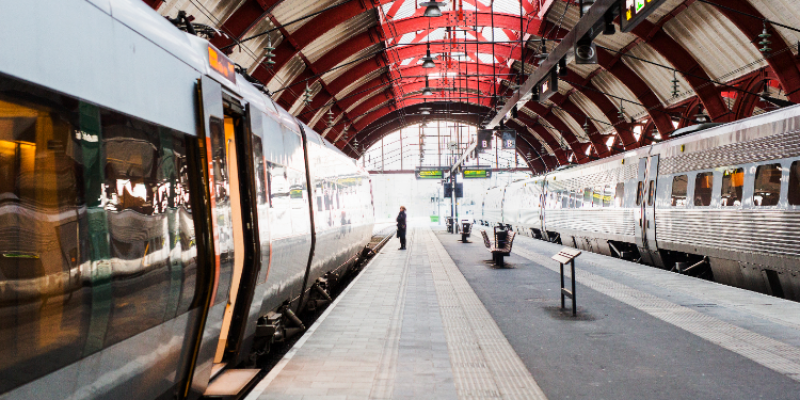
Charleroi's public transport history stretches back further than most Belgian cities expect: the city operates one of the few remaining light metro networks in the country, running on surface tracks and through tunnel sections, alongside a dense TEC bus network. Two separate operators cover the city: TEC (Opérateur de Transport de Wallonie) handles local buses and the light metro, while SNCB handles national rail services, and their ticketing systems are entirely independent of each other. For newcomers, the practical starting point is Charleroi-Central station, which connects all three modes in one place.
Two separate operators run public transport in Charleroi, and understanding that split is the single most useful thing to know before your first commute. TEC (Opérateur de Transport de Wallonie, operating under the brand LETEC) runs the local bus network and light metro (métro léger). SNCB/NMBS runs the national rail network, with Charleroi-Central as the city's main station and the key interchange between the two systems. Their ticketing systems are separate: a TEC ticket does not cover an SNCB train, and vice versa.
For daily life, three digital tools cover most situations. The TEC app handles journey planning, ticket purchase, and MOBIB card management for local bus and metro travel; it is available in French, English, Dutch, and German. The SNCB/NMBS app (belgiantrain.be) covers national train tickets. The City of Charleroi's mobility pages carry information on parking, taxis, and local mobility options. Setting up all three before you arrive saves real time on arrival.
Good to know:
The municipality actively discourages unnecessary car use inside the inner ring and directs residents toward walking, cycling, park-and-ride (P+R) sites, and public transport for central trips. For airport travel, a separate supplement applies: standard TEC and SNCB tickets do not automatically cover the shuttle between the city and Brussels South Charleroi Airport.
What Charleroi calls its "metro" is a light metro (métro léger): a surface-and-tunnel light rail system rather than a deep underground network. Frequencies and platform depths reflect that. Knowing this before you travel sets the right expectations: think of it as a fast tram with some underground sections rather than a full rapid-transit metro.
Four lines operate daily. M1 and M2 connect Anderlues with Charleroi-Central. M3 runs north toward Gosselies, passing through Dampremy, Lodelinsart, and Jumet. M4 serves Gilly. A fifth line, M5, toward Les Viviers, is part of the 2026 network plan. The main intermodal point is Charleroi-Central/Sud, where light metro, national trains, and buses all converge; key interchange stations within the network also include Ouest, Beaux-Arts, and Waterloo.
Good to know:
Metro services are replaced in the evening by bus lines M1AB, M3AB, and M4AB. Check the exact changeover time on the TEC app or at the stop before booking a late-evening journey.
Stations across the network include accessibility features: escalators, ramps, and lifts, with the equipment available at each stop marked on the TEC network map using accessibility symbols. Check station-level access in the TEC app when traveling with reduced mobility. Live schedules and real-time departures are available through the TEC app and TEC website journey planner.
Join the Charleroi community
Get regular tips and advice to make the most of your expat life
Buses in Charleroi
TEC buses fill the gaps the light metro does not cover, serving neighborhoods and hours outside the four metro lines. Charleroi-Central is the primary interchange for bus connections, sitting alongside metro and national train services. The network is dense enough that most areas within the city have some bus coverage, though frequency varies by route and time of day.
Buying your ticket before boarding is the straightforward way to save money: tickets purchased on board cost EUR 0.50 more per journey than pre-purchased fares. Use the TEC app, the TEC website, or a TEC sales point to buy in advance. At stops across the network, QR-code stop sheets are progressively being deployed; scanning the QR code at your stop gives real-time departure information and is more reliable than printed timetables.
The City Pass Charleroi integrates SNCB trains with TEC bus, tram, and metro services and also covers the TEC airport shuttle between Charleroi-Central and Brussels South Charleroi Airport; a valid activation is required for the pass to work on board. The dedicated airport bus, TEC Line A1, connecting Charleroi-Central with the airport terminal, is covered in the airport section of this article.
How to pay for transport in Charleroi
All TEC bus and light metro services in Charleroi use a unified ticketing system. Tickets and subscriptions are stored on a MOBIB or MOBIB Basic card: a reloadable contactless card that works across the entire TEC network. The TEC app can read and load MOBIB cards via NFC on compatible smartphones, making it the most convenient way to manage your balance. Contactless bank-card payment directly on board is not yet active; loading credit or a subscription in advance remains the only option.
The current fare structure, which took effect in February 2026, uses a simplified two-tier system. A Classic single ticket (bus, tram, and metro, excluding Express lines) costs EUR 2.80 when purchased before boarding. An Express single ticket costs EUR 5.50. Buying on board adds EUR 0.50 per journey; using a disposable card unit ticket adds a further EUR 0.30 on top of that. Pre-purchasing through the TEC app or at a sales point is always cheaper.
For regular travel, multi-trip and day products bring the cost down further. A Multi6 pack offers 6 Classic journeys for EUR 13.40, or 6 Express journeys for EUR 26.40. A Classic day pass costs EUR 6.00; an Express day pass costs EUR 11.00. These are practical options while you settle in and assess which subscription tier suits your actual travel pattern.
Monthly and annual subscriptions offer the best value for anyone commuting regularly. For adults aged 25 to 64, a Classic monthly subscription costs EUR 42.00 and an annual subscription costs EUR 420.00. An Express monthly subscription costs EUR 71.00 and an annual subscription costs EUR 710.00. Younger adults aged 17 and under pay EUR 12.50 per month for Classic or EUR 27.00 per month for Express.
Significant reductions apply at both ends of the age range. Travelers aged 18 to 24 can access an annual Express subscription covering the full TEC network for just EUR 12.00 per year. The same EUR 12.00 annual rate applies to passengers aged 65 and over. Those with BIM status (Bénéficiaire d'Intervention Majorée, a Belgian social tariff for low-income households) receive the annual Express subscription free of charge. Children aged 6 to 11 receive a free annual Express subscription; children under 6 travel free on the TEC bus leg of the airport route when accompanied by an adult.
Regular train commuters who also use TEC can combine both through official joint products. A SNCB + TEC Classic subscription covers the whole TEC network except Express lines alongside national rail; a SNCB + TEC Express subscription covers all lines including Express. A one-day combined option adds a TEC day pass (valid on bus, tram, and metro outside Express lines) to a national rail ticket. Tickets for the airport bus can be purchased through the SNCB/NMBS app, ticket machines, or station ticket offices, but not on board the bus.
Taxis and ride-hailing in Charleroi
The city publishes a binding municipal taxi tariff that sets the rates all taxis operating in Charleroi must apply. The tariff distinguishes between station taxis picked up at a rank and taxis booked through an electronic intermediation service (such as a ride-hailing app): app-dispatched rides fall under a lower rate, making them cheaper for short trips than rank taxis.
For a station taxi not booked via an app, the pick-up charge is EUR 3.10, the standard rate is EUR 1.85 per km, and the minimum fare is EUR 10.20 (covering 2 km plus the pick-up charge). For a taxi booked through an app-dispatched service, there is no separate pick-up charge; the rate is EUR 1.70 per km, and the minimum fare is EUR 8.20. Four official taxi ranks operate within the intra-ring area for walk-up use.
Both Uber and Bolt operate in Charleroi and can be requested through their respective apps. Both fall under the lower app-dispatched municipal tariff tier. Taxi services are also available on the airport site at Brussels South Charleroi Airport, making them the practical option for late-night arrivals after the TEC A1 bus finishes its service at 23:30.
Cycling and walking in Charleroi
Charleroi's city center is compact: roughly 1 km wide by 2 km long, with Charleroi-Central station under 300 meters from Place Verte. That scale makes walking a genuinely practical option for short central errands rather than a fallback. A central pedestrian zone covers key streets including rue de Dampremy, boulevard Roullier, place du Manège, and place Vauban; in the Ville-Basse and Ville-Haute areas, pedestrian passages, galleries, and footbridges shorten routes and cut out unnecessary road crossings. Charleroi holds designation as a Commune Piétonne in Wallonia's pedestrian-friendly municipality program.
Cycling is most reliable where you can use a protected corridor. The RAVeL W6 "Au fil de l'eau" follows the Sambre river west toward Thuin and east toward Namur: a dedicated slow path shared with pedestrians, people with reduced mobility, skaters, and horse riders, separated from motor traffic. The Ring Vélo, developed with the Service public de Wallonie, forms an urban cycling routes ring around the city. EuroVelo 3 also passes through Charleroi on a north-south European axis. On RAVeL paths and shared routes, keep predictable lines, pass at low speed, and give extra space when overtaking, particularly on Sambre-side stretches that attract leisure users at weekends.
Comfort changes sharply between these protected corridors and ordinary streets. Test any planned daily commute route on a low-pressure day before committing to it: the fastest car route is rarely the most comfortable cycling route. Belgian national road-safety data records cyclists as 18% of 30-day road deaths across the country, with accidents involving two-wheel users increasing year-on-year; ride defensively, particularly in wet or low-light autumn conditions, and at junctions and pedestrian crossings.
Bike rental is available at the Point Vélo de la gare de Charleroi-Central, operated by Brillo, on the station esplanade. The former Gilly station RAVeL relay also rents standard and electrically-assisted bicycles. For buying rather than renting, used bikes are available at retailers including Cash Express Charleroi, starting from around EUR 35 for children's models and from EUR 100 upward for adult everyday bikes.
Bicycle parking near the center is available a few meters from Place Verte. Use Vélopark, the Belgian federal bicycle parking tool, to locate spots, check available spaces, and see the parking type before locking up. The city also recommends registering your bicycle with MyBike Wallonie as a theft deterrent and to help recover a stolen bike.
Driving in Charleroi
A car makes the most sense in Charleroi for outer districts with limited TEC coverage, airport runs, bulky shopping, late-night journeys, and regional trips beyond the bus and metro network. For short trips inside the compact inner-ring center, the city's own position is clear: walking, cycling, park-and-ride, and public transport are the preferred options, and driving into the center on busy days will often be slower than the alternatives.
No low-emission zone or congestion charge applies to driving in Charleroi. Three Park-and-Ride (P+R) sites sit at the edges of the network: Soleilmont, Gosselies, and Jumet Madeleine, together offering more than 370 free parking spaces with light metro stops nearby for onward travel into the center. This is the city's recommended approach for drivers commuting in from outer areas.
On-street paid parking in managed zones costs around EUR 2.10 per hour, with the first 15 minutes free, up to a daily maximum of EUR 16.80. The city also maintains a supply of free parking spaces in outer areas. Tariff details and zone maps are available through Parking Malin / RCA Charleroi. Newcomers awaiting registration in the population register can obtain a provisional Type A resident parking card for EUR 30 (valid 3 months, maximum 2 per household) through RCA Charleroi; cards are issued per vehicle registration number.
For occasional car use without the cost of ownership, Cambioshared-car stations have been available in Charleroi city center since 2024, with 4 stations in the metropolitan area. Short-term car rental is also available in the city. On major event days, such as the Carnaval de Charleroi, the city and local police publish temporary road closures, parking bans, and alternate-access plans; check the City of Charleroi news page and local police communications before driving into the center on those dates.
Good to know:
Belgium drives on the right. A driving license from an EU/EEA country is recognized without exchange. Non-EU license holders should check the Belgian SPF Mobilité rules on exchange periods before driving.
Brussels South Charleroi Airport sits 10 km from the city center, served primarily by budget carriers, and is a common entry point for people relocating to the city. Three realistic options exist for getting between the airport and the center, ranked by cost.
The cheapest option is TEC Line A1, which links Charleroi-Central station with the airport terminal in around 18 to 20 minutes. The service runs twice per hour from 04:30 to 23:30. The dedicated Bus TEC Charleroi Airport Ticket costs EUR 6.00 per journey and must be purchased before boarding through the SNCB/NMBS app or the belgiantrain.be website, ticket machines, or station ticket offices.be website, ticket machines, or station ticket offices. Buying on board is not possible. Children under 6 accompanied by an adult travel free on the TEC bus portion. From July 4, 2026, Charleroi-Central is the correct interchange for Line A1; the line no longer stops at Luttre or Fleurus, so plan connections accordingly.
SNCB also sells combined train-plus-airport-bus products covering rail travel from other Belgian stations to Charleroi-Central and onward to the airport, useful if you are arriving from Brussels or another Belgian city. Shuttle bus connections from Brussels-Midi station and other points in the wider region also serve the airport, giving an option for newcomers arriving or departing from Brussels.
For arrivals after 23:30, when the A1 bus has finished running, taxi services are available on the airport site. Uber and Bolt also operate in the Charleroi area and can be requested through their apps as an alternative. When taking any taxi from the airport for the first time, confirm the rate applies the municipal tariff before setting off; app-dispatched bookings automatically fall under the lower per-km rate (EUR 1.70 per km, minimum EUR 8.20).
Domande frequenti
Conviene installare l'app TEC e usare Charleroi-Central come punto di riferimento per autobus, metro leggero e treni. Per gli spostamenti brevi nel centro la soluzione più comoda è camminare, visto che la zona centrale è compatta. Per gli arrivi serali, i bagagli voluminosi o gli indirizzi difficili da raggiungere, Uber e Bolt sono un'alternativa affidabile.
TEC gestisce sia autobus che una rete di metro leggero, il che rende il servizio più capillare rispetto a una città servita dai soli autobus. L'affidabilità varia a seconda della linea e dell'orario: meglio consultare le partenze in tempo reale sull'app TEC o tramite i codici QR alle fermate, senza affidarsi soltanto agli orari cartacei.
Prima di arrivare non è strettamente necessario, ma l'app TEC diventa rapidamente lo strumento più pratico per pianificare i percorsi, acquistare biglietti e ricaricare la tessera MOBIB. Comprare il biglietto in anticipo tramite l'app costa 0,50 EUR in meno rispetto all'acquisto a bordo.
Sì, se i propri spostamenti abituali coincidono con le quattro linee operative. Il metro leggero è più efficace per i percorsi verso e all'interno del centro di Charleroi, ed è più utile se abbinato agli autobus TEC. La sera le linee metro vengono sostituite dagli autobus M1AB, M3AB e M4AB: conviene verificare gli orari di cambio sull'app TEC prima di pianificare un viaggio in tarda serata.
Sia Uber che Bolt operano a Charleroi e si possono richiedere tramite le rispettive app. Sono un utile complemento ai trasporti pubblici, soprattutto per gli spostamenti notturni o verso indirizzi difficili da raggiungere. Non conviene però usarli come mezzo principale per i tragitti quotidiani, dato il costo nettamente superiore rispetto a TEC.
Camminare è una scelta concreta per le commissioni brevi nel centro: la zona intra-ring è compatta e dispone di passaggi pedonali e gallerie che accorciano i percorsi. La bicicletta funziona bene sul percorso RAVeL W6 lungo la Sambre e sull'anello ciclabile Ring Vélo, ma il comfort cala sensibilmente sulle strade ordinarie. Prima di scegliere la bici come mezzo quotidiano, conviene testare il percorso in un giorno tranquillo.
Per gli spostamenti brevi nel centro, camminare non ha costi. Per i percorsi motorizzati, TEC è l'opzione più conveniente: un biglietto singolo Classic acquistato in anticipo costa 2,80 EUR e un abbonamento giornaliero 6,00 EUR. Il pacchetto Multi6 abbassa ulteriormente il costo per viaggio. Taxi e corse su app costano molto di più e conviene riservarli a situazioni specifiche.
Lo schema più diffuso è misto: autobus e metro leggero TEC per i corridoi serviti dalla rete, spostamenti a piedi per le tratte brevi nel centro, auto o taxi per le zone meno collegate o negli orari difficili. Prima di scegliere casa, vale la pena verificare sull'app TEC il percorso reale tra l'alloggio e il posto di lavoro: la distanza sulla mappa può essere ingannevole.
Se sia casa che il posto di lavoro si trovano vicino a fermate TEC, si può fare a meno dell'auto. Chi lavora in zone industriali, fa turni serali o abita in quartieri periferici poco serviti troverà un'auto o un noleggio regolare molto più comodi. Le stazioni Cambio di car sharing presenti nel centro offrono una via di mezzo pratica per chi ha bisogno di un'auto solo occasionalmente.
La linea A1 di TEC collega il Brussels South Charleroi Airport a Charleroi-Central in circa 18-20 minuti, con due corse all'ora dalle 04:30 alle 23:30. Il biglietto speciale per l'aeroporto costa 6,00 EUR e va acquistato prima di salire a bordo tramite l'app SNCB/NMBS, il sito belgiantrain.be o le biglietterie automatiche in stazione: non è possibile comprarlo sul bus. Per chi arriva dopo le 23:30, i taxi sono disponibili direttamente in aeroporto.
ℹ️
We do our best to provide accurate and up to date information. However, if you have noticed any inaccuracies in this article, please let us know in the comments section below.
I fell in love with words at an early age After a break to focus on my studies, I rediscovered the joy of writing while keeping a blog during my years between London and Madrid. This passion for storytelling and for exploring new cultures naturally inspired me to create Expat.com, a space for my own reflections as well as for anyone wishing to share their experiences and journeys abroad.