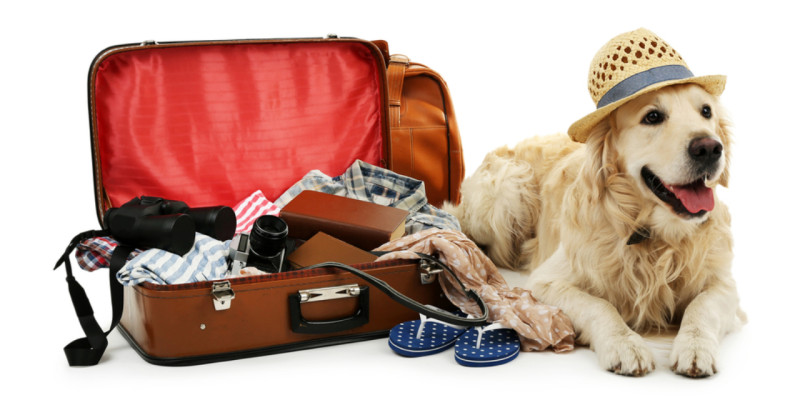
Pets traveling to Belgium
Belgium allows foreign nationals to bring their pets (dogs, cats, ferrets) under certain formalities and conditions.
There are two scenarios:
- You are coming from the EU or the EEA,
- You are coming from any other country.
Read alsoTraveling in Belgium
From EU Member States
Pets must have an HDX or FDX-B microchip technology in accordance with the ISO 11784/11785 standards. The microchip is read by a machine based on this standard. If your pet is not "microchipped" according to this standard, you have the option to use your own compatible scanner.
For tattooed animals before July 3, 2011, a microchip is not necessary.
Pets need a European passport, issued by their veterinarian.
Your pets must be vaccinated against rabies following the current protocols. Once vaccinated, they must be checked by an EU-certified laboratory. The vaccine must have been administered after the pet has received a microchip.
From any other country
Regarding the microchip, the same conditions apply to animals coming from non-EU countries.
They must be vaccinated against rabies. If it is a primary vaccination (first time), following the protocol, it must have been done at least 21 days before travel. As explained earlier, the vaccine must have been administered after the microchip is placed.
According to these regulations, your pet must be at least 15 weeks old before being able to travel to Belgium.
If your pet comes from a country not listed as "rabies-free" by the EU, a rabies antibody titration test is mandatory, performed in an EU-approved laboratory, at least 30 days after vaccination and 3 months before entering the EU.
A veterinarian must issue a health certificate valid for 4 months, dated no more than 10 days before your arrival in Belgium.
If you are coming from the United States or Canada, a USDA/CFIA accredited veterinarian must complete a form for you: the EU998 veterinary certificate.
Read alsoMoving to Belgium
Pets traveling to Belgium by plane
For pets coming from third countries, they can enter Belgium through:
- Brussels National Airport;
- Liège Airport;
- Ostend Airport;
- Charleroi Airport.
Make sure you have all the appropriate paperwork not only to enter Belgium with your pet, but also for all the countries you will transit through before arriving in Belgium.
Most airlines allow small animals (often up to 8 kg including the cage) in the cabin on short or medium-haul flights, but not to the United Kingdom, Ireland, or certain countries like Hong Kong. The number of animals allowed in the cabin is limited, generally 1 per passenger and a maximum of 2 per cabin.
Your pet must fit in an IATA-compliant crate and the crate must fit under the seat in front of you. Although it is possible to place two identical animals in one crate (if they are of the same species and under 14 kg), we recommend placing one per crate for maximum comfort.
For larger animals or those exceeding the weight limit, transport is in a pressurized and air-conditioned hold. Some airlines also impose seasonal restrictions related to extreme temperatures.
Registering dour dog in Belgium
Once in Belgium, you will need to register your pet. Specifically, you must register your dog with the Belgian Association for the Identification and Registration of Dogs (ABIEC) or Belgische Vereniging voor Identificatie en Registratie van Honden (BVIRH), which are the French and Dutch names for the Belgian association for the identification and registration of dogs. If your dog is ever lost, this registration will make it easier to find.
Identification is mandatory by microchip (tattoos are no longer accepted for new identifications since 2016, unless they were done before this date and remain legible).
Once registered, your dog receives a European pet passport, which includes its microchip number and vaccinations.
In case of loss, the registration allows authorities or veterinarians to contact the owner directly.
Useful link:
Federal Public Service - Public Health, Food Chain Safety and Environment