

 Prepared by Julien Faliu on 27 October 2025
With a population of 2.77 million and prime Adriatic coastline, Albania is emerging as a go-to destination for expats seeking affordability in Southern Europe. The country welcomes a growing international community, particularly from Italy, China, Turkey, the United States, and Portugal, drawn by favorable tax policies and exceptionally low living costs. Albanian is the official language, though English is increasingly spoken in urban areas. The local currency is the Albanian lek (ALL), trading at approximately 92 ALL to 1 USD or 100 ALL to 1 EUR.
5 compelling reasons to relocate to Albania
- Extremely affordable living costs at just 41.9% of New York City prices
- Advantageous tax regime with 0% income tax on earnings below ALL 14 million (approximately USD 152,000)
- Visa-free entry for citizens of 90+ countries including EU, USA, Canada, and Australia
- Strategic location in Southeast Europe with easy access to Italy, Greece, and the Balkans
- Growing entrepreneurial ecosystem with government-backed startup support programs
Albania appeals to entrepreneurs, digital nomads, and retirees looking to maximize their quality of life while minimizing expenses. The country combines European standards with developing-world pricing, creating unique opportunities for those willing to embrace its evolving infrastructure.
Key Indicator | Value (2025) |
Total Population | 2,768,761 |
Unemployment Rate | 8.7% (Q1 2025) |
Currency | Albanian lek (ALL) |
Exchange Rate (indicative) | USD 1 ≈ 92 ALL |
Official Language | Albanian |
Sources: Worldometers, Trading Economics
Your setup journey
Guide in 11 steps. Click any step below to jump directly to the section you need.
01Where to Live: Guide to Albania's Major Cities
Choosing your Albanian residence depends on your priorities: dynamic urban life, coastal proximity, mountain setting, or provincial tranquility. Here's a detailed overview of top expat destinations.
Tirana: the capital in transformation
Tirana, with 500,000 inhabitants (900,000 metropolitan), concentrates most economic and cultural activity. The city has undergone metamorphosis in recent years, with building renovations and green space creation. A one-bedroom city center apartment rents for ALL 40,000-60,000 (USD 435-652) monthly.
The capital houses all three major international schools: Tirana International School, World Academy of Tirana, and Albanian International School. Private healthcare facilities like the American Hospital and German Clinic provide quality care. The Blloku district concentrates international restaurants, trendy cafes, and fashion boutiques. Expats also appreciate 21 Dhjetori and Artificial Lake neighborhoods for relative calm.
Downsides: traffic can be chaotic during rush hours, and air pollution poses winter problems. Budget approximately USD 650-870 monthly for singles, and USD 1,630-2,170 for families of four (excluding rent).
Durrës: the Adriatic port city
Durrës, the country's second city with 200,000 inhabitants, sits just 30 km from Tirana. Its port, Albania's largest, maintains regular ferry connections with Italy. The city attracts expats seeking balance between urban life and sea access, with beaches stretching several kilometers.
Rents are more affordable than Tirana: ALL 30,000-45,000 (USD 326-489) for a one-bedroom city center apartment. Overall living costs run 10-15% lower than the capital. The Roman amphitheater, one of the Balkans' largest, testifies to the city's rich past.
Caution: international school options are limited, and private healthcare infrastructure less developed than Tirana. The city is highly touristic in summer, with heavy crowds June through September.
Vlorë: gateway to the Albanian Riviera
Vlorë, with 130,000 inhabitants, marks the Albanian Riviera's beginning. Situated between sea and mountains, the city offers exceptional living for nature lovers. Llogara National Park, accessible in 30 minutes, provides hiking with Ionian Sea views.
Rents remain reasonable: ALL 25,000-40,000 (USD 272-435) for a one-bedroom apartment. The property market experiences sustained growth with numerous construction projects targeting international clientele. The climate is particularly pleasant with over 300 sunny days annually.
Drawbacks: international education options are virtually nonexistent, forcing families with children toward Tirana. The local economy relies heavily on tourism, with notable winter activity decline.
Shkodër: northern cultural charm
Shkodër, with 100,000 inhabitants, is considered the north's cultural capital. The city, near Lake Shkodër (the Balkans' largest lake), offers peaceful setting with rich historical heritage. Rozafa fortress dominates the city and offers spectacular panoramas.
Living costs are lowest among major Albanian cities, with rents from ALL 20,000-30,000 (USD 217-326) for a one-bedroom. Proximity to the Albanian Alps makes Shkodër an ideal base for hiking and mountain tourism enthusiasts.
Major limitation: very few expats reside here, and international service offerings (health, education, dining) are very limited. The city suits expats speaking Albanian or Italian (common in the region).
Sarandë: the southern pearl
Sarandë, a coastal town of 20,000 inhabitants, attracts with Greek proximity (20 km from Corfu) and crystalline waters. The town has become popular among European retirees, particularly Greek and Italian. The beaches of Ksamil, 15 km south, rank among Albania's finest.
Rents vary dramatically by season: ALL 25,000-50,000 (USD 272-543) in low season, but can double in summer. The archaeological site of Butrint (UNESCO) lies nearby.
Attention: Sarandë is essentially touristic, with animation concentrated May through September. Winter is quiet with scarce services. Educational and medical offerings are very limited, making it poorly suited for families with children.
Korçë: high-altitude authenticity
Korçë, a city of 75,000 inhabitants situated at 850 meters elevation in the southeast, offers authentic experience far from tourist circuits. Nicknamed "little Paris" for its European architecture and lively cafes, the city retains old-world charm. The National Museum of Medieval Albanian Education and Museum of Medieval Art testify to its rich past.
Living costs are very low, with rents from ALL 15,000-25,000 (USD 163-272). Winters are cold and snowy, with temperatures potentially dropping below zero December through February. The expat community is virtually nonexistent, and Albanian proficiency becomes essential for successful integration.
Explore our city guides
02Residence Permits: Your Pathway to Long-Term Living
Once you've arrived with the appropriate visa, securing a residence permit becomes essential for extended stays. Albania offers several permit categories tailored to different expat profiles, from employees and entrepreneurs to retirees and digital nomads.
Understanding permit categories
Albania's system distinguishes between Type A permits (non-renewable, fixed duration), Type B or Unique permits (renewable, fixed duration), and Type C permits (permanent, indefinite duration). The Blue Card AL caters to highly skilled workers with renewable status, while the Blue Card AL-C provides the permanent version.
Unique Permit: designed for digital nomads
The Unique Permit targets remote workers and freelancers. Requirements include minimum income of USD 315 monthly, a remote work contract, a tier-2 Albanian bank account, health insurance covering at least EUR 30,000, and a clean criminal record from the past 5 years (apostilled). Initially granted for 1 year, this permit renews up to 5 years. Processing takes a maximum of 12 weeks, though some expats report approval in just 15 business days. After 5 years with this permit, you become eligible for permanent residency.
Investment-based residency
Purchasing property valued at minimum EUR 200,000 opens the door to residence permits. You must own at least 50% of the property, which must provide minimum 20 m² per family member. The initial permit lasts 1 year, renewable for two consecutive 2-year periods. Permanent residency becomes available after 5 years.
Work permits and Blue Card
Securing a work permit requires a job offer from an Albanian employer and qualification validation through the National Employment Agency. Work permits issue for minimum 6-month periods. The Blue Card, reserved for highly skilled employees, requires contracts of at least 1 year. Notable advantage: EU, US, and Schengen citizens enjoy the same employment rights as Albanian nationals.
Student and family reunification permits
Students enrolled in Albanian institutions (public or private) qualify for 12-month permits, renewable annually. Part-time work is permitted up to 15 hours weekly. Family reunification requires proving family ties to an Albanian citizen or permanent permit holder, plus demonstrating adequate financial stability.
Permanent residency: settling for the long haul
After 5 years of continuous legal residence in Albania, you can apply for permanent residency. This permit requires renewal every 10 years but grants rights equivalent to Albanian citizens, except voting privileges.
Fees and processing times
Permit fees range from EUR 60-100 depending on type, with renewals around EUR 50. Processing takes 30-60 days for temporary permits, 3-6 months for permanent permits, and up to 12 weeks for the Unique Permit.
Application procedure
The process begins upon arrival in Albania with the appropriate visa (Type D if required). You must register your address within 30 days of arrival, then submit your application through the e-Albania online platform. An in-person appointment at the Directorate of Border and Migration (DBM) Police is necessary to provide documents, photos, and biometric data.
03Working and Starting a Business: Albania's Economic Landscape
Albania's labor market shows steady improvement, with unemployment dropping to 8.7% in Q1 2025 from 11.58% in 2023. The employment rate reached 68.3% in Q4 2024, reflecting a dynamic economy offering growing opportunities for qualified expats.
Key sectors and opportunities
Albania's economy is service-driven with 48.7% of GDP from services, followed by industry at 20.7% and agriculture at 18.9%. Active hiring sectors include tourism, booming thanks to Adriatic coastline development, information technology, agriculture and food processing, and renewable energy, particularly hydroelectric and solar projects. Construction is also experiencing rapid growth, especially in urban centers like Tirana and Durrës.
Compensation and working conditions
The minimum wage stands at ALL 40,000 monthly (approximately USD 435), while the average salary hovers around ALL 66,451 (approximately USD 722) as of 2024. The standard workweek is 40 hours, with strict limits of 8 hours daily and 48 hours weekly including overtime. Employees receive minimum 20 days paid leave annually, plus 8 public holidays. Maternity leave extends to 365 days (52 weeks paid at 80% salary, then 13 weeks unpaid), with 5 days paternity leave.
Social contributions and taxes
Employees contribute 11.2% of gross salary to social charges (9.5% social security, 1.7% health insurance), while employers pay 16.7% (15% social security, 1.7% health insurance). Mandatory severance pay equals 1 month's salary per year of service, with a 2-month minimum for employees with under 2 years' tenure.
Launching your business in Albania
Albania encourages entrepreneurship with an increasingly business-friendly regulatory framework. Establishing a limited liability company (SHPK) requires minimum share capital of just ALL 100 (approximately USD 1), making business entry remarkably accessible. Promising sectors for entrepreneurs include tourism and hospitality, technology and startups, import-export, organic agriculture, and business services.
The Albanian government supports entrepreneurs through programs like Albania Tech, offering grants up to EUR 20,000 for technology startups. Applications for 2025 grants were open until December 30, 2024. Additional support mechanisms exist through the Business Network Albania for early-stage entrepreneurs.
Company formation process
Setting up a business in Albania involves 7 steps: selecting your legal structure (SHPK, sole proprietorship, etc.), registering your business name with the National Business Center, opening a business bank account, depositing minimum share capital, obtaining a tax identification number (NIPT) from the General Directorate of Taxes, registering with the commercial registry, and enrolling in social security and health insurance. Most procedures can be completed online via e-Albania, significantly accelerating the process.
Before launching, conduct thorough market research to validate your concept, prepare a solid business plan, and engage a local accountant to navigate Albanian tax specifics.
Employment Indicator | Value |
Unemployment Rate (Q1 2025) | 8.7% |
Monthly Minimum Wage | ALL 40,000 (~USD 435) |
Average Monthly Salary (2024) | ALL 66,451 (~USD 722) |
Standard Workweek | 40 hours (max 48h with overtime) |
Annual Paid Leave | Minimum 20 days |
Minimum Share Capital (SHPK) | ALL 100 (~USD 1) |
Sources: Trading Economics, Playroll
Join the discussion on the forum
04Housing in Albania: Rental and Purchase Markets
Albania's property market offers attractive opportunities for both rentals and purchases. Prices remain highly affordable compared to European standards, particularly outside the capital. The Adriatic coast and tourist areas are experiencing price increases due to growing demand.
Rental market: price ranges
In Tirana, a one-bedroom apartment in the city center costs ALL 40,000-60,000 monthly (USD 435-652), while suburban rentals drop to ALL 25,000-35,000 (USD 272-380). A three-bedroom city center apartment runs ALL 80,000-120,000 (USD 870-1,304), and ALL 50,000-70,000 (USD 543-761) outside the center.
On the coast at Durrës or Vlorë, rents run slightly below Tirana levels, except during peak tourist season (June-September) when beachfront area prices can double. In secondary cities like Shkodër or Korçë, rents are even lower, with decent apartments available from ALL 15,000-20,000 (USD 163-217) monthly.
Property purchase: price per square meter
In Tirana, average city center prices range ALL 200,000-250,000 per m² (USD 2,174-2,717 per m²), and ALL 120,000-150,000 per m² (USD 1,304-1,630 per m²) in suburbs. On the coast, particularly in Vlorë, Sarandë, and Durrës, prices vary significantly by proximity to the sea, with beachfront properties at ALL 150,000-200,000 per m² (USD 1,630-2,174 per m²).
Remember that property investment of minimum EUR 200,000 qualifies you for a residence permit, making purchases particularly attractive for expats planning long-term stays.
Finding accommodation
Local online platforms like Merrjep.al, Top-Estates.al, and Properstar.al list thousands of properties. Facebook groups dedicated to Albanian expat life are also active and enable direct rentals without agency fees. Real estate agencies typically charge one month's rent as commission.
Lease agreements and deposits
Rental contracts must be registered with tax authorities to be legally valid. Deposits typically equal one or two months' rent, payable in addition to the first month. Verify property condition and whether utilities (water, electricity, internet) are included in rent. Some landlords prefer cash payments, but insist on written receipts for each payment.
Popular Tirana neighborhoods
Blloku is Tirana's trendy district, a former communist elite neighborhood transformed into a vibrant area with cafes, restaurants, and boutiques. Rents are high but the cosmopolitan atmosphere attracts many expats. 21 Dhjetori (21 December) offers a quiet residential setting with good access to international schools. The Artificial Lake (Liqeni Artificial) area appeals to families with green spaces and central proximity. Kombinat is developing rapidly with new modern buildings at more affordable prices.
Purchase procedure
Property purchase in Albania is open to foreigners without particular restrictions. After finding a property, you sign a preliminary sales agreement with a deposit (typically 10% of price). A notary then verifies ownership and absence of charges. The final deed registers with the National Registration Office, with a registration tax of 1% of sale price. Notary and lawyer fees represent approximately 2-3% of total amount.
Join the discussion on the forum
05Cost of Living: Detailed 2025 Budgets for Albania
Albania ranks among Europe's most affordable countries. With living costs representing approximately 41.9% of New York City and 60-65% of London or Sydney, the country attracts numerous expats seeking to maximize purchasing power. Tirana, though pricier than other Albanian cities, remains highly competitive on a European scale.
Monthly budget for singles
A single expat living in Tirana can expect the following monthly expenses, based on Numbeo data from August 2025. Budgets obviously vary by lifestyle, but these estimates reflect standard comfort without extravagance.
Expense Category | Monthly Amount (ALL) | USD Equivalent |
Rent (1-bedroom, city center) | 50,000 ALL | USD 543 |
Utilities (electricity, water, gas) | 8,500 ALL | USD 92 |
Internet and phone | 2,500 ALL | USD 27 |
Groceries and food | 25,000 ALL | USD 272 |
Dining out (5-6 meals/month) | 10,000 ALL | USD 109 |
Transportation (taxi + bus) | 4,000 ALL | USD 43 |
Entertainment and leisure | 10,000 ALL | USD 109 |
Private health insurance | 15,000 ALL | USD 163 |
TOTAL | 125,000 ALL | USD 1,358 |
Sources: Numbeo Tirana (August 2025)
Monthly budget for family of four
For a family with two school-age children, monthly budgets increase significantly, primarily due to international school tuition. Here's a realistic estimate for Tirana.
Expense Category | Monthly Amount (ALL) | USD Equivalent |
Rent (3-bedroom, city center) | 100,000 ALL | USD 1,087 |
Utilities (electricity, water, gas) | 15,000 ALL | USD 163 |
Internet and phone | 3,500 ALL | USD 38 |
Groceries and food | 60,000 ALL | USD 652 |
Dining out (8-10 meals/month) | 20,000 ALL | USD 217 |
Transportation (car + fuel) | 15,000 ALL | USD 163 |
School tuition (2 children, international) | 200,000 ALL | USD 2,174 |
Entertainment and leisure | 20,000 ALL | USD 217 |
Private health insurance (family) | 40,000 ALL | USD 435 |
TOTAL | 473,500 ALL | USD 5,146 |
Sources: Numbeo Tirana (August 2025)
Comparison with other Albanian cities
Living outside Tirana significantly reduces expenses. In Durrës, expect approximately 15% less than Tirana for rent and services. In Vlorë, the gap reaches 20-25%, while in Shkodër or Korçë, living costs can run 30-40% lower than the capital. These cities offer fewer services and international infrastructure, however.
Reference prices for daily life
Here are some indicative prices to better understand daily living costs (2025 data): a meal at an inexpensive restaurant costs ALL 800 (USD 9), a cappuccino ALL 200 (USD 2), a loaf of bread ALL 60 (USD 0.65), a liter of milk ALL 140 (USD 1.50), a kilogram of chicken ALL 650 (USD 7), and a bottle of table wine ALL 700 (USD 8). Gasoline runs approximately ALL 190 per liter (USD 2), and a monthly public transport pass costs ALL 2,500 (USD 27) in Tirana.
06Healthcare in Albania: Public System and Private Alternatives
Albania's healthcare system combines a public network of facilities with an expanding private sector. While the public system is accessible and inexpensive, many expats opt for private insurance to access higher-quality care and avoid lengthy waiting times.
Public healthcare system
All legal residents in Albania can access the public healthcare system, funded through mandatory social security contributions. Basic care is theoretically free, but in practice, informal payments remain common, representing up to 60% of household health expenditures. The public system suffers from underfunding, with only 3% of GDP allocated to healthcare in 2018, limiting infrastructure and equipment quality.
Public facilities include primary health centers throughout the country, regional hospitals in major cities, and university hospitals in Tirana concentrating most specialized services. Wait times can be extensive for specialist consultations and non-urgent procedures.
Private sector: the preferred option
The private sector offers superior quality care with reduced wait times. Private clinics, particularly numerous in Tirana, feature modern equipment and staff often trained abroad. General practitioner consultations cost ALL 2,000-5,000 (USD 22-54), while specialists charge ALL 3,000-8,000 (USD 33-87). These rates remain highly affordable compared to Western standards.
International health insurance
Most expats subscribe to international health insurance to cover private care in Albania and access medical evacuations to neighboring countries if necessary. Major international insurance providers offer plans tailored to expats, with variable deductibles and coverage levels. Annual costs for comprehensive coverage range from USD 1,000-3,000 depending on age, health status, and selected benefits.
Pharmacies and medications
Pharmacies (barnatore) are plentiful in cities and generally well-stocked. Many medications requiring prescriptions elsewhere are available over-the-counter in Albania. Drug prices are regulated and remain very affordable. 24-hour pharmacies operate in major cities.
Emergency services and useful numbers
The universal emergency number is 127 for ambulances, 128 for police, and 129 for fire services. For serious medical emergencies, prioritize private clinics like the American Hospital or German Clinic in Tirana, which maintain efficient emergency departments with English-speaking staff.
07Tax System: Albania's Progressive and Competitive Framework
Albania modernized its tax system in 2024 with a progressive income tax structure that's particularly generous for low and middle-income earners. Combined with double taxation treaties with numerous countries, the framework makes Albania attractive for entrepreneurs and remote workers.
Personal income tax
The 2025 tax schedule features a significant exemption threshold: 0% tax on annual income below ALL 14 million (approximately USD 152,000). Beyond this threshold, progressive rates apply: 13% on income between ALL 14-15 million, and 23% on amounts exceeding ALL 15 million. This 2024 reform substantially improved purchasing power for most taxpayers.
Corporate income tax
The standard corporate profit tax rate is 15%. However, reduced rates exist for certain sectors: 5% for property rental companies and 0% for IT companies developing original software (copyright-based). This total exemption for the tech sector aims to attract technology startups and innovative businesses.
Value Added Tax (VAT)
The standard VAT rate is 20%. Certain products and services benefit from reduced rates: 10% for tourist accommodation rentals, 6% for pharmaceutical products and certain medical equipment, and 0% for exports of goods and services. Businesses with annual turnover exceeding ALL 10 million (approximately USD 109,000) must register for VAT.
Withholding tax
Withholding taxes apply to payments made to non-residents. Standard rates are 15% for dividends, 15% for interest, and 15% for royalties. These rates may be reduced under applicable tax treaties between Albania and the recipient's country of residence.
Double taxation treaties
Albania has signed tax treaties with over 40 countries, including the United States, United Kingdom, Canada, Australia, and numerous European nations. These treaties prevent double taxation of income and typically provide reduced withholding tax rates. If you're a tax resident of a country with an Albanian treaty, you can benefit from tax credits or exemptions as outlined in the bilateral agreement. Albania also signed the multilateral treaty facilitating implementation of the Subject to Tax Rule (STTR) in September 2025, strengthening international tax cooperation.
FATCA and US citizens
US citizens living in Albania remain subject to US worldwide income taxation and FATCA reporting requirements. Albanian banks report US account holders to the IRS under the intergovernmental agreement. However, the Foreign Earned Income Exclusion (up to USD 126,500 for 2024) and Foreign Tax Credit may significantly reduce or eliminate US tax liability on Albanian-sourced income.
Social security contributions
Social security contributions represent 11.2% of gross salary for employees (9.5% social security, 1.7% health insurance) and 16.7% for employers (15% social security, 1.7% health insurance). These contributions fund the pension system, health insurance, and social benefits.
Filing and payment obligations
Annual tax returns must be filed by April 30 of the following year with the General Directorate of Taxes. Payments can be made monthly or quarterly depending on business activity. The e-Albania platform enables most tax procedures online, considerably simplifying administrative obligations.
08Education Options: Local Schools and International Alternatives
Albania's education system provides free schooling from kindergarten through high school in public institutions. For expat families, several international schools offer English-language curricula, ensuring educational continuity for children.
Local education system
Compulsory education in Albania spans 9 years, ages 6-15. The system divides into three cycles: Parashkollor (preschool, ages 3-6), Arsimi Fillor (primary, ages 6-10, grades 1-5), Arsimi i Mesëm i Ulët (lower secondary, ages 10-14, grades 6-9), and Arsimi i Mesëm i Lartë (upper secondary, ages 14-18, grades 10-12). The academic year runs from mid-September through early June.
Public education is free, though many expat families prefer private or international schools due to language barriers and pedagogical differences. Public schools teach exclusively in Albanian, presenting challenges for non-Albanian-speaking children.
International schools in Tirana
The capital hosts most international schools. Tirana International School (TIS), established in 1991, is the oldest and follows the International Baccalaureate (IB) program. It enrolls approximately 450 students from kindergarten through high school, with strong representation from diplomatic and American expat families. Annual tuition ranges from USD 8,700-16,300 depending on grade level.
World Academy of Tirana (WAT) also offers a complete IB curriculum from kindergarten through IB diploma. This private school emphasizes academic excellence and extracurricular activities. Tuition is comparable to TIS.
Albanian International School (AIS) provides an English-language program based on American and British curricula. It welcomes students of various nationalities and offers diverse sports and cultural activities.
Bilingual and alternative schools
Several private schools offer bilingual Albanian-English or Albanian-Italian programs, enabling better local integration while maintaining strong English proficiency. These institutions typically cost less than international schools, with annual fees between USD 3,300-6,500.
Higher education
Albania has several public and private universities. The University of Tirana, founded in 1957, is the country's largest and most prestigious. Private universities, often partnering with European or American institutions, offer English-language programs in fields like business, IT, and engineering. Private university tuition ranges from USD 1,600-4,300 annually, considerably lower than Western institutions.
09Relocation Planning: Your Move to Albania Checklist
A successful international move requires meticulous preparation. Here's a detailed checklist to facilitate your Albania relocation, step by step.
Pre-departure checklist
- Verify passport validity: Ensure it remains valid at least 3 months beyond your planned departure date.
- Secure appropriate visa: If not visa-exempt, apply for Type D visa at least 2 months before departure.
- Arrange health insurance: Select international insurance covering minimum EUR 30,000 if applying for Unique Permit.
- Gather administrative documents: Birth certificates, marriage certificates, diplomas, bank statements, apostilled criminal record (if residence permit).
- Cancel contracts: Utilities, internet, mobile phone, various subscriptions.
- Notify your bank: Report address change and verify international banking fees.
- Choose moving solution: Sea container (6-8 weeks), air freight (1-2 weeks), or road transport (1 week).
- Arrange vaccinations: No vaccines are mandatory for Albania, but ensure basic immunizations are current.
- Translate documents: Driver's license, diplomas, medical certificates (certified translation to English or Albanian).
- Arrange temporary accommodation: Book hotel or Airbnb for initial weeks while finding permanent housing.
Post-arrival checklist
- Register your address: Within 30 days of arrival with local authorities.
- Open bank account: Choose from local banks like Raiffeisen Bank Albania, Intesa Sanpaolo, or Tirana Bank.
- Obtain tax identification number: NIPT (Numri i Identifikimit për Personin e Tatueshëm) from the General Directorate of Taxes.
- Apply for residence permit: Via e-Albania platform and appointment at Directorate of Border and Migration.
- Get mobile service: Main carriers are Vodafone Albania, ALBtelecom, and One Telecommunications.
- Handle driver's license: You can drive with an international or EU license, though certified translation is recommended.
- Enroll children in school: Contact international schools several months in advance as spaces are limited.
- Register with your consulate: Enroll with your embassy or consulate to facilitate future administrative procedures.
Moving budget
Relocation costs to Albania vary by volume and distance. Expect USD 2,200-5,500 for a 20-foot sea container from Western Europe, and USD 550-1,650 for road transport with shared truck. Add customs fees (typically waived for personal effects) and insurance (recommended).
10Leisure and Culture: Making the Most of Albanian Life
Albania offers surprising cultural and natural wealth, from millennia-old archaeological sites to pristine beaches along the Albanian Riviera and unspoiled mountains in the Albanian Alps. Expats particularly appreciate the diversity of activities accessible near their residence.
Cultural and historical heritage
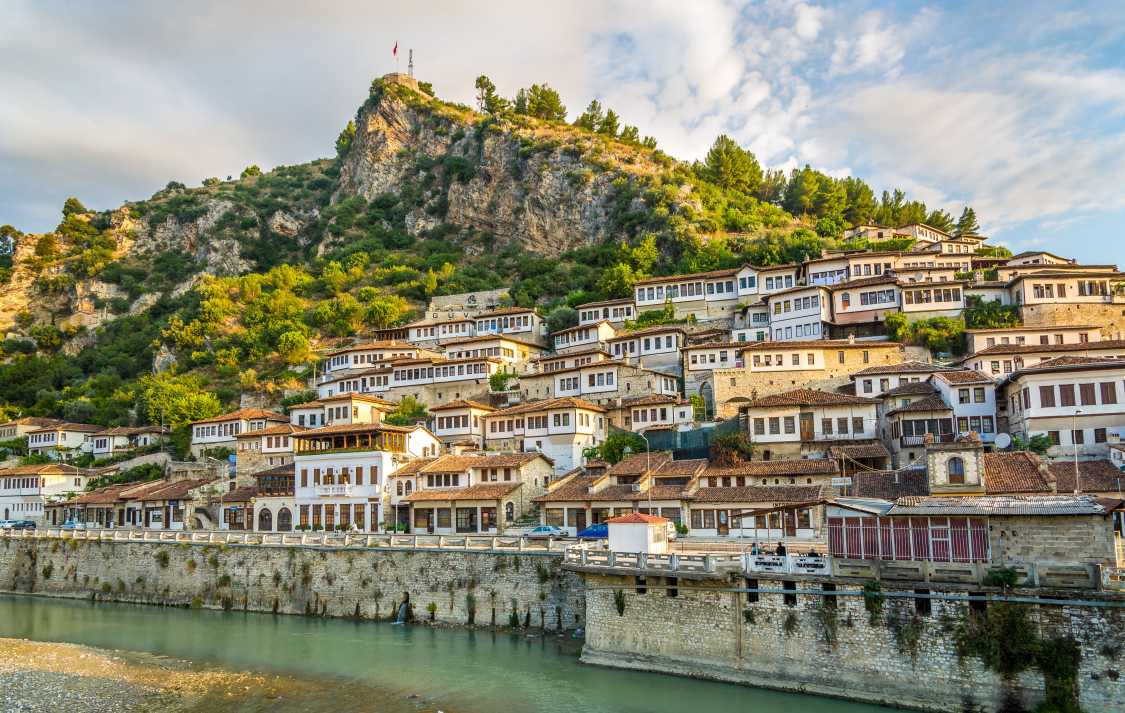
The country hosts three UNESCO World Heritage Sites. Butrint, in the south near Sarandë, is an exceptional archaeological site blending Greek, Roman, and Byzantine ruins. Berat, nicknamed the "city of a thousand windows," captivates with its perfectly preserved Ottoman architecture and castle overlooking the valley. Gjirokastër, birthplace of writer Ismail Kadaré, impresses with its stone houses and imposing fortress.
In Tirana, Bunk'Art (museum in a former communist atomic bunker) and the National History Museum trace the country's turbulent history. The Et'hem Bey Mosque and Skanderbeg Square form the historic heart of the capital.
Nature and outdoor activities
The Albanian Alps in the north offer spectacular hiking, particularly around Theth and Valbonë. The hiking trail connecting these two villages crosses breathtaking alpine landscapes. Llogara National Park on the coast combines mountains and sea with exceptional views over the Riviera.
Water sports enthusiasts will appreciate the beaches of Ksamil, Dhërmi, and Jale, plus diving opportunities around Sarandë. Lake Ohrid, shared with North Macedonia, is one of Europe's oldest lakes and perfectly suited for water activities.
Albanian cuisine
Albanian cuisine blends Mediterranean, Ottoman, and Balkan influences. Don't miss tavë kosi (lamb with yogurt), byrek (meat or cheese pastry), and fërgesë (pepper and cheese dish). Traditional restaurants (lokale) offer complete meals for ALL 800-1,500 (USD 9-16).
Tirana's Blloku district concentrates a dynamic international food scene with Italian, Asian, and fusion restaurants. Cafes are omnipresent, reflecting the coffee culture inherited from the Ottoman period.
Nightlife and entertainment
Tirana offers vibrant nightlife, particularly around Blloku with its bars, clubs, and lounges. In summer, action shifts to the coast where Durrës and Vlorë host busy beach clubs. The Tirana International Film Festival (November) and Summer Day (March 14, public holiday) are major cultural events.
Family activities
Tirana's Grand Park (Parku i Madh), with its artificial lake, offers green space appreciated by families. The Mount Dajti cable car accesses a natural park overlooking the capital, with restaurants and hiking trails. The family beaches of Golem and Spille near Durrës are easily accessible from Tirana.
Expat community
Expats regularly gather at events organized by international clubs and chambers of commerce. Facebook groups like "Expats in Albania" and "Tirana Expat Community" facilitate meetings and practical information sharing. The forum on expat.com also enables exchanges with other expats living in the country.
Join the discussion on the forum
11In Brief: Albania as Your Next Expat Destination
Albania successfully delivers European living standards at prices that challenge all competition. Between its attractive tax system with total exemption up to USD 152,000 in income, visa-free access for 90+ countries, and living costs representing less than half of major European capitals, the country appeals to entrepreneurs, digital nomads, and retirees alike.
Whether you seek Tirana's energy, the Albanian Riviera's coastal charm, or mountain town authenticity, Albania offers diverse settings suited to all profiles. Infrastructure is modernizing rapidly, English is spreading among younger generations, and the expat community grows annually, creating a welcoming environment for newcomers.
Considering making the move? Join the expat community on expat.com to exchange advice, tips, and experiences with those who've already chosen to settle in Albania.
Join the Albania community
Get regular tips and advice to make the most of your expat life
Essential services for your expat journey




Forum topics on living in Albania
Discover forums topics on expat life in Albania: join the conversation, ask your questions, get advice and share your experience.