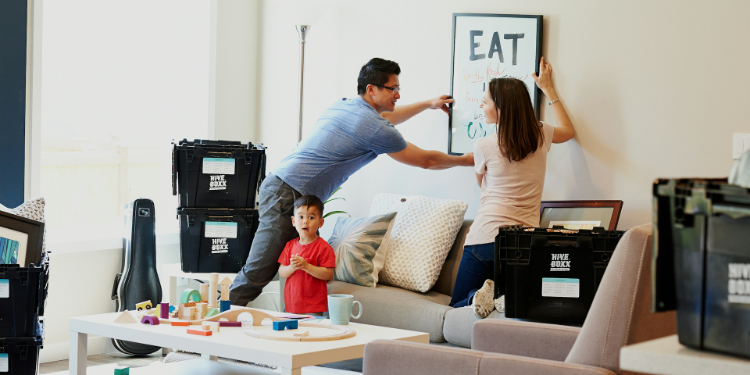
If this is your second or even third international relocation, you may already know the feeling: with each new country, you tend to accumulate anything but ordinary objects. A rug brings back memories of a market you discovered on a weekend trip. A lamp recalls a chance encounter. A piece of furniture tells the story of a home where the children grew up. A ceramic piece evokes a dinner, a landscape, or a particularly happy chapter of life. These objects may have little monetary value, but their emotional worth is immeasurable. They become the tangible witnesses of our lives abroad. And with each move, the collection grows.
When you have enough space, the question barely arises. But sooner or later, the moment comes: you're moving to another country, returning home, or simply downsizing. The children have grown up, habits have shifted, and furniture that felt perfectly at home in a spacious house abroad suddenly has no place in a city apartment.
That's when a deceptively simple question surfaces: what actually deserves to come with us?
Sorting through your belongings before an international move isn't just about cubic meters or shipping costs. It's about deciding what you want to carry forward from the life you're leaving, and how much room you want to make for the one ahead.
Don't wait until you arrive to wonder if you've brought too much
When facing an international move, it's tempting to put off the hard decisions. "We'll take it and figure it out when we get there." It's reassuring, and it spares you from letting go of things when you're already making countless choices. But it can be costly, in every sense of the word.
Once an item arrives at your destination, parting with it becomes even harder. Having paid to ship it thousands of kilometers, selling or giving it away can feel like wasted money. So you keep it, not because you love it or need it, but because it made the journey.
When the new home is smaller, that accumulation quickly becomes a daily burden: furniture blocking the flow of a room, overflowing cupboards, boxes sitting in a bedroom for months, and cluttered surfaces because you lack storage. This is especially true when returning from an expat posting. You're coming back to a country you know, but one whose rhythms you may have partly lost. You're leaving behind a community where you'd built real connections. Your material circumstances and daily routines are changing. And within the same family, not everyone adjusts at the same pace.
In that context, your home plays a vital role: it needs to be a place where you can breathe, rest, and find your footing again. A cluttered space makes that much harder.
Get regular tips and advice to make the most of your expat life
Sort for the life ahead, not just the one behind
Before a move, the instinctive question is usually: "Do I love this?"
But there's another question just as worth asking:
"Does this still fit the life I'm about to live?"
A large dinner service made sense when you regularly hosted big gatherings. An imposing desk was ideal when you had a dedicated study. A floor-to-ceiling bookcase found its natural place in a generous living room.
Your next life may look quite different. You might entertain less, or differently. You may work outside the home more. The children will have grown. You'll have less storage or floor space. Some hobbies will change with the climate, the neighborhood, or the pace of life.
Sorting through your things isn't just about looking back, then. It requires looking forward. Even if you don't yet know exactly what your next home will be like, you can already identify what's essential, what you genuinely care about, what's easily replaceable, and what might be too bulky for a smaller space.
That shift in perspective moves the process beyond pure emotion.
Do you love the object, or the story it tells?
This is often the hardest part.
Some things are hard to let go of because they're tied to memories. Take something you bought on a memorable trip ten years ago. Do you still remember the moment? Probably. But do you still genuinely love the object itself? If you came across it in a shop today, would you want to buy it? That question tends to be surprisingly clarifying.
Our tastes change. Our families change. So do the places we live. It's worth learning to tell the difference between an object you still truly love and one whose story you love more than the thing itself.
Letting go of the latter doesn't mean erasing the memory. You can photograph certain objects, pass others on to people who matter to you, or simply accept that they belonged to a particular chapter of your life without needing to follow you into every one that comes after. Not every memory needs a physical form.
A long expat posting leaves an enormous imprint: objects, yes, but also recipes, habits, words, smells, friendships, landscapes. A few carefully chosen things can sometimes tell a life story far more powerfully than a house full of everything you couldn't bring yourself to leave behind.
Making objects from different countries work together
Homes shaped by several postings often have a particular kind of charm. They tell a story of movement, encounters, and layered attachments. But that richness can be difficult to pull together.
A piece of furniture inherited from back home, a rug bought in Morocco, Turkish ceramics, an African sculpture, a print brought back from Asia, and a later-chosen sofa can each be beautiful on their own. Gathered together, they don't always form a coherent whole. The goal isn't to erase that diversity, which would be a shame. It's to give it a thread.
Color can do that work. A consistent palette can connect objects that share no common origin, era, or style. Materials, proportions, and the furniture surrounding them can create the same kind of continuity.
It also helps to think in terms of sightlines rather than room by room. When doors stay open, or spaces flow into one another, the eye takes in furniture, objects, and colors across both foreground and background at once. A degree of coherence across those layers generally makes a space feel more readable.
The question, then, isn't about stripping everything back. It's about ensuring unplanned accumulation doesn't turn richness into visual noise.
When a beloved piece of furniture is too big for the next chapter
Then there's the hardest situation of all: a piece you still love deeply, but one that's simply too large for where you're headed.
A vast bookcase, a table that seats twelve, a sideboard that filled a dining room beautifully, can all become overwhelming in a much smaller apartment.
Before arranging to ship them, it's worth being very concrete: will this piece actually fit? Will there still be room to move around it comfortably? Does it suit the way you'll be living next? Will it be shown off, or will the whole room end up organized around it?
Another question often helps cut through the uncertainty: if you didn't already own this piece, would you pay to have it shipped to your next home?
When the answer wavers, it may be better to let go before you leave. That's hard precisely because it's never just a piece of furniture. It can be tied to a house, a time in your life, who you were, or something you worked hard to achieve. But selling or passing it on while you're still in place gives you time. You can find it a good home, get a fair price, and sometimes even choose who gets it. Knowing that something you loved is continuing its life somewhere else can make the parting a little easier.
For the things you're genuinely unsure about, three questions can help:
Do I still love this today, setting aside the memory it's connected to?
Does it have a realistic place in the way I'm about to live?
If I had to pay to ship it right now, would I still choose to keep it?
There's no universal formula, of course. Some things will be completely impractical but utterly irreplaceable. Others will be genuinely useful but easy enough to find once you arrive. The goal isn't to leave with as little as possible. It's to bring what truly deserves a place in the life ahead.
Sorting through your things isn't erasing your past
Some objects are real anchors. They reconnect you to a country, people, a happy period, or an identity built over years of living abroad. Those things absolutely belong in your new home. But for them to truly shine, they need space.
Starting this process several weeks or even months before the move means you're not sorting in a panic. You can sit with your things, examine your attachments, picture how you want to live next, and let certain things go more calmly and deliberately.
Because moving on, whether returning home or heading somewhere new, doesn't mean choosing between your past life and your future one. The real aim is to let both coexist. And sometimes, a few carefully chosen objects say far more about a life lived around the world than a home packed with everything you couldn't quite bring yourself to leave.
Je suis la maman de 2 enfants agés de 10 et 6 ans. Je suis revenue il y a peu d'une expatriation de 10 ans en Turquie. Je regrette beaucoup Istanbul pour son côté éclectique et sa douceur mediterrannéenne. Mais je suis aussi heureuse de me retrouver dans un cadre naturel verdoyant et magnifique. J'ai quitté la grande ville pour une vie davantage tournée vers la nature. Dès que je peux, je retourne passer quelques jours en Turquie pour refaire le plein de cette énergie orientale qui me manque tant.