"Once this war is over, fuel prices will collapse," Donald Trump declared. The U.S. president believes he has "very good chances" of reaching a deal with Iran, while also stating he is prepared to take military action if talks fail. In the meantime, prices at the pump continue to break records worldwide, with variations from country to country. How are expats coping with this situation? How are they managing their daily commutes and travel? The Expat.com community shares its experiences.
Whether they're living in the Philippines, Portugal, Indonesia, or Vietnam, expats share the same view: with fuel prices surging, the best approach is to cut back on driving and lean on cycling and public transportation instead. That's exactly what François, an expat in the Philippines, has done. "I only use my small car to go to the market. I also built my own electric tricycle, which I use for getting around locally." Another expat has also turned to tricycles, noting that the fares "haven't changed at all. It's still 15 Philippine pesos per person."
Others have turned to cycling. Moetai, who lives in Portugal, explains: "We ordered a capacitor-based electric bike from France. No charging outlet needed and no lengthy warranty to worry about. It wasn't cheap, but given the inflation..." Lennerd made the same call: "I use my electric-assist bike to get around Ho Chi Minh City." He also thinks about the workers hardest hit by the crisis. "When I take a Grab (an app for booking cars or motorbike taxis) or a regular taxi, I tip at least 20% to help drivers cope with rising fuel costs and the government's fare caps."
That said, cycling isn't always the most practical or affordable option. One expat points out that in Indonesia, it's rarely a realistic choice: "[...] Very few Indonesians own a bike or could afford that extra expense."
Getting around: A question of cost and peace of mind
Income gaps and the differences between locals and expats make direct comparisons tricky. As Ajairon, an expat in Vietnam, puts it: "Comparing prices for locals versus expats is very relative." He explains: "The minimum wage is $420, while the cost of living runs around $600 for a modest family of four. Most people ride 110cc scooters, which cost about $1,400 and get roughly 2 liters per 100 km." Fuel for that type of scooter runs "about a dollar," which is "only $0.15 more than three months ago." For him, the real issue is public buses: "[...] they seat 22 people, or up to 35 when packed. They run every 10 minutes, from 5 a.m. to 8 p.m., and cost under $0.25. Personally, I don't understand why Vietnam isn't increasing bus frequency."
Jrharvey, who "has owned an electric motorbike since early 2023," sees things differently, noting that "the bus network in Ho Chi Minh City is actually excellent. Many buses are brand new and very clean, and the air conditioning usually runs at full blast." He didn't switch to buses because of rising fuel costs, though. It was more about safety and peace of mind. "My wife and I started taking the bus and metro when she got pregnant early last year. It was mainly about safety and avoiding the roads, far more than worrying about the price of gas." The biggest perk: "having a bus stop right in front of our apartment that gets us to the metro in about five minutes. Absolute bliss!" His one complaint: "the lack of real-time GPS tracking on many buses."
Join the community
Get regular tips and advice to make the most of your expat life
Could free public transit be the answer to soaring fuel prices?
Could making buses free be the solution? Austria, France, Luxembourg, Spain... more and more countries have been experimenting with fare-free public transportation. The idea is widely seen as an effective way to reduce private vehicle use while giving everyone affordable access to mobility.
Could Vietnam be next? Phap Tri notes that Ho Chi Minh City "plans to make 35 urban bus routes completely free and phase out all combustion-engine vehicles, replacing them with 100% electric buses in the near future." He also points out that "VinBus is the go-to option" because it's affordable.
Other expats note that, since pump prices haven't risen all that dramatically, public transit is a good deal regardless. One expat in Indonesia sums it up simply: "Public transport is generally pretty good." A fellow expat agrees, though he worries it may be "the calm before the storm." In the meantime, Daniella, who lives in Portugal, has found her own sweet spot: "walking and public transit."
With fuel prices climbing, electric vehicles have emerged as both an economical and eco-friendly alternative. The current crisis has certainly worked in their favor, drawing a growing number of drivers toward EVs. Sandra, who is preparing to move to Portugal, is right in the middle of that decision: "My husband and I are weighing the idea of buying an electric car as we plan our move to the Algarve for the summer of 2027." An expat already living in Portugal tells her he uses his "electric car for short trips."
Another expat takes advantage of living close to the Spanish border to fill up for less: "Since Tavira is only 30 km from Spain, we fill up there at €1.57/l. And for short trips, we use the hybrid." Laurent, an expat in Thailand, has also gone the hybrid route. He's the first to acknowledge he's "fortunate" and thinks about "the everyday people, delivery drivers, taxi drivers, and others who cover kilometers every day and are really feeling the pinch." Like Lennerd, he makes a point of tipping anyone who delivers to him. For Laurent, it's a matter of principle: "When you're lucky enough to be in a decent financial situation, never forget those who aren't, and do what you can to help at your own level."
The indispensable scooter
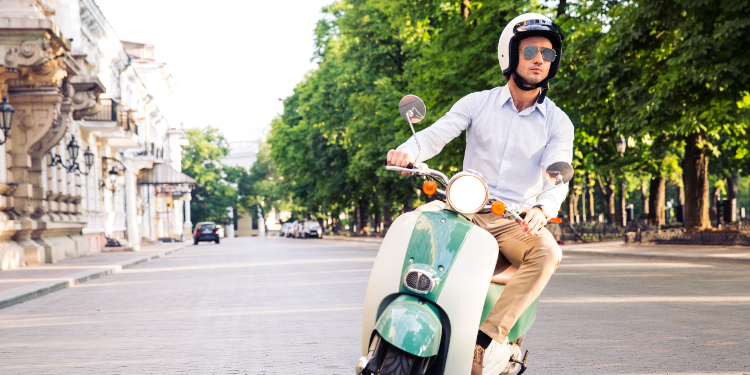
For many expats, the electric scooter is the ultimate answer to soaring fuel prices. Alexander, an expat in Brazil, confirms it: "I get around on an electric scooter. It barely uses any fuel." Kurterino, also based in Brazil, has owned a "small scooter" for two years and has no regrets: "It's a 125cc, so it's perfect for short trips. It's comfortable, though a lot less so with a passenger [...] Mine is yellow, and that's no coincidence. I'd driven thousands of kilometers in rental cars and wanted a bright-colored vehicle so I'd be easier to spot. The beauty of it is that the price of gas barely matters. I spend less than 200 reais a month doing short trips almost every day. It's so little that I hadn't even thought about it until now. I also use Uber pretty regularly."
Aidan, an expat in Vietnam, is a die-hard motorbike fan: "Riding my Honda XR150-L 150cc, I barely notice the slight increase in fuel prices. I haven't taken a bus in thirty or forty years. It's way too hot here to even think about cycling. And given the way I ride, a bike would feel far too slow."
Electric vehicles may save on fuel, but at what cost? That's the question Julien raises. An expat in Mauritius, he explains: "I can't do without a car here, even just to drop the kids off at school a few kilometers away and then commute to Port Louis (20-25 km). I've been driving electric for a while now, so fuel prices don't affect me directly, but electricity prices do." Along the same lines, another expat raises a practical concern: "I've noticed there aren't many charging points in Mauritius." He does, however, agree that "an electric car should make more sense" given the "shorter distances you typically drive on the island."
The cost of electricity and charging availability are also on Sandra's mind as she prepares for her move to Portugal. She wonders whether it's easy to "find charging stations or superchargers in the Algarve."
Uber
In Brazil, some expats have done the math and concluded that Uber beats owning a car. That's the route Tiomark has taken. Al also relies on Uber and is sticking with it even if prices go up: "We use Uber and expect fares to rise with fuel costs. It's still cheaper for us than owning a car, since we'd be paying for fuel either way."
Waiting for the crisis to pass
While the fuel price surge has prompted some expats to rethink how they get around, others haven't changed a thing. That's the case for Jean-Luc, Michel, and several other expats in Thailand, for one simple reason: they don't drive "all that much." Walking more, driving less, going electric, switching to a bike, motorbike, or scooter (electric or not), taking the bus... the range of ways to shield yourself from soaring pump prices is wide. But that variety shouldn't overshadow the bigger questions: access to more affordable and sustainable transport options, income inequality between different populations, and the measures governments are taking to protect the purchasing power of lower-income households from the impact of the fuel crisis.
Freelance web writer specializing in political and socioeconomic news, Asaël Häzaq analyses about international economic trends. Thanks to her experience as an expat in Japan, she offers advices about living abroad : visa, studies, job search, working life, language, country. Holding a Master's degree in Law and Political Science, she has also experienced life as a digital nomad.