Peru sits in one of the world's most seismically active zones, spans terrain from Pacific coastline to high Andes to Amazon jungle, and sees seasonal rains that can close roads, disrupt flights, and cut off tourist corridors for days at a time. For expats living here, knowing what to do before an emergency matters as much as knowing what to do during one. Peru uses separate free emergency numbers for each service rather than a single universal number: police, ambulance, fire, and civil protection each have their own line. Official services operate in Spanish, but a dedicated Tourist Police WhatsApp channel and the Red de Protección al Turista network provide additional support for foreign nationals navigating incidents in unfamiliar territory.
Peru does not yet operate a single nationwide emergency number. Until the unified Emergencias 911 system completes its rollout, each service has its own dedicated free number, and saving them individually before you need them is the most practical step you can take. All calls to these numbers are free from any fixed or mobile phone in Peru.
105: Policía Nacional del Perú (PNP) — police
106: SAMU — medical emergencies and ambulance
116: Cuerpo General de Bomberos Voluntarios del Perú — fire and rescue
115: Defensa Civil (civil protection)
110: Policía de Carreteras (highway police)
118: Guardacostas (coast guard)
100: Línea 100 — gender and family violence (free, 24/7, confidential)
113: Línea 113 Salud — health information and mental health support
117: EsSalud — for users covered by the EsSalud social insurance system
A unified 911 system is being rolled out by PRONATEL and has handled its first real calls during a testing phase, but the Lima Metropolitana and Callao centers are not scheduled to be operational until late 2026. The service-specific numbers above remain the active channels in the meantime.
All official Peruvian emergency lines operate in Spanish. The Tourist Police WhatsApp line at +51 980 122 335 is the most practical channel for foreign visitors who need police support and are not confident in Spanish; it offers a direct, written contact with officers focused on tourist safety. For consular emergencies, your own embassy's after-hours number is the appropriate contact and operates in your language.
Good to know:
Save all relevant numbers on your phone and write them on a piece of paper kept separately from your phone and wallet. Internet connectivity and mobile signal cannot be relied on after earthquakes or in remote areas.
Call 106 (SAMU) immediately for any acute medical emergency: the service operates 24 hours a day and responds to traffic accidents, cardiac events, breathing difficulties, seizures, severe bleeding, fainting, and unconsciousness, among other conditions. The ambulance crew stabilizes the patient during transfer to the designated health facility. SAMU coverage extends across 16 regions, including Lima, Cusco, Arequipa, La Libertad, Piura, Loreto, and Madre de Dios. EsSalud subscribers can also call 117, which coordinates triage by phone and dispatches an EsSalud ambulance when clinically warranted.
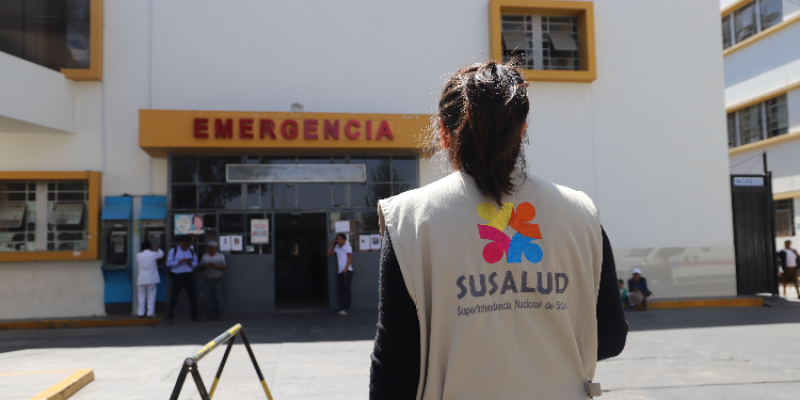
Every public and private health facility in Peru is legally required to provide emergency care without any precondition. No upfront payment, no promissory note, no administrative paperwork, and no identity document may be required as a condition of treatment when a patient's life or health is at serious risk. Both SUSALUD (the health services regulator) and Indecopi (the consumer protection authority) confirm this right. In practice, the emergency department may ask for your passport or Carné de Extranjería (foreigner's ID card) and a contact number to process insurance status and issue medical reports, but they cannot withhold treatment if you do not have these documents on you.
A stable patient may enter the emergency department unaccompanied; an unconscious patient or one unable to care for themselves may be accompanied by one family member. If further care is needed after stabilization, the patient may be transferred to a ward or critical-care area based on clinical priority and available capacity.
The practical cost reality for expats is significant. Public hospitals in Peru are free at the point of care for emergencies, but the quality and availability of services vary considerably, particularly outside Lima. Private hospitals offer better facilities but require either local health insurance, an international policy, or the ability to pay upfront. Embassies cannot pay your hospital bills under any circumstances. International health insurance that covers surgery, hospitalization, and medical repatriation is therefore essential: without it, you could find yourself unable to access the level of care you need, including in a serious situation.
Join the Peru community
Get regular tips and advice to make the most of your expat life
Roadside emergencies in Peru
Call 110 (Policía de Carreteras) for any highway incident, and 106 (SAMU) immediately if anyone is injured; SAMU attends traffic accidents 24 hours a day. The general police number, 105, is also an option if you cannot reach the highway police line.
Peruvian law sets out clear obligations for any driver involved in a road accident. You must stop immediately without obstructing traffic, remain at the scene until the PNP traffic officer arrives, clearly signal the accident site, and assist injured people until medical help arrives. You must not move any element that could be useful for the police investigation, and you must report the accident to the PNP station with jurisdiction over the area and submit to a breathalyzer test. The officer will ask for your personal details and documents.
All motor vehicles circulating in Peru must carry SOAT (Seguro Obligatorio de Accidentes de Tránsito, the mandatory traffic accident insurance) or CAT for qualifying public provincial buses. SOAT and CAT cover occupants and third parties injured or killed in a traffic accident. You can verify whether a vehicle has active SOAT or CAT cover before traveling using the free SBS Reporte SOAT/CAT y Seguro Vehicular tool, searchable by license plate. Keep proof of your own SOAT along with your passport or Carné de Extranjería in the vehicle at all times.
If a hit-and-run vehicle caused the accident and cannot be identified, the MTC's Fondo de Compensación del SOAT y CAT provides compensation. A claim requires a police report and the emergency report from the treating health facility (or, where applicable, a death certificate), submitted through the Fondo SOAT/CAT virtual form.
On Peru's concessioned toll roads, roadside assistance is available through SOS posts installed along the route or by contacting the concession operator's emergency center directly. Services on these roads include 24-hour tow trucks, mechanical assistance, and ambulance or paramedic support where contractually provided. Outside concessioned roads, breakdown assistance must be arranged privately; there is no nationwide automobile-club-style breakdown service covering the whole country.
Call 116 to reach the Cuerpo General de Bomberos Voluntarios del Perú (Peru's volunteer fire service) for fires, vehicle accidents, and rescues. The service operates 24 hours a day, and calls are free from any fixed or mobile phone. When you call, state clearly that the incident involves a fire, give your name and the number you are calling from, and provide the exact address or location. Bomberos dispatch fire, rescue, or ambulance units based on the information given. On arrival, follow their instructions: their role includes rescuing trapped people, evacuating from risk zones, and caring for injured persons.
Peru's dry season, running from roughly July through September, raises the risk of wildfires, particularly in Andean and jungle regions. The COEN (Centro de Operaciones de Emergencia Nacional), the national emergency operations center managed by INDECI (Instituto Nacional de Defensa Civil), monitors forest fires in real time and publishes imminent-danger reports and bulletins. If you live in or are traveling through fire-prone areas during this period, monitoring COEN alerts is a practical precaution.
Good to know:
Peru's fire brigade is composed of volunteers, and response times in rural or remote areas may be longer than in major cities. Health insurance that covers emergency medical evacuation is advisable when traveling in remote regions.
Police in Peru
The single national law enforcement body is the Policía Nacional del Perú (PNP), which operates under the Ministry of the Interior and is reachable at 105. Some municipalities also deploy serenazgo (local municipal security patrols) for public order and crime prevention, but formal police reports and emergency response are handled exclusively by the PNP.
A specialized directorate, the Policía de Turismo (DIRTUR PNP), focuses specifically on the security, protection, and orientation of national and foreign tourists. Tourist Police patrols operate in tourist corridors across Peru. The free Android app "Tourist Police Perú" lets tourists request Tourist Police support directly when their personal safety or that of a companion is affected; it is part of the official Red de Protección al Turista network coordinated by Mincetur, which also brings together the Public Prosecutor's Office, Indecopi, and the Ombudsman's Office. Incidents can also be reported by WhatsApp at +51 980 122 335 or by email at proteccionaturista@mincetur.gob.pe.
For robbery or assault, the recommended sequence is to call 105 first so the operator can record your location and alert the nearest unit, then go to the nearest police station to file the formal complaint. Calling 105 first is not a legal prerequisite for filing the complaint: you may go directly to the station. If the theft occurred at a property, do not touch any objects so fingerprints and evidence are preserved.
For loss or theft of documents, including a passport, driving license, university card, or work ID, the PNP's free Denuncia Policial Digital service is available 24 hours a day from anywhere in Peru. After entering your personal data (validated against Peru's national identity registry) and describing how, where, and when the loss or theft occurred, the system generates an immediately downloadable, digitally signed PDF certificate that has the same legal validity as one issued by a police station. Questions about the service can be directed to 959 051 311.
All police interactions in Peru are conducted in Spanish. The Tourist Police line and the WhatsApp channel (+51 980 122 335) are the most practical first points of contact if you do not speak Spanish.
Natural disasters in Peru
Peru sits in one of the most seismically active zones in the world, and earthquakes and tremors occur regularly across the country. Coastal earthquakes can trigger tsunamis, and higher-than-normal tides can also occur at other times of the year. Ubinas, Peru's most active volcano, has produced gas and ash emissions requiring local evacuations. Understanding which hazards are relevant to where you live or travel, and how to receive alerts, is a practical part of life in Peru for any expat.
The rainy season brings heavy rain and snow that regularly disrupt inter-provincial roads, flights, rail services, and tourist sites in northern Peru, the Andes (including the Cusco region), and jungle areas. Routes particularly vulnerable to rockslides, mudslides, and snow closures include the road to Machu Picchu via the Santa María-Santa Teresa-hydroelectric plant corridor, the Salkantay route, and the route to Manu in Cusco and Madre de Dios. The country is also on El Niño alert, and CENEPRED (Peru's risk assessment body) has updated risk scenarios for flooding and mass movements caused by intense rains in coastal and Andean areas, increasing the likelihood of disruption in those zones.
National disaster coordination is led by INDECI within the SINAGERD (national disaster risk management system) framework. The COEN, based in Chorrillos, Lima, is the national emergency operations center and publishes real-time emergency reports, imminent-danger bulletins, and seismic alerts at coen.indeci.gob.pe. SENAMHI (Peru's national meteorological and hydrological service) publishes severe-weather warnings at senamhi.gob.pe. Peru's early-warning infrastructure also includes the SASPe seismic alert system, the SISMATE emergency messaging system, and the EWBS broadcast alert system, all coordinated through INDECI's national early-warning center.
Before traveling in mountain or jungle areas, check current road and weather conditions with your tour operator and monitor COEN and SENAMHI alerts. If traveling during the rainy season, carry enough food, water, local-currency cash, personal medication, and warm clothing to cope with road, rail, flight, or site closures. The tourist information service iPeru can also provide up-to-date travel-status information for affected areas.
Preparation before an emergency matters as much as knowing what to do during one. Register with your embassy or consulate before or shortly after arriving in Peru so they can send you security alerts and locate you in a crisis. Keep a go-bag with essential documents (photocopies of your passport and visa), medication, cash, and a charged battery bank in your home if you live in an earthquake-prone area. Save all emergency numbers offline on your phone, since internet and mobile connectivity cannot be guaranteed after a major seismic event.
Embassy and consular services in Peru
Peruvian emergency services, ambulance (106), fire (116), and police (105), are the first call in any immediate danger, medical crisis, or crime. Your embassy or consulate becomes the relevant contact when local services cannot provide the support you specifically need: typically when a citizen is arrested, seriously injured or hospitalized, dies, is a victim of serious crime or sexual assault, loses travel documents, or needs nationality-specific emergency travel assistance.
Embassy emergency lines are reserved for genuine emergencies involving risk to safety, liberty, or life. Routine consular matters, such as passport renewals, visa applications, citizenship procedures, and general travel information, must go through the embassy's standard daytime channels; using the emergency line for these requests delays help for people who genuinely need it.
There are important limits to what an embassy can do. Embassies cannot cover your hospitalization or medical costs abroad; without international health insurance that covers surgery, hospitalization, and medical repatriation, you risk being unable to access care in a serious situation. Embassies cannot intervene in Peruvian immigration decisions such as expulsion orders, though they can assist with the exit procedure. They can, however, help find English-speaking lawyers, translators, and interpreters; provide support after serious crime or sexual assault; and assist with dealing with death or hospitalization.
Each major government operates a travel registration system that allows its citizens to receive security alerts and be located in a crisis. Enrolling before arriving in Peru is a straightforward precaution that costs nothing and can make a significant difference in the event of a major earthquake or civil disruption. Check your own government's travel registration portal and sign up before departure.
Lost or stolen documents in Peru
The fastest way to report a lost or stolen document in Peru is through the PNP's free online Denuncia Policial Digital service, accessible 24 hours a day from anywhere in the country via gob.pe. The service covers passports, driving licenses, SOAT, DNI, university cards, and work IDs. After entering your personal data (validated against RENIEC, Peru's national civil registry) and briefly describing how, where, and when the loss or theft occurred, you receive an immediately downloadable, digitally signed certificate PDF. This document carries the same legal validity as one issued in person at a police station. For questions about the service, call 959 051 311.
If the document was stolen during a robbery or assault rather than simply lost, call 105 so the nearest police unit can be dispatched, then go to the nearest PNP station to file the complaint in person. Going directly to the station without calling 105 first is also permitted. If the theft occurred at a property, leave objects in place to preserve fingerprints and other evidence.
Once you have the police report, contact your embassy or consulate to begin the passport replacement process. Store the police report PDF separately from your wallet and travel documents; embassies require it when issuing emergency travel documents. If you need a certified paper copy of a complaint filed in person at a police station, the fee is PEN 7.60 (approximately USD 2), payable at Banco de la Nación using procedure code 2879, with the receipt submitted at the originating police station.
If your documents were stolen through cybercrime, including identity impersonation, phishing, smishing, unauthorized account access, or fraudulent online shops, report via Peru's Central Única de Denuncias (CUD) online cybercrime channel. Reports may be submitted anonymously; after submission, you receive a tracking code to follow the status of your case.
Crime and personal safety in Peru
Street crime is a genuine concern in several of Peru's major cities, including Lima, Cusco, Arequipa, Trujillo, and Ica. The most common incidents are muggings, robberies at gunpoint, phone snatching by motorbike riders, pickpocketing and bag-snatching by organized groups, attacks on vehicles stopped at traffic lights, and robberies and assaults on intercity buses. Sexual assaults have been reported in the Cusco and Arequipa regions. Express kidnappings, short-duration abductions forcing victims to withdraw cash from ATMs, also occur.
Reducing exposure to these risks involves a few consistent habits. Avoid displaying watches, jewelry, or expensive devices in public. Carry only the cash you need for the day and use ATMs inside banks, supermarkets, or large commercial buildings during business hours rather than on the street. Keep bags secure and in your field of vision. Avoid quiet areas and walking alone after dark. When driving, keep doors locked and windows closed, particularly at traffic lights.
Transport choices carry significant safety implications. Use only licensed app-based taxis, hotel-booked taxis, or official airport taxi desks located outside the baggage hall. Never hail a taxi on the street; unlicensed taxis and criminals posing as drivers have been linked to robbery, assault, and express kidnapping. For intercity travel, use reputable bus companies and keep passports, documents, and valuables on your person or within sight rather than in overhead racks or under seats. Criminal roadblocks targeting travelers have been reported on routes outside Lima, so avoid road travel between cities after dark where possible.
Demonstrations and strikes can turn violent without warning and can block roads, railways, and river routes across Peru, including in tourist regions. Monitor local media, follow instructions from local authorities, and be prepared to adjust travel plans at short notice.
Before undertaking adventure or outdoor activities, including zipline, paragliding, kayaking, rock climbing, sand buggies, and surfing, verify that the operator holds a valid license and that they meet health and safety standards. iPeru can provide updated information on licensed tourism and sports service providers.
To report a crime, call 105 for an immediate police response, then go to the nearest PNP station to file the formal complaint. For tourist-related incidents, the Tourist Police WhatsApp at +51 980 122 335, the "Tourist Police Perú" app, or the email proteccionaturista@mincetur.gob.pe are all available channels within the Red de Protección al Turista network.
For violence against women or family members, Línea 100 (free, 24/7, confidential) provides information, counseling, and emotional support in Spanish, Quechua, and Aymara. Chat 100 offers the same support online. The free Yanapp app geolocates nearby police stations and Centros Emergencia Mujer (women's emergency centers) and can call 105 directly with one tap. Human trafficking can be reported to Peru's Central Única de Denuncias (CUD) online, to the free MININTER line 1818, or through the nearest police station, Centro Emergencia Mujer, or prosecutor's office; reports may be made anonymously.
If you or someone you know is experiencing a mental health crisis, call 113 and select option 5 for free, 24-hour support through Peru's Ministry of Health. The line covers suicidal ideation, depression, anxiety, stress, addiction, behavioral and relationship problems, and general psychological distress. You do not need to give your name to receive help. For complex cases, an optional callback within 24 hours can be arranged.
The same service operates in partnership with the Instituto Nacional de Salud Mental Honorio Delgado-Hideyo Noguchi (INSM), Peru's national mental health institute. For direct contact with the INSM, call (01) 748-5600 annex 1145, available 24 hours a day. The institute is located at Av. Eloy Espinoza Saldaña 709, Urb. Palao, San Martín de Porres, Lima.
If a phone call is not possible or safe, Línea 113 Salud also provides mental health support by WhatsApp at 955 557 000 and by Telegram at 952 842 623, as well as by email at infosalud@minsa.gob.pe. These written channels are equally available 24 hours a day.
All crisis services described above operate in Spanish. If you need support in another language, contact your embassy for a referral to a mental health professional who can work in your language.
A small set of free tools covers most emergency scenarios you are likely to face in Peru, and downloading them before you need them takes only a few minutes.
For disaster and severe-weather monitoring, bookmark the COEN-INDECI portal. It provides real-time emergency reports, imminent-danger bulletins, seismic alerts, and alert modules for all active hazards across Peru. SENAMHI (senamhi.gob.pe) publishes meteorological warnings for severe weather events. Both are free and require no account.
The free Tourist Police Perú Android app lets you request Tourist Police support directly when your personal safety or that of a companion is affected. It is part of the official Red de Protección al Turista network and connects you to officers focused specifically on tourist incidents.
The free Yanapp Android app, developed by Peru's Ministry of Women and Vulnerable Populations (MIMP), is designed for anyone facing or at risk of gender or family violence. It provides one-tap access to Línea 100, an emergency geolocation feature that identifies nearby police stations and Centros Emergencia Mujer, and a direct dial to 105.
Chat 100, accessible through MIMP channels online, provides free written counseling and orientation for violence against women and family members. It is a practical alternative when a phone call is not possible or safe.
If you have travel or health insurance with RIMAC, the RIMAC app lets insured users locate assistance services and track their case through the app. Check whether your international insurer has an equivalent app and save their emergency assistance number offline before you travel.
Finally, the single most useful preparedness step is also the simplest: save all emergency numbers as contacts on your phone and write them on a card kept separately from your wallet. The numbers to have are police (105), SAMU (106), fire (116), civil protection (115), highway police (110), Línea 100 (100), mental health crisis (113 option 5), and your embassy's 24-hour emergency number. Register with your government's travel registration system before arriving, and sign up for your embassy's security alert emails so you receive real-time updates on conditions in Peru.
Frequently asked questions
Peru does not have a single nationwide emergency number in full operation. Use service-specific free numbers: 105 for police, 106 for medical emergencies (SAMU), 116 for the fire brigade, 115 for civil protection, and 110 for the highway police. A unified 911 system is in a testing phase, but has not replaced these numbers. Save each number individually on your phone before you need it.
Call 106 (SAMU) immediately; the service operates 24 hours a day and responds to accidents, cardiac events, breathing difficulties, and other acute conditions. Any public or private hospital in Peru is legally required to provide emergency care without any precondition: no upfront payment, no administrative procedure, and no identity document can be demanded while your life or health is at serious risk. Bring your passport or residency card if available, but the hospital cannot withhold treatment if you do not have it.
File a free police report immediately using the PNP's Denuncia Policial Digital service online at gob.pe, available 24 hours a day. The system generates an immediately downloadable, digitally signed certificate with the same legal validity as one issued at a police station. If your passport was stolen in a robbery, call 105 and go to the nearest police station as well. Then contact your embassy or consulate with the police report to begin the replacement process, and keep the PDF stored separately from your travel documents.
Call 105 to alert the nearest police unit and give your location, then go to the nearest PNP police station to file the formal complaint. For document theft, the free online Denuncia Policial Digital service is available around the clock. For tourist-related incidents, the Tourist Police WhatsApp line at +51 980 122 335 is a direct channel for support. Contact your embassy for consular assistance if the crime was serious, such as assault, robbery at gunpoint, or sexual violence.
Yes. Call 113 and select option 5 for free, 24-hour mental health crisis support from Peru's Ministry of Health, covering suicidal ideation, depression, anxiety, addiction, and related concerns. You do not need to provide your name. Support is also available by WhatsApp or Telegram at 955 557 000 and 952 842 623, which is useful when a phone call is not possible. All services operate in Spanish.
Call 110 (highway police) for road incidents and 106 (SAMU) if anyone is injured. On concessioned toll roads, use the SOS posts along the route or call the concession operator's emergency center for towing and mechanical assistance. Outside concessioned roads, breakdown assistance must be arranged privately. All vehicles circulating in Peru must carry active SOAT (mandatory road insurance) or CAT cover, which protects occupants and third parties injured in an accident.
Save the following numbers offline on your phone: 105 (police), 106 (SAMU), 116 (fire brigade), 115 (civil protection), 110 (highway police), 113 option 5 (mental health crisis), 100 (gender and family violence), and your embassy's 24-hour emergency line. Bookmark the COEN-INDECI portal at coen.indeci.gob.pe for real-time disaster and severe-weather alerts. Download the Tourist Police Peru app for tourist safety incidents and the Yanapp app for gender or family violence emergencies with geolocation. Register with your government's travel registration system before arriving in Peru.
Use Peruvian emergency services first for any immediate danger: 106 for ambulance, 116 for fire, and 105 for police. Contact your embassy when you are arrested, hospitalized, seriously injured, or deceased; when you are a victim of serious crime or sexual assault; when you need emergency travel documents; or when you need nationality-specific consular support that local services cannot provide. Embassy emergency lines are reserved for genuine emergencies and are not for visa, passport renewal, or routine consular inquiries.
Official Peruvian emergency lines (105, 106, 116, and 113) operate in Spanish. The Tourist Police, reachable by WhatsApp at +51 980 122 335 and through the Tourist Police Peru app, can assist tourists and may help bridge language barriers in some situations. Your own embassy's after-hours emergency line operates in your language. Carrying a translation app saved for offline use is advisable for medical or police situations where no interpreter is present.
ℹ️
We do our best to provide accurate and up to date information. However, if you have noticed any inaccuracies in this article, please let us know in the comments section below.
A journalist, holder of the DALF C1 and C2 and a diploma from the University of Mauritius, I have nearly twenty years of writing experience. After six years in the Mauritian press, I joined Expat.com, where I have been working for over a decade, including five years as editorial assistant, and now as editorial manager.