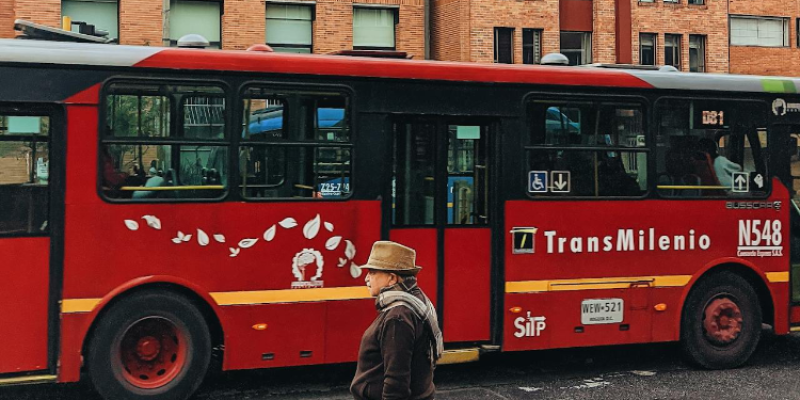
Bogota runs on one of Latin America's largest Bus Rapid Transit networks, a sprawling cycling infrastructure, and a ride-sharing scene that most expats rely on from day one. The city is also mid-way through a landmark transformation: its first metro line is under construction and reshaping traffic patterns across major corridors. Whether you plan to commute daily on the TransMilenio, cycle through Chapinero, or drive under the Pico y Placa restriction system, understanding how Bogota moves will save you time, money, and frustration from the moment you arrive.
Bogota's day-to-day mobility rests on two interlocking public systems: the TransMilenio Bus Rapid Transit (BRT) network, which runs articulated red buses along dedicated trunk corridors, and the Integrated Public Transport System (SITP), which operates blue zonal buses throughout the city's neighborhoods. Together, these two systems form the backbone of public transit for millions of daily commuters.
Alongside public transit, cycling holds a central place in Bogota's transport network. The city maintains an extensive network of dedicated bike lanes and supports a large shared-bicycle scheme operated by Tembici. For private and hired travel, regulated yellow taxis and ride-sharing apps are both widely available, with most expats gravitating toward apps for the added safety of fare transparency and driver traceability. Traffic congestion is managed through the Pico y Placa license plate restriction system, which limits when private vehicles can circulate on weekdays. The city's ongoing metro construction adds an additional layer of disruption to certain corridors, particularly along Avenida Caracas and Avenida Guayacanes, where road closures and detours are a daily reality.
Bogota currently has no operating metro system. Line 1, the city's first metro line, is under active construction and reached 73.75% completion by February 2026 (Bogotá District Government). Test runs with moving trains on a designated viaduct section, connecting the maintenance depot to Station 4 in the Kennedy locality, are scheduled to begin in July 2026. Commercial passenger service is not expected to launch until March 2028.
For expats arriving now, the metro is not yet a travel option. However, its construction directly affects daily movement: expect significant road closures and traffic delays along the affected avenues while work continues.
Good to know:
Once Line 1 opens, it will connect the western districts of Bogota to the city center, offering a faster alternative to bus transit along one of the city's most congested corridors.
Join the Bogota community
Get regular tips and advice to make the most of your expat life
Buses in Bogota
The TransMilenio trunk lines carry the heaviest passenger loads, running large red articulated buses along dedicated median lanes on major avenues. These buses operate at high frequency and connect key portals across the city. The SITP zonal buses, identified by their blue livery, extend coverage into residential neighborhoods where TransMilenio trunk lines do not reach. Both systems share a unified fare structure and use the same smart card for access.
As of January 14, 2026, the flat fare across all TransMilenio trunk routes, SITP zonal buses, and the TransMiCable aerial cable car is COP 3,550 (approximately USD 0.97). The district government maintains an active subsidy program that provides free travel to over 636,000 users, including those living in extreme poverty, seniors, and people with disabilities.
Rush hours run roughly from 6:00 a.m. to 8:30 a.m. and from 4:30 p.m. to 7:30 p.m. During these windows, TransMilenio stations and buses can become very crowded, so it's advisable to stay attentive to your belongings.
Tickets and passes in Bogota
Riding any TransMilenio or SITP service requires a Tullave smart card. The basic or personalized Tullave card costs COP 8,000 (USD 2.18) and can be bought at major TransMilenio portals. Personalizing your card is strongly recommended: it protects your remaining balance if the card is lost or stolen and unlocks free transfers within a set time window between connected services.
Frequent riders can take advantage of the TransMiPass, a monthly subscription offering 65 trips for COP 160,000 (USD 43.61). This brings the effective cost per trip down to approximately COP 2,462, well below the standard single fare. To obtain a TransMiPass, you need to present a valid identity document at an authorized TransMilenio portal ticket office, such as Portal 80, Portal Norte, or Portal El Dorado.
Since early 2026, the transit authority has integrated mobile payment options through the digital Maas app and linked banking entities, giving users an alternative to the physical Tullave card for paying fares at station gates.
Taxis in Bogota
Bogota's regulated yellow taxis operate under a strictly controlled fare structure updated annually. Following District Decree 042 of February 2026, the minimum taxi fare in the city stands at COP 8,000 (USD 2.18). Rather than displaying a direct price, taxi meters show numerical units that passengers must cross-reference against an official conversion chart displayed on the back of the front passenger seat to determine the final amount owed.
Hailing a taxi on the street is generally discouraged for safety reasons. Booking through a digital platform such as Cabify, which also connects users to regulated yellow taxis, provides fare transparency and driver identification before the trip begins. If a driver claims the meter is not working or declines to show the official conversion chart, the safest option is to end the ride and book through an app instead.
Ride-sharing in Bogota
Ride-sharing apps, including Uber, Cabify, and DiDi, are fully operational across Bogota and represent the most common way expats travel by car. These platforms offer upfront pricing before you confirm a booking, which eliminates the need to calculate fares from a meter chart. Prices fluctuate based on demand, weather, and time of day; during surge periods, traditional taxis booked through an app can sometimes work out cheaper for shorter city trips.
As of 2026, the Uber app includes a dedicated "Taxi" feature that allows users to book and pay for regulated yellow taxis directly through the platform, combining the convenience of app-based booking with the legal certainty of the regulated taxi fleet. The legal framework governing private ride-sharing tiers remains somewhat ambiguous in Colombia, and some drivers may ask passengers to sit in the front seat to avoid drawing attention from traffic enforcement. This is a widely observed local practice rather than a formal requirement.
Cycling in Bogota
Bogota has one of the most developed cycling infrastructures in the region, with extensive dedicated bike lanes running through many of the city's main corridors. The shared-bicycle network is operated by Tembici, which provides over 3,300 mechanical and electric bicycles across 300 stations throughout the city.
A monthly subscription to the Tembici system costs COP 34,650 (USD 9.44) and allows up to 4 trips of 60 minutes per day on mechanical bikes. For occasional riders, a daily plan is available for COP 9,990 (USD 2.72), with an additional COP 890 charge per bicycle withdrawal. All bikes are unlocked exclusively through the official "Tembici: bicis compartidas" smartphone app.
Every Sunday and on public holidays, Bogota's Ciclovía closes over 120 km of main roads to motor vehicles from 7:00 a.m. to 2:00 p.m., opening them exclusively to cyclists and pedestrians. It is one of the city's most distinctive and widely used public initiatives, attracting residents and visitors alike.
Walking conditions in Bogota vary significantly by neighborhood. A government study published in January 2026 found that only 10% of the city's sidewalks are in optimal condition, with many pedestrian routes affected by loose tiles, unpaved sections, and exposed tree roots. Motorcycle traffic presents a further challenge: motorcycles were involved in 44% of pedestrian-related traffic accidents between 2024 and 2025 (Bogota City Council), and riders sometimes bypass congestion by traveling on sidewalks.
The neighborhoods considered most walkable, based on local planning assessments that factor in safety, infrastructure quality, and access to green space, include La Candelaria, Usaquén, Teusaquillo, and Chapinero. These areas tend to offer more coherent pedestrian routes and a denser concentration of services within walking distance. Walking at night, including in well-lit areas, calls for extra caution.
Driving in Bogota
Traffic in Bogota is heavy across most of the working week, and many expats choose to rely entirely on public transit and ride-sharing rather than own a car. For those who do drive, the Pico y Placa system is the most important rule to understand before getting behind the wheel.
Pico y Placa restricts private vehicles from circulating between 6:00 a.m. and 9:00 p.m. on weekdays based on the last digit of their license plate. Vehicles with plates ending in 6, 7, 8, 9, or 0 may circulate on even-numbered calendar days; those ending in 1, 2, 3, 4, or 5 may circulate on odd-numbered days. The Bogotá District Government publishes the current Pico y Placa rules online. The fine for violating the restriction stands at COP 522,900 (USD 142.52), and enforcement cameras issue fines automatically. Motorcycles, fully electric vehicles, and bicycles are exempt from the restriction.
For information on driving licenses, vehicle insurance, and national road rules in Colombia, check out our article about driving in Bogota.
Bicitaxis in Bogota
In many of Bogota's peripheral localities, bicitaxis (cycle rickshaws) fill the first-and-last-mile gap between residential areas and the nearest TransMilenio or SITP stop. These three-wheeled pedal-powered vehicles are most commonly found in high-density areas such as Kennedy, Bosa, and Suba, though they also operate in parts of Chapinero. Fares for short trips are negotiated directly with the driver and typically range from COP 1,000 to COP 4,000 (USD 0.27 to USD 1.09).
The sector operates largely informally. The Bogota City Council approved a Public Policy for Bicitaxistas in early 2026, which moves toward formalizing the sector by legalizing pedal-assisted and electric tricycles, while working to phase out combustion-engine models that currently operate without legal sanction. Bicitaxis do not have standardized safety requirements, so travelers should make their own assessment before using one.
Airport connections in Bogota
Bogota is served by Aeropuerto Internacional El Dorado (BOG), located in the western part of the city. Several options exist for traveling between the airport and central neighborhoods, covering a range of budgets and comfort levels.
The most affordable option is public transit via the TransMilenio hybrid bus routes K86 and M86, which connect directly to the terminal. This option suits travelers with manageable luggage and flexibility on journey time.
For a taxi or ride-share, an official airport surcharge of COP 8,100 (USD 2.21) applies on top of the standard metered or app fare for all trips originating from or destined to El Dorado. A typical ride from the airport to central neighborhoods or key residential areas ranges from COP 25,000 to COP 35,000 (USD 6.81 to USD 9.54), depending on the platform used and traffic conditions at the time of travel.
Inside the arrivals terminal, ignore drivers approaching you directly with offers of a ride. Always follow signs to the official taxi queue or book through a ride-sharing app before stepping outside. This is the most reliable way to avoid unlicensed operators and ensure a fixed, traceable fare for your journey into the city.
Several apps are worth having on your phone before you start moving around Bogota. For ride-sharing, Uber, Cabify, and DiDi are the main options; Uber also integrates regulated yellow taxis through its dedicated Taxi feature. For bike-sharing, the Tembici app is the only way to unlock a shared bicycle at any of the 300 stations in the network.
For public transit payments, the Maas app, introduced in early 2026, allows users to pay TransMilenio and SITP fares digitally through linked banking entities, offering an alternative to the physical Tullave card. Google Maps provides reasonable coverage of Bogota's bus routes and walking directions, making it a practical starting point for navigating the city's street grid.
Frequently asked questions about getting around Bogota
The minimum regulated taxi fare in Bogota is currently COP 8,000, which is roughly USD 2.18. Taxis use a meter that shows numerical units rather than a direct price, so you need to check the official conversion chart displayed inside the vehicle to calculate the final fare. Always confirm the meter is running when you get in.
No, Line 1 of the Bogota Metro is still under construction. Test runs on a designated viaduct section are scheduled for July 2026, but commercial passenger service is not expected to begin until March 2028. In the meantime, TransMilenio and SITP buses remain the primary public transit options.
The Tullave smart card costs COP 8,000 and can be bought at any major TransMilenio portal. Personalizing the card at the time of purchase is recommended, as it protects your balance if the card is lost or stolen and enables free transfers between connected services within a set time window.
The unified flat fare across all TransMilenio trunk lines, SITP zonal buses, and the TransMiCable is COP 3,550 per trip. This rate applies regardless of journey distance, making it straightforward to budget for daily commutes.
Yes. The TransMiPass is a monthly subscription offering 65 trips for COP 160,000, bringing the per-trip cost down to approximately COP 2,462. To activate it, you need a personalized Tullave card and a valid identity document, presented at an authorized TransMilenio portal ticket office such as Portal 80, Portal Norte, or Portal El Dorado.
Any regulated taxi or ride-share trip originating from or destined to El Dorado International Airport carries an official district surcharge of COP 8,100 on top of the standard fare. This applies to both metered taxis and app-based services. Factor this into your travel budget when planning airport transfers.
Pico y Placa restricts private vehicles from circulating between 6:00 a.m. and 9:00 p.m. on weekdays based on the last digit of their license plates. Plates ending in 6, 7, 8, 9, or 0 may drive on even-numbered calendar days; plates ending in 1, 2, 3, 4, or 5 may drive on odd-numbered days. The fine for a violation is COP 522,900, issued automatically by enforcement cameras. Fully electric vehicles, motorcycles, and bicycles are exempt.
Uber, Cabify, and DiDi all operate normally in Bogota and are widely used as the preferred way to travel by car in the city. The apps offer upfront pricing and driver identification, which most expats find more reassuring than hailing a taxi on the street. The legal framework for private ride-sharing tiers can be ambiguous, but the platforms function without interruption in practice.
ℹ️
We do our best to provide accurate and up to date information. However, if you have noticed any inaccuracies in this article, please let us know in the comments section below.
A journalist, holder of the DALF C1 and C2 and a diploma from the University of Mauritius, I have nearly twenty years of writing experience. After six years in the Mauritian press, I joined Expat.com, where I have been working for over a decade, including five years as editorial assistant, and now as editorial manager.