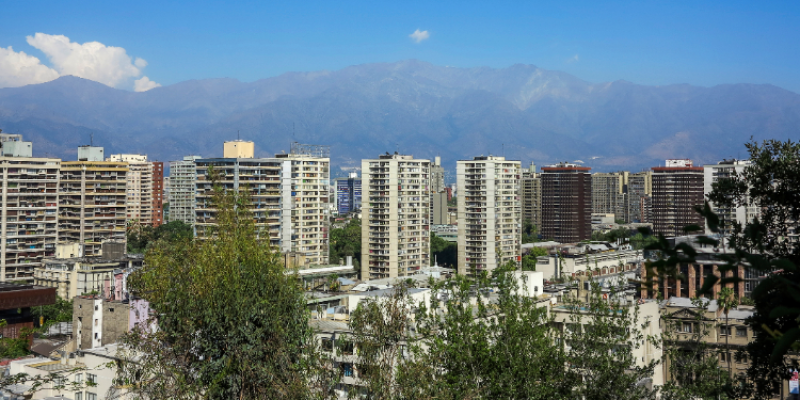
Santiago's residential property market has seen steady price growth, with values rising around 4% in real terms over the past year alone, driven by improving credit conditions and a gradual easing of central bank rates. For expats considering a purchase, the city offers a clear legal framework: foreigners can buy and own property outright, with no requirement for a local partner or special visa. This article covers everything from choosing a neighborhood and understanding price benchmarks to navigating the buying process, financing options, and the tax obligations that apply specifically to non-resident owners.
Santiago's residential property market has shown consistent resilience. Property prices in Chile rose by 8.10% nationally in the year to Q3 2025 (3.54% in inflation-adjusted terms), and within Santiago specifically, values increased by around 4% in real terms over the same period, underpinned by gradually improving credit conditions and a reduction in the central bank's benchmark rate.
One feature of the market that any buyer must understand from the outset is the use of the Unidad de Fomento (UF): an inflation-indexed unit of account maintained by the Chilean central bank. Almost all property transactions in Santiago are quoted in UF rather than Chilean pesos (CLP), which means the peso equivalent of a listed price adjusts daily in line with inflation. For buyers bringing foreign currency, this introduces a dual exchange-rate consideration: both the UF-to-CLP rate and the foreign currency-to-CLP rate will affect the final purchase amount.
Apartments dominate the city's housing stock, accounting for roughly 65% of all residential properties, reflecting decades of urban densification. Rental yields in Santiago average 4.91% as of early 2026, with central districts such as Santiago Centro offering stronger returns in the range of 5.5% to 6% annually, making the city an appealing destination for investors as well as owner-occupiers. For a broader overview of living in Santiago as an expat, including what to expect from daily life across different neighborhoods, expat resources cover the topic in depth.
Foreigners can buy and own 100% of a residential property in Santiago in their own name, with no requirement for a local partner and no special visa. The Chilean legal framework places very few restrictions on foreign property ownership within the capital, making it one of the more open markets in Latin America for international buyers.
The one administrative requirement that applies to every buyer, resident or not, is obtaining a Chilean tax identification number known as the RUT (Rol Único Tributario), issued by the tax authority (Servicio de Impuestos Internos, or SII). The RUT is mandatory for signing a deed, registering a title, and fulfilling any ongoing tax obligations related to the property. Non-resident buyers must also appoint a legal representative based in Chile to manage their tax obligations locally. Purchases can be completed remotely by granting a notarized power of attorney to a local representative, which allows that person to sign documents and handle administrative steps on the buyer's behalf.
It is worth noting that property ownership in Santiago does not confer any residency rights or accelerate immigration procedures. Chile does not operate a residency-by-investment program tied to real estate.
Good to know:
While Santiago is entirely unrestricted for foreign buyers, certain border zones elsewhere in Chile impose limitations on nationals of neighboring countries, and Rapa Nui (Easter Island) operates under a separate legal regime that restricts non-indigenous foreign ownership. Neither restriction applies to property in Santiago.
Join the Santiago community
Get regular tips and advice to make the most of your expat life
Neighborhoods and areas in Santiago
Santiago is a large, sprawling city divided into communes (comunas) that vary considerably in character, price, and infrastructure. Understanding the differences between neighborhoods is essential for making a well-matched purchase. Expats researching where to live will find detailed area-by-area comparisons in the guide to accommodation in Santiago, which covers rental and ownership options across the city's main communes.
Providencia is consistently popular among expats. It offers excellent Metro connectivity, a walkable urban environment with international restaurants and bilingual services, and a relatively safe residential atmosphere. Building height is capped at seven floors in much of the area, which keeps buildings smaller and community fees slightly higher per unit than in denser zones.
Las Condes, sometimes referred to as "Sanhattan," is the city's corporate and financial hub. It is home to several embassies, high-end shopping centers, and the headquarters of many multinational firms, making it a natural fit for executive relocations. Vitacura, immediately to the north, is one of Santiago's most affluent communes. It has a more suburban feel, anchored by green spaces such as Parque Bicentenario, and is consistently cited for its safety and quality of life. The absence of a Metro line through Vitacura means that a car is practical for daily use, but for families needing proximity to international schools, it remains a top residential choice.
Santiago Centro is the historic and administrative core of the city. Property prices here are lower than in the eastern communes, and rental demand from students and young professionals is strong, which supports solid yields. The tradeoff is a busier, louder urban environment. Ñuñoa has developed a reputation as an up-and-coming, culturally active district with cafes, parks, and a strong local identity, offering lower entry prices than the eastern corridor communes while remaining well connected.
At the northern edge of the metropolitan area, Lo Barnechea and the neighborhood known as La Dehesa offer large-format suburban houses and gated communities in a more secluded setting, appealing to families seeking space and privacy. For families with children, proximity to good schooling is a key consideration, and an overview of education in Santiago can help narrow down the most practical commune for a family purchase.
Property prices in Santiago
The average price per square meter in Santiago sits at around USD 2,650, though this figure masks substantial variation across the city's communes. Prices are almost universally quoted in UF, so peso equivalents shift daily.
At the entry level, a studio or one-bedroom apartment of 25 to 35 square meters in areas such as Estación Central or Santiago Centro typically costs between 2,200 and 2,800 UF, equivalent to roughly USD 96,000 to USD 122,000. Mid-range two-bedroom apartments in Santiago Centro are priced at around USD 150,000 (USD 2,300 to 2,500 per square meter), while comparable units in Providencia range from USD 250,000 to USD 350,000, with per-square-meter prices between USD 3,500 and USD 4,000.
At the top of the market, high-end apartments in Vitacura command between 15,000 and 35,000 UF, equivalent to approximately USD 655,000 to USD 1.5 million, with per-square-meter rates reaching 105 to 130 UF in premium buildings.
Because properties are priced in UF, buyers bringing USD or other foreign currencies need to account for movements in both the UF-to-CLP rate and the foreign currency-to-CLP exchange rate between the time of signing a pre-sale agreement and the final closing date. Converting funds as close to the signature date as possible reduces exposure to currency fluctuation.
Types of property in Santiago
Apartments in condominium buildings (departamentos) make up the majority of Santiago's residential market, accounting for about 65% of the housing stock. Urban densification has driven sustained apartment construction across central and eastern communes, giving buyers a wide range of sizes, finishes, and price points within this category.
Detached houses and villas are primarily found in suburban communes such as Lo Barnechea and La Dehesa, where larger plots make single-family homes more viable. These properties tend to command a premium both for land and for the additional space they offer.
New-build properties, whether purchased off-plan (en verde) or at the start of construction (en blanco), carry a price premium of around 12% over comparable resale units. This reflects in part the application of a 19% value-added tax (VAT, known as IVA in Chile) on new residential construction. Buyers of resale properties are not subject to this tax. The VAT premium on new builds is a meaningful cost consideration when comparing new construction against the secondary market.
The buying process in Santiago
The property purchase process in Santiago follows a well-defined sequence and typically takes between 30 and 60 days from offer acceptance to registration. Foreign buyers should budget time at the outset to obtain their RUT before the process can formally begin.
Obtain a RUT: Apply for a Chilean tax identification number at any SII office, bringing a valid passport. Non-residents will need a local representative or guarantor to complete the application.
Conduct a title study (Estudio de Títulos): Engage a specialized property lawyer to review the property's full legal history, verify ownership, and check for any liens, encumbrances, unpaid community fees, or planning irregularities.
Sign a pre-sale agreement (Promesa de Compraventa): This contract is signed before a notary and secures the transaction. A deposit of around 10% of the purchase price is paid at this stage.
Sign the public deed (Escritura Pública): The final sale agreement is executed at the notary's office. Note that signing the deed does not, by itself, transfer ownership.
Register the title at the Real Estate Conservatory (Conservador de Bienes Raíces): This is the step that legally transfers ownership. Until the deed is inscribed in the Conservador's register, the buyer does not hold legal title to the property, regardless of what has been signed or paid.
The role of a qualified property lawyer throughout this process is not optional in practice. A lawyer will conduct the title study, coordinate with the notary, verify that any existing mortgage on the property is formally released at closing, and ensure the registration is completed correctly.
Costs of buying in Santiago
Total closing costs in Santiago generally range from 1.5% to 5% of the purchase price for cash buyers, and up to 6% when financing with a mortgage. Understanding each cost component helps avoid surprises at closing.
Real estate agent commission: Typically 4% in total, split as 2% charged to the buyer and 2% to the seller. A 19% VAT applies on top of the commission itself.
Notary and property registration fees: Combined, these generally amount to 1% to 2% of the transaction value. Notary fees account for roughly 0.1% to 0.2%, while registration at the Conservador adds a further 0.2% to 0.8%.
Legal and due diligence fees: These range from 0.2% to 0.6% of the property value, approximately USD 400 to USD 1,200 on a USD 200,000 property.
Mortgage stamp tax: If using a mortgage, an additional stamp tax of 0.4% to 0.8% of the loan amount applies.
As a worked example, for a property valued at approximately USD 500,000, total closing fees (excluding stamp tax) would typically range from USD 15,000 to USD 20,000, with an additional USD 2,000 to USD 4,000 in stamp tax if a mortgage is used.
Financing and mortgages in Santiago
Obtaining a mortgage in Santiago as a foreigner is possible, but the conditions are more demanding than for Chilean residents. Most local banks require legal residency, specifically permanent residency (Residencia Definitiva), a valid RUT, and verifiable income sourced within Chile. Without permanent residency, mortgage access is significantly more limited.
For foreign buyers who do qualify, the required down payment is higher than for local borrowers, typically set at 30% to 40% of the property's value, meaning banks will lend up to 60% to 70% of the purchase price. Mortgage interest rates for foreign buyers currently range from 4% to 5.6%, with lenders typically applying a premium of 0.25% to 0.75% above the standard rate, reflecting the perceived additional risk of lending to non-citizen borrowers.
Mortgages in Chile are typically fixed-rate but denominated in UF rather than pesos. This means the nominal interest rate remains stable throughout the loan term, but the peso value of both the outstanding principal and monthly payments will adjust in line with inflation. Buyers should factor this inflation-linked structure into their long-term financial planning. Among the banks most accessible to foreign buyers in Santiago, Banco Santander Chile, Banco BCI, and Scotiabank Chile are the most commonly cited options. A guide to banking and finances in Chile covers how to establish accounts, manage finances, and navigate the local banking system as a foreigner.
Legal considerations in Santiago
One of the more technically complex scenarios in Santiago property purchases involves buying a property that already carries a mortgage in the seller's name. This situation is common in Chile, and it requires a precise legal mechanism known as an "alzamiento de hipoteca" (release of mortgage) to ensure the seller's debt is cleared at exactly the same moment as the title transfers to the buyer.
The standard instrument used to manage this risk is the "Vale Vista": a secure bank draft held by the notary until the Conservador has confirmed registration of the new title and the seller's bank has formally released its mortgage. This mechanism protects the buyer from the risk of funds being transferred before the legal encumbrance is cleared. Engaging a lawyer who is familiar with this process is essential when purchasing a property with an existing mortgage.
Beyond mortgage-related issues, the due diligence process (Estudio de Títulos) covers a broader set of checks: confirming the seller holds clear and unencumbered title, verifying that the property complies with urban planning regulations, and identifying any unpaid community fees or hidden liens that would pass to the new owner at closing. Skipping or abbreviating this step is one of the most common mistakes made in the Chilean property market and can result in significant legal and financial exposure after the sale.
Owning property in Santiago
Once a property is registered in a buyer's name, two principal ongoing obligations apply: property taxes and, if the property is rented out, income tax on rental earnings.
Annual property taxes (Contribuciones) are levied at between 0.5% and 1% of the property's fiscal value, which is assessed by the SII and is generally lower than market value. These taxes are paid quarterly and must be kept current to avoid penalties.
For property owners who rent out their Santiago property while living abroad, the tax treatment is considerably less favorable than for residents. Non-residents are subject to a flat 35% Additional Tax applied to gross rental income, with no deductions permitted for maintenance costs, management fees, or mortgage interest. Tax residents, by contrast, add rental income to their annual declaration, pay progressive rates, and can deduct legitimate operating costs. This distinction makes the effective net yield for non-resident investors substantially lower than the gross yield figures suggest, and it should be factored into any investment analysis before purchase.
Furnished rentals advertised as "amoblados" carry an additional complication: they are subject to 19% VAT, which requires the owner to register with the SII, issue electronic invoices, and file monthly VAT declarations.
The total cost of selling property in Santiago typically ranges from 3% to 6% of the sale price, depending mainly on the negotiated agent commission and whether capital gains tax applies.
On the question of capital gains tax, the rules differ significantly depending on whether the seller is a Chilean tax resident or a non-resident, and when the property was originally purchased. For properties bought after 2004, tax residents benefit from a lifetime exemption of 8,000 UF (approximately USD 280,000). Gains above that threshold are taxed at 10%. Non-residents receive no exemption and are taxed at a flat rate of 35% on the entire capital gain from the first peso.
For expats who acquired property while tax residents in Chile and are planning to leave the country, the timing of the sale relative to the loss of tax residency status has a direct and significant financial impact. A sale completed while the seller remains a Chilean tax resident qualifies for the 8,000 UF exemption; the same sale completed after residency status is lost is taxed at 35% on the full gain with no deduction.
An additional consideration applies to quick resales: selling a property within 12 months of purchase, or within 12 months of delivery for off-plan acquisitions, classifies the transaction as a "habitual sale" under Chilean law, triggering an additional 19% VAT charge on top of any applicable capital gains tax. Buyers who acquire property in Santiago with a short-term resale intention should factor this rule into their planning from the outset.
Frequently asked questions about buying property in Santiago
No. Chile does not offer a golden visa or residency-by-investment program linked to real estate. Buying property in Santiago, regardless of price or location, does not grant any residency rights or speed up immigration procedures. If you want to live in Chile long-term, you will need to pursue residency through a separate immigration pathway.
The Unidad de Fomento (UF) is an inflation-indexed unit of account used throughout the Chilean financial system. Most properties in Santiago are priced in UF, meaning the peso equivalent of any listed price adjusts daily in line with inflation. For buyers bringing USD or another foreign currency, this creates a dual exchange-rate exposure: both the UF-to-CLP rate and the foreign currency-to-CLP rate will affect the final amount paid.
No. Signing the public deed (Escritura Pública) at the notary is a necessary step, but it does not transfer legal ownership. Ownership only passes once the deed is formally inscribed at the local Conservador de Bienes Raíces. Until that registration is complete, the property legally remains in the seller's name.
Non-residents can buy property in Santiago but must first obtain a RUT (Chilean tax identification number) from the SII. You will also need to appoint a legal representative based in Chile to manage your ongoing tax obligations and, if needed, sign documents on your behalf through a notarized power of attorney. The purchase itself can be completed remotely once these two elements are in place.
It is possible, but challenging without permanent residency. Banks typically require non-residents to provide a down payment of 30% to 40% of the property value, demonstrate verifiable income generated in Chile, and show an established local credit history. Interest rates for foreign buyers are generally 0.25% to 0.75% higher than those offered to Chilean residents.
A Vale Vista is a secure bank draft used during property settlements in Chile, particularly when the property being sold carries an existing mortgage. The funds are held by the notary until the Conservador confirms registration of the new title and the seller's bank formally releases its mortgage. This instrument protects the buyer from transferring funds before all legal encumbrances are cleared.
In Santiago, the standard real estate commission is 4% of the sale price in total, split equally between buyer and seller at 2% each. A 19% VAT is added on top of the commission amount for each party. This commission structure is negotiable in practice, but the 2%/2% split is the market norm.
Yes. Non-residents renting out a property in Santiago are subject to a flat 35% Additional Tax on gross rental income, with no deductions permitted for any operating expenses. This is considerably more expensive than the progressive tax treatment available to Chilean tax residents, who can also deduct costs such as maintenance and mortgage interest. The gap between gross and net yield is therefore significantly wider for non-resident landlords.
ℹ️
We do our best to provide accurate and up to date information. However, if you have noticed any inaccuracies in this article, please let us know in the comments section below.
A journalist, holder of the DALF C1 and C2 and a diploma from the University of Mauritius, I have nearly twenty years of writing experience. After six years in the Mauritian press, I joined Expat.com, where I have been working for over a decade, including five years as editorial assistant, and now as editorial manager.