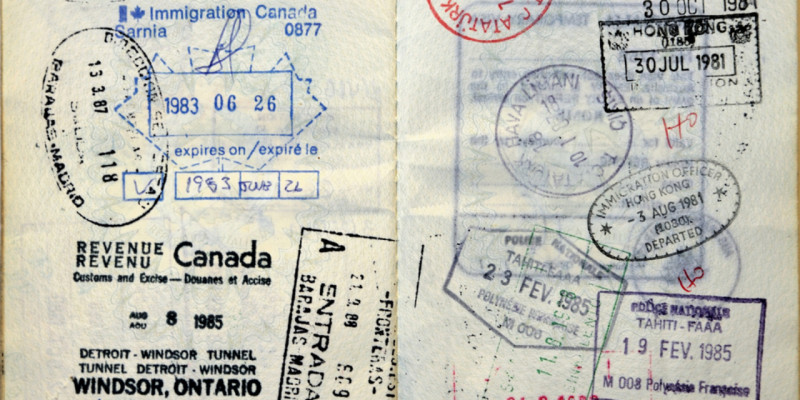
Nationals of certain countries are required to obtain a visa to enter Canada. Therefore, if your journey takes you through Canada, even without stopping, you may need a transit visa. To find out if your country or territory of origin is subject to this requirement, you can check the official Citizenship and Immigration Canada website.
You may obtain your transit visa by completing the Temporary Resident Visa Application Form; you will need to select "transit visa" on this document. Please note that transit visas are free, except for the biometric data fee (85 CAD). Processing times vary by country. For more information, you can consult the "Check processing times" section on the Government of Canada website. You will receive instructions to follow once you have submitted your visa application.
Holders of a transit visa can leave a Canadian airport, provided they can demonstrate to a border services officer that they have a valid reason for entering Canada and that they will not exceed the authorized 48-hour limit. It can be valid for one or two entries, depending on your travel plans. You must use your transit visa before it expires.
Note:
The transit visa may be denied in cases of criminal records, incomplete documents, or suspicions about the intent to leave the transit area. Travelers whose transit exceeds 48 hours or who wish to visit Canada must apply for a visitor visa. Border agents retain discretionary power: even with a visa, entry can be denied if the reasons for transit seem dubious.
Minors in Transit
Minor children transiting through Canada must present an individual passport, a copy of their birth certificate, and a letter of authorization signed by both parents or guardians, including their contact information. If the child is traveling with only one parent, written authorization from the other parent is required, along with a copy of their passport. In cases of sole custody or a parent's death, additional legal documents (custody order, death certificate) are necessary.
If you are a national of a country subject to the eTA requirement, you must obtain an Electronic Travel Authorization to transit through Canada by air.
However, the eTA is not required if your transit is by train, bus, boat, or cruise ship. Ensure that you have the appropriate travel documents with you.
The Electronic Travel Authorization (eTA) for Canada is obtained through an online application for 7 CAD, is valid for 5 years or until the passport expires, and allows multiple entries with stays of up to 6 months per entry.
The Electronic Travel Authorization (eTA) replaces the transit visa for visa-exempt travelers who transit through Canada by air.
Get regular tips and advice to make the most of your expat life
eTA vs. transit visa: what's the difference?
eTA: Required for citizens of visa-exempt countries who transit through Canada by air. It is electronically linked to the passport and allows transit without a visa. Examples of affected countries: France, Germany, the United Kingdom, Australia, and Japan.
Transit Visa: Mandatory for travelers from countries requiring a Canadian visa, even if they do not leave the airport. It is necessary for any transit of less than 48 hours. Examples of affected countries: India, China, Pakistan, the Philippines, and Nigeria.
Some people do not need a visa to enter Canada. However, they must obtain specific documents to enter the country. Ensure you have followed the appropriate identification procedures for yourself and any accompanying children. You can use the Canadian government's "Check if you need a visa" tool to find out if you need a transit visa for Canada.
Additionally, some travelers may benefit from two options established by Canada's immigration services and the Canada Border Services Agency to transit through Canada without a visa. These are the Transit Without Visa (TWOV) Program and the China Transit Program (CTP). These programs allow some foreigners to transit through Canada when traveling to or from the United States without a Canadian visa, provided they meet specific criteria.
The TWOV is aimed at people from Indonesia, the Philippines, Taiwan, or Thailand; the CTP is for people from China, with their last point of embarkation before arriving in Canada being 15 specific cities in Asia, such as Osaka, Hong Kong, or Beijing.
These individuals must also hold a valid U.S. visa, travel with an approved airline, and transit through a participating Canadian international airport.
The Canadian international airports participating in the CTP are:
Toronto Pearson International Airport (Terminal 1 only);
Vancouver International Airport;
Montreal International Airport (Air Canada flights only);
Calgary International Airport;
Winnipeg International Airport.
The same airports participate in the TWOV, except for Montreal International Airport.
The airlines participating in both programs are:
Air Canada;
Air Canada Rouge;
Air China;
Cathay Pacific;
China Airlines;
China Eastern;
China Southern;
Hainan Airlines;
Jazz Air;
Philippine Airlines;
WestJet;
Xiamen Airlines.
The main objectives of the programs are to facilitate transit through Canada and Quebec for legitimate travelers to or from the United States, and to support economic development by making Canadian international airports more attractive to passengers and airlines for flights to or from the United States.
We do our best to provide accurate and up to date information. However, if you have noticed any inaccuracies in this article, please let us know in the comments section below.
A journalist turned travel writer, Charlotte has seen almost 30 countries as a digital nomad. She has been settled in Canada for two years (Montréal then Vancouver).