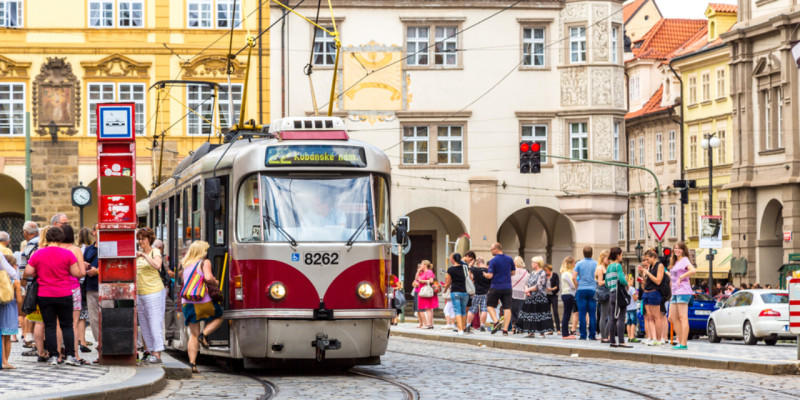
The Czech Republic has a well-developed transport network that makes it easy to get around, whether you're staying in a city or traveling across the country. Public transport is reliable and widely used, with buses, trams, and trains connecting most areas. For daily trips, most people rely on public transport. For longer distances, trains and long-distance buses are usually the best option. Taxis and ride-hailing apps are also available, especially in larger cities.
The Czech Republic has a reliable railway network that connects most cities, towns, and even smaller villages. Trains are one of the easiest transportation options to travel across the country, and they are often the best option for longer distances.
There are two main types of operators. The national company, České dráhy (ČD), runs most regional and long-distance routes. Private operators like RegioJet and Leo Express run many of the main intercity routes, often at competitive prices and with more modern trains. Trains range from slow regional services to faster intercity and high-speed connections (such as SuperCity/Pendolino trains). Not all routes are direct, so you may need to change trains depending on your destination.
Tickets can be bought at the station, but it's usually easier and cheaper to book online in advance, especially for RegioJet and other private operators where seat reservations are included. Prices vary a lot depending on demand, time of day, and how early you book.
Pets are generally allowed on trains, but the rules depend on the operator. On České dráhy trains, small animals in carriers travel for free, while larger dogs are allowed in second class with a leash and muzzle and require a small fee. On RegioJet, small pets are only allowed if they stay in a carrier during the journey, and larger dogs have more restrictions depending on the train type.
Public transport is the easiest way to get around Czech cities, especially in Prague. The system is reliable, runs frequently, and covers most areas.
In Prague, the metro is the backbone of the network. It has three lines (A, B, and C) and runs every few minutes during the day. Trams and buses fill in the gaps, reaching neighborhoods the metro doesn't cover. In other cities, transport relies mostly on trams and buses.
The system is fully integrated. The same ticket works across metro, trams, and buses. Tickets are time-based, not route-based. You can buy 30-minute, 90-minute, 24-hour, or 72-hour tickets, depending on how much you plan to travel. For longer stays, monthly and yearly passes are available through the Lítačka system. A short ride in Prague starts at around CZK 30–40, depending on the ticket type, while longer tickets and passes offer better value if you travel often.
Good to know:
Unlike cities like London, there are no gates or tap-in systems in most places. You need to validate your ticket when you first use it. Inspections are common, and fines for not having a valid ticket are high.
Public transport typically runs from around 5 am until midnight. After that, night trams and buses operate on reduced schedules but still cover most of the city.
Useful transportation apps
A few apps make getting around much easier. IDOS is the main journey planner and works across the entire country. You can use it to check routes, connections, and schedules for trains, buses, and city transport.
For Prague, the PID Lítačka app is the most useful. It allows you to buy tickets, store your pass, and show it during inspections, so you don't need a physical ticket.
Pubtran is helpful for real-time updates. It shows live departures, delays, and nearby stops, which is useful when you're already out and need quick information.
Join the Czech Republic community
Get regular tips and advice to make the most of your expat life
Long-distance buses in the Czech Republic
For long-distance travel, buses are often one of the cheapest and easiest options. Companies like RegioJet and FlixBus connect major cities within the Czech Republic and run frequent routes to nearby countries across Europe.
They are also a convenient way to reach popular day-trip destinations from Prague, such as Dresden (Germany) or Český Krumlov (South Bohemian Region), usually with direct routes and competitive prices.
Buses are modern and include basic amenities like Wi-Fi, power outlets, and reserved seating. Tickets should be bought in advance, either online or through the company's app. In Prague, most long-distance buses depart from the Florenc bus station, the city's main hub for intercity travel.
Taxis are widely available in Czech cities, especially in Prague and Brno.
Ride-hailing apps are the easiest and most reliable option. The most commonly used are Uber, Bolt (formerly Taxify), and Liftago. Prices are generally reasonable compared to other European cities, and using an app helps avoid misunderstandings over fares.
If you hail a street taxi, it's worth being a bit careful. Overcharging can still happen, especially near airports, train stations, and tourist areas. Make sure the taxi is licensed, the meter is running, and ask for a receipt at the end of the ride.
Carpooling and ride sharing in the Czech Republic
Platforms like BlaBlaCar connect drivers with passengers traveling between cities, often at lower prices than other options. Unlike taxis, where you pay for a private ride, carpooling means sharing a trip with others who are already heading in the same direction. It's commonly used for routes between major cities and can be a flexible option if train or bus times don't work for you.
Car rental/driving in the Czech Republic
Renting a car is easy in the Czech Republic, with international and local rental companies available in major cities and airports. Prices vary depending on the car type and season, but you can expect to pay from around CZK 800–1500 per day (€32–€62). Driving is on the right-hand side, and roads are generally in good condition.
EU driving licenses are accepted without any issues. If your license is from outside the EU, you may need an International Driving Permit (IDP), especially for car rentals.
If you plan to use highways, you must have a valid vignette (toll sticker), which is now electronic and linked to your license plate. Rental cars usually include this, but it's worth confirming. Parking in cities can be more complicated. Most urban areas use paid parkingzones, with different rules for residents and visitors. In Prague, parking is strictly controlled, and finding a spot in central areas can be difficult and expensive.
Cycling and biking in the Czech Republic
Cycling is possible in the Czech Republic, but it depends a lot on where you are. Prague has some bike lanes, but the terrain is hilly and traffic can be busy. In smaller cities and rural areas, cycling is more common and generally easier, with better routes and less traffic.
Bike-sharing is available in larger cities, including Prague. Services like Rekola and Nextbike let you rent bikes through an app for short trips. They're a convenient option for occasional use, especially in flatter areas, but not always the fastest way to get around.
The main airport in the Czech Republic is Václav Havel Airport in Prague, which serves as the main entry point for international travel. Other airports are located in Brno, Ostrava, Pardubice, and Karlovy Vary, but they handle far fewer flights.
Domestic flights are very limited and rarely used, as trains and buses are usually faster and more practical. Most air travel is international, with both full-service airlines and budget carriers operating routes across Europe. Low-cost airlines such as Ryanair, Wizz Air, and easyJet offer frequent connections to other European destinations at relatively low prices, especially if booked in advance.
We do our best to provide accurate and up to date information. However, if you have noticed any inaccuracies in this article, please let us know in the comments section below.
Diana Bocco is a freelance writer and serial expat who has lived and worked in Argentina, Thailand, Siberia, and Vietnam—and now calls Prague home. With a career spanning over two decades, she's written for major outlets like Forbes, Business Insider, National Geographic, and USA Today Travel, covering everything from culture and wellness to offbeat destinations and expat life. Her writing often explores what it means to build a life abroad, blending personal insight with practical advice for those chasing new beginnings around the world.