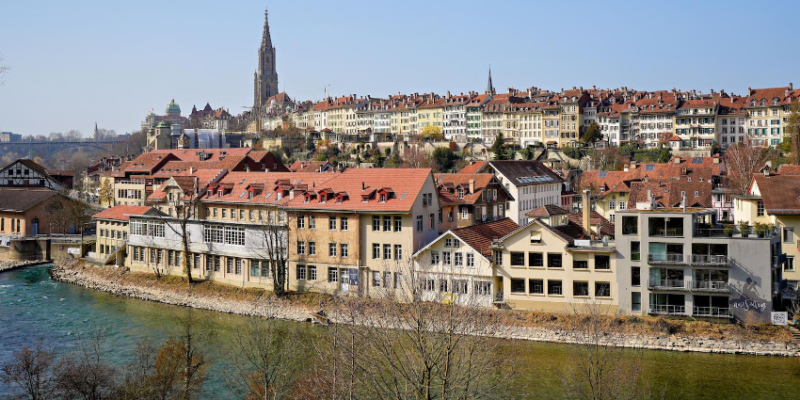
Bern is a compact federal capital where a furnished apartment can be arranged within days for a bridging stay, yet securing a permanent lease typically takes 4 to 8 weeks and demands documents most newcomers have never assembled: an official extract from the Swiss debt-enforcement register, pre-warned landlord references, and proof of liability insurance before many agencies will consider an application. Rents range from around CHF 1,328 per month for a 1-room apartment to over CHF 4,200 for a large family flat, and they vary significantly across the city's six administrative districts.
Bern divides into six official administrative districts called Stadtteile, each with its own price level, character, and practical implications for a newcomer choosing a base.
The two most expensive Stadtteile are Innere Stadt (Stadtteil I) and Kirchenfeld-Schosshalde (Stadtteil IV), both averaging around 13% above the citywide rent level (City of Bern municipal statistics). Innere Stadt is the historic center: compact, walkable, and suited to professionals who put a short commute above apartment size. Kirchenfeld-Schosshalde to the east covers the neighborhoods of Kirchenfeld, Brunnadern, Murifeld, and Schosshalde; it offers a quieter residential setting within easy reach of the center and is the preferred address for families with higher budgets and senior professionals.
Three Stadtteile cluster around the citywide rent average, covering most of the inner city outside the historic core. Länggasse-Felsenau (Stadtteil II) in the inner northwest, taking in Länggasse, Muesmatt, and Stadtbach, has a clear identity as the student and young-professional district, combining central access with mid-range costs. Mattenhof-Weissbühl (Stadtteil III), in the inner west and south, is larger and more varied, with neighborhoods including Holligen, Monbijou, Weissbühl, and Sandrain; it suits families, professionals, and students who want a non-premium inner-city base with the broadest housing choice at mid-range rents. Breitenrain-Lorraine (Stadtteil V) in the inner north, covering Breitenrain, Lorraine, Spitalacker, and Altenberg, has an urban residential feel popular with young professionals and couples who want to live outside the old town without paying a premium for it.
For those working to a tighter budget, Bümpliz-Oberbottigen (Stadtteil VI) in the west offers the lowest average rents in Bern, clearly below the citywide mean. Neighborhoods including Bümpliz, Bethlehem, and Stöckacker involve a longer commute into the center, but the trade-off is meaningfully lower rent and more space for the money. You can explore the City of Bern's district-level statistics to compare rent levels across all six Stadtteile before starting your search.
Good to know: Places like Ostermundigen, Zollikofen, and Belp appear in broader property searches for the Bern area, but these are separate municipalities within the Canton of Bern, not Stadtteile of the City of Bern. Their administrative rules and rent levels are distinct from those that apply within the city boundary.
Apartments are the dominant housing type in Bern. The standard long-term option is an unfurnished apartment rented from a property management company or a private landlord, usually on an open-ended lease. Houses for rent exist but are less common than apartments; families needing more space should widen their search to the outer and western districts where detached housing supply is broader.
Furnished and temporary apartments are available for newcomers who cannot secure a permanent place before arriving. Bern Welcome, the city's international arrival service, points newly arrived residents toward this category when a viewing before landing is not practical. Serviced apartment providers in Bern include Stay KooooK Bern Wankdorf, b20 serviced apartments, and GLANDON Apartments Holzikofenweg. For a more central furnished option, Mohnhaus offers furnished apartments at Brunngasse 6 in the historic center. UMS Untermietservice Schweiz lists furnished temporary apartments in Bern with defined availability windows and minimum stays of around one month; this is the main Swiss platform for this category and worth checking first.
A practical consideration: you need an official Bern address to register with the city, and city registration is a prerequisite for opening a Swiss bank account and signing a telecommunications contract. Arriving on a temporary furnished lease first solves this dependency and gives you time to search for a permanent apartment from within the city, which landlords strongly prefer.
Shared apartments, known locally as WGs (Wohngemeinschaft), are predominantly student-oriented. Incoming students and researchers at the University of Bern are directed toward student residences, SUB housing, and shared-flat platforms; the University of Bern Welcome Center accommodation page lists available rooms and studios for incoming university affiliates.
Join the Bern community
Get regular tips and advice to make the most of your expat life
Rental prices in Bern
Accommodation prices in Bern vary substantially by apartment size and district, so building a realistic budget requires considering both. A 1-room apartment starts from around CHF 1,328 per month; 2- to 3-room apartments, which cover the range most working professionals and smaller families consider, typically run between CHF 1,420 and CHF 1,990 per month. At the larger end, a 5.5-room apartment can reach CHF 4,200 per month. The market average works out to roughly CHF 369 per square meter per year across the city.
District tier adds another layer to this. Apartments in Innere Stadt and Kirchenfeld-Schosshalde cost around 13% more than the citywide average, so a 2-room apartment that rents for CHF 1,600 in Länggasse-Felsenau or Mattenhof-Weissbühl could be closer to CHF 1,800 in the premium eastern districts. Bümpliz-Oberbottigen sits clearly below the city average, making it the most accessible option for those prioritizing cost over commute length.
Advertised rents in Bern are almost always quoted as Nettomiete (net rent), meaning they do not include ancillary costs. On top of the net rent, most leases add a monthly Nebenkosten (ancillary cost) provision of roughly CHF 150 to CHF 260. This provision covers heating, hot water, shared-area electricity, caretaker services, refuse, water, and wastewater as listed in the lease. Critically, this amount is an advance payment reconciled at year-end: if actual costs come in lower, you receive a refund; if higher, you pay the difference. Budget for both the net rent and the Nebenkosten provision from the outset (Mieterinnen- und Mieterverband Schweiz).
Personal electricity and internet are always billed separately and are not covered by the Nebenkosten provision. Total household utility costs for a typical Bern apartment, including electricity, heating, water, and refuse, run to around CHF 190 to CHF 226 per month. Internet costs are covered in the utilities section below. When comparing apartments, make sure you are looking at the same basis: net rent only, or net rent plus Nebenkosten, since advertised totals sometimes combine the two.
Finding accommodation in Bern
For long-term unfurnished apartments, the main listing platforms active in Bern are ImmoScout24, Homegate, Comparis, and Flatfox. ImmoScout24 operates a full English-language interface, and Comparis also offers English navigation, which makes the initial search considerably more accessible for newcomers working in English. Beyond the commercial portals, the Stadt Bern Mietobjekt portal lists apartments managed by the city and by major property companies and is the city's own recommended starting point for newcomers. Check all of these daily: good flats go quickly.
For rooms and shared apartments, wgzimmer.ch is the main Swiss room-search platform and is available in English. Students affiliated with the University of Bern should also consult the university's Welcome Center accommodation page, which lists rooms and studios for incoming affiliates.
For furnished short-term stays, UMS Untermietservice Schweiz is the primary platform. Airbnb is an option for very short bridging stays, though daily rates are substantially higher than monthly furnished-flat rates and it is not a realistic substitute for the first month of a longer stay.
Searching from outside Switzerland takes time because landlords and agencies strongly prefer applicants who can attend viewings in person. A realistic minimum planning window for a newcomer with a complete application dossier ready is 4 to 8 weeks. Foreigners who cannot view apartments before landing should book temporary accommodation first and begin their permanent search from within Bern.
One firm warning: the Swiss National Cyber Security Center has flagged rental scam listings as a recurring risk. Red flags specific to the Bern search context include unusually cheap offers for well-located apartments, landlords claiming to be abroad and unable to show the property, requests to move communication off the listing platform quickly, and any demand for a deposit or advance payment before you have seen the apartment and signed a lease. Never transfer money before a viewing and a signed contract.
How renting works in Bern
Before attending a viewing, assemble a complete rental application dossier. Landlords and agencies in Bern commonly ask for the following:
A completed application form with income details and employer information
A current Betreibungsregisterauszug (debt-enforcement register extract): an official document showing that you have no outstanding debt enforcement proceedings against you in Switzerland; the extract must be original and is valid for 6 months
Proof of income, such as recent pay slips or an employment contract
Contact details for previous landlords, pre-warned that they may be contacted directly as references
Proof of household contents and personal liability insurance
Having this dossier ready before viewing matters. The market is competitive enough that applicants who cannot submit a complete file the same day as their viewing are at a meaningful disadvantage. Apply immediately after the viewing rather than waiting.
Swiss law caps the rental deposit (Mietdepot) at a maximum of three months' rent for residential apartments. The deposit must be paid into a blocked bank account held in the tenant's name: the landlord cannot hold the money directly. Newcomers who have not yet opened a Swiss bank account, or who prefer not to tie up three months' cash, can use a rental deposit insurance product as an alternative. This option avoids the cash outlay but operates as an insurance instrument rather than a returnable deposit; weigh the ongoing premium cost against the liquidity benefit.
Once the deposit is held, the account is released only at the end of the tenancy. If a landlord does not initiate debt-enforcement or conciliation proceedings within one year of the tenancy ending, you can apply to the bank directly to release the deposited amount. For contested cases, the Bern cantonal rental law authority is the reference for the rules governing deposits and ancillary costs.
The statutory minimum notice period for a residential tenant in Bern is 3 months, served to coincide with a local termination date set in the lease. If the lease specifies a longer period, the longer period governs. Notice must be given in writing using the correct procedure. Early termination before the lease end date or notice period is possible under Swiss law but only under specific legal conditions: do not assume you can leave freely without cost. The cantonal tenancy termination guidance sets out the conditions; if you are unsure before giving notice, use the free advice line of the Schlichtungsbehörde (conciliation authority).
Tenant protections are clearly defined: a landlord can only increase rent using an officially approved form, delivered at least 10 days before the notice period starts. You then have 30 days from receiving the notice to challenge the increase by filing a conciliation request with the competent authority. Equally important: a landlord can only charge ancillary costs that are explicitly listed in the lease. Any cost not named in the lease cannot legally be passed to the tenant.
Good to know:
Furnished and short-term leases in Bern, whether through UMS or a serviced apartment provider, are a distinct legal category from standard open-ended leases. They carry their own termination terms and defined end dates; check these carefully before signing, since the flexibility that makes them useful for arrival also means they differ significantly from a standard residential tenancy.
Challenges for expats in Bern
The application process in Bern is more document-intensive than in many countries. Landlords routinely require income details, employer information, a current Betreibungsregisterauszug, and references from previous landlords. The Mieterinnen- und Mieterverband Schweiz (the Swiss tenants' association) notes that declining to provide any of this information is legally possible but reduces the chance of being shortlisted. Newcomers without a Swiss rental history should prepare the fullest possible dossier before any viewings: this is the most practical way to compensate for the absence of local references.
German is the working language of rental life in Bern. Official city move-in and move-out procedures, most application forms, and standard landlord communications are all in German. Key terms like Betreibungsregisterauszug appear without translation in standard documents. Tenant support services at the cantonal level operate primarily in German. For newcomers who are not yet comfortable navigating German-language paperwork, engaging a relocation agent for the initial application phase is a practical option; this is especially worth considering if you are signing a lease remotely before arriving.
City registration after moving to Bern requires proof of address, which means having a signed lease in hand. This creates a sequencing dependency: you need a lease to register, city registration to open a bank account, and a bank account to pay bills and set up telecom contracts. Arriving on a temporary furnished lease first is the standard way newcomers break this chain, since a short-term rental contract is sufficient for initial registration. You can review the full registration process on the city's moving and registration page.
For rental-law questions, the Mieterinnen- und Mieterverband Kanton Bern / ASLOCA du canton de Bern provides personal advice for renters in the canton. The association operates primarily in German, with French-language support available through ASLOCA Bern's French-language service. In-person consultations are available by appointment in Bern, Thun, Burgdorf, and other cantonal locations through the ASLOCA network.
For a quick one-off legal question, the national tenants' association telephone advice line is available without membership at 0900 900 800 (CHF 4.40 per minute), open Monday 09:00 to 15:00 and Tuesday through Friday 09:00 to 12:30. The line operates in German and French.
Energie Wasser Bern (ewb) is the city-owned utility supplying electricity, water, and natural gas within the City of Bern. In a standard unfurnished apartment where the tenant is billed directly for electricity, the bills will come from ewb. Heating and water costs, however, are typically handled through the landlord's Nebenkosten account rather than through a direct tenant contract with ewb, so these items usually appear in your Nebenkosten reconciliation rather than as a separate ewb bill.
For electricity billed directly, the ewb tariff works out to approximately CHF 124 per month for a five-room apartment with a standard appliance set consuming around 4,500 kWh annually. Actual costs vary by apartment size and usage habits. Total household utility costs, including electricity, heating, water, and refuse, run around CHF 190 to CHF 226 per month for a typical Bern apartment. The exact split between what appears on your Nebenkosten provision and what arrives as a direct electricity bill depends on how your individual lease is structured.
The tenant must arrange internet directly; it is never included in standard Nebenkosten. The main fixed-broadband operators serving Bern are Swisscom, Sunrise, Salt, and Quickline. Entry-level residential plans start from around CHF 39.90 per month with Swisscom and CHF 49.95 to CHF 69.95 per month with Salt, depending on speed tier. Check availability at your specific address before signing, since fiber activation typically takes 48 to 72 hours where an optical socket is already installed.
A practical note on how bills are paid in Bern: utility bills from ewb and through the landlord's Nebenkosten account are commonly issued by post with a payment slip for bank transfer. Major telecom providers allow full contract management online. The standard Swiss payment method is online bank transfer (e-banking), so setting up a Swiss bank account early is a prerequisite for managing your household bills smoothly. Setting up your bank account as soon as your city registration is complete removes the main payment bottleneck most newcomers encounter in the first weeks.
In a furnished or serviced apartment, utilities are generally included in the rental price, which is one of the practical advantages of this category for short-term arrivals: no immediate utility contracts to set up, and no Nebenkosten reconciliation to manage.
Frequently asked questions
Expect to pay from around CHF 1,328 per month for a 1-room apartment and CHF 1,420 to CHF 1,990 for a 2- to 3-room apartment, rising to CHF 4,200 for a large 5.5-room flat. These are advertised net rent figures; add a monthly Nebenkosten (ancillary charge) provision of roughly CHF 150 to CHF 260 on top, and budget separately for electricity and internet, which are always the tenant's own contracts.
There is no single documented expat quarter in Bern; neighborhood choice is best driven by commute, budget, and family needs. For the lowest rents in the city, Bümpliz-Oberbottigen in the west offers the clearest value. For a central mid-range base, Länggasse-Felsenau, Mattenhof-Weissenbühl, and Breitenrain-Lorraine all sit around the citywide rent average. For a quieter, more premium residential setting, Kirchenfeld-Schosshalde and Innere Stadt both average around 13% above the citywide mean.
For long-term unfurnished apartments, search daily on Homegate, ImmoScout24, Comparis, Flatfox, and the Stadt Bern Mietobjekt municipal rental portal. For rooms and shared apartments, use wgzimmer.ch. For furnished short-term stays, UMS Untermietservice Schweiz lists temporary furnished flats in Bern with defined availability windows. If arriving from abroad, book temporary accommodation first and search from within Bern: the market strongly favors applicants who can attend viewings in person, and a realistic search window with a complete application dossier is 4 to 8 weeks.
Landlords and agencies in Bern typically require a completed application form with income and employer details, a current Betreibungsregisterauszug (debt-enforcement register extract, valid for 6 months), proof of income or an employment contract, pre-warned references from previous landlords, and proof of household contents and personal liability insurance. Once a lease is signed, the rental contract also serves as your proof of address for city registration, which in turn is needed to open a bank account or sign a telecom contract.
Competitive enough that speed and a complete application dossier matter significantly. Good apartments receive multiple applications, and submitting without a full dossier ready after a viewing reduces your chances considerably. The City of Bern advises widening searches to include listings from major property management companies rather than waiting for a single ideal address.
There is no single standard; leases may be open-ended or fixed-term depending on what the landlord offers. Read the lease carefully for termination dates and notice provisions before signing. The statutory minimum notice period for a residential tenant is 3 months, served to coincide with a local termination date. Furnished short-term sublets, known as Zwischenmiete, are a separate category with their own defined end dates and different termination rules.
Swiss law caps the residential rental deposit at a maximum of 3 months' rent. The deposit must be held in a blocked bank account in the tenant's name, not directly by the landlord. If you cannot yet open a Swiss bank account, rental-deposit insurance is available as an alternative: it avoids tying up 3 months' cash upfront, but it is an insurance product rather than a sum you recover at the end of the tenancy.
Not in standard long-term leases. Advertised rent is a net figure; a separate monthly Nebenkosten provision of roughly CHF 150 to CHF 260 may cover heating, hot water, shared-building electricity, caretaker, refuse, water, and wastewater, but only items explicitly listed in the lease can be charged this way. Electricity and internet are always the tenant's own contracts. Furnished short-term and serviced apartments generally include utilities in the price.
Three friction points stand out. First, applications are documentation-heavy: landlords routinely require a Betreibungsregisterauszug, income proof, references, and insurance confirmation, and declining to provide any of these significantly reduces your chances. Second, rental administration in Bern is conducted predominantly in German, from application forms to landlord correspondence and tenancy law advice services. Third, city registration requires a rental contract as proof of address, so securing a lease directly affects when you can register, which in turn affects access to banking and telecom. Arriving on a temporary furnished lease first resolves the third problem while giving you time to search properly.
UMS Untermietservice Schweiz lists furnished temporary apartments in Bern with defined availability windows and minimum stays of around one month. Serviced apartment providers operating in the city include Stay KooooK Bern Wankdorf, b20 serviced apartments, GLANDON Apartments Holzikofenweg, and Mohnhaus in the historic center. Bern Welcome compiles a list of these options specifically for international arrivals. For very short bridging stays, Airbnb is an option, though daily rates are significantly higher than monthly furnished-flat rates.
ℹ️
We do our best to provide accurate and up to date information. However, if you have noticed any inaccuracies in this article, please let us know in the comments section below.
I fell in love with words at an early age After a break to focus on my studies, I rediscovered the joy of writing while keeping a blog during my years between London and Madrid. This passion for storytelling and for exploring new cultures naturally inspired me to create Expat.com, a space for my own reflections as well as for anyone wishing to share their experiences and journeys abroad.