Dakar is in the middle of a transport revolution. The city that was long defined by gridlocked roads and aging minibuses now has Africa's first fully electric Bus Rapid Transit network and a modern commuter rail line connecting its dense suburbs to the city centre. For expats arriving today, the options are broader and more reliable than ever, though informal transport still dominates large parts of the network and traffic congestion remains a daily reality. This article covers every meaningful way to get around Dakar: from the new BRT and TER systems to ride-hailing apps, taxis, driving conditions, and getting in from the airport.
Dakar's transport landscape is changing faster than in almost any other West African capital. The city now runs a fully electric Bus Rapid Transit (BRT) system launched in May 2024, an expanding Train Express Régional (TER) commuter rail line, and a modernised fleet of state-owned Dakar Dem Dikk (DDD) buses. These systems are designed to offer structured, affordable, and reliable alternatives to the chaotic traffic that has long frustrated residents and newcomers alike.
That said, congestion ("embouteillages") remains severe on Dakar's narrow peninsular road network, particularly during the morning rush between 7:00 and 9:00 AM and again from 5:00 to 7:30 PM. For expats, the most practical daily transport options are ride-hailing apps such as Yango and Heetch, the BRT for cross-city corridors, the TER for suburban commuting, and private vehicles for those who need flexibility. Fares across the formal public network are heavily subsidised and very affordable by international standards, making cost rarely the deciding factor when choosing how to travel.
Dakar has no underground metro, but the Train Express Régional (TER) serves a very similar function for suburban commuters. Phase 1 of the network covers 36 km across 13 stations, connecting the central Plateau station to the satellite city of Diamniadio via densely populated suburbs including Pikine and Rufisque. The trains are modern, air-conditioned, and significantly faster than road travel on the congested N1 highway, making the TER the most comfortable mass transit option currently operating in the city.
Trains run daily from approximately 5:35 AM to 10:05 PM. During peak hours, departures are every 10 minutes; off-peak and on Sundays, frequency drops to every 20 minutes. Fares are heavily subsidised: a short Zone 1 trip from Dakar to Thiaroye costs XOF 500 (about USD 0.83), while a full journey from Dakar to Diamniadio costs XOF 1,500 (about USD 2.50) in economy class or XOF 2,500 (about USD 4.15) in first class.
A Phase 2 extension of an additional 19 km, connecting Diamniadio directly to Blaise Diagne International Airport (AIBD), is scheduled to begin commercial operations by mid-2026. Once open, this will give expats a fast, affordable rail link from the city centre to the airport for the first time.
Join the Dakar community
Get regular tips and advice to make the most of your expat life
Buses in Dakar
Dakar now operates three distinct bus networks, each targeting a different type of journey. The BRT, DDD buses, and AFTU minibuses together cover most of the city, though their comfort levels and reliability vary considerably.
The Bus Rapid Transit (BRT) is the flagship of Dakar's transport modernisation. Recognised by the World Bank as a landmark infrastructure project, it runs on 18.3 km of dedicated lanes from the Petersen station in central Dakar to Guédiawaye, bypassing much of the city's surface traffic. The fleet is fully electric, air-conditioned, and equipped with Wi-Fi. Because it operates on segregated lanes, the BRT largely avoids the congestion that slows other road vehicles. Fares range from XOF 400 to XOF 500 (about USD 0.65 to USD 0.83) depending on the zone. For expats unfamiliar with Dakar's road network, the BRT is particularly straightforward: stations are well-marked, and the route is linear.
Dakar Dem Dikk (DDD), recognisable by its blue-and-white livery, is the primary state-owned bus operator, covering over 45 urban routes across the capital and its suburbs. Fares for standard urban trips range from XOF 150 to XOF 250 (about USD 0.25 to USD 0.42), and buses generally operate from 6:00 AM to 8:30 PM. Routes are less intuitive for newcomers than the BRT, but DDD remains one of the most affordable ways to cover medium-distance urban trips. Both BRT and DDD buses become very crowded during rush hours: keep a close eye on your belongings when travelling on a full bus.
The AFTU white TATA minibuses operate on numbered routes at fares under XOF 200 (about USD 0.33). They are less structured than DDD services, stopping more frequently and with less predictable schedules, but they fill gaps in areas less well served by the main networks.
Tickets and passes in Dakar
Each of Dakar's main transport networks runs its own ticketing system. There is currently no unified card that covers the TER, BRT, and DDD simultaneously, so you will need separate payment methods for each.
For the BRT, you can buy single-journey tickets at stations or get a reloadable SunuBRT contactless smart card. The card costs between XOF 500 and XOF 2,000 (about USD 0.83 to USD 3.30) to issue, depending on the type selected. Monthly passes are available and offer 30% to 40% savings compared to paying per ride. A discounted youth subscription is available for riders under 25 upon presenting a valid ID.
For the TER, tickets can be purchased at station counters as QR code paper tickets or loaded onto a Sama TER rechargeable card. DDD recently introduced a monthly student pass offering unlimited travel for XOF 10,000 (about USD 16.50) with a valid student ID.
Good to know:
Carry small CFA denominations, particularly XOF 500 and XOF 1,000 notes, when buying tickets at counters. Agents frequently cannot make change for large notes such as XOF 5,000 or XOF 10,000.
Taxis in Dakar
Yellow and black taxis are everywhere in Dakar and can be hailed directly from the street at almost any time of day. They remain the most flexible on-demand transport option for short to medium urban trips. However, none of them use meters: you must agree on a fixed price ("tout compris") with the driver before getting in. Skipping this step means the fare is open to dispute at the end of the ride.
Indicative fares for central trips, such as from the Plateau to Point E or the Médina, range from XOF 1,000 to XOF 1,500 (about USD 1.65 to USD 2.50). A medium trip to the Mamelles area averages XOF 1,500 to XOF 2,000, while longer urban rides out to Almadies typically cost between XOF 2,000 and XOF 3,000 (about USD 3.30 to USD 5.00). Fares routinely rise by 20% to 50% late at night, during heavy rain, or at peak rush hours.
Before getting in, take a quick look at the vehicle. Maintenance standards vary widely: many taxis lack functioning air conditioning or rear seatbelts. Bring small bills to pay, as presenting a XOF 10,000 note for a XOF 1,500 fare will often result in the driver claiming they have no change. Most traditional taxi drivers speak Wolof and French but little to no English, so having your destination clearly mapped on your phone or written down helps considerably.
Ride-hailing in Dakar
Ride-hailing apps have become the transport mode of choice for most expats in Dakar, and it is easy to see why. They offer upfront fixed pricing, GPS-tracked routes, and registered drivers, removing the need to negotiate fares or assess individual vehicles. Uber does not operate in Dakar. The dominant platforms are Yango (the most widely used), Heetch, and Yassir.
App-based fares are generally comparable to a well-negotiated yellow taxi fare, which means you get the same cost without the haggling. In central neighbourhoods such as the Plateau, Almadies, and Point E, wait times are usually under 5 minutes. Payment can be made in cash at the end of the ride, and some apps also support in-app card payments.
One practical note for new arrivals: GPS address mapping in Dakar can be inconsistent, since street numbering is often imprecise. Drivers will frequently call after accepting your ride to confirm your exact location. Having a few basic directional phrases in French will help you communicate your position quickly.
Cycling in Dakar
Cycling is not a practical daily commuting option in Dakar. Dedicated cycling infrastructure is almost entirely absent from the road network, and sharing main roads with heavy, unpredictable traffic makes riding hazardous. Exhaust emissions and frequent road obstructions add to the deterrent effect.
Cycling does have a recreational niche, however. On weekends, expats and locals alike ride along the coastal paths of the Corniche, and the atmosphere there is quite different from the chaos of inland roads. If you want to ride recreationally, you will need to buy a bike privately or rent one from a leisure shop near the beaches.
Walkability depends heavily on where in Dakar you are. The Plateau, Point E, and Les Almadies are generally manageable on foot for short distances, though sidewalks are frequently uneven, narrowed by street vendors, or blocked by parked cars. Pedestrians have no practical right-of-way: traffic is chaotic, and crossing roads requires active alertness rather than any expectation that vehicles will yield.
Between July and October, the rainy season brings sudden, severe flooding to many streets. Dakar's drainage infrastructure is limited, and low-lying areas can become impassable on foot after a heavy downpour. Walking alone in poorly lit areas after dark is also best avoided: uneven terrain and the risk of opportunistic theft make ride-hailing a safer choice for nighttime travel.
Driving in Dakar requires patience and high alertness. The city's peninsula geography concentrates an enormous volume of traffic onto a limited road network, and congestion is severe throughout the working day. The toll highway (Autoroute à péage) is the most efficient route for travel between the city centre, the suburbs, Diamniadio, and the airport, and it cuts journey times significantly compared to surface roads.
Parking in the Plateau area is genuinely difficult. Formal paid car parks are scarce, and most drivers rely on informal street parking, typically paying a small informal fee of XOF 200 to XOF 500 to unofficial guards. During the rainy season from July to October, driving during or immediately after heavy storms is strongly inadvisable: standing water can be deep enough to block roads entirely.
Car rental is available from both international agencies and local providers. Standard economy vehicles cost around XOF 35,000 (about USD 58) per day. Because driving conditions in Dakar are demanding and accident rates are high, hiring a local chauffeur alongside the rental is widely considered the safer and more practical choice. A driver adds approximately XOF 10,000 to XOF 15,000 (about USD 16 to USD 25) to the daily rate.
Traditional transport in Dakar
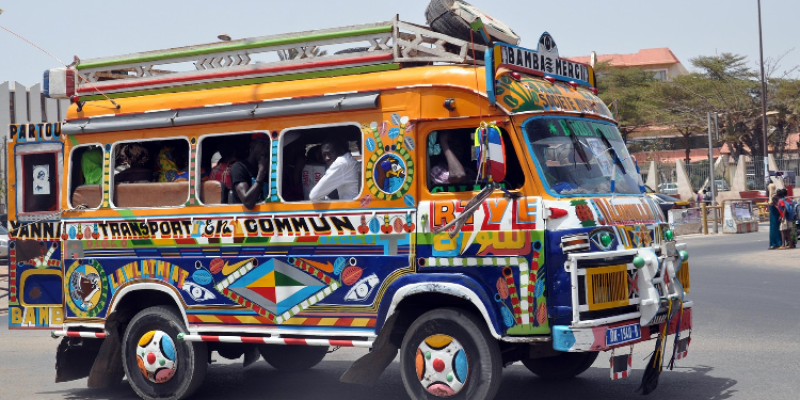
Three informal transport modes are deeply embedded in Dakar's urban fabric, though they are used primarily by residents rather than expatriates. Cars Rapides are the iconic blue and yellow painted minibuses that have symbolised Dakar's streets for decades. They run informal routes with on-demand stops and fares between XOF 100 and XOF 400 (about USD 0.16 to USD 0.66). An "apprenti" hanging from the back door collects fares as the bus moves.
Ndiaga Ndiaye minibuses are larger white Mercedes vehicles used primarily for longer suburban and intercity routes. Clandos, or clandestine shared taxis, operate on fixed suburban routes where formal transport is absent, leaving when full rather than on a fixed schedule. All three modes are extremely cheap but aging, unreliable, and lacking basic safety standards. Most expats travel on the BRT, TER, or ride-hailing apps instead.
Getting to and from the airport in Dakar
Blaise Diagne International Airport (AIBD) is located in Diass, approximately 47 km from central Dakar. The journey takes between 45 and 75 minutes, depending on traffic and the time of day. Several transport options cover this route, and the right choice depends on your budget and how much you value comfort and predictability on arrival.
A pre-booked private transfer or ride-hailing app is the most reliable and recommended option. Fixed rates run from around XOF 25,000 (about USD 41) for central Plateau pickups to XOF 35,000 (about USD 58) for Almadies.
Official yellow airport taxis wait outside the arrivals hall around the clock. The stated base fare to Dakar is between XOF 15,000 and XOF 21,000, but in practice, drivers frequently negotiate this upward to XOF 25,000 or XOF 30,000, depending on the destination and the time of night. Agree on a fixed fare before getting in.
The most economical option is the Dakar Dem Dikk airport bus (navette), which runs air-conditioned express services to Dakar, Thiès, and Mbour for XOF 3,000 to XOF 6,000 (about USD 5.00 to USD 10.00). Schedules are limited and there is no night service, so this works best for daytime arrivals when you are not in a hurry. Air Sénégal provides up-to-date information on airport access at their Diass airport page.
Once the TER Phase 2 extension opens, a direct rail connection from central Dakar to AIBD via Diamniadio will become available, offering the fastest and most affordable airport link the city has ever had.
A small set of apps covers the most important transport needs in Dakar. Yango is the most widely used ride-hailing app in the city, offering upfront pricing, fast pickup times in central areas, and no need to negotiate fares. Heetch is a solid alternative operating on the same model. Both apps accept cash payment at the end of the ride, and some in-app card payment is also available.
The SunuBRT app is the official platform for the Bus Rapid Transit network, providing route maps, fare information, and operating hours. It is a useful reference tool even if you pay at the station rather than through the app. Google Maps works reasonably well for basic navigation and traffic monitoring in Dakar, but address precision can be inconsistent given the irregularity of street numbering in many neighbourhoods. For exact pickup locations, confirming with your driver by phone remains standard practice.
Frequently asked questions about transport in Dakar
A pre-booked private transfer or ride-hailing app typically costs between XOF 25,000 and XOF 35,000 (about USD 41 to USD 58), depending on the neighbourhood. Official yellow airport taxis have a stated base fare of around XOF 15,000, but drivers often negotiate up to XOF 30,000 for central destinations. Agreeing on a fixed price before getting in is essential.
No, Uber does not operate in Dakar. The main ride-hailing alternatives are Yango, Heetch, and Yassir. All three work on the same principle as Uber: upfront pricing, GPS tracking, and registered drivers. Yango is currently the most widely used of the three.
No. Yellow and black street taxis do not use meters. You must state your destination and negotiate a fixed fare before getting into the vehicle. Skipping this step leaves the price open to dispute at the end of the journey. Ride-hailing apps eliminate this issue entirely by showing the fare upfront.
You can buy single-journey paper tickets at BRT stations or use a reloadable SunuBRT contactless smart card. Fares range from XOF 400 to XOF 500 per ride, depending on the zone. Monthly passes are available and offer meaningful savings for regular users.
Not yet. The TER currently runs from central Dakar to Diamniadio. A Phase 2 extension connecting Diamniadio directly to Blaise Diagne International Airport is scheduled to open by mid-2026. Until then, the airport is only accessible by road.
Renting a standard economy car costs around XOF 35,000 (about USD 58) per day. Adding a local chauffeur costs an additional XOF 10,000 to XOF 15,000 (about USD 16 to USD 25) per day. Given Dakar's traffic conditions and road complexity, hiring a driver is widely considered the more practical option.
Walking alone at night in poorly lit areas is not recommended. Streets are often uneven, and the risk of opportunistic theft increases after dark. Using a ride-hailing app such as Yango is the safest and most practical option for nighttime travel in and around the city.
Between July and October, heavy thunderstorms can cause sudden, severe street flooding across Dakar. Roads can become completely blocked, making both driving and walking hazardous during and immediately after intense downpours. If possible, avoid travelling during major storms and check conditions before setting out.
ℹ️
We do our best to provide accurate and up to date information. However, if you have noticed any inaccuracies in this article, please let us know in the comments section below.
I fell in love with words at an early age After a break to focus on my studies, I rediscovered the joy of writing while keeping a blog during my years between London and Madrid. This passion for storytelling and for exploring new cultures naturally inspired me to create Expat.com, a space for my own reflections as well as for anyone wishing to share their experiences and journeys abroad.