


 Guide updated by Veedushi Bissessur on 16 November 2026
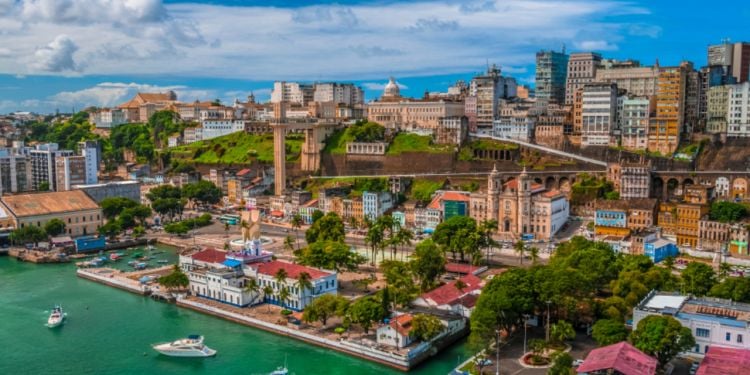
Salvador, the capital of Bahia state, was Brazil’s first capital from 1549 to 1763 and remains the country’s strongest centre of Afro-Brazilian culture. With an estimated 2,559,945 residents in 2026 (IBGE), it is Brazil’s fifth-largest city. Newcomers find a coastal city of beaches, music and festivals, with living costs well below those of São Paulo or Rio de Janeiro.
Salvador at a glance
The city spreads over 692.6 km² on a peninsula between the Atlantic Ocean and the Bay of All Saints (Baía de Todos-os-Santos). Its historic centre, the Pelourinho, has been a UNESCO World Heritage Site since 1985. The official language is Portuguese, and the currency is the Brazilian real (BRL). Throughout this guide, amounts are converted at about USD 1 = BRL 5.45 (November 2026).
Daily life follows the rhythm of the coast. Most residents spend time outdoors, beaches are public, and the cultural calendar runs all year. The trade-offs are real: unemployment is high, Portuguese is essential, and safety varies a lot between districts. Planning your budget, visa and neighbourhood in advance makes the move much smoother.
5 good reasons to move to Salvador
- History you live in: a UNESCO-listed colonial centre and some of the oldest churches in the Americas.
- Warm weather all year: an annual average of 25–26°C and more than 50 km of coastline.
- A rich cultural life: capoeira, candomblé, Afro-Brazilian music and one of the world’s largest Carnivals.
- Affordable living: a one-bedroom flat in the centre averages BRL 2,889 (USD ~531) a month.
- International links: an international airport with direct flights to Europe, South America and, since January 2026, the United States.
Sources: IBGE Cidades@, IBGE estimate via Bahia Notícias, Numbeo
Your setup journey
Guide in 9 steps. Click any step below to jump directly to the section you need.
01Working in Salvador: Jobs, Key Industries and Work Permits
Salvador’s job market is tough for newcomers. The city has the highest unemployment rate among Brazil’s 27 state capitals, and most jobs require fluent Portuguese. Foreigners who succeed usually arrive with a job offer, a remote income or a business project.
The job market in figures
The table below shows the main labour indicators published by the national statistics institute (IBGE) through its PNAD Contínua survey. Salvador’s unemployment rate is more than double the national average, and average earnings remain modest by international standards.
Indicator | Value | Period |
Unemployment rate, Salvador city | 11.4% | Q2 2026 |
Unemployment rate, Salvador metro area | 12.5% | Q2 2026 |
Unemployment rate, Brazil | 5.2% | Jul–Sep 2026 |
Average monthly income from work, Salvador | BRL 3,568 (USD ~655) | Q1 2026 |
National minimum wage | BRL 1,621 (USD ~297) per month | From 1 Jan 2026 |
People in work, Salvador | 1.22 million | Q1 2026 |
Sources: IBGE PNAD Contínua Q2 2026, IBGE PNAD Contínua Q1 2026, IBGE via Muita Informação, IBGE via Jornal de Brasília, Decree 12.797/2025 via CNI
Key industries
The biggest recent driver is the car industry. In nearby Camaçari, about 40 km away, BYD opened an electric vehicle plant on the former Ford site in October 2025. It had more than 8,500 direct employees by October 2026 and aims for 20,000 direct and indirect jobs at full capacity. Camaçari also hosts a large petrochemical complex.
Tourism and hospitality are the other pillar: Bahia welcomed 136,558 foreign air passengers between January and August 2026, more than any other state in the North and Northeast. Services, retail, the creative economy (music, events, Carnival) and port logistics complete the picture. Remote workers paid from abroad face none of the local market’s constraints.
Work permits and starting a business
You cannot work on a tourist entry. A local job requires the VITEM V work visa, based on a contract with a Brazilian employer. The VITEM XIV digital nomad visa lets you live in Brazil while working for foreign clients only.
To set up a company, every foreign partner needs a CPF tax number, and the company needs a manager resident in Brazil. Registration goes through the Junta Comercial do Estado da Bahia (Juceb) via the national REDESIM system. Bahia averages about 9–10 hours to formalise a business, and the new REGIN 2.0 system aims to cut Salvador’s municipal checks to under one hour. Residents can also register as a MEI (individual micro-entrepreneur), paying a monthly fee of about BRL 82–86 in 2026.
Sources: BYD Camaçari – Movimento Econômico, Autodata, Embratur via A Tarde, Juceb via A Tarde, REGIN 2.0 – A Tarde, MEI 2026 – InfinitePay
Discover more
02Housing and Neighbourhoods: Where to Live in Salvador
Salvador has two very different rental markets: the seafront districts and the inland neighbourhoods. A short move away from the coast can halve your rent. Most expats rent an apartment in a secure building before deciding where to settle long term.
Types of housing
The most common choice is an apartment in a condomínio, a residential building with 24-hour security, a pool and parking. Families often look at houses in gated communities (condomínio fechado) in Patamares, Alphaville Salvador, Piatã or Stella Maris. Furnished short-term flats are a practical option for your first weeks while you visit neighbourhoods.
Average rents
The table below shows average monthly rents from Numbeo, updated on 1 November 2026. The “city centre” covers the main coastal and commercial districts, while “outside the centre” refers to inland areas.
Apartment | Monthly rent (BRL) | Monthly rent (USD) |
1 bedroom, city centre | BRL 2,888.89 | USD ~531 |
1 bedroom, outside the centre | BRL 1,897.14 | USD ~349 |
3 bedrooms, city centre | BRL 5,202.50 | USD ~956 |
3 bedrooms, outside the centre | BRL 2,767.50 | USD ~509 |
Sources: Numbeo – Salvador, November 2026
If you plan to buy, apartments cost about BRL 9,930 per m² (USD ~1,825) in the centre and BRL 6,905 per m² (USD ~1,269) further out. A 20-year fixed-rate mortgage carries an interest rate of about 10%.
Expat-friendly neighbourhoods
Asking rents per square metre show how much location matters. The figures below come from a July 2025 survey; no neighbourhood-level data has been published for 2026.
Neighbourhood | Profile | Rent per m² per month |
Barra | Lighthouse peninsula, seafront, Carnival route | BRL 81.68 (USD ~15) |
Rio Vermelho | Bars, live music, Atlantic side | BRL 54.29 (USD ~10) |
Pituba | Middle-class residential grid, shops, offices nearby | BRL 49.77 (USD ~9) |
Graça | Older, quiet district above Barra | BRL 44.39 (USD ~8) |
Sources: Bahia Econômica and FipeZAP data via The Rio Times
Caminho das Árvores and Itaigara suit professionals who want to be close to business centres. Patamares, Piatã and Stella Maris attract families thanks to houses, space and easy access to PASB and the airport. Across the city, asking rents rose by almost 20% compared with 2024.
Renting as a foreigner
You need a CPF tax number to sign a lease. Under the tenancy law (Lei do Inquilinato, Law 8.245/1991), landlords may ask for one guarantee only: a Brazilian guarantor (fiador), a deposit of up to three months’ rent (caução), or rental insurance (seguro-fiança). As few newcomers have a local guarantor, the deposit or insurance is the usual route.
Discover more
03Cost of Living in Salvador: Budgets for Singles and Families
Salvador is affordable for anyone earning in a strong currency. According to Numbeo, living costs excluding rent are 69% lower than in New York, and rents are 89.5% lower. The average net local salary, however, is only BRL 2,666 (USD ~490), so local wages stretch much less far.
Monthly budget for a single person
This table estimates the main monthly costs for one person renting a one-bedroom apartment in the centre. Excluding rent, Numbeo puts total monthly spending at BRL 2,991 (USD ~550).
Expense | Monthly cost (BRL) | Monthly cost (USD) |
Rent, 1 bedroom, city centre | BRL 2,888.89 | USD ~531 |
Groceries (official basic food basket) | BRL 696.22 | USD ~128 |
Utilities (electricity, cooling, water, waste, 85 m²) | BRL 472.92 | USD ~87 |
Monthly public transport pass | BRL 354.00 | USD ~65 |
Leisure (gym, 2 cinema tickets, 4 simple meals, 2 dinners for two) | BRL ~708 | USD ~130 |
Health insurance | Quote-based, by age band | Quote-based |
Sources: Numbeo – Salvador, November 2026, DIEESE – June 2026
Monthly budget for a family of four
For two adults and two children, Numbeo estimates monthly spending excluding rent at BRL 10,889.50 (USD ~2,003). The food line uses DIEESE’s method, which counts a family of four as three adult food baskets. School fees are the largest variable.
Expense | Monthly cost (BRL) | Monthly cost (USD) |
Rent, 3 bedrooms, city centre | BRL 5,202.50 | USD ~956 |
Rent, 3 bedrooms, outside the centre | BRL 2,767.50 | USD ~509 |
Groceries (3 basic food baskets) | BRL ~2,089 | USD ~384 |
Utilities (85 m² baseline) | BRL 472.92 | USD ~87 |
Public transport, 2 monthly passes | BRL 708.00 | USD ~130 |
International primary school, per child | BRL 74,925 per year | USD ~13,773 per year |
Full-day private preschool, per child | BRL 1,833.33 | USD ~337 |
Family health insurance | Quote-based, by age band | Quote-based |
Sources: Numbeo – Salvador, November 2026, DIEESE – June 2026
Budgeting tips
No public price list exists for private health insurance in Salvador. Premiums depend on age: under ANS rules there are ten age bands, and the oldest band cannot cost more than six times the youngest. Ask for several quotes before you arrive.
Fixed costs change on a predictable calendar: bus fares in January, electricity tariffs in April and health plan ceilings in May. Exchange rates matter just as much. A stronger real makes Salvador more expensive for anyone paid in dollars, pounds or euros.
04Retirement in Salvador: Visa, Pensions and Healthcare
Salvador appeals to retirees thanks to its warm climate, coastline and moderate living costs. Brazil offers a dedicated visa for people with a foreign pension, and a single person can live on about BRL 2,991 (USD ~550) a month excluding rent, according to Numbeo.
The retirement visa
The retirement visa (VITEM XIV – aposentado) is for foreigners who can prove a regular passive income of about USD 2,000 a month. Pensions, rental income and investment income from abroad all count. You apply at a Brazilian consulate in your country of residence, using the online form of the Ministry of Foreign Affairs. After arrival, you register with the Polícia Federal within 90 days.
Pensions, tax and healthcare
US retirees benefit from the Brazil–US social security agreement, in force since 2018, which allows contribution periods in both countries to be combined. The UK has no such agreement with Brazil, and neither the UK nor the US has a comprehensive tax treaty with Brazil, so seek tax advice before moving your pension.
Healthcare deserves careful planning. Private plan premiums rise by age band, and the top band (59 and over) can cost up to six times the youngest. Only about one in three seniors in Salvador has a private plan. The public SUS remains available to all residents.
Sources: Embassy of Brazil in Vienna – VITEM XIV, Consulate General of Brazil in New York, Ministério da Previdência, Correio, Numbeo
05Higher Education and Universities in Salvador
Salvador is a major university city for northeastern Brazil. Its public universities charge no tuition fees, including for foreign students, while private institutions charge monthly fees. Teaching is almost entirely in Portuguese, so language preparation is the first step.
Main universities
- Universidade Federal da Bahia (UFBA): the leading federal university, with campuses in Ondina, Canela and Federação. It offers bachelor’s, master’s and doctoral programmes, and is free of tuition.
- Universidade do Estado da Bahia (UNEB): the state university, with its main campus in Cabula. Tuition is free.
- Instituto Federal da Bahia (IFBA): a federal institute focused on technology and engineering, with a campus in Barbalho. Tuition is free.
- Universidade Católica do Salvador (UCSal) and UNIFACS: private universities with monthly fees. Check current prices directly with each institution.
Admission routes for international students
Brazilian students enter public universities through the national exam ENEM and the SISU allocation system, and foreigners can follow the same route. Most international students, however, come on exchange agreements between their home university and UFBA or another Brazilian institution. This is usually the simplest option for students from the UK, the US, Canada or Australia.
The government’s PEC-G programme offers free full degrees to students from developing countries that have a cooperation agreement with Brazil. Its 2026 cycle is active, and candidates need the Celpe-Bras Portuguese proficiency certificate. Some Commonwealth countries in Africa and Asia take part; check with the Brazilian embassy in your country.
Student visa and diploma recognition
Degree students need the VITEM IV student visa, issued by a Brazilian consulate before departure. After arrival, you must register with the Polícia Federal within 90 days.
Foreign degrees are not recognised automatically. Bachelor’s degrees go through revalidação and postgraduate degrees through reconhecimento, handled by public universities such as UFBA via the Plataforma Carolina Bori of the Ministry of Education. Documents need an apostille (Brazil joined the Hague Convention in 2016) and a sworn translation. Doctors must also pass the Revalida exam.
Sources: Ministry of Education – PEC-G 2026, Polícia Federal registration guide – Ribeiro Cavalcante
06Schooling for Children: International and Bilingual Schools
Most expat families in Salvador choose private schools. The city has one fully international school and several bilingual Portuguese-English options. Fees are high by local standards but lower than in many major English-speaking cities.
The Brazilian school system
Brazilian schooling has three stages: Educação Infantil (ages 0–5), Ensino Fundamental (ages 6–14, nine years) and Ensino Médio (ages 15–17, three years). The Ensino Médio diploma is roughly equivalent to a high school diploma or A-levels. The school year runs from February to December. Public schools are free and open to foreign children, and 97.47% of children aged 6–14 in Salvador attend school (IBGE, 2022). Teaching is in Portuguese.
International and bilingual schools
The Pan American School of Bahia (PASB), in Patamares, is the only international school in Bahia. Founded in 1960, it teaches about 720 pupils aged 2 to 18 and follows an American curriculum with the IB Primary Years Programme and IB Diploma. Graduates can earn three diplomas: Brazilian, American and IB. PASB is accredited by NEASC and follows a Northern Hemisphere calendar (August to June), which eases transfers from abroad.
The table below compares the monthly fees reported by the local press for the most expensive private schools. Figures refer to the final school year and to the latest available publication; 2026–27 fees may be higher.
School | Curriculum | Monthly fee |
Pan American School of Bahia (Patamares) | American + IB (PYP, DP) | BRL 8,919 (USD ~1,637) |
Escola Gurilândia | Bilingual Portuguese-English, IB PYP, ages 1–11 | BRL 5,438 (USD ~998) |
Escola Concept | Bilingual Portuguese-English | BRL 5,325 (USD ~977) |
Colégio Bernoulli | Brazilian (non-bilingual) | BRL 6,831 (USD ~1,253) |
Colégio Anchieta (Pituba / Patamares) | Brazilian (non-bilingual) | BRL 6,540–7,073 (USD ~1,200–1,298) |
Sources: Correio, September 2025, Correio, 2024 fees, PASB High School Profile 2025–2026, Pan American School of Bahia
At PASB, a full year costs about BRL 107,000 (USD ~19,600). Escola Internacional Sartre COC also offers a bilingual Portuguese-English programme from nursery to high school; ask the school directly for its fees.
Enrolling your child
Contact schools early, as places at PASB and the bilingual schools are limited. Schools ask for previous school reports and identity documents. Official records from abroad generally need an apostille and a sworn Portuguese translation. Once your child holds a residence card (CRNM), registration in a public school follows the same rules as for Brazilian children.
07Daily Life in Salvador: Transport, Shopping and Local Habits
Daily life in Salvador is relaxed, sociable and centred on the outdoors. Distances are long and the city is hilly, so getting around takes some planning. Learning basic Portuguese early makes shopping, paperwork and friendships much easier.
Getting around
A single fare of BRL 5.90 (USD ~1.08) covers buses, the BRT rapid bus and the yellow STEC minibuses since 5 January 2026. A monthly pass costs about BRL 354 (USD ~65). The metro has two lines, one of which links the city to the airport. Taxis start at BRL 6.47, and ride-hailing apps are widely used.
Many residents drive. Petrol costs about BRL 6.57 (USD ~1.21) per litre, and a new compact car costs around BRL 117,000 (USD ~21,500). Expect heavy traffic along the seafront avenues at peak hours. The Deputado Luís Eduardo Magalhães International Airport (SSA) offers direct flights abroad, including a US route launched on 7 January 2026.
Shopping, food and utilities
Residents buy fresh produce at feiras (street markets) such as the Feira de São Joaquim, and do larger shops in supermarkets. The official basic food basket measured by DIEESE reached BRL 696.22 (USD ~128) in June 2026, up from BRL 616.28 in January. A meal in a simple restaurant costs about BRL 45 (USD ~8).
Air conditioning runs most of the year, so electricity is a real budget line. The distributor, Neoenergia Coelba, raised residential tariffs by 3.93% in April 2026. A mobile plan with 10 GB costs about BRL 49 a month and home broadband about BRL 89.
Healthcare
Brazil’s public health system, the SUS, is free and open to foreign residents on the same terms as Brazilians, much like the NHS or Medicare. Waiting times for specialists are long, so most expats also take out a private health plan. The regulator, ANS, capped increases for individual plans at 5.11% for 2026–27.
Safety and local culture
Safety needs attention: Salvador recorded the highest estimated homicide rate among Brazil’s 27 state capitals in a 2026 ranking, with large differences between districts. Locals advise using apps for night travel and keeping valuables discreet. Culturally, the city mixes Catholicism and candomblé, and music such as axé, pagode baiano and samba-reggae is everywhere. Try local dishes like acarajé and moqueca, and expect friendly, informal social codes.
Sources: Numbeo, DIEESE – June 2026, Prefeitura de Salvador, ANEEL and ANS data via The Rio Times, Embratur via A Tarde
08Leisure, Culture and Things To Do in Salvador
Salvador’s free time revolves around music, festivals, beaches and the sea. Many of its best experiences cost nothing, from sunset at the lighthouse to street parties. The cultural calendar is busy all year, peaking with Carnival.
Museums and heritage
Start in the Pelourinho, with the Church and Convent of São Francisco, the Fundação Casa de Jorge Amado and the Museu Afro-Brasileiro, run by UFBA. The Museu de Arte Moderna da Bahia sits in the waterfront Solar do Unhão, and the Casa do Rio Vermelho, the writer Jorge Amado’s former home, is now a museum. The Teatro Castro Alves hosts concerts and dance. The Elevador Lacerda connects the upper and lower city, near the Mercado Modelo.
Festivals and events
- Lavagem do Bonfim (January): a procession to the Nosso Senhor do Bonfim church.
- Festa de Iemanjá (2 February): offerings to the sea goddess in Rio Vermelho.
- Carnival: the 2027 edition falls in the week of Tuesday 9 February, on the Barra-Ondina and Campo Grande routes.
- São João (June): traditional June festivals across Bahia.
- AFROPUNK Brasil (7–8 November 2026) and República do Reggae (28 November 2026, tickets from BRL 220).
Carnival can be free if you watch from the street, or expensive if you join a bloco or a VIP box. The table below shows 2026 prices.
Carnival 2026 option | Price |
Abadá (bloco entry shirt) | BRL 240–2,150 (USD ~44–394) |
Camarote (VIP box), one day | BRL 2,750–4,235 (USD ~505–777) |
Camarote Salvador, six-day package (men) | BRL 19,890 (USD ~3,650) |
Sources: Correio and G1 Bahia data via The Rio Times
Sports and outdoor life
Football fans follow EC Bahia and EC Vitória, with big matches at the Arena Fonte Nova. You can learn capoeira in traditional schools in the Pelourinho, surf at Stella Maris and Flamengo, paddleboard at Porto da Barra, or sail and dive in the bay. Green spaces include the Parque da Cidade, Parque de Pituaçu and the Dique do Tororó lagoon. A gym membership costs about BRL 130 (USD ~24) a month, and a cinema ticket about BRL 39.
Nightlife and weekend trips
Rio Vermelho is the heart of nightlife, with bars, live music and acarajé stalls. The Pelourinho hosts drumming groups and open-air concerts. For weekends, take the ferry to Itaparica Island, or head to Morro de São Paulo, Praia do Forte or the Chapada Diamantina national park, about 400 km inland.
09In Short: Is Salvador Right for You?
Salvador offers something few cities can match: a UNESCO-listed historic centre, warm weather all year and a cultural life that shapes every week. Rents start at around BRL 1,900 (USD ~349) outside the centre, and public universities are free. The challenges are real, from a tight local job market to safety concerns in some districts, so careful planning pays off.
With the right visa, a well-chosen neighbourhood and some Portuguese, you can build a rewarding life by the Bay of All Saints. Ready to take the next step? Join the Expat.com Brazil forum to ask questions and connect with expats already living in Salvador.
Join the Salvador da Bahia community
Get regular tips and advice to make the most of your expat life
Essential services for your expat journey




Forum topics on living in Salvador da Bahia
Discover forums topics on expat life in Salvador da Bahia: join the conversation, ask your questions, get advice and share your experience.