


 Guide updated by Veedushi Bissessur on 16 November 2026
Curitiba is the capital of the state of Paraná in southern Brazil. It has an estimated 1,832,183 residents (IBGE, July 2026), which makes it the 8th largest state capital in the country. Around 3.7 million people live in the wider metropolitan region of 29 municipalities. The city sits on a plateau at about 930 metres, so the climate is cooler and wetter than most people expect from Brazil.
Curitiba is known for long-term urban planning. Its bus network with dedicated lanes, introduced in 1974, became a model for bus rapid transit systems worldwide. The city also has more than 50 public parks and woods, a strong services economy and one of the lowest unemployment rates among Brazilian capitals. The official language is Portuguese and the currency is the Brazilian real (BRL). In this guide, BRL amounts are converted at about USD 1 = BRL 5.44 (late October 2026).
5 good reasons to move to Curitiba
- A strong job market: the city added a net 19,265 formal jobs between January and September 2026, and unemployment stood at 3.5%.
- Efficient public transport: a flat bus fare of BRL 6.00 (~USD 1.10), frozen for all of 2026, covers the integrated network.
- Green space everywhere: parks such as Barigui, Tanguá and Tingui are part of daily life for runners, cyclists and families.
- Fast business set-up: opening a company takes about 2 hours on average, the fastest among Brazilian capitals.
- A good base for travel: the Paraná coast is about 1.5 hours away by road, and the Iguaçu Falls can be reached by car or a short flight.
Curitiba suits professionals, families and remote workers who want a large Brazilian city with organised services, a temperate climate and living costs well below those of São Paulo.
Sources: Tribuna PR / IBGE population estimate 2026, IBGE Cidades, Prefeitura de Curitiba – Census 2022 migration data, Prefeitura de Curitiba – DataMigra, Prefeitura de Curitiba – CAGED 2026
Your setup journey
Guide in 8 steps. Click any step below to jump directly to the section you need.
01Working in Curitiba: Jobs, Key Sectors and Work Visas
Curitiba’s labour market is one of the strongest in Brazil. Unemployment has fallen every year since 2023, and the city leads most capitals for new formal jobs. For foreigners, the main hurdles are Portuguese and the right visa, not the number of openings.
The labour market in figures
The table below brings together the latest official indicators. City data comes from the IBGE household survey (PNAD Contínua) and the Ministry of Labour’s formal-jobs register (CAGED). Average income is only available at national level.
Indicator | Value | Period |
Unemployment rate (Curitiba) | 3.5% (national: 5.2%) | Latest quarter, 2026 |
Employment rate (Curitiba) | 66.2%, 1.047 million people in work | Q1 2026 |
Net new formal jobs (Curitiba) | +19,265 | January–September 2026 |
Average real monthly income (Brazil) | BRL 3,732 (~USD 686) | February–April 2026 |
National minimum wage | BRL 1,621 (~USD 298) per month | 2026 |
Paraná regional minimum wage | BRL 2,105–2,408 (~USD 387–443), by category | 2026 |
Sources: Prefeitura de Curitiba – CAGED, Prefeitura de Curitiba – PNAD Contínua, IBGE – PNAD Contínua (national data)
Key industries
Services drive hiring, with 16,392 of the 19,265 net new jobs in early 2026. New service companies grew by 34% between January and July 2026. Commerce (+1,102 jobs), industry (+926) and construction (+868) also grew. The Cidade Industrial de Curitiba (CIC) and the metropolitan area host car makers, parts suppliers and metal-engineering firms. Tech and start-up activity is supported by the city’s innovation programme, Vale do Pinhão. The city’s free job portal, Emprega Curitiba, and the municipal Sine offices list local vacancies.
Work permits and visas
Brazil offers no free movement for any non-Mercosur nationality. To work locally, you need a residence authorisation that allows employment, usually the VITEM V work visa sponsored by a Brazilian employer. Remote workers paid from abroad can apply for the digital nomad visa (VITEM XIV, CNIg Normative Resolution 45/2022), but it does not allow work for Brazilian companies or clients. Since 1 September 2026, temporary visas are issued electronically for visa-exempt nationalities such as UK citizens. US citizens need a visa even for short visits.
Starting a business
Company registration runs online through the Junta Comercial do Paraná (Jucepar) and the federal Redesim system, which issues the CNPJ tax number. In Curitiba it takes about 2 hours on average, against 21 hours nationally. Under the 2025 Facilita Mais decree, 1,200 low-risk activities need no licence, and medium-risk activities receive one automatically.
Sources: Prefeitura de Curitiba – business openings, Jucepar data via AEN
Discover more
02Housing and Neighbourhoods: Where to Live in Curitiba
Renting in Curitiba is affordable by international standards, but prices are rising. Residential rents increased by 10.98% over 12 months (Secovi-PR, 2026). Most newcomers rent an apartment first and look at buying later.
Types of housing
Apartments in buildings with a doorman or security desk are the most common option in central areas. Tenants usually pay a monthly condomínio fee for building services on top of the rent. Compact one-bedroom flats and studios are in high demand. Houses and homes in gated communities (condomínios fechados) are more common in the western and outer districts, such as Santa Felicidade, Campo Comprido and Ecoville.
Expat-friendly neighbourhoods
- Batel: the most expensive area, with upmarket shops, restaurants and offices close to the centre.
- Bigorrilho / Champagnat: an affluent residential area next to Batel, with parks and shops.
- Água Verde: a family-friendly district with good services and transport; the 2nd most searched area for rentals.
- Centro and Centro Cívico: the most searched area for rentals (15.6% of searches), close to government offices, universities and bus lines.
- Ecoville (Mossunguê) / Campo Comprido: a planned western district with newer buildings and green space, close to the International School of Curitiba.
- Juvevê, Cabral and Ahú: quieter residential areas north of the centre.
Average rents
Numbeo data from October 2026 puts a one-bedroom apartment in the city centre at about BRL 2,527 (~USD 464) per month, and BRL 1,637 (~USD 301) outside the centre. A three-bedroom apartment costs about BRL 4,168 (~USD 766) in the centre and BRL 2,880 (~USD 529) outside it. The table below shows average rents per square metre in popular districts, which helps compare offers of different sizes.
Neighbourhood | Average rent per m² per month |
Batel | BRL 52.8 (~USD 9.70) |
Centro | BRL 51.8 (~USD 9.50) |
Água Verde | BRL 48.9 (~USD 9.00) |
Bigorrilho | BRL 48.9 (~USD 9.00) |
Sources: FipeZap index, Numbeo – Curitiba, October 2026, Secovi-PR via Band B
How renting works
Leases follow Brazil’s tenancy law (Lei do Inquilinato, Law 8,245/1991) and usually last 30 months. Landlords can ask for only one type of guarantee: a fiador (a guarantor who owns property in Brazil), a caução deposit of up to three months’ rent, or rental guarantee insurance (seguro-fiança). Newcomers rarely have a local guarantor, so the deposit or insurance is the usual route. Expect to show your passport, your CPF and proof of income.
03Cost of Living in Curitiba: What to Budget in 2026
Curitiba is affordable for anyone earning in US dollars or another strong currency. Numbeo gives the city a Cost of Living Index of 31.0 and a Rent Index of 9.3 (South America ranking, 2026), well below major cities in North America, the UK or Australia. Local salaries are lower, however, so budgets depend heavily on where your income comes from.
Monthly budget for a single person
The table below shows typical monthly costs for one person. Numbeo estimates total monthly spending excluding rent at BRL 3,201 (~USD 588). Groceries are based on the official basic food basket (cesta básica), which covers essential items for one adult; a more varied diet will cost more.
Expense | BRL | USD (approx.) |
One-bedroom apartment, city centre | 2,527 | 464 |
Groceries (basic food basket, one adult) | 843 | 155 |
Utilities (electricity, water, 85 m²) | 393 | 72 |
Internet and mobile plan | 183 | 34 |
Monthly public transport pass | 360 | 66 |
Gym membership | 143 | 26 |
Two cinema tickets and two cheap restaurant meals | 150 | 28 |
Total excluding rent (Numbeo estimate) | 3,201 | 588 |
Sources: Numbeo – Curitiba, Numbeo – October 2026 update, DIEESE / Conab basic food basket, June 2026
Monthly budget for a family of four
For two adults and two children, Numbeo estimates monthly costs excluding rent at BRL 11,622 (~USD 2,136). Groceries below use the official method of counting a family of four as three adult food baskets. School fees are the largest variable cost for expat families.
Expense | BRL | USD (approx.) |
Three-bedroom apartment, city centre | 4,168 | 766 |
Three-bedroom apartment, outside centre | 2,880 | 529 |
Groceries (three basic food baskets) | 2,528 | 465 |
Utilities (85 m² apartment) | 393 | 72 |
Two monthly transport passes | 720 | 132 |
Private full-day preschool, per child per month | 1,725 | 317 |
International primary school, per child per year | 41,665 | 7,659 |
Total excluding rent (Numbeo estimate) | 11,622 | 2,136 |
Sources: Numbeo – Curitiba, Numbeo – South America index 2026, DIEESE / Conab basic food basket
Health insurance
Brazil’s public health system, the SUS, is free and universal, a little like the NHS or Medicare, but many residents add a private health plan (plano de saúde) for faster access. Premiums depend on age and coverage, and no reliable average for Curitiba is published. For individual and family plans, the regulator ANS capped the 2026–2027 annual price increase at 5.11%. Group plans through employers are not capped and rose about 9.9% on average in early 2026.
Sources: Agência Nacional de Saúde Suplementar (ANS)
Tips to manage your budget
Living outside the centre can cut rent by about a third. Shopping at feiras livres and using the bus instead of a car also make a real difference. Remember that the exchange rate moves: check the current BRL rate before signing a lease or comparing salary offers.
04Higher Education and Universities in Curitiba
Curitiba is a major university city in southern Brazil. Its two federal universities charge no tuition fees, and several private institutions add programmes in medicine, law, business and engineering. Teaching is almost always in Portuguese, so language preparation is the first step for international students.
Public universities
The Universidade Federal do Paraná (UFPR) is the main public university. Founded in 1912, it has campuses in Curitiba and in Jandaia do Sul, Matinhos, Palotina and Toledo. For 2026 it offered 5,313 undergraduate places and received 39,565 applications. The Universidade Tecnológica Federal do Paraná (UTFPR) focuses on engineering and technology and also has a large Curitiba campus. Both are free to attend, but competition for places is strong.
Private universities
The Pontifícia Universidade Católica do Paraná (PUCPR) is the best-known private university in the city. It offers medicine, law, business and engineering degrees. Private universities charge monthly fees that vary by course; check current rates directly with each institution, as 2026 figures are not published centrally.
Admission process
Most places at UFPR are filled through its own entrance exam, the Vestibular UFPR (about 80% of places). The rest go through the national exam Enem and the Sisu platform. The registration fee for the vestibular is BRL 195 (~USD 36). Registration for the 2027 intake ran from 18 May to 20 July 2026, so plan about a year ahead. The federal PEC-G programme offers free undergraduate places, but only to citizens of partner developing countries. It is not open to UK or US nationals.
Getting a foreign degree recognised
Brazil does not recognise foreign degrees automatically. Bachelor’s degrees must be revalidated, and master’s or doctoral degrees recognised, through the Ministry of Education’s Plataforma Carolina Bori. You apply to a public university that acts as the assessing body. Documents need a Hague apostille, and doctors must also pass the Revalida exam. This matters for regulated professions such as medicine, engineering, law and teaching.
Student visas and first steps
International students need the student visa (VITEM IV), requested from a Brazilian consulate with the university’s acceptance letter. After arrival, you must register with the Polícia Federal within 90 days to obtain the CRNM residence card. You will also need a CPF tax number to enrol, open a bank account or sign a lease. Both UFPR and UTFPR have international offices that guide exchange and degree students through these steps.
Sources: UFPR, UTFPR – PEC-G, Ministry of Education – PEC-G call 2026, Agência Gov / MEC – degree revalidation
05Schooling for Children: Local, International and Bilingual Schools
Families moving to Curitiba can choose between free public schools, Portuguese-language private schools and a small number of international schools. The school year runs from February to December, so mid-year moves need planning. Education is compulsory from age 4 to 17.
The local school system
Public education is free. The city’s Secretaria Municipal da Educação mainly runs early childhood education (ages 0–5) and the first years of primary school (ages 6–10). The State of Paraná mainly runs lower and upper secondary school (ages 11–17), ending with the ensino médio, the equivalent of a high school diploma or A-levels. Foreign children have the right to enrol in public schools whatever their immigration status. Enrolment information is available from the municipal education department.
International schools
The leading English-language option is the International School of Curitiba (ISC) in Santa Felicidade. Founded in 1959, it follows an American curriculum and offers the IB Diploma Programme (IB World School since 1994) and Advanced Placement courses. It has about 750 pupils aged 2 to 18. The table below compares annual fees for the main international options.
School | Curriculum and language | Annual fees |
International School of Curitiba | American curriculum, IB Diploma, AP – English | BRL 53,804–70,860 (~USD 9,890–13,026), 2026/27 |
Colégio Suíço-Brasileiro de Curitiba | Swiss school – German and Portuguese | BRL 22,896–40,104 (~USD 4,209–7,372), based on earlier published rates |
Deutsche Schule Curitiba | German, English and Portuguese, ages 2–15 | Fees on request |
Average of international schools in Curitiba | – | BRL 46,916 (~USD 8,624) |
Sources: International School of Curitiba – fees 2026/27, International Baccalaureate – school 000793, International schools in Curitiba
Bilingual options and enrolment
Beyond ISC, the Deutsche Schule Curitiba and the Colégio Suíço-Brasileiro are trilingual or bilingual schools that also teach English. No British-curriculum school was identified in the city. To enrol, schools usually ask for the child’s passport, birth certificate, previous school reports, a vaccination record and, once available, the parents’ CRNM residence card and CPF tax number. Apply early: international schools often have waiting lists for the February intake.
Choosing a school and a neighbourhood
Because ISC is in Santa Felicidade, many international families look for housing in nearby Ecoville or Campo Comprido to keep school runs short. For younger children, a private full-day preschool costs about BRL 1,725 (~USD 317) per month. Visit schools in person if you can, ask about bus services and after-school activities, and check whether Portuguese support is offered to new pupils.
06Daily Life in Curitiba: Transport, Food and Local Habits
Daily life in Curitiba is organised and calm by Brazilian big-city standards. Public transport is easy to use, fresh food markets are common and most administrative services are online. Learning basic Portuguese early will make every task simpler.
Getting around
The bus network, the Rede Integrada de Transporte (RIT), is run by the city company URBS. It uses dedicated bus lanes, tube-shaped stations and express Ligeirão lines. About 580,000 passengers use it every weekday, on a fleet of 1,207 buses (August 2026). The fare is BRL 6.00 (~USD 1.10) and is frozen for all of 2026. With the rechargeable URBS transport card, you can change buses within a set time without paying again. On Sundays, the Domingão paga Meia scheme halves the fare. Buses to the wider metropolitan area cost BRL 6.00 in cash or BRL 5.90 with the Metrocard.
There is no metro. Taxis and ride-hailing apps are widely used, and petrol costs about BRL 6.64 (~USD 1.22) per litre. Afonso Pena International Airport is in São José dos Pinhais, in the metropolitan area.
Sources: Prefeitura de Curitiba – bus fare 2026, URBS data via Tribuna PR, Metropolitan fares – Diário do Transporte
Shopping and food
The Mercado Municipal de Curitiba in the centre sells fresh produce, cheese and local specialities. Weekly street markets (feiras livres) take place in most neighbourhoods, and large supermarket chains are everywhere. The city’s Armazéns da Família and Sacolões da Família sell a basic food basket about 46% cheaper than average prices, mainly for lower-income residents. Typical prices in October 2026 included BRL 5.39 for a litre of milk, BRL 12.68 for a dozen eggs and BRL 13.73 (~USD 2.50) for a cappuccino.
Lifestyle and local habits
Curitiba is the coldest state capital in Brazil. Winters (June to August) are cool, and rain is common all year, so warm clothing and a good umbrella are essential. Locals have a reputation for being reserved at first, but friendly once you get to know them. The city’s European roots show in its food, festivals and memorials. Seniors make up 17.9% of the population, and parks are busy with all age groups at weekends.
Practical services
Many city services are available through the Central 156 helpline and the official Curitiba App. Newcomers can also get free guidance at the Agência do Migrante, a State of Paraná support centre for migrants that opened in the city centre in 2025.
Join the discussion on the forum
07Leisure, Culture and Things to Do in Curitiba
Curitiba offers a steady programme of culture, outdoor activity and day trips. Most attractions are linked by public transport or by the hop-on, hop-off Linha Turismo bus. The official Turismo Curitiba portal publishes the current events calendar.
Museums and culture
The Museu Oscar Niemeyer (MON), known locally as “the Eye” for its shape, is one of the largest art museums in Latin America and focuses on modern and contemporary art. The Ópera de Arame is a concert hall built from steel tubes in a former quarry, surrounded by water and trees. The Teatro Guaíra is the main theatre in Paraná, with dance, music and drama. In the historic centre, the Largo da Ordem hosts a large craft fair every Sunday morning, and its bars and live-music venues draw crowds in the evenings.
Parks and sport
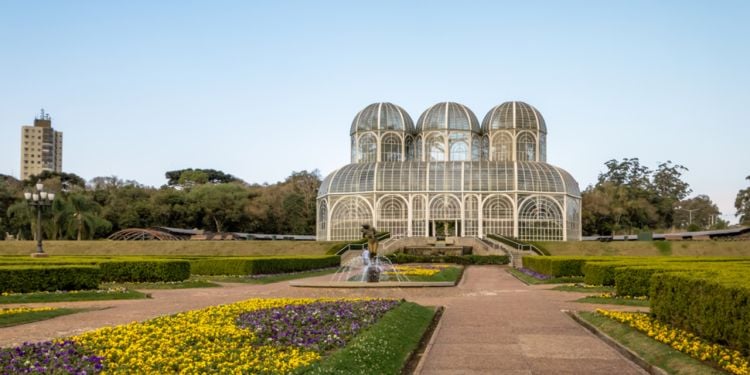
Parks are central to local life. Parque Barigui, Parque Tanguá, Parque São Lourenço and Parque Tingui have running paths, cycle routes and picnic areas. The Jardim Botânico, with its glass and metal greenhouse, is the city’s best-known landmark. Football fans can follow Athletico Paranaense at the Ligga Arena or Coritiba at the Couto Pereira stadium. Hikers head for the Serra do Mar mountains, with trails such as Pico do Marumbi and Pico Paraná.
Immigrant heritage
Several parks honour the communities that shaped the city. The Bosque do Papa celebrates Polish immigrants, the Ukrainian Memorial stands in Parque Tingui and the Bosque Alemão recalls German settlers. The Santa Felicidade district, founded by Italian families, is known for its large family restaurants.
Food and evenings out
Eating out is good value: a three-course meal for two in a mid-range restaurant costs about BRL 200 (~USD 37), and a draught beer about BRL 14 (~USD 2.60). Batel has many of the city’s upmarket restaurants and bars, while the historic centre is livelier and more casual. Coffee culture is strong, with independent cafés across the central districts.
Day trips and seasonal events
- Curitiba–Morretes train: a scenic ride down the Serra do Mar through Atlantic rainforest.
- Paraná coast: Ilha do Mel island and the port town of Paranaguá, about 1.5 hours by road.
- Iguaçu Falls: in Foz do Iguaçu, about 640 km west, ideal for a long weekend.
- Christmas in Curitiba: the 2026 programme includes a Christmas park in Parque Barigui and events across the city.
08In Short: Is Curitiba Right for You?
Curitiba offers a rare mix in Brazil: a large city with low unemployment, an efficient bus network, plenty of green space and a mild climate. Rents remain moderate, with a one-bedroom apartment in the centre at about USD 464 a month, and daily costs are low for anyone earning in a strong currency. The main challenges are the Portuguese language, the visa process and a cooler, rainier climate than many expect. If you value organised services, parks and a calmer pace than São Paulo or Rio, Curitiba deserves a place on your list. To ask questions and meet people who already live there, join the Curitiba forum on Expat.com.
Join the Curitiba community
Get regular tips and advice to make the most of your expat life
Essential services for your expat journey




Forum topics on living in Curitiba
Discover forums topics on expat life in Curitiba: join the conversation, ask your questions, get advice and share your experience.