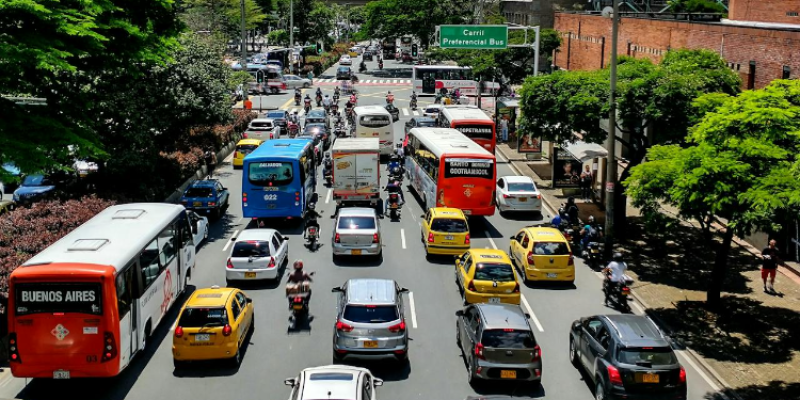
Medellín's public transport network is built around one of the most integrated urban transit systems in Latin America, combining a metro, aerial cable cars, a tram, and feeder buses under a single payment card. For expats settling in the city, understanding how these pieces connect and what restrictions apply to driving makes a real difference from day one. This article covers every mode of transport available in Medellín, from the metro schedule and Cívica card top-up rules to taxi fares, cycling corridors, and the airport bus.
Medellín's public transport backbone is the Sistema Integrado de Transporte Masivo (SITVA), operated by Metro de Medellín. The system brings together four modes: metro trains, Metrocable aerial gondolas, the Ayacucho tram, and integrated bus routes, all accessible through a single contactless payment card called the Cívica. On the main lines, service runs Monday to Saturday from 4:30 a.m. to 11:00 p.m. and on Sundays and holidays from 5:00 a.m. to 10:00 p.m.
The base metro fare for occasional riders stands at COP 4,400 (approximately USD 1.20), with a reduced rate of COP 3,820 (approximately USD 1.04) for registered frequent users. A 90-minute integration window lets you chain metro, tram, cable, and feeder bus trips at a combined integrated fare rather than paying separately for each leg.
For those planning to drive, Medellín's pico y placa vehicle restriction applies Monday to Friday from 5:00 a.m. to 8:00 p.m. and rotates by plate number, so it directly affects when and whether you can use a private car. The Metro and Cívica ecosystem is well-developed enough that many expats find car ownership unnecessary for day-to-day life in the city.
Good to know:
If you arrive without a Colombian bank account or national ID, plan to top up your Cívica card at in-station machines rather than through banking apps, as some digital recharge channels require Colombian identification.
The Medellín Metro is the centerpiece of the city's transit network. The integrated system includes multiple lines totaling 85.12 km, with 42 stations, additional stops, and interchange points across the city. New trains have improved peak-hour frequency on the two main surface lines: Line A now operates at intervals of around 3 minutes 14 seconds during rush hour, and Line B at around 3 minutes 50 seconds.
The official Metro schedule lists operating hours by line. Monday through Saturday, Lines A, B, T-A, H, J, K, M, O, P, 1, and 2 run from 4:30 a.m. to 11:00 p.m. On Sundays and holidays, Lines A, B, T-A, O, 1, and 2 operate from 5:00 a.m. to 10:00 p.m.; Line K runs from 8:30 a.m. to 10:00 p.m.; and Lines H, J, M, and P run from 9:00 a.m. to 10:00 p.m. The Metrocable Arví line (Line L) operates Tuesday through Saturday from 9:00 a.m. to 6:00 p.m. and on Sundays and holidays from 8:30 a.m. to 6:00 p.m.; it does not run on the first business day of the week.
Paying for the metro is straightforward: tap your Cívica card at the turnstile. The same card works across the tram, cables, certain bus lines, and feeder routes integrated into the system. You can also travel using a QR code generated through the Cívica app, which lets you recharge your card digitally. Metro de Medellín has strengthened its recharge ecosystem by adding green recharge machines ("máquinas de recarga verde") at key stations, including Niquía, Madera, Universidad, Parque Berrío, San Antonio, and Sabaneta, and by supporting digital top-ups through apps such as Nequi and Bancolombia.
If you plan to bring your bicycle on the metro, there are specific time windows: Monday to Friday from 10:00 a.m. to 12:00 p.m. and from 8:00 p.m. to 11:00 p.m.; Saturdays from 9:00 a.m. to 11:00 a.m. and from 4:00 p.m. to 11:00 p.m. These rules apply to Lines A, B, H, J, K, M, and P. Folding bikes and non-folding scooters follow the same schedule.
Service can change during maintenance periods, so it's worth checking Metro de Medellín's alerts before traveling, especially during holiday weeks when frequencies on some lines may be reduced.
Join the Medellin community
Get regular tips and advice to make the most of your expat life
Buses in Medellín
Beyond the metro network, Medellín operates a fleet of collective transport buses, including standard buses, busetas, and microbuses. The Metro Medellín's official bus page provides route maps showing trajectories, stop locations, and nearby points of interest, which makes it a useful first stop for newcomers who don't yet know the local operator names.
Some bus routes form part of the integrated Metro system and accept the Cívica card under the 90-minute integration rule. This only applies when the metro is part of the journey: the integrated fare is valid for metro-to-bus, bus-to-metro, or double-integration bus-to-metro-to-bus chains. If you board an integrated-route bus without including the metro in your trip, the full route fare applies rather than the discounted integrated rate. The 90-minute clock starts from your first payment; once that window closes, each mode charges its own fare separately.
For newcomers, the city's official bus page centralizes route maps and stop information, which is particularly useful when you are still getting your bearings and don't yet recognize the local operator names or route numbering conventions.
Trams and light rail in Medellín
Medellín operates the Tranvía de Ayacucho, designated as Line T-A in the Metro schedule, as part of the integrated transit system. The tram line spans 4.2 km and is served by a fleet of 12 tram vehicles. It runs on the same broad timetable as the main metro lines: Monday to Saturday from 4:30 a.m. to 11:00 p.m., and on Sundays and holidays from 5:00 a.m. to 10:00 p.m. This alignment with metro hours makes it a reliable option for late-evening returns.
Payment on the tram works exactly the same way as on the metro: tap your Cívica card at the reader. The tram is fully integrated into the SITVA network, so it counts within the 90-minute multimodal transfer window. For detailed stop and route information, consult the Metro de Medellín maps section.
Tickets and passes in Medellín
All fares across the SITVA network are set by the Área Metropolitana del Valle de Aburrá. The current fare structure defines several user profiles, each with a different rate. The two most relevant for expats are:
Al Portador / Eventual (Univiaje): COP 4,400 (approximately USD 1.20) for a single metro trip. This is the standard rate for non-registered, occasional, or tourist use.
Frecuente (personalized): COP 3,820 (approximately USD 1.04) for registered frequent users with a named Cívica card.
Other defined user profiles include Persona con discapacidad (PCD), Estudiantil, Adulto mayor, and Bancarizado, each with corresponding preferential rates set in the official fare agreement.
The 90-minute integration window is central to how fares work across modes. When you transfer between metro, tram, cable, Metroplús bus rapid transit, and feeder routes within 90 minutes of your first tap, the integrated multimodal fare applies. If your total journey exceeds 90 minutes, you pay the full fare for each mode used beyond the window.
The Cívica card is the key to accessing all of these fares. It functions as a contactless stored-value card that you load with credit and tap at readers across the network. The Cívica app lets you top up the card and generate QR codes to travel without the physical card. Recharge is also available through Nequi, Bancolombia, and at the green recharge machines located at major stations. Note that Bancolombia's in-app top-up is limited to individuals with a Colombian national ID, so expats without local identification should use in-station machines or other available app channels instead. After topping up via a digital channel, you must pass the card at a Metro station reader to activate the balance before traveling.
Good to know:
The Cívica Eventual profile is designed for tourists and occasional travelers and gives access to integrated fares and digital recharge channels without requiring a personalized registered card.
Taxis in Medellín
Traditional taxis remain a widely used option in Medellín. The city's Secretaría de Movilidad sets official tariffs and publishes them on its taxi page. The minimum fare (carrera mínima) stands at COP 6,800 (approximately USD 1.85). For electric taxis, the published rate breakdown shows a flag fall (arranque o banderazo) of COP 4,327, a distance unit charge of COP 124 per 78 meters, and a waiting-time charge of COP 200 per 60 seconds.
An important practical detail: only taxis that have completed taximeter calibration and carry the required calibration sticker (calcomanía) on the windshield are authorized to charge the current official tariff. When you get in, check for this sticker as a quick confirmation that the meter has been properly set.
The city sets tariffs through official resolutions, and the rates on the Secretaría de Movilidad page reflect the current authorized schedule. Fares are subject to change, so consulting the official city page before traveling is advisable.
Cycling in Medellín
Medellín runs a well-established ciclovía program through INDER (the city's Institute of Recreation and Sport), which temporarily closes select roads to motor vehicles on designated days, creating safe corridors for cyclists, runners, and pedestrians. Major ciclovía corridors and their distances include:
Estadio: 3.1 km, typically 7:00 a.m. to 1:00 p.m.
Avenida del Río: 12.8 km along the Autopista Sur from Solla to Colcafé, 7:00 a.m. to 1:00 p.m.
El Poblado: 5.3 km from Premium Plaza to La Frontera, 7:00 a.m. to 1:00 p.m.
Cerro El Volador: 2.6 km, 7:00 a.m. to 12:00 p.m.
Las Palmas: 16 km from Glorieta de San Diego to Viva Palmas, 5:30 a.m. to 10:00 a.m.
For current routes and schedules, the Alcaldía de Medellín's INDER FAQ page directs users to an official source for up-to-date trayectos and times. Verify the current schedule directly, as routes and hours can vary by season.
Cyclists can also combine riding with the metro: conventional bicycles and non-folding scooters are permitted on Lines A, B, H, J, K, M, and P during specific off-peak windows (Monday to Friday 10:00 a.m. to 12:00 p.m. and 8:00 p.m. to 11:00 p.m.; Saturdays 9:00 a.m. to 11:00 a.m. and 4:00 p.m. to 11:00 p.m.). This makes it practical to cycle part of a journey and connect to the metro for longer distances.
Driving in Medellín is shaped by two major practical factors: the pico y placa vehicle restriction and parking availability. Expats planning to use a private car should understand both before committing to car ownership in the city.
Pico y placa is Medellín's plate-based traffic restriction, enforced Monday to Friday from 5:00 a.m. to 8:00 p.m. The restriction rotates by the last digit of the plate for private cars and the first digit for motorcycles. The current first-semester rotation is:
Monday: plates ending in 1 and 7
Tuesday: plates ending in 0 and 3
Wednesday: plates ending in 4 and 6
Thursday: plates ending in 5 and 9
Friday: plates ending in 2 and 8
Check the official pico y placa page for the current semester's rotation and any exemptions, as the schedule updates each semester. The restriction applies within the jurisdiction of Medellín and does not extend automatically to surrounding municipalities.
For parking, the city publishes example rates at major facilities. At Plaza Mayor, the published rates are COP 5,300 per hour and COP 21,500 per day for cars, and COP 2,400 per hour and COP 10,800 per day for motorcycles. Rates vary across the city depending on location and facility type.
Given the strength of the integrated public transport network, many expats find that the metro, tram, and cable system covers most daily journeys without needing a car. Driving makes more practical sense for trips outside the metro coverage area or for occasional weekend travel.
Airport connections in Medellín
Medellín's main international gateway is Aeropuerto Internacional José María Córdova, located in Rionegro, roughly 45 km from the city center. The most budget-friendly way to travel between the airport and Medellín is the direct airport bus, which currently costs COP 20,000 per person (approximately USD 5.44). The service is reported to operate on a 24-hour basis, though you should confirm current operating hours and payment methods directly with the operator before relying on late-night service.
The bus departs from three points in Medellín: Hotel Nutibara, near Centro Comercial San Diego, and Metro station Exposiciones. Having a pickup point near a metro station makes it straightforward to connect from other parts of the city without needing a taxi for the first or last leg.
Taxis and private transfers are also available from the airport, though fares are considerably higher than the bus fare. If you arrive by taxi, confirm the meter is calibrated before the journey begins, as the same official tariff rules that apply in the city extend to airport runs.
Good to know:
The airport bus is the lowest-cost transfer option available. Confirm payment methods and the current schedule with the operator before traveling, particularly for very early or very late flights.
The Cívica app, available through Metro de Medellín, is the essential digital tool for public transport in Medellín. It lets you recharge your Cívica card remotely and generate QR codes to board metro trains without tapping the physical card. The app also supports account management and balance checks. You can find the app through the Cívica official page.
For top-ups, the Nequi app is an accessible option that does not carry the same Colombian ID restrictions as the Bancolombia in-app channel. Metro de Medellín has expanded its digital recharge ecosystem to include multiple platforms, so it's worth checking the current list of enabled channels on the Metro website to find the option that works best for your situation.
For navigating the city's broader bus network and planning multi-modal routes, the Alcaldía de Medellín's official bus page provides route maps and stop locations that can be used alongside general mapping tools to plan journeys across the integrated system.
Frequently asked questions
Monday to Saturday, Lines A, B, T-A, H, J, K, M, O, P, 1, and 2 run from 4:30 a.m. to 11:00 p.m. On Sundays and holidays, Lines A, B, T-A, O, 1, and 2 operate from 5:00 a.m. to 10:00 p.m., while some cable lines start later: Line K at 8:30 a.m. and Lines H, J, M, and P at 9:00 a.m. The Metrocable Arví line (Line L) operates Tuesday through Saturday from 9:00 a.m. to 6:00 p.m. and on Sundays and holidays from 8:30 a.m. to 6:00 p.m.
When you transfer between metro, tram, cable, Metroplús, and feeder bus routes within 90 minutes of your first tap, the integrated multimodal fare applies across the whole chain. If you exceed 90 minutes, each mode charges its own full fare separately. The 90-minute clock starts from the moment you make your first payment.
The standard fare for occasional and non-registered riders (Al Portador and Eventual) is COP 4,400, approximately USD 1.20. Registered frequent users with a personalized Cívica card pay COP 3,820, approximately USD 1.04. Both rates are set by the Área Metropolitana del Valle de Aburrá and apply across the integrated system.
Yes. The Cívica contactless card stores credit that covers metro trains, Metrocable gondolas, the Ayacucho tram, certain integrated bus routes, and feeder services. You can also top up the card and generate travel QR codes through the Cívica app, allowing you to board without the physical card.
The official minimum fare (carrera mínima) published by the city's Secretaría de Movilidad is COP 6,800, approximately USD 1.85. Only taxis that have completed taximeter calibration and display the required windshield sticker are authorized to charge the current official rate. Check for the calibration sticker when you get in.
Pico y placa restricts private vehicles from driving in Medellín Monday to Friday between 5:00 a.m. and 8:00 p.m., based on the last digit of the license plate. The digit pairs rotate each weekday: Monday (1 and 7), Tuesday (0 and 3), Wednesday (4 and 6), Thursday (5 and 9), and Friday (2 and 8). For motorcycles, the restriction applies by the first digit. The schedule updates each semester, so check the official city page for the current rotation.
The direct bus between Medellín and Aeropuerto Internacional José María Córdova costs COP 20,000 per person, approximately USD 5.44. The bus departs from three points in the city: Hotel Nutibara, near Centro Comercial San Diego, and Metro station Exposiciones. Confirm current hours and payment methods with the operator before traveling, particularly for early morning or late-night flights.
The Alcaldía de Medellín's INDER FAQ page links to the official source for ciclovía routes and timetables. Major corridors include El Poblado (5.3 km), Avenida del Río (12.8 km), and Las Palmas (16 km), each with specific morning hours. Check the official source directly for current schedules, as they can change between seasons.
ℹ️
We do our best to provide accurate and up to date information. However, if you have noticed any inaccuracies in this article, please let us know in the comments section below.
A journalist, holder of the DALF C1 and C2 and a diploma from the University of Mauritius, I have nearly twenty years of writing experience. After six years in the Mauritian press, I joined Expat.com, where I have been working for over a decade, including five years as editorial assistant, and now as editorial manager.