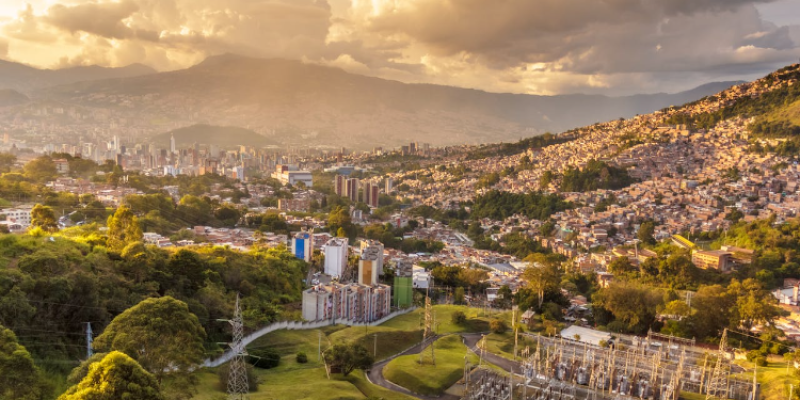
Medellín sits in a narrow Andean valley at roughly 1,500 meters above sea level, giving it a mild year-round climate that sets it apart from most cities at the same latitude. For expats, that climate is just one of several reasons the city has attracted a growing international community: a relatively low cost of living by global standards, a well-connected public transit network, and distinct neighborhoods that range from buzzing international hubs to quieter residential streets where Spanish is the clear default. This article covers the practical and cultural essentials you need to plan or settle into life in Medellín.
Medellín is Colombia's second-largest city and the capital of the Antioquia department. It sits in the Valle de Aburrá, a narrow valley in the Andes that shapes both its geography and its famously mild climate. The city is organized into comunas (administrative districts), each with its own character, and the official city tourism guide highlights the idea of getting to know Medellín "through its neighborhoods," naming Laureles, Centro, and El Poblado as key areas that reflect the city's range of personalities.
One anchor in the city's cultural calendar is the Feria de las Flores, a free citywide festival that the official Medellín.travel events calendar lists as running from July 31 through August 9 each year. The festival is free to attend and fills the streets with parades, flower arrangements, and live events across neighborhoods throughout the city. For newly arrived expats, it offers an immediate introduction to the city's civic pride and community culture.
Understanding the city's neighborhoods is one of the first practical steps for any expat planning where to live. The official Medellín tourism guide specifically points to Laureles, Centro, and El Poblado as defining areas of the city, and these three tend to dominate discussions among new arrivals.
El Poblado is the neighborhood most associated with the expat and tourist presence. It concentrates a large share of the city's international restaurants, coworking spaces, bars, and short-term rental options. For first-time arrivals, it offers a soft landing: English is more widely heard here than anywhere else in the city, and services are geared toward international residents. The trade-off is that El Poblado can feel somewhat removed from everyday Colombian city life, and costs for food, accommodation, and entertainment tend to be higher than in other districts.
Laureles, to the west of the city center, offers a different balance. It is a residential neighborhood with a strong local identity and sub-areas including Estadio and Nutibara. The environment is more Spanish-first, meaning expats who settle here tend to engage more directly with Colombian daily life and find the integration experience more immersive. It is a popular choice among expats who have already spent time in El Poblado and want a quieter, more neighborhood-oriented setting without leaving the city's better-connected zones.
Centro, the historic downtown, is the city's commercial and administrative heart. It is denser, busier, and significantly more affordable than the southern neighborhoods. Expats with a higher tolerance for urban intensity and a practical interest in proximity to government offices, markets, and cultural institutions sometimes choose this area, though it is less commonly recommended as a first base for new arrivals.
Belén comes up as a more locally flavored residential option in expat community discussions: it is generally quieter than El Poblado and more affordable, with a resident population that is largely Colombian rather than international.
Good to know: Envigado is a separate municipality immediately south of Medellín, connected to the city by the Metro. It is not a Medellín neighborhood or comuna. Expats sometimes consider it a residential option, but it falls outside Medellín city limits and has its own municipal government and services.
Join the Medellin community
Get regular tips and advice to make the most of your expat life
Cost of living in Medellín
Medellín is considered affordable by the standards of North America and Western Europe. The city's cost-of-living index stands at 37.9 and its rent index at 15.2, with a combined cost-of-living-plus-rent index of 27.4 (Numbeo, Colombia city comparison, 2026). These figures place it among the more affordable major cities in Latin America.
Rent is the largest variable in most expats' budgets. Numbeo's Medellín cost-of-living page lists a typical monthly rent for a one-bedroom apartment in the city center at COP 2,515,767, and outside the center at COP 1,782,505. However, the estimates will vary by neighborhood, furnishings, and building amenities. El Poblado apartments generally sit at the higher end of the market, while Laureles and Belén tend to come in lower.
Basic utilities for an 85-square-meter apartment cost around COP 354,063 per month. A broadband internet connection at 60 Mbps or faster costs around COP 105,150, and a mobile phone plan with 10 GB or more of data runs approximately COP 41,761. These figures are indicative averages rather than guaranteed rates and are subject to provider and plan variation.
Public transport adds relatively little to monthly outgoings. A one-way local transport ticket costs COP 3,700, and a monthly pass costs COP 248,000. These benchmarks cover Metro, bus, and integrated route services and are useful for budgeting purposes, though official fares should be confirmed directly with the transit authority.
For families, a private full-day preschool or kindergarten monthly fee per child is COP 2,339,106, and the annual tuition at an international primary school is approximately COP 28,411,609.
Medellín's position at roughly 1,500 meters above sea level gives it what is locally called "eternal spring": temperatures remain moderate throughout the year without the tropical extremes found at lower altitudes. The city does experience distinct rainy and dry seasons, with rain generally more frequent between April and May and again from September to November, while the driest months typically fall in December through February and again in July and August. These seasonal patterns are shaped by Colombia's broader Andean climate dynamics, which are monitored nationally by IDEAM, Colombia's national meteorology and hydrology institute.
Getting around Medellín
Medellín has one of the most developed urban transit systems in Colombia, centered on the Metro de Medellín. Lines A and B operate from 4:30 a.m. to 11:00 p.m., as listed on the official Metro schedules page. The Metro connects to a network of cable cars (Metrocable), a tram line (Tranvía de Ayacucho), and integrated bus routes, giving the system a wide reach across the city's different elevations.
Payment across the integrated system is handled through the Cívica card, a rechargeable smart card available at Metro stations. Official 2026 fare tables are published on the Cívica fares page. A one-way ticket costs COP 3,700, and a monthly pass costs COP 248,000.
The Metro also allows bicycle access during off-peak windows on weekdays and weekends, making it a useful option for expats who combine cycling with transit for last-mile connectivity. Ride-hailing apps operate widely in the city and are commonly used for trips outside the Metro network or late at night.
For a full breakdown of routes, fares, and transport options in the city, refer to our Getting around Medellín article.
Language and communication in Medellín
Spanish is the official language of Colombia and the working language of daily life in Medellín. Unlike some Latin American capitals, Medellín does not have a large population of English-speaking residents outside El Poblado, where international businesses, hostels, and expat-facing services mean English is more widely understood. Outside that neighborhood, navigating daily tasks such as dealing with utility companies, local markets, health appointments, and government offices will require functional Spanish.
Colombians from Medellín (known as paisas) are widely regarded for speaking a particularly clear and articulate form of Spanish, which can be an advantage for expats learning the language. Local Spanish schools and private tutors are available throughout the city for those building their language skills after arrival.
Mobile connectivity is generally reliable across the city's main neighborhoods. A mobile plan with 10 GB or more of data runs approximately COP 41,761 per month (Numbeo), and several national carriers offer prepaid options that expats can access without a local residency document in the early stages of their stay.
Culture and social norms in Medellín
Medellín's cultural identity is closely tied to paisa culture: a regional identity centered on warmth, entrepreneurialism, family loyalty, and a strong sense of local pride. Residents tend to be sociable and direct in conversation, and strangers often exchange greetings in elevators, shops, and on public transport, which can feel surprising to expats from more reserved urban cultures.
Catholicism plays a significant role in shaping the city's social rhythms. Religious holidays punctuate the calendar throughout the year, and Sunday family gatherings remain a central part of social life for many households. Public festivities around holidays such as Semana Santa (Holy Week) and Día de los Muertos bring neighborhoods together in ways that are worth experiencing as a new resident.
The concept of time in social settings tends to be flexible. Arriving 15 to 30 minutes after a stated time for informal gatherings is standard practice and carries no social implication. Professional settings operate closer to stated times, though some fluidity remains the norm. Dress tends to be neat and presentable even in casual contexts; the concept of looking put-together in public is taken seriously across most social situations.
Pace of life and work culture in Medellín
Medellín has developed a reputation as one of Latin America's more entrepreneurial cities, with a growing concentration of startups, creative industries, and internationally oriented businesses. The city's work culture blends Latin American relationship-building norms, where trust and personal connection matter as much as credentials, with a level of ambition and innovation that distinguishes it from slower-paced Colombian cities.
For expats working in international roles or running location-independent businesses, the city offers a functional infrastructure: reliable broadband (a 60 Mbps or faster connection is available at around COP 105,150 per month), a reasonable supply of coworking spaces concentrated in El Poblado and Laureles, and a time zone (UTC-5, with no daylight saving adjustment) that aligns well with North American business hours.
Outside working hours, the pace slows noticeably. Evenings tend to revolve around food, social gatherings, and family time rather than the frenetic after-work scene found in some larger Latin American capitals. Weekends, particularly Sundays, carry a strong family-oriented rhythm that expats often find grounding after adjustment.
Medellín's food scene reflects both its paisa heritage and its growing international population. The traditional staple is the bandeja paisa: a large plate combining red beans, white rice, ground beef, chicharrón, fried egg, sweet plantain, avocado, and arepa. It is found in local restaurants throughout the city and remains a daily meal for many residents, not merely a tourist attraction.
Beyond traditional cuisine, the city has developed a range of dining options across price points. El Poblado has the highest concentration of international restaurants, ranging from Japanese and Italian to Middle Eastern and North American cuisines. Laureles has a strong local restaurant culture with a growing number of contemporary Colombian dining options. For everyday eating, platos del día (daily set menus) at local restaurants typically include soup, a main dish, juice, and sometimes dessert, priced between COP 8,000 and COP 15,000, making home cooking optional rather than necessary for budget management.
Fresh produce markets operate throughout the city, and the variety of tropical fruits available at low cost is one aspect of local food culture that most expats mention positively. Street food, particularly arepas and empanadas, is available throughout the day at low prices across all neighborhoods.
Leisure and social life in Medellín
Medellín'ssocial life is organized around neighborhoods, parks, and a calendar of civic events. The Feria de las Flores is the signature event on the city's public calendar: listed as free to attend, it runs for roughly ten days each year and fills the city with music, flower-covered floats, horse parades, and cultural programming across multiple venues.
Day-to-day leisure centers on parks and public spaces. The city has invested significantly in urban renewal, and areas such as Parque El Poblado, Parque de los Deseos, and the riverfront Parques del Río corridor provide accessible green and social space for residents. Hiking and cycling routes accessible from within the urban area attract residents who want outdoor activity without leaving the metro zone.
Nightlife is concentrated in El Poblado and, increasingly, in the Laureles-Estadio area. Bars and live music venues range from salsa clubs playing classical Colombian music to craft beer bars and rooftop spaces. The city has a genuinely varied nightlife culture that suits different preferences and budgets.
For expats building a social network, the city's large international community means that English-language events, meetups, and informal gatherings are regularly organized, particularly in El Poblado. Spanish-language social integration tends to come more naturally in Laureles and Belén, where expat-specific spaces are less dominant.
Medellín is a practical choice for expat families, with a range of schooling options and family-oriented neighborhoods. The cost of private full-day preschool is approximately COP 2,339,106 per month per child, while international primary school annual tuition averages COP 28,411,609.
El Poblado and Laureles are the most commonly cited neighborhoods for expat families, with access to international schools, pediatric healthcare, and family-friendly parks and amenities. The city's relatively mild climate means outdoor play and activities are possible year-round, a practical advantage families with young children frequently mention.
Family support networks are generally strong within both the Colombian community and the expat community. Colombian culture places a high value on extended family involvement, which can translate into a welcoming social environment for expat families who engage with local communities rather than staying within the expat bubble.
Safety in Medellín
Safety is a topic that requires honest, measured framing for anyone considering life in Medellín. Numbeo's crime perception data for Medellín shows a Crime Index of 53.99 and a Safety Index of 46.01, based on the perceptions of website visitors over the past five years. However, Numbeo is explicit that these figures reflect perception rather than official crime statistics. The city's crime index and safety index place it in a moderate range by global comparison, and broadly similar to other large Latin American cities.
In practical terms, expats living in Medellín generally apply the same common-sense precautions used in any large urban environment: staying aware of surroundings, avoiding displaying expensive items in public, using registered taxis or ride-hailing apps rather than street taxis, and familiarizing themselves with which areas carry higher risk at different times of day. The neighborhoods most popular with expats (El Poblado, Laureles, Belén) tend to score better on resident safety perception than some other parts of the city, though no urban area is uniformly safe or unsafe.
Medellín has a well-established expat community, particularly in El Poblado, where the concentration of coworking spaces, international restaurants, and English-language services reflects years of international migration into the neighborhood. The community skews toward younger adults, including remote workers, freelancers, and entrepreneurs, alongside a smaller number of retirees drawn by the city's cost of living and climate.
Social integration varies considerably by neighborhood. In El Poblado, it is possible to spend extended periods within a predominantly English-speaking social world, which can ease the initial transition but may limit deeper integration into Colombian life. Expats who settle in Laureles or Belén tend to build Spanish-language social connections more quickly, simply because the environment offers fewer English-language alternatives.
Community information, accommodation leads, and event listings circulate through expat Facebook groups and informal networks. These can be useful as a starting point, but should be treated with the same caution applied to any unverified online community source, particularly for official or procedural matters.
Frequently asked questions
Numbeo's Medellín cost-of-living data lists a typical monthly rent for a one-bedroom apartment in the city center at COP 2,515,767 and outside the center at COP 1,782,505. These estimates vary by neighborhood, building amenities, and whether the unit is furnished. El Poblado consistently sits at the higher end, while Laureles and Belén tend to be lower.
A one-way local transport ticket at COP 3,700 and a monthly public transport pass at COP 248,000. For current official fares across the Metro, Metrocable, and integrated routes, check the Cívica fares page directly, where 2026 fare tables are published.
The Metro de Medellín runs from 4:30 a.m. to 11:00 p.m. on the main Lines A and B. These hours are listed on the official Metro schedules page. Station-specific first and last service times can be checked using the integrated schedule tool available on the same page.
Numbeo's crime perception data shows a Crime Index of 53.99 and a Safety Index of 46.01 for Medellín, based on visitor perceptions over five years. These are perception indicators, not official crime statistics. In practice, expats apply standard urban precautions: using registered or app-based transport, avoiding visible displays of valuables, and staying informed about which areas carry higher risk at different times of day. Checking your home country's current travel advisory is also recommended.
Basic utilities for an 85-square-meter apartment cost COP 354,063 per month, broadband internet at 60 Mbps or faster costs COP 105,150, and a mobile phone plan with 10 GB or more of data costs COP 41,761.
The Feria de las Flores takes place over roughly ten days each year, typically running from late July into early August. The official Medellín.travel events calendar confirms the festival is free to attend. It includes flower parades, horse cavalcades, live music, and cultural events across the city. The official programming schedule is published on the city's events calendar closer to each edition.
Outside El Poblado, Spanish is the practical language of daily life in Medellín. Healthcare appointments, utility providers, local government offices, and most restaurants and shops operate only in Spanish. Expats in El Poblado can manage a good deal of daily life in English, but this limits integration and creates dependency on a single neighborhood. Investing in Spanish from arrival significantly expands both practical capability and social experience across the city.
ℹ️
We do our best to provide accurate and up to date information. However, if you have noticed any inaccuracies in this article, please let us know in the comments section below.
A journalist, holder of the DALF C1 and C2 and a diploma from the University of Mauritius, I have nearly twenty years of writing experience. After six years in the Mauritian press, I joined Expat.com, where I have been working for over a decade, including five years as editorial assistant, and now as editorial manager.