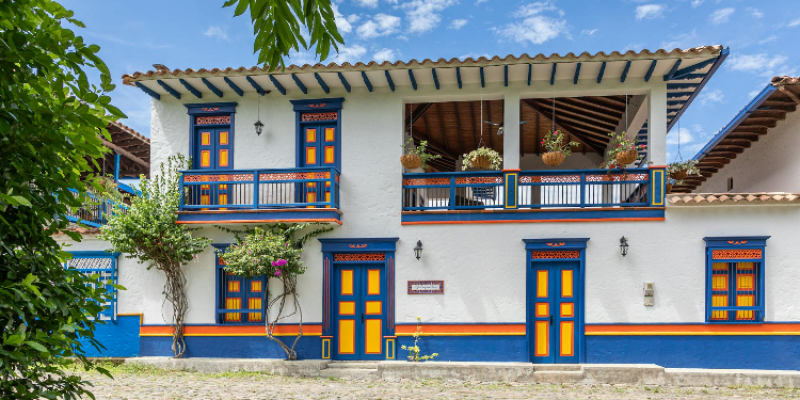
One in four residential properties sold in Medellín in 2024 was acquired by an international buyer or non-resident Colombian: a figure that says a great deal about how Colombia's real estate market has evolved. Foreign nationals enjoy the same constitutional property rights as Colombian citizens, face no nationality-based restrictions on standard urban purchases, and can complete a transaction using only a valid passport. This article covers the full buying process, from understanding the market and choosing a location to registering your investment with the Central Bank, managing ongoing taxes, and qualifying for an investor visa.
Colombia's residential property market has shown steady nominal price growth of 7% to 9% year-over-year, which translates to roughly 2% to 4% in real terms after accounting for inflation. The central bank has held its policy interest rate at 9.25%, keeping local mortgage costs elevated and stretching the average time a resale property sits on the market to between 180 and 210 days.
New-build and off-plan properties (known locally as sobre planos) are appreciating up to 5% faster than resale homes and typically sell close to the asking price. Buyers of used homes, by contrast, can often negotiate discounts of around 6%. Rental yields remain strong by international standards, averaging 7.78% in Medellín and 7.31% in Cali, driven by structural housing demand and a growing short-term rental sector.
Foreign buyer participation is particularly visible in Medellín, but demand from abroad has spread to Bogotá, Cartagena, and secondary cities. The strength of major currencies against the Colombian peso gives many foreign buyers significant purchasing power relative to local buyers, which partly explains the sustained international appetite for Colombian real estate.
Foreign nationals can purchase and own property in Colombia under the exact same legal framework as Colombian citizens. This right is guaranteed by Article 58 of the Colombian Constitution and applies regardless of the buyer's nationality or residency status. There is no minimum residency requirement: a foreigner can legally acquire, own, and transfer property using a valid passport while in the country on a tourist visa.
Two administrative steps apply specifically to foreign buyers. First, all foreign nationals must obtain a Colombian Tax Identification Number, known as the Registro Único Tributario (RUT), issued by the National Tax Authority (DIAN). This number is required to register the property and pay taxes. Second, and critically, all purchase funds must be channeled through Colombia's official foreign exchange market. Buyers must then submit the relevant registration form to the Banco de la República (Colombia's Central Bank) to formally record the capital as Foreign Direct Investment.
Skipping this second step has serious long-term consequences: without proper foreign investment registration, the buyer will be legally blocked from repatriating the proceeds of any future property sale back to their home country. Both steps should be completed before or at the point of closing.
Apartments and condominiums make up 58% of all residential listings nationwide, making them the dominant property type available to buyers. Freehold standalone houses account for roughly 26% of listings and are primarily found in suburban expansion zones such as Llanogrande or Soacha rather than in dense city centers.
A large share of Colombian residential buildings operate under Propiedad Horizontal rules, a homeowners' association framework that strictly governs amenities, security, and short-term rental policies. Buyers should review these bylaws carefully before signing anything, as restrictions vary considerably from one building to the next.
Rural fincas and land plots are also available to foreign buyers, provided they carry a clearly titled private ownership history and are not classified as state-owned baldíos, which cannot legally be transferred to private buyers under any circumstances. Pre-construction apartments (sobre planos) remain a popular investment vehicle, offering built-in appreciation potential, though they carry standard developer delivery risks that require specific contractual protections.
Join the Colombia community
Get regular tips and advice to make the most of your expat life
Best areas for expat property buyers in Colombia
Bogotá commands the highest prices in the country, averaging COP 9,800,000 (USD 2,613) per square meter, with premium demand concentrated in transit-adjacent neighborhoods and upscale districts like Chapinero, La Cabrera, and El Nogal. As the capital, it offers the broadest range of property types, employment infrastructure, and international connectivity.
Medellín is the most popular destination for digital nomads and expats settling long-term. Premium neighborhoods like El Poblado and Laureles have seen real estate appreciation exceeding 10%, drawing sustained international buyer interest. Some buildings in these areas have adopted strict rules against short-term Airbnb-style rentals, so buyers with investment intentions must verify building policies before committing.
Cartagena commands strong premiums driven by tourism demand. Bayside apartments in areas like Bocagrande and Castillogrande range from USD 200,000 to over USD 1,000,000, making it the most expensive coastal market in the country. The combination of a historic center, beach access, and year-round tourism makes it appealing both for personal use and rental income strategies.
Cali offers the best affordability among major cities, with premium neighborhoods like Ciudad Jardín priced at roughly COP 6,000,000 (USD 1,600) per square meter. The city provides the best house-size-to-price ratio in the country for buyers seeking more space.
Suburban municipalities, including Chía (outside Bogotá), Envigado, and Rionegro (outside Medellín), are experiencing rapid price growth as buyers pursue larger properties away from dense urban cores. These areas represent an increasingly active segment of the expat buyer market.
Restrictions on foreign property buyers in Colombia
Colombia imposes no blanket bans, size limits, or nationality-based value caps on foreign property ownership. Foreign nationals hold the same rights as Colombian citizens for standard urban and rural purchases.
Several categories of land are off-limits to all private buyers, including foreign nationals. These include protected national parks, indigenous territories (resguardos), Afro-Colombian collective lands, and state-owned agrarian reform lands (baldíos). None of these categories can be legally transferred to private ownership under any circumstances.
Land located within approximately 100 kilometers of Colombia's international borders carries additional security restrictions that apply universally, regardless of nationality. In practice, this restriction rarely affects expat buyers, as demand is heavily concentrated in urban centers and coastal cities well outside these zones.
Buyers should always verify the Plan de Ordenamiento Territorial (POT), Colombia's municipal zoning framework, to confirm that a property is fully approved for its intended residential or commercial use before signing any binding agreement.
Conditions and formalities for buying property in Colombia
The buying process follows a defined sequence of steps, each with its own legal significance. Skipping or mishandling any stage can create complications that are difficult to resolve after closing.
The process begins with obtaining the RUT tax identification number from DIAN, which must be in hand before closing. Buyers must also formally declare the origin of their funds to satisfy Colombia's anti-money laundering requirements when bringing capital into the country.
Once a property is identified, the buyer and seller sign a Promesa de Compraventa (Promise to Buy and Sell), a legally binding agreement that commits both parties to the transaction and defines penalties for withdrawal. A deposit of typically 10% to 20% of the purchase price is required at this stage. The Promesa must clearly specify where the deposit is held and under what conditions it can be released or forfeited.
The transaction closes with the signing of the Escritura Pública (Public Deed) before a Colombian Notary Public. Foreign buyers who cannot be present in Colombia can authorize a local attorney to act on their behalf through a notarized Power of Attorney. The final legal step is to file the signed deed with the local Oficina de Registro de Instrumentos Públicos (Public Instruments Registry); ownership is not legally effective until this registration is complete.
Required documents for buying property in Colombia
The following documents are required to complete a property purchase in Colombia:
Valid passport (a residency visa is not required)
Certificado de Tradición y Libertad: the official title history document showing a clean 20-year ownership record, provided by the seller. Request a copy dated within 30 days of closing, as older copies may not reflect recently filed liens
RUT: the Colombian tax identification document for the buyer, issued by DIAN
Proof of property tax payment (Impuesto Predial) and a Paz y Salvo certificate confirming no outstanding municipal debts or homeowners association fees on the property
The registration form for the Banco de la República, confirming the legal import of foreign funds into Colombia as Foreign Direct Investment
A notarized Promesa de Compraventa detailing agreed transaction terms, deadlines, and penalties
Any foreign legal documents required for the transaction, such as a Power of Attorney issued abroad, must be apostilled and officially translated into Spanish before they can be used in Colombia.
Working with real estate professionals in Colombia
Navigating Colombia's property market without local professional support is not advisable, particularly for buyers unfamiliar with the legal framework. Three types of professionals play distinct and non-interchangeable roles.
Real estate agents are useful for identifying properties and understanding local market dynamics. In Colombia, the seller typically pays the standard agency commission of 3% to 5%, meaning buyers generally do not incur direct agent fees. However, an agent's primary obligation is to close the sale on behalf of the seller, not to protect the buyer's legal interests.
A Colombian real estate attorney is universally considered essential. Notaries in Colombia authenticate identities and signatures and formalize deeds, but they do not verify the legal validity of the title or check for hidden debts. Only an independent attorney performing an Estudio de Títulos (Title Study) can uncover encumbrances, active liens, succession disputes, or outstanding tax obligations attached to the property. Hiring an attorney who is independent of the seller or the agent is strongly recommended: the buyer needs representation whose only interest is theirs.
An independent structural surveyor or inspector is advisable for resale properties and particularly important for homes in hillside zones, which are subject to specific construction regulations. For buyers who do not speak Spanish, bilingual legal counsel is essential, as all contracts, deeds, and filings must be executed in Spanish.
The median house price in Colombia is approximately COP 390,000,000 (USD 104,000). Price per square meter ranges from around COP 4,500,000 in Cali to over COP 12,900,000 (USD 3,440) in prime Bogotá neighborhoods. A realistic entry budget for a mid-market apartment in an urban center ranges from USD 86,000 to USD 113,000.
Beyond the purchase price, buyers should budget for the following closing costs, which typically total 2.5% to 4.5% of the transaction value:
Notary fees: 0.3% to 0.5% of the property value, usually split evenly between buyer and seller
Land registry charges: approximately 1.5% to 1.67% of the transaction value
Independent legal fees for a full title study: around 1% of the purchase price
These costs are in addition to the purchase price and should be factored into the total investment budget from the outset. Currency risk is a further consideration for foreign buyers: the Colombian peso can fluctuate significantly against major currencies, affecting the total cost of a transaction between the signing of the Promesa and the closing date.
Financing and mortgages for expats in Colombia
Securing a local mortgage as a non-resident foreigner is extremely difficult. Colombian banks require a residency card (Cédula de Extranjería), an established local credit history, and verifiable local income before considering a mortgage application. Foreign nationals who meet these conditions face strict loan-to-value ratios of 50% to 70%, a cash down payment of 30% to 50%, and local interest rates of 10% to 18% annually.
Given these conditions, the overwhelming majority of foreign buyers purchase properties outright in cash, wiring funds from their home countries through official channels. All large transfers must be routed through a compliant local structure to satisfy the Banco de la República's foreign capital reporting requirements, which is also the mechanism through which the Foreign Direct Investment registration is completed.
Buyers who need financing should consider leveraging equity from property in their home country rather than relying on Colombian bank lending at current rates.
Risks and pitfalls when buying property in Colombia
Several common errors can have serious financial or legal consequences. Understanding them in advance is part of effective due diligence.
Failing to register foreign funds with the Banco de la República is arguably the most costly mistake a foreign buyer can make. Without this registration, the buyer will be legally unable to repatriate the proceeds upon the eventual sale of the property. This is not a procedural formality: it is a condition for recovering your investment.
Skipping the Title Study is equally dangerous. Without an Estudio de Títulos conducted by an independent attorney, a buyer may unknowingly inherit the previous owner's unpaid property taxes, utility bills, or active embargoes. The Certificado de Tradición y Libertad provides a 20-year title history, but interpreting it correctly requires legal expertise.
Off-plan purchases carry developer insolvency risk. Buyers should ensure that any deposit paid for a sobre planos property is held in a fiducia (a protected trust account), not paid directly into the developer's bank account. This contractual protection should be confirmed before signing the Promesa.
Propiedad Horizontal bylaws in buildings across Medellín and Cartagena frequently prohibit short-term tourist rentals. Buyers planning to rent their apartment on short-term platforms must confirm in writing that such rentals are expressly permitted by the building's rules before placing an offer.
Finally, overpaying in popular expat zones is a common trap. Listing prices in high-demand areas are often calibrated to international buyers rather than the local market. Insisting on recent comparable closed sales data, rather than relying on asking prices, is the best protection against this.
Property investment visa in Colombia
Colombia offers a specific residency pathway for foreign nationals who purchase property in the country: the Migrant (M-10) Real Estate Investment Visa. The minimum qualifying investment is set at 350 times the current Monthly Legal Minimum Wage (SMMLV). Following the 2026 minimum wage increase, this threshold stands at COP 612,816,750 (approximately USD 163,418).
The property must be held entirely in the applicant's name, and the purchase funds must be formally registered as Foreign Direct Investment with the Central Bank. The M-10 visa grants temporary residency valid for up to 3 years and provides a pathway to a permanent Resident (R) visa after 5 cumulative years of holding the visa.
The investment threshold is recalculated each year in line with the annual minimum wage decree, so buyers pursuing this pathway should verify the current figure at the time of application.
Good to know:
The M-10 visa threshold is pegged to the minimum wage, which increases annually by presidential decree. The figure stated here reflects the current cycle and will change in subsequent years.
Property taxes and ongoing costs in Colombia
Annual property tax (Impuesto Predial) ranges from 0.5% to 1.2% of the cadastral value, varying by municipality and the property's assigned socioeconomic stratum (Estrato). The Estrato classification is a Colombian system that assigns a socioeconomic level to a neighborhood, and it directly affects property taxes, utility tariffs, and homeowners' association fees.
Non-resident property owners who generate rental income from a Colombian property are subject to a flat 35% tax rate on all Colombian-source income. This rate applies regardless of the amount earned and should be factored into any rental income projection.
When selling a property held for more than two years, a 15% Capital Gains Tax applies. Properties sold within two years of purchase are taxed as standard income at progressive rates of up to 39%. Holding a property for at least two years before selling is therefore a meaningful tax consideration.
Monthly homeowners association fees (Administración) in modern condominiums governed by Propiedad Horizontal law typically range from COP 300,000 to COP 1,500,000 (USD 80 to USD 400), depending on the building's amenities, security level, and Estrato classification.
Foreign property owners whose total Colombian assets exceed the government's wealth threshold for the fiscal year may also face a wealth tax liability. Consulting a Colombian tax advisor before completing a purchase is strongly recommended, particularly for buyers with multiple Colombian assets or significant rental income plans.
Once the Escritura Pública is signed, the first post-closing priority is filing it with the local Oficina de Registro de Instrumentos Públicos. Ownership is not legally complete until this registration is on record: it is the act that finalizes the transfer under Colombian law.
Buyers should then update billing details for municipal utilities, including water, electricity, and gas, and register their contact information with the building's homeowners association administration. Both steps are simplified by having the RUT in hand.
Maintaining complete records of the Banco de la República's foreign investment registration is not optional: buyers should keep both paper and digital copies permanently. These documents will be required when the property is sold and funds need to be repatriated abroad. Losing them can create significant bureaucratic delays years down the line.
Owners who intend to rent the property for short-term tourism must register it with Colombia's Registro Nacional de Turismo (RNT) and confirm that the building's Propiedad Horizontal rules explicitly allow transient rentals. Securing local building and contents insurance is also advisable, particularly for properties where structural matters not covered by the HOA insurance may arise.
Frequently asked questions about buying property in Colombia
Yes. Foreign nationals enjoy the same property rights as Colombian citizens under the Colombian Constitution. You can legally buy, own, and sell urban or rural land using only a valid passport, without needing a resident visa. Residency is a separate immigration matter that does not affect property ownership rights.
The M-10 real estate investor visa requires a minimum investment of 350 times the current Monthly Legal Minimum Wage. The threshold currently equals COP 612,816,750 (approximately USD 163,418). This figure is recalculated annually following each minimum wage decree, so verify the current threshold at the time of your application.
Securing a local mortgage as a non-resident is extremely difficult. Colombian banks require a local residency card, an established credit history in Colombia, and verifiable local income. Those few who qualify face loan-to-value ratios of 50% to 70% and annual interest rates ranging from 10% to 18%. Most foreign buyers purchase outright in cash.
Buyers should budget 2.5% to 4.5% of the total purchase price for closing costs. This includes notary fees of 0.3% to 0.5%, land registry charges of approximately 1.5%, and independent legal fees for a full title study of around 1% of the purchase price.
While not legally required, hiring an independent attorney is universally considered essential. Colombian notaries authenticate identities and signatures but do not verify the legal safety of the title. Only an independent attorney performing a Title Study (Estudio de Títulos) can identify hidden debts, liens, or succession disputes attached to the property. Never rely solely on a lawyer recommended by the seller or the agent.
It is the official property title document issued by the Colombian government, outlining the complete 20-year legal history of a property. It shows ownership, past mortgages, liens, and any active embargoes. Always request a copy dated within 30 days of closing, as older copies may not reflect recently filed encumbrances.
Yes. Non-resident foreign owners generating rental income from a Colombian property are subject to a flat 35% tax rate on their Colombian-source income. This applies regardless of the rental amount and should be built into any investment return calculation from the outset.
Short-term rentals are legally permitted but heavily regulated at the building level. Many buildings in popular areas explicitly ban transient rentals through their Propiedad Horizontal bylaws. Buyers must review the building's rules before placing an offer and register the property with the National Tourism Registry (RNT) if short-term letting is intended.
ℹ️
We do our best to provide accurate and up to date information. However, if you have noticed any inaccuracies in this article, please let us know in the comments section below.
A journalist, holder of the DALF C1 and C2 and a diploma from the University of Mauritius, I have nearly twenty years of writing experience. After six years in the Mauritian press, I joined Expat.com, where I have been working for over a decade, including five years as editorial assistant, and now as editorial manager.