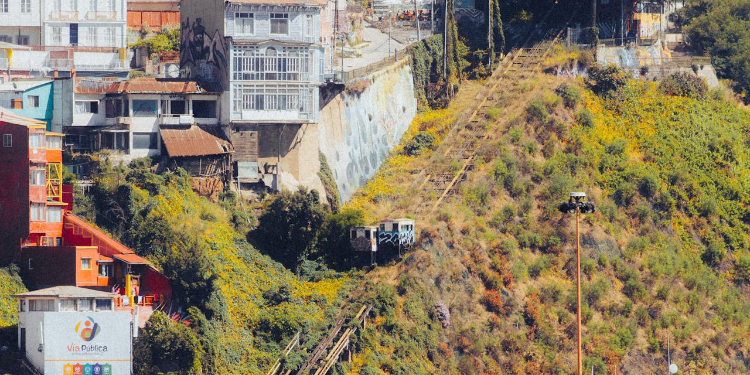
Valparaíso's geography shapes everything about how people move through it. The city splits into two distinct zones: El Plan, the flat coastal strip where commerce and port activity concentrate, and Los Cerros, the steep residential hills that climb dramatically behind it. Getting around efficiently means learning to read this topography and combining the right mix of transport options. The regional commuter train links Valparaíso to neighboring cities along the coast, while shared taxis known as colectivos and historic funiculars handle the vertical challenge of the hills. Trolleybuses designated as national monuments still run daily routes along the flat waterfront. This article covers all the main ways to travel around Valparaíso, including tickets, apps, cycling, driving, and getting in from Santiago's airport.
Transport overview in Valparaíso
The transport network in Valparaíso reflects the city's divided landscape. El Plan, the flat coastal business district, is served by trolleybuses, buses, and the regional commuter train, all of which run efficiently along the main avenues. Los Cerros, the steep residential hills, require a different approach: funiculars (known locally as ascensores) provide the most direct vertical connection, while colectivos navigate fixed routes up into neighborhoods that standard buses cannot reach.
The network as a whole is undergoing significant modernization. A major ticketing upgrade introduced QR code and credit card payment across trolleybuses, new electric buses, and funiculars, allowing passengers to move between modes with a single integrated payment method. Looking further ahead, a public tender process that opened in late 2025 aims to replace the aging bus fleet across the Gran Valparaíso region with nearly 600 new high-standard buses, of which 40% will be electric, with deployment planned from 2027 onward (Ministerio del Interior).
For day-to-day commuting, most expats find that combining the regional train for fast intercity travel along the coast with colectivos or funiculars for navigating the hills meets most of their transport needs efficiently and affordably.
The Tren Limache-Puerto in Valparaíso
Valparaíso has no underground subway, but the Tren Limache-Puerto, operated by EFE Valparaíso, functions as the city's rail backbone. The line stretches 43 kilometers across 20 stations, connecting Valparaíso to Viña del Mar, Quilpué, Villa Alemana, and Limache. It is the fastest and most reliable option for traveling between these cities, running at high frequency during peak hours.
Fares are calculated based on the number of zones crossed and the time of travel. Off-peak base fares range from CLP 500 to CLP 1,260 (USD 0.52 to USD 1.30), while peak hour fares run from CLP 600 to CLP 1,400 (USD 0.62 to USD 1.45). Afternoon peak hours run from 16:00 to 20:00, with trains operating at 6-minute frequencies during this window. A personalized EFE transport card is required to board; passengers cannot pay in cash at the turnstiles. Senior citizens who register for the dedicated card receive a 50% discount on all fares, and students holding a Tarjeta Nacional Estudiantil (TNE) receive a 33% discount.
Good to know:
EFE offers a daily tourist pass during the summer season, providing unlimited train travel for CLP 3,000 (USD 3.10) per day. This can be practical for new arrivals who want to explore the coastal cities before settling into a regular commuting pattern.
Buses in Valparaíso
The local bus network, commonly called micros, operates under the Transporte Metropolitano de Valparaíso (TMV) system and covers the full urban area. Standard fares generally range between CLP 450 and CLP 550 (USD 0.46 to USD 0.57) depending on the route, and most older buses still require cash paid directly to the driver on board. Carrying small change is advisable for anyone planning to rely on this network regularly.
The existing fleet is notably aged, with an average vehicle age of 11 years across approximately 1,863 buses. However, newly introduced electric buses deployed as part of the 2025 modernization program feature electronic validators that accept the EFE card and mobile QR codes, making them a more convenient option where available. The larger fleet renewal, which will bring nearly 600 modern vehicles equipped with Wi-Fi, air conditioning, and USB charging ports, is expected to roll out from 2027. The incoming contracts also include 11 dedicated night bus routes, which will meaningfully improve mobility after 22:00 for those who currently rely on taxis or ride-sharing for late-night travel.
Trolleybuses in Valparaíso
Valparaíso operates the only trolleybus network in Chile and the second oldest in South America, having run continuously since 1952. The system covers El Plan along two main routes, 801 and 802, and serves both as practical urban transport and as a living piece of the city's heritage. The fleet includes historic 1940s Pullman Standard vehicles alongside newer Swiss-built models, all of which carry official National Monument status under Chilean law (Consejo de Monumentos Nacionales de Chile).
In early 2025, the network was upgraded with digital validators, meaning passengers can now pay using the EFE transport card, credit cards, or QR codes generated through the BancoEstado banking app. This integration has made the trolleybus a more seamless part of the city's wider ticketing system rather than a separate cash-only service. Local government efforts are actively underway to financially support the private owners who maintain the fleet, helping keep all operational vehicles running rather than risking the system being scaled back.
Tickets and passes in Valparaíso
The EFE Valparaíso card is the primary travel document for anyone using the train regularly, and it is increasingly useful across other modes of transport as well. The card is strictly required to access the Tren Limache-Puerto and can also be used on electric buses, trolleybuses, and some funiculars following the 2025 fare integration program. Passengers who do not have a bank account in Chile can generate equivalent QR codes through the BancoEstado app to pay for the same modes.
The integration system also applies automatic transfer discounts for multi-modal journeys. Passengers save CLP 90 (USD 0.09) when combining a train with an electric bus, CLP 210 (USD 0.22) when transferring to a trolleybus, and CLP 50 (USD 0.05) when adding a funicular ride. While these amounts are modest individually, they add up for daily commuters. For those making more than 42 trips per month during peak hours, monthly passes offer discounts of 13% to 20% compared to standard per-ride fares (EFE Trenes de Chile). It is worth noting that most colectivos and older micros still operate on a cash-only basis, so keeping local currency available alongside any card or app setup remains practical.
Taxis in Valparaíso
Traditional taxis in Valparaíso are easily identified by their black bodywork and yellow roofs. They are widely available near the bus terminal (Rodoviario), Plaza Sotomayor, and around major tourist hubs. All official taxis are legally required to use a taximeter, and passengers should confirm that the driver activates it at the start of the journey. Rates in the Valparaíso and Viña del Mar area are known to be among the highest meter rates in Chile, partly due to the region's strong domestic tourism activity.
In response to fuel price increases in early 2026, the Chilean government introduced a temporary monthly fuel subsidy of CLP 100,000 (USD 103) for registered taxi and colectivo drivers to limit the impact on end fares (24horas.cl). For direct trips, airport runs, or travel with luggage, taxis remain a convenient option. However, many residents find ride-sharing apps or colectivos more predictable for routine journeys.
Ride-sharing in Valparaíso
Uber, Cabify, and DiDi all operate across the Gran Valparaíso region and are widely used by expats for the transparency of their upfront pricing. Standard fares for short urban trips or journeys between Valparaíso and Viña del Mar typically range from CLP 7,000 to CLP 15,000 (USD 7.20 to USD 15.50), varying with traffic conditions and demand levels.
The sector is currently adjusting to the full implementation of Law 21,553, known informally as the "Ley Uber," which requires all ride-sharing drivers to hold a professional Class A driving license and operate vehicles less than 10 years old with an engine capacity of at least 1,400cc. Enforcement is removing a significant number of non-compliant vehicles from the national pool, which may result in longer waiting times and modest price increases during this transition period. Uber launched its "Uber Pro" tier in Valparaíso in mid-2025, offering priority trip access and higher earnings to top-rated drivers as a measure to stabilize availability (Uber Blog).
Cycling in Valparaíso
Cycling in Valparaíso is genuinely challenging. The steep hills, narrow roads, and heavy traffic in the port area make the city difficult terrain for everyday cyclists. The Gran Valparaíso conurbation has only 3.1 kilometers of dedicated cycle lanes per 100,000 inhabitants, well below the national average (Pontificia Universidad Católica de Valparaíso). Cycling as a primary daily commuting option is not practical for most residents given these conditions.
That said, local authorities are investing in a "Valparaíso Ciclo-Amigable" project, which includes new cycle parking infrastructure, signage, and engineering studies for a proposed 40-kilometer regional cycling network. In the meantime, two funiculars offer a practical assist for cyclists: the Ascensor Barón and Ascensor Cordillera both permit bicycles on board for a fee of CLP 600 (USD 0.62). Bicycles can also be brought onto the Tren Limache-Puerto during designated off-peak and weekend hours, making it easier to reach flatter terrain in Viña del Mar and Concón where riding conditions are considerably better.
Walking in Valparaíso
Walking is one of the most rewarding ways to experience Valparaíso, particularly in the UNESCO-listed hills of Cerro Alegre and Cerro Concepción, which are known for their street art, colorful architecture, and panoramic views. The experience is inherently vertical: navigating the hills means climbing steep staircases and following winding, narrow alleys, which demands a reasonable level of physical fitness. Many expats adopt a practical approach of using a funicular to ascend and walking back down to El Plan, combining convenience with the pleasure of exploring the hillside streets at a comfortable pace.
In El Plan, sidewalks can be uneven and occasionally congested with informal street vendors, so pedestrians benefit from staying alert. For personal safety, it is advisable to stick to well-lit tourist areas and main avenues after dark, and to avoid walking alone through unfamiliar or poorly lit residential hills at night.
Driving in Valparaíso
Driving in Valparaíso is demanding. Local driving habits tend toward the assertive, traffic congestion is frequent, and the city's topography creates particular challenges for unfamiliar drivers. Hill roads are famously narrow, steep, and dotted with blind corners and limited signage. The main coastal artery between Valparaíso and Viña del Mar, Avenida España, is prone to severe bottlenecks during morning commuter hours (07:30 to 09:00) and the evening peak (17:30 to 19:30).
Parking in El Plan is scarce and almost always paid, either at municipal meters or through informal parking attendants known locally as acomodadores, who customarily expect a small tip. Given the strength of the public transport network along the coast and the stress of parking and navigating the hills, many expats living and working in the Gran Valparaíso urban core choose to forgo car ownership entirely. For those who do plan to drive, more detailed information on license requirements, insurance, car registration, and Chilean road rules falls outside the scope of this article and should be verified with the relevant Chilean authorities. You should also take a look at our article about driving in Chile.
Funiculars and colectivos in Valparaíso
Two forms of transport are so central to daily life in Valparaíso that they deserve particular attention. The city's funiculars (ascensores) are iconic cliff railways that form part of its UNESCO World Heritage designation and provide essential access to the steepest residential hills. Of the 15 that exist, only around 7 were consistently operational in 2024 and 2025 due to ongoing maintenance and management disputes (BioBioChile). The standard local fare for most funiculars is CLP 200 (USD 0.21), with Ascensor Concepción priced at CLP 300 (USD 0.31). A dual-pricing system introduced in early 2026 now charges foreign tourists CLP 1,000 (USD 1.03) per ride. Expats who hold a local ID (RUT) should present it to claim the resident rate. Several funiculars now accept digital payments via the EFE card and BancoEstado QR codes.
Colectivos are shared taxis, typically black sedans displaying a numbered roof sign indicating their fixed route. They operate much like buses in terms of route structure but offer the speed and flexibility of a car, reaching elevated neighborhoods that standard buses cannot access. Fares are regulated and typically range from CLP 500 to CLP 800 (USD 0.52 to USD 0.82) per ride, paid in cash to the driver. For anyone living on the hills, colectivos are often the most reliable and affordable daily option for getting to and from El Plan.
Getting from Santiago Airport to Valparaíso
Valparaíso has no commercial airport of its own. The closest major hub is Arturo Merino Benítez International Airport (SCL) in Santiago, approximately 120 kilometers away. There are two main ways to make the journey, and the choice largely comes down to convenience versus cost.
The most direct option is a dedicated intercity airport transfer bus (such as those operated by Aeroquinta) that runs directly from the airport's ground-floor bus terminal to the Viña del Mar and Valparaíso area, with a journey time of roughly 2 to 2.5 hours. A more affordable alternative is to take a shuttle bus operated by TurBus or Centropuerto from the airport to the Pajaritos metro station in Santiago, a 30- to 40-minute journey. From Pajaritos, intercity buses to the Valparaíso Rodoviario terminal depart every 15 minutes; this leg takes about 1.5 to 2 hours and costs between CLP 5,000 and CLP 8,000 (USD 5.15 to USD 8.25).
Booking an Uber or other ride-sharing app directly from SCL to Valparaíso is very expensive, with fares typically exceeding USD 80. It is also worth noting that ride-share drivers are not permitted to pick up passengers from the official arrivals curb at SCL under current airport regulations, so this option requires additional coordination and is rarely the most practical choice on arrival.
Transport apps in Valparaíso
Several apps make navigating Valparaíso's network considerably easier. The official EFE Trenes de Chile app is the most important for residents, allowing users to plan train journeys, check real-time schedules, and manage the balance on their EFE transport card. It is available on both iOS and Android. When searching the app stores, search for "EFE Trenes" specifically to avoid confusion with unrelated apps sharing similar names.
The BancoEstado app has become more practical following the 2025 fare-integration update. It enables users to generate QR codes to pay for journeys on electric buses, trolleybuses, and funiculars directly from a smartphone, making it useful even for those who have not yet obtained an EFE card. For private car bookings, Uber, Cabify, and DiDi all function reliably across the Gran Valparaíso area. Journey planning apps, including Moovit and Google Maps, provide useful scheduling for the Tren Limache-Puerto and main bus routes, though real-time GPS tracking for smaller hill-bound micros and colectivos remains limited within these platforms (EFE Trenes de Chile).
Frequently asked questions about transport in Valparaíso
Is Uber legal in Valparaíso?
Yes, Uber operates legally and is widely used across the Gran Valparaíso region. The service is currently adapting to the requirements of Law 21,553, which mandates professional driving licenses and newer vehicles for all ride-share drivers. This transition may temporarily affect driver availability and waiting times in some areas.
How do I get from Santiago Airport to Valparaíso?
The most cost-effective route is to take a shuttle bus from the airport to the Pajaritos metro station in Santiago (30 to 40 minutes), then catch an intercity bus to the Valparaíso Rodoviario terminal, which runs every 15 minutes and costs between CLP 5,000 and CLP 8,000 (USD 5.15 to USD 8.25). Direct airport buses to Valparaíso are also available but run less frequently.
Can I pay with a bank card on public transport in Valparaíso?
On newer electric buses, trolleybuses, and some funiculars, you can pay using a credit card or a QR code generated through the BancoEstado app. Older standard buses and colectivos still operate on a cash-only basis, so carrying small change remains important for day-to-day travel.
Do I pay the tourist or local price on the Valparaíso funiculars?
A pricing update introduced in early 2026 set a tourist fare of CLP 1,000 (USD 1.03), compared to the standard local fare of CLP 200 (USD 0.21). Expats who have obtained a Chilean ID number (RUT) should present it when boarding to claim the resident rate rather than the tourist price.
How does a colectivo work in Valparaíso?
Colectivos are shared taxis that follow fixed, numbered routes much like a bus. You flag them down on the street, share the vehicle with up to three other passengers going the same direction, and pay a regulated cash fare directly to the driver, typically between CLP 500 and CLP 800 (USD 0.52 to USD 0.82). They are particularly useful for reaching hill neighborhoods that buses do not serve.
Are the funiculars open every day?
The funiculars are intended to run daily to serve local residents, but ongoing maintenance issues mean only around 7 of the 15 existing ones are consistently operational. Operating hours generally run from 07:00 to 23:00, though occasional closures for repairs are not uncommon. It is worth knowing the location of an alternative staircase or colectivo route as a backup.
Can I take my bike on the funiculars?
Yes, but only on specific lines. The Ascensor Barón and Ascensor Cordillera officially permit bicycles on board for a dedicated fee of CLP 600 (USD 0.62). Bicycles can also be taken on the Tren Limache-Puerto during designated off-peak and weekend hours.
Do I need a car while living in Valparaíso?
For expats living and working within the Gran Valparaíso urban area, a car is generally unnecessary. The combination of the regional train, buses, funiculars, colectivos, and ride-sharing apps covers most daily needs effectively. Driving involves dealing with narrow steep roads, limited parking, and significant congestion on the main coastal route, which makes ownership a less appealing proposition for many residents.
Have questions about getting around Valparaíso? Join the Expat.com community to connect with expats who have already figured out the best routes and tricks for navigating this unique city.
We do our best to provide accurate and up to date information. However, if you have noticed any inaccuracies in this article, please let us know in the comments section below.