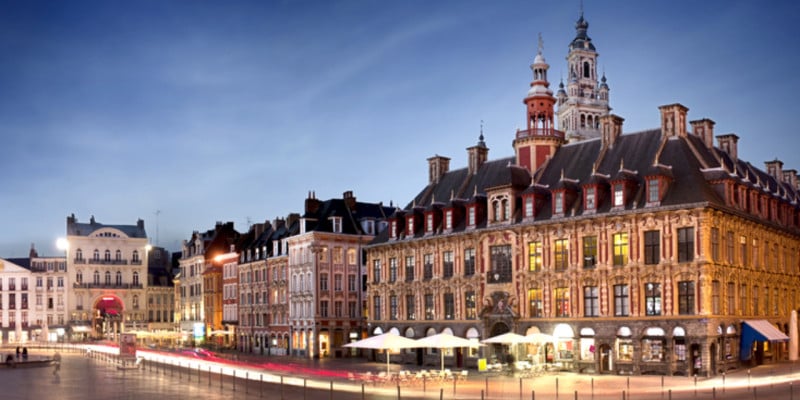
The most important companies in Lille
The Hauts-de-France region is home to over 36,500 companies, with 62,400 new start-ups launched in 2021 alone. Here are some reputable companies worth considering if you're seeking employment in Lille:
- Abildoc: Abildoc, located near Lille's main railway station, specializes in electronic document processing and management solutions to help businesses with their digital transformation. The company focuses on three main areas: design and implementation engineering, training and change management, and technical support and maintenance to ensure smooth operations. Abildoc often advertises positions for engineers and project managers;
- Campus Science U Lille: Besides studies, Campus Science U Lille also offers a wide range of jobs in the teaching field. This higher education group comprises four schools:
- EDBS: Business School of Entrepreneurship and Digital,
- EFFICOM Lille, Digital-Design-Business-Tech School,
- EFAB Lille, école supérieure des métiers de l'immobilier,
- EIML, international luxury marketing and management school,
- MOD'ART, French fashion school;
- Crédit Mutuel Nord Europe: Crédit Mutuel Nord Europe, in the banking sector, may also be a company to consider for candidates with expertise in this field. The head office is right in the center of Lille. More than 2,000 employees work in this banking group, which emphasizes its commitment to gender equality and recruits both expert candidates and students looking for an internship or work-study placement;
- Wepa: Wepa, located in Bousbecques, about 20 km from Lille, specializes in providing innovative and sustainable hygiene solutions for food retailers across Europe. Wepa frequently offers positions for students, recent graduates, and professionals in various fields, depending on their specific needs.
Read also Working in France
How do I find a job in Lille?
The internet is the most effective tool for job hunting in Lille. You can explore a variety of general and specialized websites (see links below) and utilize professional social networks like LinkedIn. LinkedIn, in particular, is highly recommended for job seekers in France, including those in Lille. Its search feature allows you to discover companies and job openings by city and browse all current opportunities in Lille. You can also use LinkedIn to connect with professionals from companies of interest or with hiring managers to introduce yourself.
France Travail, the national employment service, is also a perfect solution for those already settled in France (visa, residence permit...). Foreigners from countries outside the European Union (EU) or the European Economic Area (EEA) who wish to register with the service must have a residence permit and a long-stay visa. Here is the list of residence permits required to register with France Travail:
- temporary or multi-annual residence permits (from 1 to 10 years) for "private and family life", "salaried employee", "seeking employment or setting up a business", or "temporary worker";
- multiannual residence permit with "talent passport" mention;
- carte de résident (issued for 10 years), marked "résident", "résident permanent" or "résident longue durée – UE";
- residence permit for "foreign students or trainees", marked "seeking employment or setting up a business";
- long-stay visa issued for 4 to 12 months, with the words "employee", "private and family life" or "seeking employment or setting up a business";
- temporary work permit, in the case of an employment contract terminated early by the employer;
- Algerian residency certificate, marked "vie privée et familiale" (private and family life), "salarié" (employee), "scientifique" (scientist), "professions artistiques et culturelles" (artistic and cultural professions) or "travailleurs temporaires" (temporary workers).
Read also Work visa for France
However, European expatriates who are members of the EU or EEA only need to present proof of identity to register with France Travail.
Good to know:
The job offers available on France Travail are freely accessible. Whether you register or not, you can consult job offers.
Don't hesitate to contact Lille Avenirs, which offers services for companies, employees, and job seekers. You can also contact temporary employment agencies such as NordJob, Adecco, and RAS Intérim.
We also recommend sending unsolicited applications to companies that interest you. This is a common practice in France. Even if the company currently has no job openings, you can still submit your CV and cover letter for consideration.
Remember that the local job market, particularly within small and medium-sized companies, often has hidden opportunities. Networking and social media can be valuable resources for uncovering these. Include Facebook groups and online forums in your job search strategy in Lille.
Find a student job in Lille
As a student city par excellence, Lille offers a wide range of jobs for students, even foreign ones. We remind you that foreign students holding a long-stay student visa can work around 20 hours a week (964 hours a year) for the duration of their studies in France.
If you're looking for a student job in Lille, start by contacting your school, college, or university. They often receive job offers specifically for students, giving you an advantage. Additionally, don't hesitate to network with your fellow students or roommates. Many of them may already be working and can guide you on where and how to find job opportunities. In some cases, they might even recommend you for openings at their workplace.
Read also Accommodation in Lille
France Travail is also a valuable resource for finding a student job and can provide helpful advice if you're not familiar with the job application process.
We also recommend websites dedicated to students, such as Student Job or l'Étudiant and, for Erasmus students, Erasmusu.
Professional networking in Lille
Professional networking is beneficial in your job search in Lille. Contact the Cercle des Gens Bien et Bienveillants (CDGBB) or Maison Folie, which organize interesting networking events in Lille in sometimes unusual locations. They'll put you in touch with professionals with whom you can share your ambitions and, why not, hand out a few CVs or gain a few important contacts? And don't forget to check out the job offers for foreigners regularly posted on Facebook.
Moreover, Lille hosts themed networking events that are open to all. These gatherings include evenings, happy hours, and sometimes even breakfasts where you can connect with professionals in your field or beyond. It's an opportunity to discuss work trends and the job market's future and potentially secure job interviews with your target companies. To discover these events in Lille, explore Eventbrite or Meetup websites where you can register for dates and locations. Most events are free of charge.
Networking through word-of-mouth is highly effective. Don't hesitate to ask new acquaintances about companies that hire foreigners or people in your field. Keep your CV handy on your smartphone so you can share it instantly if needed. You might be just one conversation away from landing a job in Lille!
Setting up a business in Lille
If you're moving to Lille to set up your own business, we've got good news for you: it's perfectly possible to do it, even if you're a foreigner! With the right residence permits and the right knowledge of the French job market and economy, you'll have no trouble doing it. In recent years, the municipality of Lille and the Hauts-de-France region have set up support and assistance programs and training courses for entrepreneurs wishing to set up in the area. For more information, visit Lille.fr, BGE Hauts de France, CCI Hauts de France, Lille Métropole, Initiative Lille Métropole Nord, and the Fabrique à Entreprendre de Lille.
Before launching your business, ensure you have the appropriate visa/residence permit and all necessary documents in place. Among the crucial steps in starting a company (following the development of your business plan) is selecting the appropriate legal structure from those available in France. These include société par actions simplifiée (SAS), which is widely used for startups, société en commandite par actions (SCA), société en nom collectif (SNC), société anonyme (SA), société à responsabilité limitée (SARL), société par actions simplifiée unipersonnelle (SASU), entreprise unipersonnelle à responsabilité limitée (EURL), and entreprise individuelle (EI). Note that the individual limited liability company (EIRL) ceased to exist in 2022.
Thoroughly preparing your business plan, particularly focusing on the financial aspects, will help you choose the appropriate legal structure. It's crucial to decide your legal status based on your business plan rather than making a hasty decision upfront. You can find detailed information at the Chamber of Commerce and Industry (CCI) or through a BGE (business start-up assistance center).
Read also Being a digital nomad in France
Unless you can work independently from home, you'll also need to find commercial space to start your business. Lille offers plenty of offices and commercial properties available for rent or purchase, along with numerous coworking spaces scattered across the city. In recent years, these shared workspaces have grown in popularity throughout France, and Lille hosts several coworking options as well. We can mention the following:
- Now Coworking Lille, Palais de la Bourse, 40, place du Théâtre;
- Startway Coworking Lille Europe, 143, rue d'Athènes;
- La Maison du Coworking, 116, rue Nationale;
- Clockwork – Coworking, 38, boulevard Carnot;
- La Coroutine, 16, allée de la Filature.
If you're looking for one in a specific neighborhood or street, you can use tools like Google Maps, for instance.
How to prepare for a job interview in Lille
How do you sell yourself to the recruiter? How can I get their attention? Should I present my CV with or without a photo?
Looking for a job is a job in itself. The content (assignments carried out, qualifications obtained, etc.) is almost as important as the form (CV presentation, interview dress, etc.).
Of course, the advice given below applies regardless of the city you're applying to.
CV: with or without a photo?
Learn about common French practices regarding CV presentation. While some advocate for CVs with photos, others prefer them without. In reality, there's no legal requirement for a photo on a CV, so the choice is yours. Recruiters often appreciate CVs with photos as they add a personal touch, but be cautious of potential discrimination issues.
Discrimination in hiring is still rife in France. Keep this in mind, but don't let it dampen your spirits. On the contrary, whether or not you opt for a photo CV, make your CV speak for itself by detailing your missions. It's an excellent way of showing yourself off.
Read also Diversity and inclusion in France
Preparing yourself mentally
Preparing for a job interview requires strong mental readiness. Like athletes who mentally prepare before competitions and throughout their careers, you should approach job interviews with the same mindset. Job hunting can feel like running a marathon with its challenges. Mental preparation helps you manage stress, navigate unexpected situations, and anticipate tricky questions from the interviewer.
Knowing how to answer the recruiter
Candidates often fear trick questions, which can unsettle many. These questions might be complex, tricky, or even unrelated to the job (like being asked what plant or animal you'd prefer to be). However, they serve as a way to assess your ability to think quickly, communicate effectively (including through gestures or voice modulation), engage with your interviewer, and, importantly, manage stress.
Here are a few questions you might be asked:
When discussing a genuine flaw, avoid being overly harsh on yourself. Instead, mention a skill you're actively improving. Share an example where this flaw impacted a task or project, emphasizing the lessons you've learned. Conclude positively by highlighting your ongoing efforts to grow. When discussing strengths, avoid exaggeration and focus on relatable qualities that others appreciate, using humor sparingly.
Be honest. Don't think that the employer will be irritated to learn that you're looking elsewhere – on the contrary. Applying to other companies shows that you're active and in demand.
This question is frequently asked in interviews. Showcase your past successes and illustrate how you can seamlessly integrate into the company, stressing the importance of conducting thorough research beforehand. Clearly explain how the company can benefit from your accomplishments.
Even today, addressing gaps in your CV can be daunting. However, it's crucial to be honest. Employers are not looking to blame you but rather to understand your current situation. Use this opportunity to demonstrate what you've learned during any period of unemployment. If you've faced challenges like job loss, family issues, or illness, discussing them can showcase your resilience and ability to overcome adversity. There are differing opinions on whether to mention sensitive issues such as serious illnesses or conditions like depression, with some advocating for open discussion. In contrast, others caution against it due to potential stigma.
Certainly, when the recruiter asks if you have any questions, they aren't expecting you to evaluate them. Instead, it's a chance for you to bring up any points that weren't covered during the interview. Rather than simply saying, “It was good", consider mentioning a topic related to your role or the company that you would have liked to delve into further. You can also use this opportunity to turn the question back to the employer, demonstrating your interest in the company and your motivation. This approach also shows humility, indicating that you are open to feedback from the recruiter.
Salaries in Lille
According to the INSEE report published in February 2024, the average hourly net salary in Lille is approximately 16.2 euros as of 2021. However, salary levels can vary significantly based on factors such as industry, job position, hierarchy, benefits, and more. It's common for recruiters to inquire about your salary expectations during a job interview.
The inflationary and economic crisis has brought the issue of salaries to the forefront once again, with many employees lamenting that their salaries are not high enough. Others are seizing the opportunity to renegotiate contracts, request promotions, or explore new opportunities amid competition. Lille and its metropolitan area continue to attract entrepreneurs, with the Hauts-de-France region investing to draw more business ventures. A prime example is the success of La Pleine Image, recognized as "Europe's hub for creative industries". Dynamic, innovative, and open to Europe and the world, Lille offers a compelling environment for success.
Useful links:
La Voix Emploi
Indeed
Graduate Land
Erasmusu
Glassdoor
Student Job
Jobs l'Étudiant
France Travail
France Travail – Student Jobs
NordJob
Adecco
RAS Intérim
Maison Folie
Cercle des Gens Bien et Bienveillants
LinkedIn