

Living in Aswan: the ultimate expat guide
Everything you need to know for a successful life in Aswan.
Aswan, located in southern Egypt along the majestic Nile River, stands as one of the country's most captivating cities. With a population of approximately 378,000 residents in 2025, this historic city offers a unique blend of ancient heritage and modern development. Known as the gateway to Africa, Aswan has long served as a vital commercial and cultural hub, bridging Egypt with Sudan and the rest of the African continent. The city's warm climate, stunning natural landscapes, and rich Nubian heritage create an atmosphere distinct from Cairo or Alexandria, offering expatriates a more relaxed pace of life while maintaining access to essential amenities and services.
Aswan's strategic location makes it an ideal base for exploring some of Egypt's most remarkable archaeological sites, including the world-famous temples of Abu Simbel and Philae. The city itself features the engineering marvel of the Aswan High Dam, which has shaped modern Egypt's development since the 1960s. For expatriates considering a move to Aswan, the city presents opportunities in tourism, education, and agriculture, particularly sugar production. The welcoming Nubian community, picturesque Nile views, and considerably lower cost of living compared to major Egyptian cities make Aswan an increasingly attractive destination for those seeking an authentic Egyptian experience away from the hustle of larger metropolitan areas.
Five compelling reasons to relocate to Aswan
- Unparalleled historical and cultural heritage: Living in Aswan means having direct access to some of the world's most impressive ancient monuments, including the UNESCO World Heritage Sites of Abu Simbel and Philae Temple. The city's proximity to these archaeological wonders, combined with its authentic Nubian culture, offers daily immersion in one of humanity's most fascinating civilizations.
- Exceptional quality of life at affordable costs: Aswan offers significantly lower living expenses compared to Cairo or Alexandria, with monthly costs averaging 40-50% less than Egypt's major cities. Housing, food, and transportation remain remarkably affordable, allowing expatriates to maintain a comfortable lifestyle without financial strain.
- Year-round pleasant climate: Aswan enjoys one of Egypt's warmest and driest climates, with minimal rainfall and abundant sunshine throughout the year. The city's position along the Nile provides a refreshing contrast to the surrounding desert, creating an ideal environment for outdoor activities and Nile cruises.
- Tranquil pace of life: Unlike Egypt's bustling metropolises, Aswan maintains a relaxed, unhurried atmosphere. The city's manageable size, friendly local population, and scenic riverside setting contribute to a peaceful lifestyle that many expatriates find refreshing after experiences in larger, more chaotic urban centers.
- Growing tourism and employment opportunities: With Egypt's tourism sector experiencing remarkable growth—reaching 15.8 million visitors in 2024 and targeting 30 million by 2028—Aswan's position as a major tourist destination creates expanding opportunities in hospitality, tour operations, education, and related services for qualified expatriates.
Working in Aswan
Aswan's economy centers primarily on tourism, agriculture, and education, creating distinct employment opportunities for qualified expatriates. The city's strategic importance as a tourist destination generates consistent demand for professionals in hospitality management, tour operations, and cultural interpretation. Egypt's tourism industry has demonstrated remarkable resilience, with the sector contributing 8.5% to the country's GDP and supporting approximately 2.7 million jobs nationwide in 2024. This robust growth trajectory, projected to reach 18 million tourists by 2025, translates into expanding opportunities in Aswan, particularly during peak tourist seasons from October through April.
For expatriates seeking employment in Aswan, obtaining proper work authorization remains essential. Egypt maintains specific regulations requiring foreign workers to secure both a work permit and a work visa before commencing employment. The Egyptian government prioritizes local employment, implementing quota restrictions that limit foreign workers to no more than 10% of a company's total workforce and 20% of the payroll. Employers must demonstrate that no qualified Egyptian national can fill the position before sponsoring a foreign employee. The work permit application process typically requires two to three months and involves clearance from Egypt's National Security Agency, submission of academic qualifications and employment contracts, and completion of mandatory health testing including HIV screening.
Key employment sectors and opportunities
Tourism and hospitality form the cornerstone of Aswan's job market, with numerous hotels, Nile cruise operators, and tour companies seeking qualified professionals. Aswan University, established in 2012, employs international faculty and researchers across its 15 faculties, offering opportunities in education and academic research. The agricultural sector, particularly sugar production at the region's factories, occasionally recruits technical specialists and engineers. Language instruction represents another growing field, with demand for qualified English, French, and other European language teachers to serve both the tourism industry and educational institutions.
Professional positions in Aswan typically offer monthly salaries ranging from USD 600 to USD 1,500 for entry to mid-level roles, with senior positions and specialized technical roles commanding higher compensation. While salaries may appear modest compared to Western standards, they align well with the local cost of living and can provide comfortable lifestyles when converted to Egyptian Pounds.
Work permit requirements and procedures
The work permit process begins with the employer submitting applications to the Ministry of Manpower and Immigration. Required documentation includes a valid passport, academic degree certificates (legalized and translated into Arabic), police clearance certificates, employment contract, and proof of professional qualifications. Initial permits are typically valid for one year and renewable for up to three years. First-year work permit fees amount to approximately EGP 5,205, with additional costs for HIV testing (EGP 850) and residence visa processing (EGP 7,100). Most expatriates enter Egypt on tourist visas, which are subsequently converted to work visas once the work permit is approved.
Employment indicator | Current figure |
National unemployment rate | 6.1% (Q2 2025) |
Average monthly salary (national) | EGP 9,200 - 14,370 (USD 183 - 286) |
Tourism sector jobs (national) | 2.9 million projected for 2025 |
Sources: Trading Economics, EARLY Salary Data, World Travel & Tourism Council
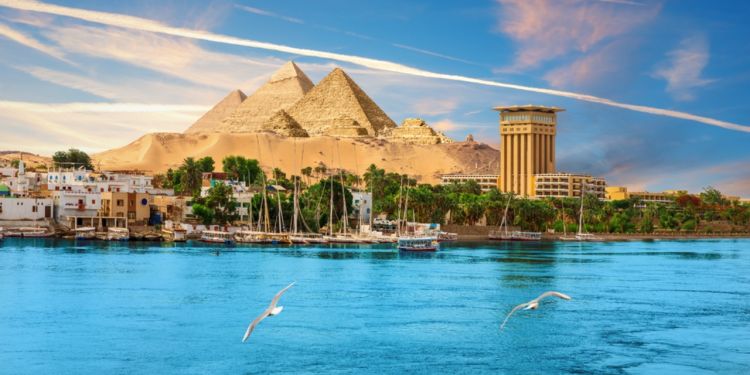
Work in Aswan
Besides Cairo and Alexandria, Aswan is also a major Egyptian city. If you intend to settle and work there, here is how to proceed to find a job.
Higher Education & Universities
Aswan's higher education landscape centers on Aswan University, a comprehensive public institution serving southern Egypt and offering diverse academic programs to both Egyptian and international students. Established as an independent university in 2012 after operating as a branch of South Valley University since 1995, Aswan University has grown into a significant educational hub with modern facilities and expanding research capabilities. The university's main campus occupies 400 acres in Sahary City along the Airport Road, with an additional headquarters in New Aswan covering 98.5 acres, providing extensive infrastructure for academic and research activities.
For expatriate families considering higher education options in Aswan, the university offers a viable alternative for undergraduate and postgraduate studies. The institution maintains 15 faculties including Engineering, Medicine, Science, Arts, Commerce, Agriculture, Languages and Translation, and Energy Engineering, among others. According to international rankings, Aswan University ranks 22nd among Egyptian universities and holds a position in the top 2,600 universities globally according to Times Higher Education and Webometrics assessments from 2022. While primarily Arabic-medium instruction dominates, several programs, particularly in engineering and sciences, incorporate English-language components and materials.
Academic programs and admission requirements
Aswan University provides bachelor's degree programs typically spanning four to five years depending on the field of study, alongside master's and doctoral programs in various disciplines. International students seeking admission must submit completed secondary school certificates (equivalent to the Egyptian Thanaweya Amma), official transcripts, passport copies, and proof of language proficiency. For programs taught in Arabic, students may need to complete Arabic language preparation courses. The university maintains partnerships with international institutions and participates in student exchange programs, facilitating academic mobility for enrolled students.
Tuition fees for international students vary by faculty and program level but generally remain considerably lower than European or North American institutions. Annual tuition for undergraduate programs typically ranges from USD 1,500 to USD 3,000, with medical and engineering programs commanding higher fees. Graduate programs cost approximately USD 2,000 to USD 4,000 annually. The university provides six dormitories across Aswan City, offering affordable accommodation options for students. Scholarship opportunities exist through the Egyptian government's international scholarship programs and bilateral educational agreements between Egypt and various countries.
Campus facilities and student life
The university's infrastructure includes modern laboratories, specialized research centers such as the Artificial Intelligence and Robotics Center and the Natural Hazard Studies Unit, comprehensive libraries with digital resources, and sports facilities utilizing local governorate clubs for student training. The university's location in Aswan provides unique advantages for students studying archaeology, environmental sciences, and energy engineering, given the city's proximity to major archaeological sites and the Aswan High Dam. Student services include psychological counseling, career development support, and cultural activities reflecting Aswan's rich Nubian heritage.
For detailed information about programs, admission procedures, and international student services, visit Aswan University's official website or contact the International Relations Office directly.
Schooling for Children
Educational options for expatriate families in Aswan differ significantly from those available in Cairo or Alexandria, reflecting the city's smaller size and more specialized character. Egypt's public education system follows a structured progression: kindergarten for ages 4-6, primary school for six years beginning at age six, preparatory school for three years, and secondary school for three additional years. While this system serves the local population effectively, most expatriate families seek alternatives that maintain continuity with their home country curricula or provide internationally recognized qualifications.
Unlike major Egyptian cities where numerous international schools cater to diverse expatriate communities, Aswan's educational landscape offers more limited choices for non-Arabic instruction. The city hosts several Egyptian National Schools that provide quality Arabic-medium education, alongside Language Schools that incorporate English instruction for mathematics, sciences, and IT subjects while teaching social studies in Arabic. For families requiring full international curricula, the nearest comprehensive international schools operate in Cairo or Alexandria, approximately 12 hours by train or 1.5 hours by flight from Aswan. This geographical reality necessitates creative educational planning for many expatriate families.
Local educational options and alternatives
Aswan's education sector includes several reputable language schools that blend Egyptian curriculum with enhanced English instruction. These institutions typically charge annual fees ranging from EGP 15,000 to EGP 40,000 (USD 300 to USD 800), representing affordable options for families comfortable with Arabic-medium education supplemented by English components. For families prioritizing English-language education, the Nile International Schools (NIES) network, which operates 14 branches across Egypt, maintains facilities in some Upper Egypt locations, though direct Aswan presence remains limited.
Many expatriate families working in Aswan's tourism and education sectors opt for homeschooling or distance learning arrangements, utilizing international curricula such as the British IGCSE, American Common Core, or International Baccalaureate programs through accredited online platforms. This approach provides curriculum continuity while allowing families to benefit from living in Aswan's unique cultural environment. Parents pursuing this route should verify their home country's recognition of distance learning credentials and consider supplementing with local tutors for Arabic language acquisition and cultural integration.
Enrollment procedures and educational planning
Families intending to enroll children in Egyptian schools must provide birth certificates, previous school records with transcripts, passport copies, residence permits, and immunization records. All foreign documents require legalization by the Egyptian embassy in the home country and translation into Arabic by certified translators. The Egyptian academic year runs from September to June, divided into two semesters. Enrollment typically occurs during July and August, though mid-year transfers may be accommodated depending on school capacity and grade level.
For families committed to long-term residence in Aswan but requiring international education, some choose boarding school arrangements in Cairo for older children while maintaining family bases in Aswan. Cairo hosts numerous well-established international schools offering British, American, French, and German curricula with full boarding facilities. This arrangement, while requiring family separation during school terms, enables children to access internationally recognized education while parents maintain professional engagements in Aswan. Boarding school fees in Cairo typically range from USD 15,000 to USD 30,000 annually, including accommodation, meals, and educational expenses.
Prospective families should contact schools directly well in advance of planned relocation to discuss enrollment options and requirements. The Egyptian Ministry of Education website provides information on school recognition and curriculum standards.
Housing & Neighbourhoods
Aswan's housing market offers expatriates considerably more affordable options than Egypt's major metropolitan areas, with rental prices approximately 40-50% lower than Cairo or Alexandria. The city's residential landscape comprises a mix of traditional Nubian-style homes, modern apartment complexes, and villa developments, primarily concentrated along the Nile Corniche and in newer planned districts. For expatriates, accommodation choices typically involve furnished apartments in central areas or unfurnished units in residential neighborhoods, depending on length of stay and budget considerations.
The rental market in Aswan caters primarily to Egyptian residents, with a smaller but growing segment serving tourists and expatriates working in the city's tourism and education sectors. Unlike major cities where online property platforms dominate the market, Aswan's housing searches often rely on local networks, word-of-mouth recommendations, and direct inquiries with property owners or local real estate agents. Understanding this localized approach proves essential for newcomers seeking suitable accommodation.
Popular residential areas for expatriates
The Nile Corniche area represents Aswan's prime location, offering stunning river views, proximity to major tourist attractions, and easy access to restaurants, markets, and transportation. Apartments along the Corniche command premium prices but provide the convenience of central location and modern amenities. The Al-Aqqad extension area has developed into a middle-class residential zone with newer apartment buildings offering good standards at moderate prices, popular among Egyptian professionals and some expatriate families.
Elephantine Island, accessible by boat, hosts the prestigious Mövenpick Resort and scattered residential properties, providing a unique living environment surrounded by Nile waters and archaeological sites. Some expatriates prefer this location for its tranquility and distinctive character, though daily boat transport to mainland Aswan adds logistical considerations. New Aswan City, located approximately 10 kilometers north of downtown, represents a planned development designed to accommodate 70,000 residents with modern infrastructure, though it remains less established than older neighborhoods.
Rental costs and housing types
Rental prices in Aswan vary significantly based on location, apartment size, furnishing status, and building age. Furnished apartments suitable for expatriates typically rent for EGP 2,000 to EGP 4,500 monthly (USD 40 to USD 90) for one-bedroom units in decent neighborhoods, while three-bedroom apartments range from EGP 4,000 to EGP 8,000 monthly (USD 80 to USD 160). Premium locations along the Nile Corniche or in newer developments may command 20-30% higher rates. Unfurnished apartments generally cost 15-20% less but require initial investment in furniture and appliances.
Standard rental agreements in Egypt require security deposits equivalent to one to two months' rent, along with advance payment of the first month. Lease contracts typically span one year with annual renewal options, though shorter-term arrangements may be negotiated for furnished tourist apartments. Utility costs (electricity, water, gas) average EGP 300 to EGP 600 monthly (USD 6 to USD 12) for a moderate-sized apartment, with higher consumption during summer months when air conditioning becomes essential. Internet connection fees range from EGP 200 to EGP 400 monthly (USD 4 to USD 8) depending on speed and provider.
Finding accommodation and rental procedures
Expatriates seeking housing in Aswan benefit from connecting with their employers, who often assist with accommodation arrangements or provide recommendations. For independent searches, engaging local contacts or Arabic-speaking friends proves invaluable, as many property owners advertise through personal networks rather than formal platforms. The Aswan Tourist Market area and nearby streets host several small real estate offices handling rentals and property management. Building superintendents (bawwab) often know about available units in their buildings and neighboring properties, serving as informal but effective information sources.
Before signing rental agreements, inspect properties thoroughly, document existing conditions with photographs, and clarify maintenance responsibilities with landlords. Standard practices include landlord responsibility for structural repairs and major appliances, while tenants handle minor maintenance and consumables. Written lease agreements in Arabic, though sometimes supplemented with English translations, constitute the legal document governing tenancy. Foreign residents should ensure their residence permits properly reflect their registered address, as required by Egyptian law for visa maintenance.
Note: Most property advertisements in Aswan use Egyptian Pounds (EGP). Exchange rates fluctuate; verify current rates before budgeting. For housing search assistance, contact expatriate community groups or consult with your employer's HR department.
Accommodation in Aswan
If you are planning to move to Aswan, finding accommodation will be one of your main priorities. Find out how to proceed in this article.
Leisure, Culture & Things To Do
Aswan's cultural landscape revolves around its extraordinary archaeological heritage, positioning residents within reach of some of humanity's most magnificent ancient monuments. Living in Aswan transforms world-famous tourist destinations into accessible weekend excursions, enabling expatriates to develop deep familiarity with sites that most people only glimpse during brief vacations. This unique privilege extends beyond mere proximity to ancient temples—it encompasses immersion in authentic Nubian culture, participation in river-based activities on the legendary Nile, and engagement with a community maintaining traditions spanning millennia.
The city's calendar follows seasonal tourism patterns, with peak activity from October through April when comfortable temperatures attract international visitors. During these months, cultural events, Nile cruises, and special programs at archaeological sites create vibrant atmosphere. Summer months, while quieter due to intense heat, offer opportunities for more intimate exploration of attractions without tourist crowds, along with special rates at hotels and tour operators seeking local clientele.
Major archaeological sites and cultural attractions
The Temples of Abu Simbel, located approximately 280 kilometers south of Aswan, represent the pinnacle of ancient Egyptian rock-cut architecture. Built by Ramses II, these UNESCO World Heritage Sites feature colossal statues and intricate interior chambers that continue to astound visitors. Twice annually, on February 22 and October 22, the sun's rays penetrate the temple interior to illuminate the sanctuary statues in a phenomenon demonstrating ancient astronomical knowledge. Day trips to Abu Simbel depart Aswan early morning by coach (EGP 300-500 / USD 6-10) or by direct flight (EGP 2,500-4,000 / USD 50-80), with the overland journey requiring approximately three hours each direction.
The Temple of Philae, dedicated to the goddess Isis, occupies the island of Agilkia following its UNESCO-led relocation from original Philae Island to save it from Aswan High Dam flooding. Accessible only by motorboat from the mainland (EGP 50-100 / USD 1-2 per person), the temple complex showcases Ptolemaic and Roman period architecture with exceptionally preserved reliefs and hieroglyphics. Evening sound and light shows bring the temple's history alive through multimedia presentations. Standard admission costs EGP 550 / USD 11, with additional fees for sound and light experiences.
The Nubian Museum, opened in 1997, presents comprehensive exhibitions documenting Nubian civilization from prehistoric times through the modern era. The museum's architecture incorporates traditional Nubian design elements while housing approximately 3,000 artifacts illustrating this culture's distinct identity. Adjacent to the museum, the Fatimid Cemetery contains unique domed tombs from the Fatimid period. Museum admission costs EGP 200 / USD 4, making it an affordable cultural resource for regular visits.
The Aswan High Dam, completed in 1970, represents modern Egypt's most significant engineering achievement, creating Lake Nasser and fundamentally transforming the country's agricultural and electrical infrastructure. Visitor centers explain the dam's construction, engineering specifications, and socio-economic impact. Adjacent to the dam, the Kalabsha Temple, another relocated monument dating to Roman times, stands on Lake Nasser's shore.
Nile activities and island exploration
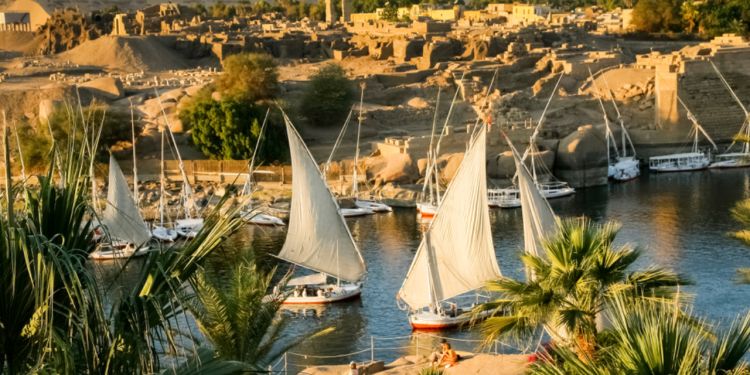
Traditional felucca sailing provides quintessential Nile experiences, with these wooden sailboats offering peaceful river journeys powered solely by wind. Sunset felucca rides, lasting one to two hours, cost approximately EGP 100-300 / USD 2-6 for the entire boat, accommodating six to eight passengers. Longer excursions to Nubian villages, botanical gardens, or downstream destinations offer immersive river experiences. Many expatriates establish relationships with specific captains for regular sailing outings, negotiating monthly or seasonal rates for frequent use.
Elephantine Island, Aswan's largest island, contains archaeological ruins dating to 3200 BCE, including temples dedicated to Khnum and Satet. The island hosts the Aswan Museum displaying artifacts from excavations, along with residential areas inhabited by Nubian families. The Aswan Botanical Garden on adjacent Kitchener's Island showcases diverse plant species in landscaped grounds originally created by British Lord Kitchener. Access to both islands requires brief boat rides from Aswan's Corniche.
Visiting authentic Nubian villages on the west bank provides insights into Nubian culture, with colorful homes, traditional crafts, and warm hospitality. Organized village tours typically include meals with local families, henna demonstrations, and opportunities to purchase handmade goods including baskets, textiles, and jewelry. These cultural exchanges support local communities while offering expatriates meaningful connections beyond superficial tourism.
Markets, dining, and social life
The Aswan Souk, stretching behind the Corniche, offers traditional market experiences with spice vendors, textile merchants, and craftspeople selling Nubian handicrafts, jewelry, and souvenirs. While primarily tourist-oriented, the souk rewards exploration with authentic finds including hibiscus tea, henna, and colorful scarves. Negotiation remains standard practice, with final prices typically settling around 40-60% of initial asking prices.
Aswan's dining scene combines traditional Egyptian cuisine with Nubian specialties including ful medames (stewed fava beans), koshari (rice, lentils, and pasta), and fresh Nile perch dishes. Riverside restaurants along the Corniche provide atmospheric settings for evening meals, with prices ranging from EGP 150-400 / USD 3-8 per person at mid-range establishments. The city's restaurant offerings, while more limited than major cities, include Egyptian, Nubian, and basic international cuisine.
Expatriate social life in Aswan tends to develop through professional networks, shared accommodations, and participation in tourism industry events. While lacking the established expatriate clubs found in Cairo or Alexandria, the city's smaller foreign community often forms close-knit connections. Many expatriates join Egyptian friends and colleagues for social gatherings, celebrating local festivals and maintaining active engagement with Nubian cultural events.
Daily Life
Daily life in Aswan unfolds at a notably slower pace than Egypt's metropolitan centers, reflecting the city's character as a regional hub rather than a sprawling megacity. The rhythm of life here follows the Nile's tranquil flow, with residents and visitors alike enjoying the riverside atmosphere, vibrant Nubian culture, and stunning natural surroundings. Expatriates adjusting to Aswan typically appreciate the manageable city size, where most essential services and attractions remain within reasonable distance, reducing the stress and time commitments associated with navigation in larger Egyptian cities.
The Nubian community constitutes a significant portion of Aswan's population, contributing distinctive cultural elements including colorful traditional architecture, unique musical traditions, and renowned hospitality. This cultural richness creates a welcoming environment for newcomers, with local residents generally displaying friendly attitudes toward foreign residents. However, expatriates should prepare for limited English proficiency outside tourist-oriented establishments, making basic Arabic language skills valuable for daily interactions in markets, government offices, and residential neighborhoods.
Transportation and mobility
Aswan's compact geography makes most areas accessible through various transportation modes. Taxis represent the most convenient option for expatriates, with rides within the city typically costing EGP 20 to EGP 50 (USD 0.40 to USD 1.00). While ride-hailing apps like Uber operate in major Egyptian cities, their presence in Aswan remains limited, requiring reliance on traditional taxis. Negotiating fares before departure prevents misunderstandings, as most taxis lack functioning meters. For regular commutes, some expatriates arrange monthly agreements with specific drivers, ensuring reliable transportation at agreed-upon rates.
Microbuses provide economical public transportation, serving set routes throughout the city for EGP 5 to EGP 10 (USD 0.10 to USD 0.20) per trip. Though crowded and lacking air conditioning, they offer authentic local experience and rock-bottom prices. The Aswan Railway Station connects to Cairo, Luxor, and intermediate stops, facilitating travel to other Egyptian cities. First-class train tickets to Cairo cost approximately EGP 250 to EGP 400 (USD 5 to USD 8), with the journey taking around 12 hours.
For exploration of Nile islands including Elephantine Island, Kitchener's Island, and Philae Temple, traditional felucca boats and motorized ferries provide essential water transport. Felucca rides cost EGP 50 to EGP 200 (USD 1 to USD 4) depending on duration and destination, offering peaceful alternatives to road travel while providing classic Nile experiences. Motor ferries serving regular island routes charge minimal fares of EGP 5 to EGP 10 (USD 0.10 to USD 0.20).
Lifestyle and practical considerations
Aswan's climate demands adjustment for many expatriates, particularly those from temperate regions. Summer temperatures regularly exceed 40°C (104°F), with the period from June through August presenting challenging heat conditions. Air conditioning becomes essential rather than luxury during these months, significantly impacting electricity consumption and costs. Conversely, winter months from December through February offer pleasant temperatures averaging 15-25°C (59-77°F), ideal for outdoor activities and sightseeing.
Shopping for daily necessities centers on local markets (souks) and smaller grocery stores rather than large supermarkets common in major cities. The Aswan Tourist Market and surrounding bazaars offer fresh produce, spices, household goods, and Nubian handicrafts. While prices remain negotiable in markets, established rates apply in modern shops. For international products or specialty items, many expatriates supplement local shopping with periodic trips to Luxor or Cairo, or arrange online deliveries through Egyptian e-commerce platforms.
Healthcare facilities in Aswan include government hospitals and private clinics, though sophisticated medical procedures may require travel to Cairo or Alexandria. Basic medical services, routine check-ups, and common treatments are readily available at reasonable costs. Expatriates should maintain comprehensive health insurance covering emergency medical evacuation to major medical centers if necessary.
Practical tip: Learning basic Arabic greetings and common phrases significantly enhances daily interactions. Egyptian hospitality culture values polite exchanges, and demonstrating effort to communicate in Arabic, however imperfectly, generates goodwill from local residents.
Cost of Living
Aswan maintains one of Egypt's most affordable cost structures, with living expenses significantly lower than Cairo, Alexandria, or international destinations. According to recent data, Egypt's overall cost of living averages 67.9% lower than the United States, with Aswan specifically positioned approximately 5% above the national Egyptian average but still remarkably economical by international standards. This affordability enables expatriates to maintain comfortable lifestyles on modest incomes, with monthly budgets for singles typically ranging from USD 400 to USD 600 excluding rent, and families managing on USD 800 to USD 1,200 monthly excluding accommodation costs.
The favorable exchange rate relationship between most Western currencies and the Egyptian Pound (EGP) amplifies purchasing power for expatriates earning foreign income. However, currency fluctuations affect costs, and Egypt's recent inflationary pressures have increased prices, particularly for imported goods. Despite these adjustments, Aswan's cost structure remains highly competitive, enabling quality living standards unattainable at equivalent budgets in Western countries or even other Middle Eastern destinations.
Monthly expenses for a single person
Expense category | Monthly cost (EGP) | Monthly cost (USD) |
Apartment rent (1 bedroom, city center) | 2,500 - 4,000 | 50 - 80 |
Utilities (electricity, water, gas, internet) | 500 - 800 | 10 - 16 |
Groceries and food | 2,000 - 3,500 | 40 - 70 |
Transportation | 400 - 800 | 8 - 16 |
Dining out (occasional) | 800 - 1,500 | 16 - 30 |
Entertainment and leisure | 500 - 1,000 | 10 - 20 |
Total (excluding rent) | 4,200 - 7,600 | 84 - 152 |
Total (including rent) | 6,700 - 11,600 | 134 - 232 |
Sources: Numbeo Egypt, Hikersbay Aswan, local market surveys
Monthly expenses for a family of four
Expense category | Monthly cost (EGP) | Monthly cost (USD) |
Apartment rent (3 bedrooms, good area) | 5,000 - 8,000 | 100 - 160 |
Utilities (electricity, water, gas, internet) | 900 - 1,500 | 18 - 30 |
Groceries and food | 5,000 - 8,000 | 100 - 160 |
Transportation | 1,000 - 1,800 | 20 - 36 |
Education (local schools, 2 children) | 2,500 - 6,000 | 50 - 120 |
Healthcare and insurance | 1,000 - 2,000 | 20 - 40 |
Entertainment and leisure | 1,500 - 3,000 | 30 - 60 |
Total (excluding rent) | 11,900 - 22,300 | 238 - 446 |
Total (including rent) | 16,900 - 30,300 | 338 - 606 |
Sources: Numbeo Egypt, Expat.com Aswan Guide, expatriate community reports
Additional cost considerations
These estimates reflect mid-range lifestyle choices suitable for most expatriates. Actual expenses vary based on personal preferences, accommodation standards, and consumption patterns. Notably, dining at home using local markets costs substantially less than frequent restaurant meals. A home-cooked meal costs approximately EGP 30-50 per person, while restaurant meals range from EGP 80-250 per person depending on venue type. Healthcare costs remain relatively low for routine medical care, though serious medical conditions may necessitate travel to Cairo's advanced facilities, incurring additional transportation and accommodation expenses.
Expatriates should budget for periodic travel to larger cities for shopping, specialized services, or cultural amenities unavailable in Aswan. Return train tickets to Cairo cost approximately EGP 500-800 (USD 10-16) in first class, while domestic flights average EGP 2,500-4,000 (USD 50-80) depending on booking timing. These supplementary trips, occurring perhaps monthly or quarterly, add to overall living costs but provide access to broader services and goods.
In short
Aswan offers expatriates a rare opportunity to experience authentic Egyptian life in one of the country's most historically significant cities, all while maintaining remarkably affordable living costs and comfortable lifestyle standards. The city's unique position as gateway to ancient Nubia, combined with its stunning Nile setting and welcoming local community, creates an environment where cultural immersion and professional opportunities merge seamlessly. Whether drawn by employment in tourism, education, or archaeological fields, expatriates discover that Aswan's tranquil pace and rich heritage provide fulfilling alternatives to the intensity of larger Middle Eastern cities.
Living expenses averaging 40-50% below Cairo's costs enable comfortable lifestyles on modest budgets, while direct access to world-renowned temples and authentic Nubian culture enriches daily experiences beyond typical expatriate assignments. The city's manageable size, where most destinations remain within short distances, reduces daily stress while maintaining access to essential services and amenities. Though educational options for expatriate families require creative planning, and international healthcare necessitates occasional travel to larger centers, these considerations pale against the distinctive advantages of residing in a city where ancient history and modern life coexist harmoniously along the timeless Nile.
For those considering this move, connecting with Aswan's expatriate community through the Expat.com Aswan forum provides valuable insights from current residents who've successfully navigated the relocation process. Their experiences, advice, and ongoing support help newcomers transition smoothly into this remarkable city, ensuring that your Aswan adventure begins on solid footing with practical guidance from those who've already made this fascinating Egyptian destination their home.
We do our best to provide accurate and up to date information. However, if you have noticed any inaccuracies in this content, please contact us.


Essential services for your expat journey



