

Why I would never ride in a double decker bus in Brazil

James ViP

 |
|11272POSTS
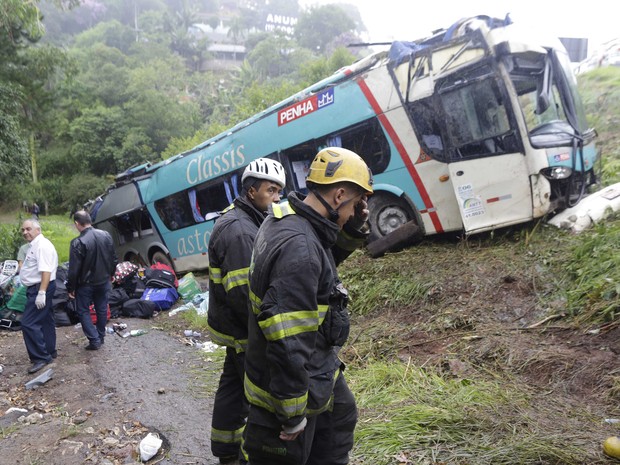 A double decker bus enroute from Curitiba to Rio de Janeiro rolled down an embankment just outside of São Lourenço da Serra - SP on the Régis Bittencourt Highway (BR-116), more commonly known as the "Highway of Death". The crash left 14 dead and 32 injured. This first photo is what the bus looked like following the fatal crash. You couldn't even tell that it originally had a second level since it has been completely crushed, leaving no visual evidence that it was ever there. It is beyond me how these vehicles can operate anywhere in the world given that they offer absolutely no protection whatsoever to the passengers of the upper level. There are no protective roll bars that would prevent the complete structural collapse of the second level that we see here in the photo.
 This photo shows how the vehicle should have appeared before the roll over. It isn't a big leap of logic to assume that the vast majority of the fatalities, if not all of them, were passengers on the upper level of the bus. Apart from the fact that there is no structural protection these buses, by virtue of their added height, are much more prone to roll over accidents due to a much higher center of gravity. They are also very much more difficult to control since they are in effect a rolling wall effected much more severely by cross-wind conditions and at highway speeds this can be deadly.
See also
- Public transport in Brazil - Guide
- Coach & bus services in Brazil - Business
- Why Not Wear Flip-Flops in Brazil? - 40 Replies
- This is why you never buy a beachfront home or plot in Brazil - 22 Replies
- Why are import taxes so high in Brazil? - 19 Replies
- Double taxation - what taxes I will pay - Poland / Brazil - 2 Replies
- I am starting to wonder why anyone moves to Brazil !!!! - 50 Replies

TigerMcTeague Active member
 |
|94POSTS
Essential services for your expat journey

Choose the best health insurance
Protect your health and get easy access to treatment for expats in Brazil.

Plan your international move
Facilitate your move to Brazil by getting a quote from our top rated movers.

Open a bank account that suits you
Discover the best international banks to manage your money securely.

International life insurance
Simple term-life insurance covering you & your family across borders
Other discussions on transports in Brazil
- My pleasant experience with Localiza (rental car)
- Regular IDP works in Brazil for a year?
- Automobile Fuel Cost in Brazil
- Moving items from Canada to Brazil
- Registering a car and obtaining insurance as a tourist.
- Airline Not Responsible For Lost Luggage
- New Car Leasing in Brazil?
- Import a vehicle from Canada to Rio
- Car debts - Detran
- Drivers license in Brazil
- Buying a car in Brazil
- Driving and Renting a car in Brazil
- How to bring your car to Brazil
- Azul flights
- Thoughts on UBER (Brazil)
- Driving a motorcycle
- Sending car parts from US to Brazil
- Staying safe on Brazil's roads and highways
Further reading
Schools and childcare in Brazil
Moving to Brazil with children can mean learning Portuguese, joining a new school, and rebuilding the familiar ...
Dating culture in Brazil: what expats need to know
Dating in Brazil runs through several channels at once, including mutual friends, travel, social networks and ...
Accommodation in Brasilia
Brasilia, the country's federal capital, is home to many highly-paid government employees and foreign ...
Accommodation in São Paulo
São Paulo is Brazil's largest city by far. It offers a wide variety of accommodations with different ...
Working in Curitiba
Curitiba attracts many foreigners, who come both for work and because Curitiba offers a high standard of living. ...
Brazil internships
Brazil's internship law has covered students enrolled at a university abroad, opening the VITEM IV study visa ...
Brazil work visa requirements
Working legally in Brazil starts with immigration paperwork, not a job offer alone. Foreign professionals need a ...
How to create a company in Brazil
Brazil lets foreign individuals and foreign companies own an ordinary limited-liability company outright, with no ...