Hi Sarah, please introduce yourself. Where are you from, what are you doing in Colombia, and what were you doing before you arrived?
I'm originally from Maine and for the last 5 years I've been living in New York City and working in advertising.


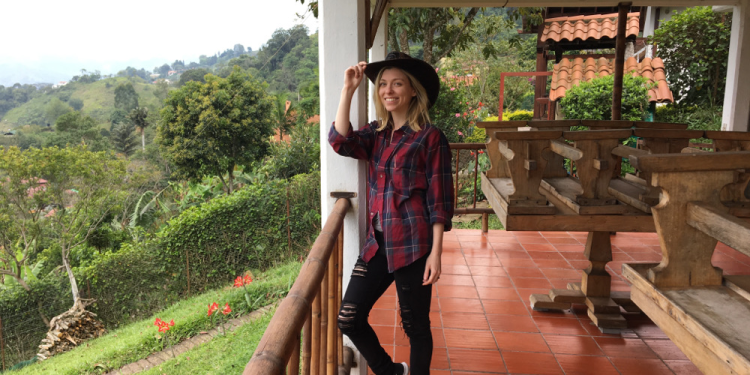
Sarah is originally from Maine but spent five years in New York City, where she met her Colombian husband. They decided to move together to Bogotá pending his green card approval. Fascinated by the Colombian culture, especially the music and dance as well as the hiking opportunities, Sarah talks to Expat.com about her everyday life enjoying a pleasant family-oriented lifestyle and unique cuisine.
I'm originally from Maine and for the last 5 years I've been living in New York City and working in advertising.
Updated in 2026, comprehensive and free
Read it now
I've been in Colombia for about a year now. My husband is Colombian. We met while we were both working for the same company in New York. We were waiting in New York to process his greencard, but the whole thing is running almost a year behind schedule, as the visa and immigration process has become seriously delayed after the elections of 2016. We hit the limit on my husband's work visa so I got permission from my job to work remotely and we moved to Colombia before my husband would be deported.
Get regular tips and advice to make the most of your expat life
It was so much easier than the process of him moving to the U.S. We arrived in Colombia and then immediately filed the applications for my “foreign spouse visa”. We were able to do almost everything online, and the whole thing took about a month.
My favorite thing about Colombia is the culture for music and dance. Colombian people sing without any of the reluctancy or nervousness that we have about singing in the U.S. I'm also certain that with all the music around, Colombian babies learn to dance before they can walk. However, my least favorite thing about Colombia also relates to the music and dance, as sometimes the people aren't as considerate regarding noise levels compared to the U.S. Nearly every few weeks one of my neighbors will have a party with blasting music that lasts until 3 or 4 in the morning on a weekday, and then it's impossible to sleep. In the U.S. you could call the police and complain about the noise and they'd do something immediately, but here the police are so busy with other more major crimes, that noise complaints take a back seat.

Colombia is a rich, verdant country that suffers from too many admirers.
The extreme levels of poverty have been the most surprising parts of Colombia.
The expat job market is probably more robust than the local market. It's focused heavily on the tourism industry, and most international companies want professionals who speak English perfectly. After moving here, I reached out to a an expat group in Colombia about potential work recommendations, and had job offers within the week.
I don't know how locals find apartments, I think most of them actually live with their parents until they get married. I used airbnb and had no trouble at all. The value for your rent is really high, especially if you're accustomed to the high costs of New York and San Francisco. You could probably rent a luxury room for around $300 USD per month, and a 2 bedroom luxury apartment in the best part of the city for $900 per month.

The funny thing about Colombia is that there is a holiday almost every other week and when you ask people no one has idea what the holiday is for. Colombia has the highest number of public holidays in the world and most of them are Catholic holidays.
While there is all this music and dancing, the lifestyle in Colombia is actually a bit more stressful than in the U.S. sometimes. You have to constantly worry about safety and the job market is so tough that you're constantly worried about losing your job.
Transportation in Colombia is really poor and sometimes dangerous. Instead of a subway, they have a limited amount of above-ground buses that are typically packed with people. If you drive, then you have to deal with the unbelievable traffic which takes over the entire city, and finding parking is a nightmare. Taking a taxi can be dangerous if you're a foreigner. Many of them overcharge you, and occasionally some of them are in collusion with criminals and may try to rob you. I typically use Uber to get where I need to go, however using an Uber is not the same as using it in the U.S. because the taxi union does not like Uber and will sometimes attack Uber drivers if they see them, so when you use it you have to get in the front and ride next to the driver to make it look like it's someone you know.
I've been able to adapt to Colombian society pretty easily. I have this kind of permanent foreigner status (they call white foreigners “gringos”), so everyone is very forgiving of language mistakes or cultural slip ups.
Everyday life revolves around work, food, and family. You go to work, deal with the traffic, come home for dinner, and then spend time with family.
In free time my husband and I do a lot of road trips to the small beautiful towns in Colombia.

Definitely. There are numerous places to drink and dance on any night of the week in Bogota.
New habits that I've developed revolve around safety. In New York City, I could walk anywhere alone at any time of the night, but in Colombia you have to be a lot more careful. And I definitely don't walk about wearing expensive or designer brands as I did in New York.
The cost of living is fantastic if you are earning in U.S. dollars, Euros or Pounds. A bus ticket, a beer and a loaf of bread all cost around $2 USD each.
I would like to do more hiking in Colombia. Bogota, where I live, sits right in the middle of the Andes, however the last time I've tried to go I got altitude sickness and had to turn back.

My most memorable experience in Colombia was when I went for a walk on a country road. My husband told me to take a hiking stick with me in case I encountered any dangerous wild dogs. I thought he was exaggerating. I took the stick reluctantly, but sure enough it actually happened. Within 400 meters from the house I encountered this huge growling dog who cornered me on the road. I heard this voice behind me start yelling, I thought someone was coming to help me but it turned out to be a talking parrot. I thought I was about to be attacked and that I would have to beat the dog with the stick, but thankfully the dog chilled out and decided to let me pass.
I would have brought less clothing from the U.S. It's so hard to part with things when you're moving and you think that you'll need something someday, but in reality your needs are completely different in your new expat country and so you end up buying more stuff there.
The local cuisine is great and it utilizes a totally different palate than in the U.S. Instead of bread and butter, you find olive oil and arepas. Fresh fruit and vegetables are a lot more commonly used than in the U.S. The only thing I have issues with is cilantro, which finds its way into almost every dish. Most people think that I'm lying or exaggerating when I tell them that cilantro tastes bad to me.

I miss the safety and the equality that women have in the U.S. Colombia has this really strong machista culture that leaves women at a disadvantage.
Avoid looking like a tourist. Don't walk around with a $1000 USD DSLR camera around your neck or an iphone sticking out of your back pocket. Most people don't realize that their cell phone is worth three times more than what the average person makes in a month, so they end up being easy targets for thieves. And wear sunscreen. Due to the extreme elevation, Colombia gets exposed to high levels of radiation which can give you an extreme burn even on a cloudy day.
Rather than bring things from outside, I would recommend five things to buy when in Colombia: A ruana, a mochila, rum infused with coca, a classic cowboy hat if you're a guy and a pair of good jeans if you're a woman.
Our future plans will be to return to New York once the greencard process is complete.
Updated in 2026, comprehensive and free
Read it nowIn Colombia, when greeting someone or saying goodbye you always hug and kiss the person on the cheek. You do this with everyone, from family members to coworkers. It's a little more physical than what we typically do in the U.S. and it was strange for me at first, however I've come to enjoy it. It's a very honest way of showing someone that you care, and that you're happy to see them, and I think I'll be giving a lot more hugs and greetings when I return to the U.S.






Get regular tips and advice to make the most of your expat life