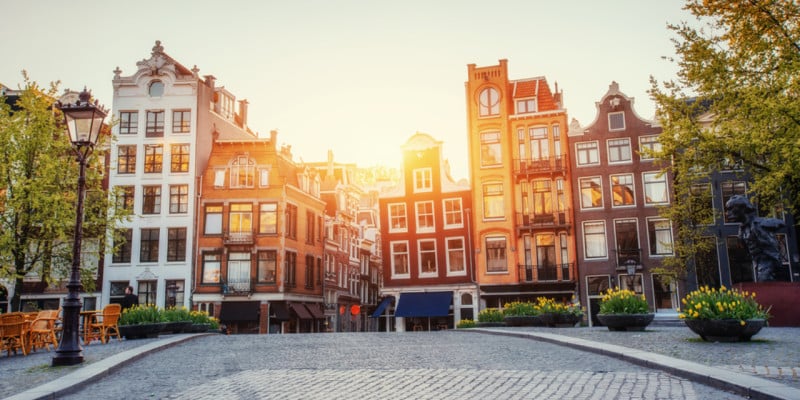
They always say that paying money towards a mortgage is better than spending money on rent, as you won't own the property at the end of things. Plus, mortgage payments are often lower than rent prices. While other countries may place restrictions on expats purchasing homes, fortunately for you, the Netherlands isn't one of them. However, that doesn't mean it's easy. If you want to learn more about buying a home in Amsterdam, then read on.
To call the housing market in Amsterdam “crazy” would be an understatement. In fact, it'd be one for the entire country. Over the last decade (except for the period between 2012 and 2016, briefly in 2020 during the pandemic, and a little in 2023), housing prices have soared, as has the demand. This is especially true after Brexit was finally completed, and many of the British chose to move to the Netherlands before so.
Amsterdam is a particularly attractive city for many expats, plus it's already densely populated with many natives, so don't be surprised if it's hard to get a real estate agent to even respond to you. They're handling so many requests that it's easy for some to slip through the cracks.
The median price for homes in Amsterdam is €707,420, and that's set to only rise. Back at home, you'd only really have the mortgage, inspection, and some other assorted fees to worry about. But in Amsterdam, there's more.
Since the official papers will be in Dutch, you'll have to account for translation fees. You'll probably also have to pay for the services of a notary and Dutch real estate agent, which we'll discuss below.
First of all, you'll probably have to get a mortgage (hypotheek). The good news is that you're allowed to apply for one as an expat, but banks will usually want to see that you've resided in the country for at least five years.
There's also one caveat; banks can reject your application for a 100% mortgage if it's higher than the National Mortgage Guarantee. As of 2024, this amount is €435,000, and €461,100 if there are energy-efficiency measures included. Otherwise, it should be fairly simple to get a maximum mortgage of 90%. Other factors that may make it harder for you to get loan approvals are self-employment, low income, or non-EU nationality.
Chances are, you aren't fluent in Dutch, so you'll have to hire a native real estate agent, which is called a “makelaar.” They'll help you find suitable properties and typically charge you 1 to 2% of the purchase price.
Once you've decided on a home, you'll have to get an appraisal. When that's done, you can make an offer through your agent. In this competitive housing market, expect to get in bidding wars that go well over the asking price.
If you're successful, then the next step is to sign the presale and provisional contracts; these are called the “koopovereenkomst/koopakte” and “voorlopige”. Then, you'll pick a notary (or “notaris”) to hold the contract for you and take a 10% deposit.
At this point, you should apply for your mortgage loan if you haven't already. Once you provide the funds, then you'll sign the final contract, called the “akte van levering”. Your notary will go to the land registry office (called the “kadaster”), and the deal's done!
ℹ️
We do our best to provide accurate and up to date information. However, if you have noticed any inaccuracies in this article, please let us know in the comments section below.
Stephanie is an American expat who's moved all around the world to the UK, Malta, and now, the Netherlands. She's a foodie who loves experiencing cultures through different cuisines.