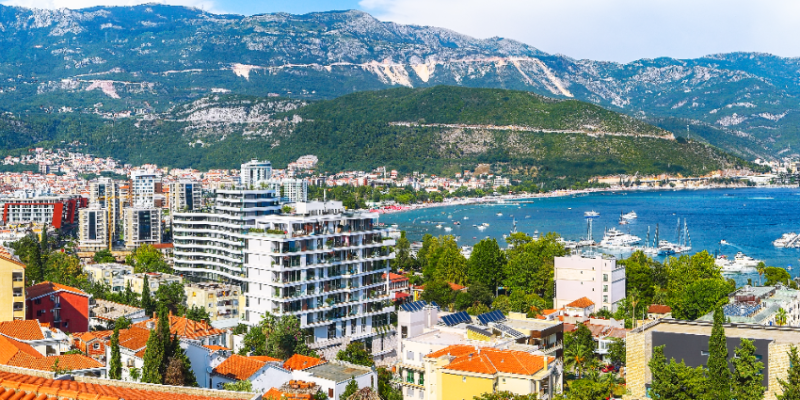
Foreigners already hold rights over more than 50,000 buildings and separate units in Montenegro, with the largest concentrations in coastal towns such as Budva, Kotor, and Tivat. You can buy as a foreign buyer, yet the law keeps some land out of reach, and a farmhouse with fields, a plot on an island, or a house near a land border needs a closer look before you commit. Ownership also stops short of residence, which remains a separate application. New-build prices have risen for three quarters in a row, and the purchase taxes added on top of the price shape your budget as much as the choice between the coast, Podgorica, and the inland regions.
New-build home prices in Montenegro rose in each of three consecutive quarters, from the end of 2025 to mid-2026 (Statistical Office of Montenegro). These prices come from first sales of newly built dwellings, which makes them a useful benchmark if you are looking at an apartment from a developer. The national average went from EUR 2,206 per square meter (USD 2,502) in the last quarter of 2025 to EUR 2,445 (USD 2,773) in the first quarter of 2026, then to EUR 2,557 (USD 2,900) in the second quarter. Since each quarter brought a higher average, budget from the latest figure when you set a price range for a new build.
Existing homes and land sell outside these averages. If you are considering a resale apartment, an older house, or a plot, compare asking prices for that kind of property directly, since the new-build figures do not cover it.
Foreigners already hold rights over 50,071 buildings or separate units in Montenegro, along with 94,090 parcels or parts of parcels. Together, these cover 34,213 hectares of land and 2,705,283 square meters of building area. Foreign ownership on this scale makes buying as a foreigner an ordinary transaction here, as long as the property sits outside the categories the law restricts.
The Property Relations Law (the statute that governs how foreign persons acquire real estate and which categories they cannot own) allows foreign individuals and companies to acquire real estate in Montenegro. Ordinary residential property, such as an apartment or a house in town, is open to you on these terms, and the limits apply to specific categories of land and property. You can therefore buy a home in your own name as an individual, or through a company if that suits your plans.
Montenegro has already passed amendments that will give citizens and companies of the European Union (EU) the same acquisition rights as Montenegrin nationals. The change takes effect only once Montenegro joins the EU, so until that day every foreign buyer works under the current foreign-buyer rules, whatever their passport. When it does apply, it will benefit EU citizens, including Irish buyers, and leave buyers from the United States, the United Kingdom, Canada, Australia, and South Africa under the rules described in this article.
Buying a home does not by itself give you the right to live in Montenegro. Ownership can support a separate application for temporary residence under general immigration law, so treat the residence permit as a second process, with its own file, that you run alongside the purchase.
The coastal municipalities have the largest concentrations of foreign-owned property in Montenegro, particularly Budva, Herceg Novi, Ulcinj, Kotor, and Tivat. The coast is also the most expensive region for new homes, so a seaside purchase sets the upper end of any budget. New-build dwellings there averaged EUR 2,838 per square meter (USD 3,219) in the second quarter of 2026. If you want to live near the sea among other foreign owners, plan for this premium on every square meter you buy.
Podgorica, the capital, offers day-to-day amenities, employment opportunities, and a central base that works year-round. It suits buyers who will work in Montenegro and want services within reach in every season. New-build prices in the city averaged EUR 2,510 per square meter (USD 2,847) in the second quarter of 2026, a little below the coastal average, so you get the capital's jobs and services for less per square meter than on the coast.
Inland, the central region and the northern mountain region offer the lowest new-build prices in the country. The central region keeps you close to Podgorica, while the north appeals to buyers drawn to mountain scenery and a quieter pace of life. New-build dwellings averaged EUR 2,131 per square meter (USD 2,417) in the central region and EUR 2,145 (USD 2,433) in the north in the second quarter of 2026. Both sit about 25% below the coast, which stretches the same budget to roughly a third more floor area.
Join the Montenegro community
Get regular tips and advice to make the most of your expat life
Restrictions on foreign buyers in Montenegro
Montenegrin law closes six categories of land and property to foreign individuals, whatever the price or the buyer's plans. If the property you have in mind falls into one of them, you cannot own it outright:
agricultural land
forests and forest land
real estate on islands
property within the 1-kilometer-deep land border zone
cultural monuments of exceptional or special significance
property in areas legally designated as unavailable to foreigners for national-security reasons
Rural homes come with an exception for the first two categories. When you buy agricultural or forest land together with a residential building standing on it, you can acquire up to 5,000 square meters of that land as a foreign individual. A farmhouse with its fields or a mountain house with a patch of woodland therefore stays within reach, provided you buy the house and land together and the land stays under that ceiling.
Several of the categories you cannot own remain accessible through other legal arrangements. The applicable legislation allows long-term leases, concessions, build-operate-transfer arrangements, and other public-private structures. If a site you want falls into a restricted category, find out which arrangements apply before you drop the project.
Since these limits depend on how a plot is classified and where it lies, check the land category and the exact location of any property against this list before you make an offer, especially for land outside towns and anything close to a land border.
How to buy property in Montenegro
Once you have found a property, do not start with the payment. Start with the title. Ask for the property's list nepokretnosti, the cadastral property sheet that identifies the registered owner, the property itself and any rights or restrictions recorded against it. Montenegro's Real Estate Administration now issues legally valid electronic property sheets through eKatastar. This is the document to compare with the seller's identity, the apartment or plot you visited, and the description in the proposed contract.
At this stage, check more than the owner's name. Look for mortgages, other registered burdens, disputes or annotations affecting the property, and make sure the building and the individual apartment are properly recorded. This matters particularly with older houses and properties that may have been built or extended without all the required permits. A low price is little consolation if the home cannot later be registered, mortgaged or resold.
If the title is clear and you want to proceed, the parties may sign a preliminary contract before the final sale agreement. This is often when a deposit, known locally as kapara, is paid. Montenegrin law regulates the legal effect of this deposit, but it does not impose one standard percentage of the purchase price. The amount, the circumstances in which it is returned, and what happens if either side pulls out should therefore be written clearly into the agreement rather than assumed.
The final sale contract then goes before a notary. Once the transaction is completed, ownership must still be entered in the cadaster. Since July 2026, Montenegrin notaries can submit cadastral applications and the supporting documents electronically through eKatastar, which removes part of the paper-based handover between the notary and the Real Estate Administration.
You normally have 15 days from the acquisition or contract to request registration. The cadaster itself has a statutory 15-day decision period for an ordinary application and 8 days for certain simplified cases. These are legal deadlines for the registration stage, not a promise that the whole purchase will take two weeks. Negotiating the contract, checking the title, arranging a mortgage, obtaining translations and resolving irregularities can all extend the process.
If the transaction is subject to real-estate transfer tax, the buyer also needs to deal with the tax declaration and payment after the sale. For a new build on which VAT is chargeable, the tax treatment differs, so confirm before signing whether you are buying a VAT-taxable first sale or a resale property subject to transfer tax.
Notaries, lawyers and real estate agents in Montenegro
The notary is central to the legal completion of a property purchase in Montenegro. The notary formalizes the transaction, checks the documents required for the deed, and can now transmit the registration file electronically to the cadaster. Do not confuse that role with having someone independently advise you on whether the property is a good or legally safe purchase: the notary is part of the formal transaction process, not your personal property adviser.
Notary fees follow an official tariff rather than a percentage chosen by the individual notary. A new tariff entered into force on 9 April 2026, replacing the previous scale. For a standard deed, the tariff starts at EUR 180 for a transaction worth up to EUR 19,999.99, then rises to EUR 250, EUR 350, EUR 420 and EUR 480 across the next value bands. Above EUR 119,999.99, EUR 13 is added for each additional EUR 15,000, subject to the tariff's overall ceiling. VAT must also be taken into account.
If you sign a preliminary contract before the final deed, the notarial tariff charges 50% of the fee that would apply to the corresponding final deed. When the same notary later executes the final contract, the amount already paid for the preliminary contract is deducted. A notarial power of attorney for a transaction that requires a notarial deed carries a tariff of EUR 60. This can be useful if you cannot remain in Montenegro for every stage of the purchase.
An independent lawyer is not the same as the notary. Hiring a private lawyer is not compulsory for every residential purchase, but it can help when the title is complicated, the property is being bought off-plan, land boundaries are unclear, the seller is a company, or the cadastral record does not perfectly match what exists on the ground. If you appoint one, make sure the lawyer is acting for you, not the seller or developer.
Real estate agents are now subject to Montenegro's dedicated Real Estate Brokerage Law. The Ministry of Economic Development also operates a registration procedure for brokers, so checking whether an intermediary is properly registered is becoming an important part of choosing an agent.
There is no single statutory agency commission such as “3% for every purchase”. The commission, who pays it, and when it becomes due depend on the brokerage agreement. Ask for these terms in writing before you view or reserve a property through an agency, particularly if both the buyer and seller are dealing with the same intermediary.
Getting a mortgage as a foreign buyer in Montenegro
Being a foreigner does not automatically rule out a mortgage in Montenegro, but access depends heavily on the bank and on your status in the country. There is no nationwide rule requiring banks to lend to non-residents, nor one universal deposit or loan-to-value ratio for foreign buyers.
There are nevertheless concrete options. CKB, one of Montenegro's major banks, explicitly says its housing loans are available to residents andnon-residents with regulated residenceand employment in Montenegro, along with other categories of borrowers with regular, provable income. Its published housing-loan range runs from EUR 10,000 to EUR 300,000, with repayment periods of up to 360 months, or 30 years.
This distinction matters if you are buying before you move. A person living abroad with no regulated status, employment or provable local income should not assume that the same mortgage conditions will apply. Contact several banks before signing a binding purchase agreement and ask specifically how they treat your nationality, residence status, employment location and source of income.
Budget for more than the interest rate. A mortgage can bring valuation fees, property insurance, mortgage-registration costs and other bank-specific charges. Published bank examples can help you see the scale of these extras, but they are not national tariffs and will vary according to the property and loan.
If you need financing, obtaining at least an initial assessment from the bank before paying a non-refundable deposit is safer than agreeing to a purchase first and trying to arrange the loan afterwards. The bank will also need to assess the property offered as security, so a home with unclear registration or legalization issues can create problems for the mortgage as well as for the purchase itself.
Does buying property give you residence in Montenegro?
Property ownership and immigration are connected in Montenegro, but they are not the same process. Owning real estate is one of the grounds on which a foreigner may apply for temporary residence. To apply on this basis, you need to show the cadastral certificate or other legally accepted evidence proving that you own the property.
The residence permit is therefore something you apply for after establishing the ownership basis; it is not automatically created when the sale contract is signed. The government currently states that temporary residence based on real estate ownership is issued for one year. A complete temporary-residence application is normally decided within 40 days, and the applicant must also meet the other immigration conditions, including the requirements relating to means of subsistence, accommodation and health insurance.
You may come across references online to a EUR 200,000 minimum property value. Be careful with that figure. The government announced it in November 2025 as part of amendments to a draft Foreigners Law, so that announcement alone should not be used as proof of the final rule currently in force.
Buying costs and taxes in Montenegro
The tax on your purchase in Montenegro depends on whether you buy a resale property or a new build. Newly built buildings and building land sold with value-added tax (VAT) fall under the VAT regime, at the standard rate of 21%, while resale properties carry real-estate transfer tax. As the buyer, you are the taxpayer for transfer tax, and foreign and Montenegrin buyers are treated the same unless an international agreement provides otherwise. Confirm at the outset whether a property is a resale or a new build sold with VAT, since that single fact decides which tax you budget for.
Transfer tax rises in bands with the property's taxable value, and each band applies its own rate to the portion of the value that falls within it.
Taxable value
Transfer tax due
Up to EUR 150,000 (USD 170,130)
3%
EUR 150,000.01 to EUR 500,000 (USD 170,130 to USD 567,100)
EUR 4,500 (USD 5,104) plus 5% of the portion above EUR 150,000
Above EUR 500,000 (USD 567,100)
EUR 22,000 (USD 24,952) plus 6% of the portion above EUR 500,000
Tax rates are subject to change. Verify current rates with the official tax authority.
A worked example shows how the bands combine on a resale home. At a taxable value of EUR 200,000 (USD 226,840), transfer tax comes to EUR 7,000 (USD 7,939), or 3.5% of the value. Add this sum to the agreed price when you work out how much cash you need to complete the purchase.
Mortgages and financing in Montenegro
The Central Bank of Montenegro publishes the Informative List on Offered Consumer Loans, which lists the housing and mortgage loans of credit institutions, including their interest rates, repayment periods, and rate types. Use it to compare offers side by side before you approach a bank.
Across the economy, the weighted average effective lending rate on all loans stood at 6.13% in August 2026, and at 6.35% for newly granted loans. These averages cover every kind of loan, so read them as a benchmark when you compare the mortgage rates on the Central Bank's list.
Risks to check before buying property in Montenegro
Buildings in Montenegro that have not completed the required registration or legalization procedures can face removal orders. Once legalization is complete, the property can be legally sold, inherited, and otherwise disposed of. Check the cadaster entry and the legalization status of any property before you sign, because both decide whether you will later be able to resell it or pass it on to your children.
Annual property tax in Montenegro
Montenegro sets its annual real-estate tax within ranges that vary with the type of property. For an ordinary home, the general rate falls between 0.25% and 1.00% of market value. Check which range your property falls into before you set your running budget, since the same price can lead to very different yearly bills.
A second home costs more to hold. Secondary residential homes and apartments carry a permitted range of 0.3% to 1.5%, which matters if the apartment you buy will be a vacation base while your main residence is elsewhere.
Land you plan to build on later carries the widest range. Undeveloped building land can be taxed at 0.3% to 5% a year, so holding a plot for several years before you build can add up quickly.
Capital gains on property in Montenegro are taxed at 15% for individuals. The gain is the difference between the value you receive on the sale and the value at which you acquired the property, and the tax authority can substitute market value when the declared sale price falls below it. Keep your purchase contract and declare the real sale price, since the authority can recalculate the gain on market value in any case.
Have questions about buying property in Montenegro? Join the Expat.com community to connect with expats who've been through the process.
Frequently asked questions
Yes. Foreign individuals and companies may own real estate in Montenegro without being residents. Statutory restrictions apply to categories such as agricultural land, forests, islands, and the border zone.
Property ownership alone does not grant residence. Temporary residence may be granted on the basis of owning real estate valued at a minimum of EUR 200,000 under the Law on Foreigners. This is a residence route only and does not lead to citizenship.
At least one Montenegrin bank offers housing loans to non-residents who have employment and regular residence in Montenegro. Without local employment or residence, most international buyers pay in cash or arrange financing in their home country.
Real estate transfer tax starts at 3% up to EUR 150,000 and rises to 5% and then 6% on higher brackets. Independent legal fees run around EUR 1,000-3,000, while notary fees and agent commission are negotiated case by case.
No law requires one, so hiring a lawyer is optional. The transfer itself must still run through a notarized contract that can be registered in the cadastre.
You cannot acquire agricultural land, forests, islands, cultural monuments of exceptional importance, or property within one kilometer of the land border, among other restricted categories. Your notary or lawyer can check a specific parcel against the cadastre before you sign.
A progressive real estate transfer tax applies when you acquire the property. An annual property tax of 0.25% to 1.00% of market value applies afterward.
Renting out a property involves separate tax and registration checks with the municipality and the Tax Administration. Ownership alone does not settle what is required to let it.
A future sale is treated as a new transfer within Montenegro's real estate transfer tax framework. Get tax advice specific to your situation before you proceed.
ℹ️
We do our best to provide accurate and up to date information. However, if you have noticed any inaccuracies in this article, please let us know in the comments section below.
A journalist, holder of the DALF C1 and C2 and a diploma from the University of Mauritius, I have nearly twenty years of writing experience. After six years in the Mauritian press, I joined Expat.com, where I have been working for over a decade, including five years as editorial assistant, and now as editorial manager.