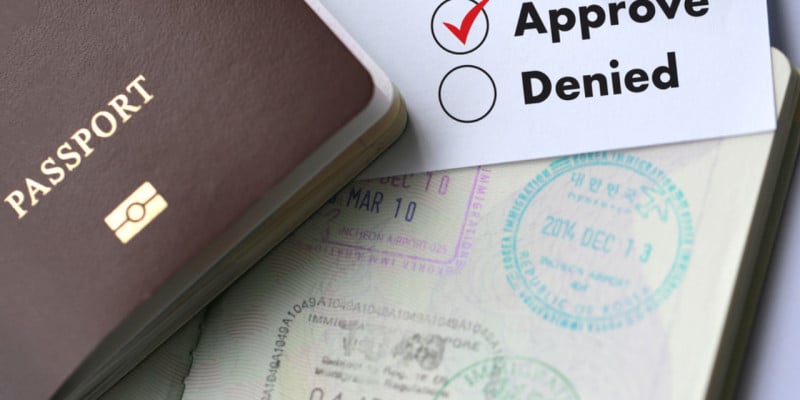
As a member of the EU/EFTA and the Schengen area, and as a holder of visa waiver agreements with 30 countries worldwide (consult our section on Travelling to Hungary), you can enter Hungary without a visa for a short-term stay. Immediately afterwards, however, you must apply for a residence permit if you wish to continue your stay in the country. As from late 2026, non-EU visa-exempt travellers will also need an ETIAS travel authorisation before entering the Schengen area.
For EU/EFTA, Schengen and visa waiver agreement nationals
If you're a national of the many countries Hungary has signed a visa waiver agreement with (see the full list here), or a citizen of the EU/EFTA or one of the Schengen countries (Norway, Iceland, Liechtenstein, and Switzerland), you can enter Hungary with just a valid passport or identity card for stays up to 90 days in any 180-day period (subject to the Schengen short-stay rules).
You should be aware that the amount of time you can stay in Hungary differs depending on your nationality and the type of identification you have, but in any case, it should not exceed a period of 90 days without registration. After that, you are entitled to stay in the country for 180 more days if you can prove that you're pursuing employment and that you have enough funds to support yourself.
By the 93rd day of your arrival in Hungary, you need to notify your residence to the regional directorate. This notification is mandatory for EEA citizens, like expats who are planning to stay longer than 90 days, and involves applying for a Registration Certificate (“regisztrációs igazolás”). Your family members can enter the country with a short-term visa (type C) even if they intend to stay longer than 90 days. But within 93 days from their arrival in Hungary, they need to apply for a residence card at the Office for Immigration and Nationality's regional directorate.
The EU Blue Card, a specialized permit for highly qualified non-EU/EFTA nationals, also applies in Hungary; it requires a university degree and meeting a high salary threshold.
Good to know:
The registration certificate for EU/EFTA nationals costs 1,000 HUF (about 3 euros), and you can pay for it by card or by bank transfer at the venue. You will also have to pay a separate fee for your address card (“lakcímkártya”) to the tune of 5,700 HUF. You can submit your application online via the EnterHungary government website.
For all other nationals: long-stay visas and residence permits in Hungary
If you wish to stay in Hungary for longer than what the short-term visa would allow, you should apply for a residence permit right away. You should start the process at the Hungarian consulate in your home country by applying for a Type D, or long-term visa. The residence permit application normally costs 110 euros, and only 64 euros if you apply through the Enter Hungary platform. It usually takes 30 days.
Good to know:
When applying for a residence permit in Hungary, you are required to give your fingerprints. This rule also applies to children from 6 years old and up.
As of 2026, Hungary also offers specialized residence permit programs for expats. A “white card” or digital nomad visa serves as a one-year residence permit for remote workers earning at least 3,000 euros per month from foreign employers (which you can extend for a second year). There is also a “golden visa”, which is targeted at guest investors with six- or seven-figure investments to make for a ten-year permit of stay.
You can also get a residence permit for employment if you are employed by a Hungarian company. This requires a labour contract and is renewable as long as you maintain the job. Unlike the white card, you can bring your family along with this visa. After 3-5 years, you can apply for permanent residency as well.
Citizens of Serbia, Ukraine, Russia, Belarus, Bosnia and Herzegovina, Moldova, North Macedonia, and Montenegro can also make use of a National Card.
Students enrolled in accredited Hungarian universities can request a Residence Permit for the Purpose of Studies with a letter of acceptance and documents proving student status and tuition payment.
Get regular tips and advice to make the most of your expat life
How to apply for a residence permit in Hungary
The documents you'll need to apply for a residence permit may vary depending on whether you're coming to Hungary to work, start your own business, study, or conduct research, as well as on your nationality. It is important that you check with the Hungarian embassy or consulate in your home country what applies in your particular case. As a general rule, you will be expected to procure the following:
A passport that will be valid for at least three months after the requested visa expires
A recent (taken within the last six months) passport-size photo in colour
Documents supporting the purpose of your stay (aka university acceptance documents if you're in Hungary to study or a contract if you've come to work)
Documents showing you have accommodation (like a lease)
Proof of sufficient funds and health insurance depending on your visa/residence goal
Good to know:
If your application for a residence permit is declined, you have eight days from the moment you receive the notification to submit an appeal. Procedures and deadlines may vary by office or consulate.
We do our best to provide accurate and up to date information. However, if you have noticed any inaccuracies in this article, please let us know in the comments section below.
I am a writer and editor with over a decade of multi-niche experience in content creation. With an international background, I have a strong understanding of expat culture and its associated needs and pain points. I currently reside in Budapest but there is still so much of the world left to explore.