

Living in Meknes: the ultimate expat guide
Everything you need to know for a successful life in Meknes.
Meknes is one of Morocco's four Imperial Cities, located in the northern-central part of the country within the fertile Saïss Plain. Founded in the 11th century by the Almoravids, this historic city served as Morocco's capital under Sultan Moulay Ismail from 1672 to 1727. With a population of approximately 551,500 according to the 2024 Moroccan census, Meknes offers a more relaxed pace of life compared to larger cities like Casablanca or Marrakech.
A City of History and Opportunity
Often called the "Versailles of Morocco" due to its magnificent gates and imperial architecture, Meknes combines rich heritage with modern amenities. The city's medina and the remains of the royal palace earned it a place on the UNESCO World Heritage List in 1996. Unlike more tourist-heavy destinations, Meknes retains an authentic Moroccan character, with fewer crowds and a welcoming local community. The city serves as an economic hub in the Fès-Meknès region and is recognized as Morocco's agricultural capital.
5 Good Reasons to Move to Meknes
- Affordable cost of living – significantly lower than Casablanca, Rabat, or Marrakech while offering good quality of life.
- Rich cultural heritage – UNESCO-listed medina, imperial monuments, and proximity to the Roman ruins of Volubilis.
- Strategic location – excellent connections to Fes (60 km), Rabat, and other major cities by train and road.
- Authentic atmosphere – fewer tourists means more genuine cultural experiences and easier integration.
- Pleasant climate – Mediterranean climate with mild winters and warm summers, ideal for year-round outdoor living.
Working in Meknes: Employment and Economic Opportunities
Meknes has been recognized as one of the most competitive cities in Africa according to a 2015 World Bank report. The city's economy is diversified across agriculture, industry, and services, making it economically attractive for investment and employment. Understanding the local job market and work permit requirements is essential for expats considering relocation.
Key Industries and Sectors
As Morocco's agricultural capital, Meknes is the center of the fertile Saïss Plain, one of the country's most productive agricultural regions. The agri-food sector employs thousands of workers in farms, processing plants, and related businesses. Major employers include companies like Les Domaines Brahim Zniber, one of Morocco's largest private agricultural enterprises. Beyond agriculture, the services sector accounts for significant employment, particularly in commerce, education, and tourism. Light industry and manufacturing also contribute to the local economy.
Work Permits and Visa Requirements
Foreign nationals intending to work in Morocco must obtain both a work visa and a work permit. The employer must apply for the work permit through the Ministry of Employment and Vocational Training, demonstrating that no qualified Moroccan candidate is available for the position. This involves obtaining approval from ANAPEC (National Agency for the Promotion of Employment and Skills). Work permits are typically valid for 3 years and must be renewed before expiry. After three years of regular presence, you become eligible for a residence permit valid for 5-10 years. As of June 2023, short-term work authorizations allow employment for up to 90 days.
The following table provides key employment indicators for the region:
National unemployment rate (2024) | 13.6% |
Average monthly salary (Meknes) | MAD 4,600 (~USD 460) |
Main sectors | Agriculture, Services, Industry |
Sources: High Commission for Planning (HCP), Numbeo
Higher Education in Meknes: Universities and Academic Programs
Meknes is home to one of Morocco's most important public universities, offering diverse academic programs for both local and international students. The city provides an affordable environment for higher education with access to quality institutions and research opportunities.
Moulay Ismail University
Moulay Ismail University (UMI) was established in 1989 and has grown to become a leading institution in Morocco, currently enrolling over 82,000 students, including nearly 1,000 international students. The university is named after Sultan Moulay Ismail and operates across two campuses in Meknes and Errachidia. UMI is ranked among the top 10 universities in Morocco according to UniRank and is positioned 100th in the Best Arab Region Universities rankings by US News.
Faculties and Programs
The university comprises 10 academic institutions offering programs at bachelor's, master's, and doctoral levels. Key faculties include:
- Faculty of Sciences – programs in mathematics, physics, chemistry, and biology
- Faculty of Arts and Humanities – languages, literature, and social sciences
- Faculty of Law, Economics and Social Sciences – business, economics, and legal studies
- National School of Engineering (ENSAM) – engineering and technology programs
- Higher School of Technology – applied technology and professional training
Tuition and Admission
As a public university, UMI offers highly affordable tuition fees. Local students pay approximately MAD 1,000 (~USD 100) per year for registration and administrative fees. International students may have slightly higher fees but benefit from various scholarship programs and financial aid options. Admission is selective, based on entrance examinations and academic records. The university maintains over 245 international cooperation agreements with institutions in Europe, Asia, the Middle East, and North America, facilitating exchange programs and research collaboration.
Sources: Moulay Ismail University Official Website, US News Rankings
Schools for Expat Children: Education Options in Meknes
Education in Morocco follows a structure similar to the French system, with primary, secondary, and high school levels. For expat families, Meknes offers both local schools and an established French international school that provides education from kindergarten through high school graduation.
The French School: Lycée Paul Valéry
Lycée Paul Valéry (LPV) is the primary international schooling option in Meknes. Established in 1914 as the "École française de Meknès," it is directly operated by the Agency for French Education Abroad (AEFE), part of the French Ministry of Foreign Affairs. The school occupies a beautiful 16-hectare campus in the heart of the Ville Nouvelle and serves students from maternelle (preschool) through lycée (high school). LPV follows the French national curriculum and prepares students for the French Baccalaureate. The school has consistently achieved high success rates, with excellent mention rates at the baccalaureate examination.
Local and Private Schools
Beyond the French school, Meknes has numerous private Moroccan schools offering bilingual education in Arabic and French. These schools typically cost between MAD 600 and MAD 1,600 per month (USD 60-160) depending on the level and facilities. The Moroccan curriculum teaches in both Arabic and French, with English introduced as a third language. Private schools often provide transportation services and smaller class sizes compared to public schools. Education is compulsory for children aged 6 to 16 in Morocco.
School Fees Overview
Private preschool (monthly) | MAD 600-1,600 (~USD 60-160) |
Private primary school (annual) | MAD 12,000-50,000 (~USD 1,200-5,000) |
Lycée Paul Valéry (French curriculum) | Contact school for current fees |
Sources: Lycée Paul Valéry, Numbeo
Housing in Meknes: Neighborhoods and Rental Prices
Finding accommodation in Meknes is straightforward, with options ranging from traditional riads in the historic medina to modern apartments in the Ville Nouvelle. Rental prices are considerably lower than in Morocco's larger cities, making Meknes an attractive destination for expats seeking affordable housing without sacrificing quality of life.
Best Neighborhoods for Expats
The Ville Nouvelle (New Town) is the most popular area for expats, offering modern amenities, international restaurants, and proximity to the train stations. This French-built district features wide tree-lined avenues, apartment buildings, and a quieter atmosphere compared to the medina. The area around Avenue Mohammed V provides easy access to shops, banks, and cafés. For those seeking a more traditional experience, the medina offers charming riads (traditional houses with interior courtyards) at very affordable prices. While the medina requires adaptation to narrow streets and a more bustling environment, it provides an authentic Moroccan living experience. The area near Lycée Paul Valéry in the Ville Nouvelle is particularly popular among expat families for its convenience and safety.
Rental Prices
The following table shows average monthly rental costs in Meknes:
1-bedroom apartment (city center) | MAD 2,000-3,000 (~USD 200-300) |
1-bedroom apartment (outside center) | MAD 1,000-2,000 (~USD 100-200) |
3-bedroom apartment (city center) | MAD 3,500-5,000 (~USD 350-500) |
3-bedroom apartment (outside center) | MAD 2,500-3,000 (~USD 250-300) |
Rental Process
Rentals are typically arranged directly with landlords or through local real estate agents. Expect to pay 1-2 months' rent as a deposit. Lease agreements can be flexible, ranging from month-to-month to annual contracts. Most apartments come unfurnished, though furnished options are available at higher rates. Utilities (electricity, water, gas) are usually paid separately and average around MAD 300 (~USD 30) per month for a standard apartment.
Sources: Numbeo Meknes
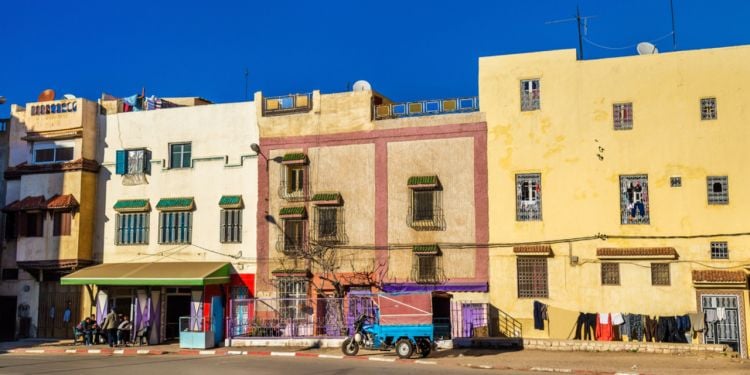
Accommodation in Meknes
Meknes is one of the quieter cities in Morocco, yet it has plenty of beautiful sites. As one of Morocco's imperial cities, it is the home of ...
Leisure, Culture and Things to Do in Meknes
Meknes offers a wealth of cultural, historical, and recreational activities. As a UNESCO World Heritage Site with a rich imperial past, the city provides endless opportunities for exploration. The surrounding region adds even more attractions, from ancient Roman ruins to Morocco's holiest pilgrimage site.
Historical and Cultural Attractions
Bab Mansour is the city's most iconic landmark – a monumental gate considered one of the finest examples of Hispano-Moorish architecture in Morocco. Adjacent Place El Hedim serves as the main square, coming alive in the evenings with food vendors, musicians, and street performers. The Mausoleum of Moulay Ismail is one of the few religious sites in Morocco open to non-Muslims, featuring stunning courtyards and intricate tilework. Don't miss the Bou Inania Madrasa, a beautifully preserved 14th-century Islamic school, or the Dar Jamai Museum showcasing traditional Moroccan arts and crafts.
Day Trips and Excursions
Just 30 km north of Meknes lies Volubilis, one of North Africa's most impressive Roman archaeological sites and a UNESCO World Heritage Site. The well-preserved mosaics, triumphal arch, and ancient streets offer a fascinating glimpse into Roman Morocco – entry costs MAD 70 (~USD 7). Nearby Moulay Idriss Zerhoun, a whitewashed hillside town considered Morocco's holiest site, is worth a half-day visit. Wine enthusiasts can explore the vineyards of the Guerrouane region south of the city, sampling some of Morocco's award-winning wines.
Local Experiences
The medina souks offer excellent shopping for traditional crafts, with less tourist pressure than Fes or Marrakech. Meknes is famous for damasquinerie – the art of embedding silver into metal surfaces – a craft now practiced only here. The Marché Couvert (covered market) near Place El Hedim is perfect for experiencing local food culture, from pyramids of olives to aromatic spices. For sports enthusiasts, gym memberships cost approximately MAD 275 (~USD 28) per month, and tennis court rental is around MAD 315 (~USD 32) per hour. Cinema tickets for international releases are about MAD 40 (~USD 4). The city's restaurants serve excellent Moroccan cuisine, from traditional tagines to fresh grilled meats.
Sources: Moroccan National Tourist Office, UNESCO
Daily Life in Meknes: Transportation and Lifestyle
Daily life in Meknes offers a blend of Moroccan tradition and modern convenience. The city is smaller and more manageable than Morocco's major urban centers, allowing for easy navigation and a relaxed pace. Understanding local transportation options and cultural habits will help you settle into your new home.
Getting Around the City
Petit taxis (small city taxis) are the most common way to travel within Meknes. These light-blue vehicles are metered and very affordable – a typical ride across town costs between MAD 10-25 (~USD 1-2.50). Always ensure the driver uses the meter. Grand taxis (larger shared taxis) operate on fixed routes both within the city and to nearby destinations like Volubilis or Moulay Idriss. Local city buses are available but can be confusing for newcomers; however, they cost only about MAD 4 (~USD 0.40) per ride. A monthly public transport pass costs approximately MAD 150 (~USD 15). Within the medina and much of the Ville Nouvelle, walking is the best way to explore – the main attractions and amenities are within comfortable walking distance.
Intercity Connections
Meknes is a major transportation hub with excellent connections to other Moroccan cities. Two train stations serve the city, with Gare el Amir Abdelkader being most convenient for the Ville Nouvelle. ONCF trains run regularly to Fes (40 minutes), Rabat (2.5 hours), Casablanca (3.5 hours), and Tangier. Bus services operated by CTM and Supratours offer comfortable and affordable intercity travel. The A2 expressway connects Meknes to the national highway network, with two exits serving the city.
Cultural Customs and Daily Rhythm
Moroccan life follows its own rhythm. Shops typically open from 9:00 AM to 1:00 PM and 3:00 PM to 8:00 PM, with a break for lunch. Many businesses close on Fridays for prayers. The call to prayer (adhan) sounds five times daily, beginning before sunrise. Meknes has a relaxed atmosphere compared to more tourist-heavy cities, with locals generally welcoming to foreigners. French is widely spoken alongside Arabic and Amazigh, making communication easier for French speakers. The pace of life is unhurried – embrace it!
Cost of Living in Meknes: Monthly Budget Breakdown
Meknes offers one of the most affordable costs of living among Morocco's major cities. With living expenses approximately 9% below the national average, expats can enjoy a comfortable lifestyle on a modest budget. The following tables provide a comprehensive breakdown of typical monthly expenses.
Monthly Budget for a Single Person
A single person can live comfortably in Meknes on approximately USD 500-700 per month, including rent. Here is a detailed breakdown:
Rent (1-bedroom, city center) | USD 200-260 |
Utilities (electricity, water, internet) | USD 40-60 |
Groceries | USD 100-150 |
Transportation | USD 20-40 |
Dining out and leisure | USD 50-100 |
Health insurance (private) | USD 50-100 |
Total estimated | USD 460-710 |
Monthly Budget for a Family of Four
A family of four should budget approximately USD 1,200-1,800 per month, depending on lifestyle choices and schooling options:
Rent (3-bedroom, city center) | USD 350-450 |
Utilities (electricity, water, internet) | USD 60-80 |
Groceries | USD 250-350 |
Transportation | USD 40-80 |
Schooling (private/international) | USD 200-600 |
Dining and leisure | USD 100-150 |
Health insurance (family) | USD 150-250 |
Total estimated | USD 1,150-1,960 |
Everyday Prices
A meal at an inexpensive local restaurant costs around MAD 23 (~USD 2.30), while a three-course meal for two at a mid-range restaurant is approximately MAD 150 (~USD 15). A cappuccino costs about MAD 12 (~USD 1.20), and a liter of milk is around MAD 8 (~USD 0.80). Fresh produce from local markets is exceptionally affordable.
Sources: Numbeo Meknes
In Short
Meknes offers expats an authentic Moroccan experience without the tourist crowds of Marrakech or the urban intensity of Casablanca. This imperial city combines rich history, affordable living, and genuine hospitality in a manageable, safe environment. With excellent transport connections, quality international schooling at Lycée Paul Valéry, and proximity to fascinating sites like Volubilis and Fes, Meknes serves as an ideal base for exploring Morocco while enjoying a comfortable daily life. The city's role as Morocco's agricultural capital ensures a steady local economy and access to fresh, affordable produce year-round. Whether you're drawn by career opportunities, educational pursuits, or simply the appeal of Mediterranean climate and imperial architecture, Meknes welcomes you with open arms.
Ready to connect with others who've made the move? Join the Meknes forum on Expat.com to ask questions, share experiences, and become part of our growing community!
We do our best to provide accurate and up to date information. However, if you have noticed any inaccuracies in this content, please contact us.


Essential services for your expat journey



